
Skip to content
RESEARCH · RESEARCH

A theory sharpens how one atom-thin layer senses another

A Physical Review Letters study models neighboring-layer exciton shifts and explains why a small correction can matter when comparing signals.
Published Source report Sources checked
My reading list
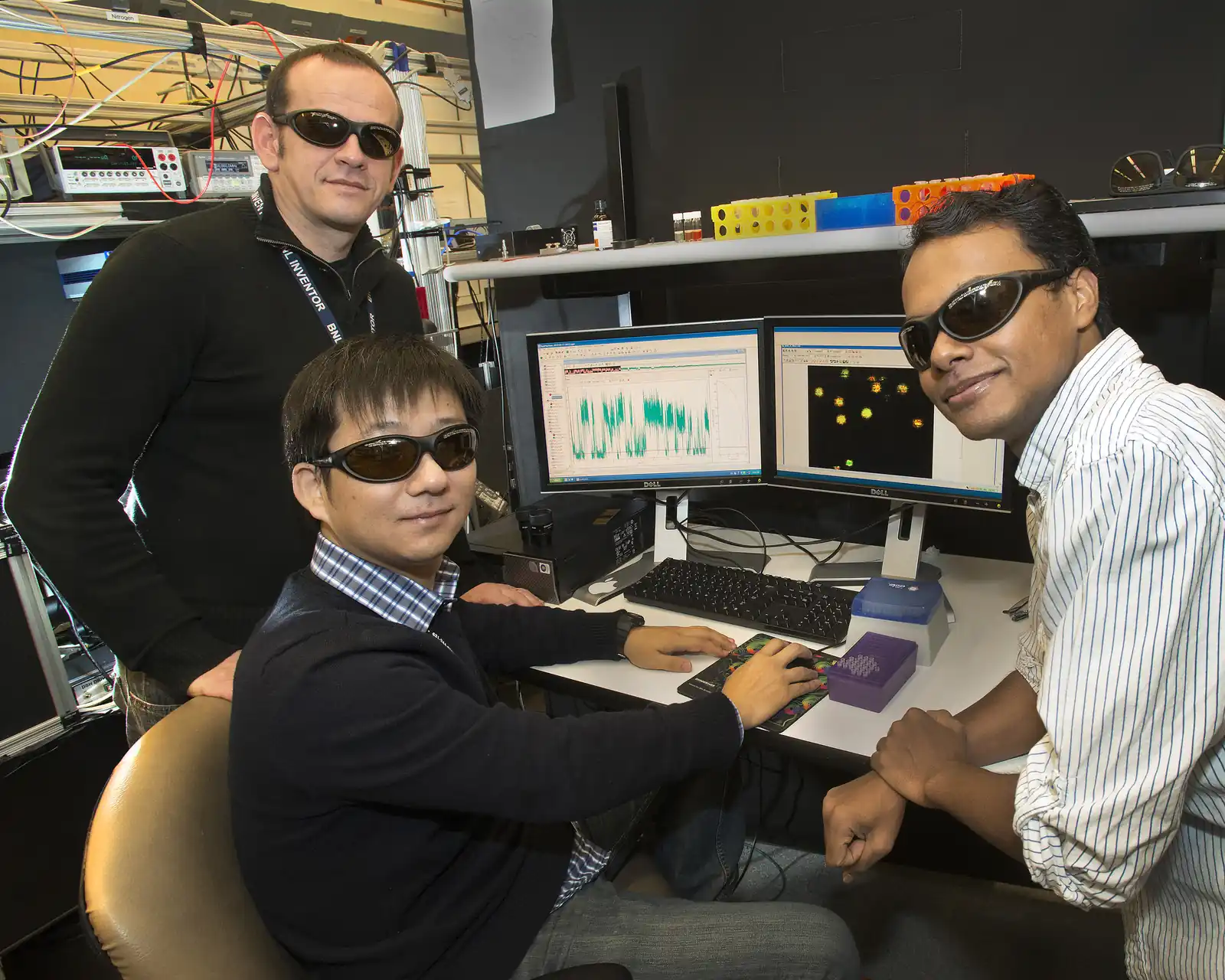
Archival context: Three researchers wearing protective glasses sit beside laboratory monitors and instruments.
Researchers in a Brookhaven National Laboratory quantum-dot laboratory, photographed in December 2013. Archival New York research context. Archival context only; this does not show the new experiment, apparatus or organization described in the article.Image: Brookhaven quantum-dot laboratory · U.S. Department of Energy · US federal public domainFull image credit

A theory published in Physical Review Letters on October 26 examines how the electrons in one atom-thin layer influence optical resonances in another, nearby layer.[1][2][3]

The authors model excitonic frequency shifts caused by electron correlations in an electrically isolated neighboring material. Their examples place tungsten diselenide beside graphene layers. The analysis separates a static exchange contribution from a retardation correction, which can become important when comparing signals whose static contributions partly cancel.[1][2][3]

This is a theory of adjacent-layer sensing, informed by earlier experiments. It does not introduce a newly fabricated sensor. Here, “remote” means a nearby layer in a stacked material, rather than detection across an ordinary long distance. The preprint first appeared on October 24, 2025; the October 26 milestone is journal publication.[1][2][3]

### QubitWire analysis

The central interpretive challenge is separating a measured response from the property inferred through it. A detectable optical shift is useful only if its possible causes can be distinguished closely enough for the intended scientific question.

Comparing two signals makes that requirement especially sharp. A correction that is small beside either complete signal could be significant beside their difference. An analysis that dismisses every small term before specifying the comparison could therefore overlook a consequential source of uncertainty.

A useful experimental follow-up would choose a controlled change in one layer and test whether the predicted optical response in the other separates competing explanations. Calibration, material variation and uncertainty in the model would belong alongside the measured signal. That would connect a theoretical interpretation to a defined sensing task.

Keep your reading trail

Your Updates →

Evidence & context

3 linked sources

Condensed-matter sensing theory informed by prior experiments. Journal-publication milestone; earlier disclosures retained. Source scope checked October 26, 2026; original analysis is identified in the text.

How to read the evidence and dates

An announcement records what an organization stated. An experiment reports an observation. A simulation or resource estimate depends on its assumptions. QubitWire’s analysis connects these sources; the labels are not quality scores.

Published is the article’s first QubitWire publication. Updated marks a substantive content change. Sources checked records a review of the underlying evidence. An older paper can support a new explanation, and another press release about the same work is not independent replication.

Sources

  1. Publisher record: 10.1103/246f-2p98

    Primary evidence checked October 26, 2026. Scope and stage retained in the article.

  2. Earlier disclosure for 10.1103/246f-2p98

    Primary evidence checked October 26, 2026. Earlier disclosure; journal date is a separate milestone.

  3. Publisher primary record

    Primary evidence checked October 26, 2026. Scope and stage retained in the article.

READ NEXT

Continue exploring

All Research stories
  1. Explore the related question

    Giant-atom theory puts quantum-transfer control into device geometry

    A proposed arrangement uses distributed coupling points to shape emission. The reported transfer fidelities come from models rather than a built link.

    Published · Source report · Sources checked
  2. Explore the related question

    A Quantum Sensor Remembers Weak Signals That Classical Memory Forgets

    A new theory result uses persistent quantum memory to decode weak coded rotations that comparable classical-memory receivers lose.

    Published · Source report · Sources checked
THE QUANTUM BRIEFING

A clearer signal.
Read the latest edition.

A little perspective on a fast-moving field.

Read the on-site briefing →

Read selected quantum coverage in the on-site briefing, or register your interest below.