Research, engineering and commercial ambition move on different timelines.
A published experiment, an announced roadmap and an available service answer different questions. QubitWire helps readers connect them without making them interchangeable.
A good quantum story leaves you able to explain something more clearly. Start with a complete short answer, then use the optional full explanation and primary sources when you want more depth. Directories connect the people and opportunities around the work.
Got Qubits, same QubitWire
gotqubits.com is another way to reach QubitWire.
Why quantum matters
Different physics. Different possibilities.
A different way to process information. A demanding engineering challenge.
Quantum computers use controlled quantum systems to process information. Algorithms use interference and, in many cases, entanglement to work with information in a different way.
That creates research questions in simulation, computation and cryptography. It also creates hard questions about errors, control and scale.
Directory inclusion is not endorsement. Editorial scores do not certify performance or recommend buying a security.
Look for the people around a result: authors, collaborators, instruments and institutions. The People directory highlights contributions; Jobs reveals different professional disciplines. Neither reduces an organization’s work to one individual.
The interactive exhibit
A small chip. A world of engineering.
Step inside the engineering.
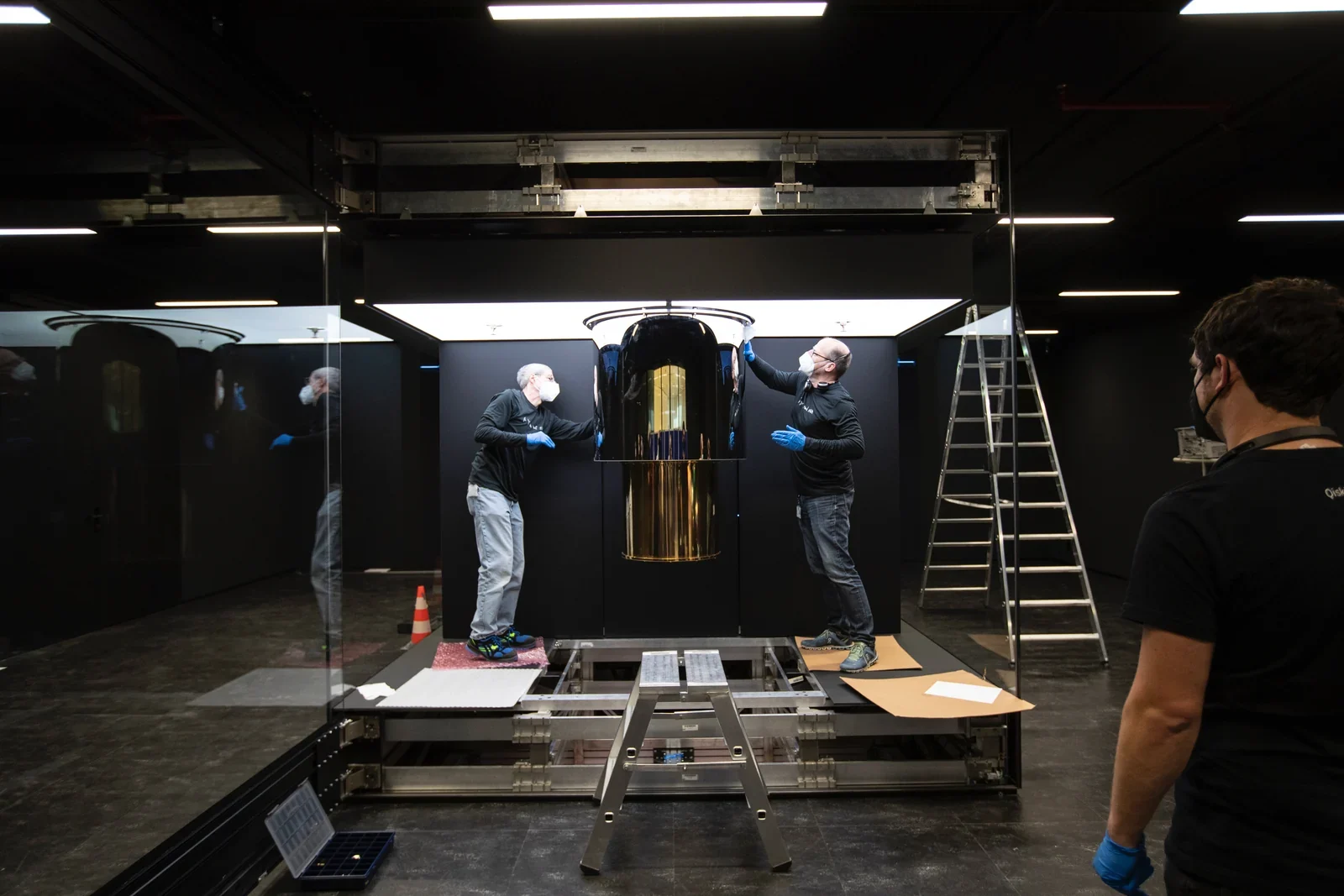
Rotate the installation, inspect components and follow the relationships between a processor, its cooling, its signals and the ordinary computers around it.
The Model represents one superconducting approach. Its geometry and reference values are educational examples, not live measurements or a digital twin. Other approaches use different hardware.
Classical equipment sends instructions and reads results.
03
Processor
The small circuit at the heart of the installation.
Authored educational diagram. Simplified relationships, not to scale.
Make your next question more precise
There is more than one way in.
Understand
“Where do I begin?”
Start with an explanation before an equation. Students and curious readers can connect an idea with the engineering behind it.
Teachers, families and curious readers can choose one reading question without an account. Separate observation, analogy and uncertainty. Some recordings and sources are specialist; choose the depth that suits your conversation.
What happened. What supports it. What remains open.
Our standards call for original explanation, source links and a distinction between company announcements, theoretical estimates and measured results. Reports repeating one announcement do not become independent corroboration. A headline should stay within what its source supports.
Event, source and publication dates can differ. A material update changes the explanation; a routine check verifies a link or status. Check the organizer or employer before acting on a time-sensitive opportunity.
Sources let you follow the argument beyond our summary. Editorial review is not scientific peer review or independent replication.
An analogy should come with an exit
A comparison can open the door to an unfamiliar idea. Look for the physical question, the helpful comparison and where it stops working. An analogy should lead you toward the mechanism and evidence.
The interference explanation labels its simple amplitude example as an illustration rather than a reconstruction of the apparatus. The randomness explanation uses a public coin toss while distinguishing a public outcome from a secret. Follow the source when that distinction needs more detail.
The approach in practice
An announcement is not an outcome.
A facility announcement can establish a plan without demonstrating production yields or computing performance. Read the claim alongside its source and its limits.
An attributed facility plan announced September 4, not a commissioned service or demonstrated computing result.
Limitation
That is the promise, not a measured result. The announcement does not give production yields, customer prices or a qubit error target. A larger cleanroom is not, by itself, evidence of a better quantum computer.
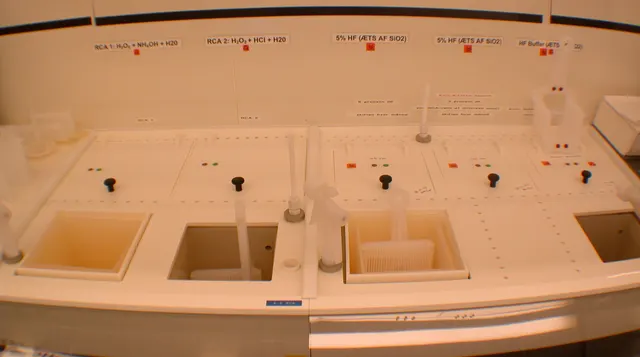
Contextual photography
Archive photograph of a wet-etch bench at the Danchip cleanroom in Denmark. Context for chip fabrication—not the planned Quantum Foundry Copenhagen facility. Uploaded in 2006; capture date not supplied.
“WetEtchBench.jpg” — Kristian Mølhave, CC BY 2.5, via Wikimedia Commons. Creative Commons Attribution 2.5 Generic. Resized and converted to WebP for this page, without cropping.
Read a score with its evidence. Scores are editorial opinions about documented maturity within a sector. They are not measured performance, investment ratings or predictions of success. A partnership or programme selection can add context without changing a score: ask which relevant evidence changed.
These figures use the same published organizations, eligible assessments and sector definitions as QRank. The scored total counts eligible profiles, rather than reviews completed in the past seven days.
Figures are retrieved when this page opens and are valid for 15 minutes from the time shown. The score edition dates the underlying assessments, not the retrieval. If current figures cannot be confirmed, we leave them out. For a fresh view, open QRank.
Responsibility and transparency
Accountability belongs with the publication.
Responsibility stays with QubitWire.
QubitWire is responsible for material published under its name. Sources and images do not imply a partnership or institutional endorsement. Our policies set operating standards, not a claim that every past item is error-free or independently replicated.
A contextual photograph is not proof of the result discussed. Captions identify what is shown; the media record keeps sources, permission and required credit. Finding a public image does not establish permission to republish it.
Share the explanation, not only the surprise
Keep the useful distinction with the article link: a laboratory result differs from a product launch; a future target differs from delivery. Add a sentence about the question the story answered for you.
Sharing a link does not grant permission to republish third-party images, videos or quoted material. Copy feedback confirms a clipboard action, not a repost. A cancelled share does not establish that a story was shared.
You do not need technical vocabulary to ask a useful question. “What was actually measured?” and “what would this change outside the laboratory?” are good places to begin.
Send the page URL, identify the statement or image and include a supporting source. For event or job changes, link the organizer or employer. A receipt confirms submission, not editorial review or acceptance. Please avoid unnecessary sensitive information.
No. Start with an explanation, a selected video or the Model’s beginner introduction. Specialist material and original sources remain available when your questions become more specific.
No. Scores reflect the published sector methodology and editorial judgment. Directory inclusion and a scored assessment are different. Neither is a product certification, endorsement or investment rating.
It is an educational representation of one superconducting approach. Its geometry and reference values are illustrative, not live measurements or a digital twin. Other approaches use different hardware.
Send the page URL, identify the statement or image and explain the concern. Include an original source when available. Please avoid unnecessary sensitive information.
The on-site briefing brings selected coverage together in dated editions. Read the latest selection or return to an earlier edition. New editions appear when ready. You can keep reading without joining the email launch list.
Choose a route according to the question you want it to answer.
Reader guideAbout: understand what an editorial explanation can establishRead an editorial explanation for its reasoning, source trail and clearly stated boundary.Context reviewed +
An editorial explanation connects a source to a reader’s question. It can distinguish a vendor statement, a measurement and an editorial interpretation, but it does not itself reproduce an experiment or confer peer review. Follow the source links when the method, conditions or original wording matter.
For a performance claim, identify the device, operation, comparison and uncertainty. For a business announcement, identify the organization, traded instrument where relevant, and whether the statement describes an agreement or completed event. These checks make technical and commercial coverage easier to compare without giving them the same meaning.
The site’s model is an educational representation of a superconducting setup. Use it to connect components and concepts; do not treat it as an exact digital twin or measured specification of an installed machine. Editorial standards, disclosures and media credits explain the corresponding responsibilities and source boundaries.
Questions to take with you
Does a source-linked article count as independent replication?
No. It can explain and assess the source, but replication requires separate experimental or computational work with its own record.
What should I check in an organization assessment?
Identify which statements are reported facts, which are attributed claims and which are editorial judgments under the displayed method. Keep the dates and sources attached to each.