
Oxford’s tiny quantum loop turns two routes into no way through
Two qubits and two vibrations recreate a counterintuitive effect: possible paths can cancel. Oxford’s trapped-ion simulator makes quantum interference tangible.
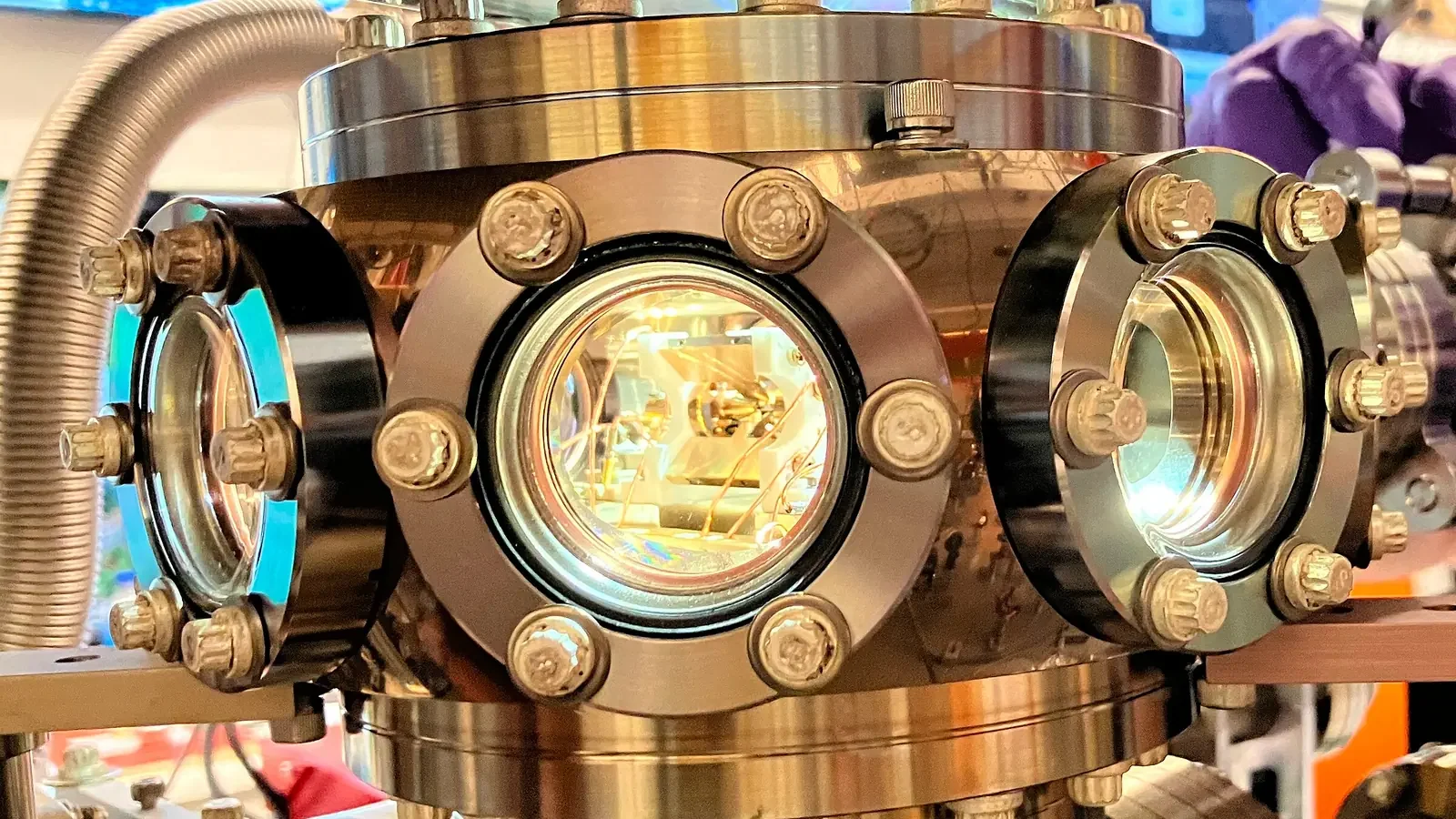

A new quantum-simulation experiment revisits the Aharonov–Bohm effect in a system made from and vibrations. The surprise is real, but the simulated particle is not a miniature traveller taking a literal tour of a laboratory. Imagine two routes leading to the same destination. In ordinary traffic, opening another route usually gives a traveller another way through. In a quantum experiment, adding possible routes can have the opposite effect. Their contributions can cancel, making an outcome less likely or, under the right conditions, suppressing it altogether.
An Oxford-led experiment reported on 25 September 2026 uses that strange possibility in a compact quantum simulator. The researchers combined two qubits with two oscillator modes to represent a small lattice-gauge system and observe Aharonov–Bohm interference. The work was published in Nature Physics. It is a new setting for a known physical effect, not a first discovery of the effect itself. The phrase “a particle stops” therefore needs a careful translation. The device represents the motion of matter within a model. It does not contain a tiny road junction in which a visible bead comes to a halt. Understanding that distinction makes the experiment more impressive, not less: the researchers are using one controllable quantum system to investigate another.[1][2]
The original mystery: a phase without a local magnetic push
The Aharonov–Bohm effect is associated with a prediction made in 1959 by Yakir Aharonov and David Bohm. In its familiar form, a charged particle can acquire an observable phase difference associated with magnetic flux even when its paths avoid the region containing the magnetic field. Electron experiments subsequently established the effect. The word “phase” does much of the work. A wave is not described only by how large it is. Its position in an oscillation matters too. Two contributions of similar size can reinforce each other when aligned and cancel when opposed.[1]
For an elementary illustration, assign two routes mathematical contributions of +1 and −1. Adding the contributions gives zero. That does not mean one route has a negative probability. In quantum mechanics, amplitudes are combined before the probability of the final outcome is calculated. Confusing those two stages is one reason quantum behaviour sounds more contradictory than it is. This little arithmetic example is an explanation of interference, not a reconstruction of the Oxford apparatus. The actual experiment involves controlled states, interactions and measurements. A simple illustration can expose the logic while leaving the engineering where it belongs: in the research method.
Why build a simulator rather than repeat an electron experiment?
A familiar physical effect can become newly useful when scientists learn to reproduce it in a system whose ingredients they can vary. Repeating the same observation is not the only purpose of an experiment. Establishing a controllable building block can open a route to questions that are harder to approach in the original setting. In a lattice-gauge model, matter is represented at sites and fields on the links between them. Oxford assigns the gauge links to qubits encoded in the ions’ internal states. The matter sites are represented by oscillator modes in the ions’ motion. The compact loop therefore connects two oscillator matter sites through two qubit gauge links.[1][2]
That division matters because a qubit and an oscillator are not interchangeable storage boxes. A qubit has two basis states. An oscillator has a ladder of possible excitation levels, although any experiment uses a finite, controlled portion of that ladder. Combining them can give researchers a natural way to represent systems containing different kinds of quantum ingredient. It would be a mistake to look at the two-qubit count and conclude that the entire experiment is equivalent to an ordinary four-entry table. It would be another mistake to treat oscillator levels as unlimited, perfectly controllable computational capacity. Both simplifications erase the actual experimental question.
The field is part of the experiment, not just background scenery
One reason this setting is interesting is that the gauge degrees of freedom are represented inside the quantum device rather than being only an externally specified classical background. That lets the investigation connect interference with the relationship between matter and the field variables in the model. For a non-specialist, a useful comparison is the difference between a dancer moving to a fixed recording and two dancers responding to each other. The analogy is limited: quantum fields are not performers with intentions. Its purpose is simply to separate a prescribed environment from degrees of freedom that participate in the system being studied.[2]
The important measurement is not whether the experiment produces an eerie-looking animation. It is whether the measured behaviour responds to controlled changes in the way the model predicts. A compelling demonstration needs a way to turn a feature on, alter it and test what changes. This is where the phrase “quantum simulation” becomes practical. The machine is not being asked to answer every possible question. It is being prepared, evolved and measured so that the observations reveal something about a particular mathematical model. The narrower scope is a strength when the mapping is clear.
Small experiments can be useful without beating a supercomputer
A tiny, carefully controlled model may remain accessible to classical calculation. That is not an embarrassment. Agreement with a tractable case is one of the ways researchers can test whether they have built the system they intended to build. The tempting but incorrect headline would be that the experiment has already solved a problem beyond all classical computers. The defensible statement is narrower: it demonstrates a capability in a particular hybrid quantum platform. Whether a larger version becomes scientifically or computationally advantageous requires its own evidence.
There is a useful analogy with a wind tunnel. A small test model does not have to transport passengers to tell engineers something valuable. But observing good behaviour in a model does not mean a finished aircraft is ready. The connection between model and application is something to establish, not something to assume. For quantum simulation, increasing the size of a model brings questions about control, measurement, errors and interpretability. A larger state space can be difficult to reproduce classically while still being difficult to verify experimentally. Difficulty alone is not a measure of usefulness.
What the public data changes
A supporting dataset for the Oxford experiment was deposited publicly after publication. That gives interested researchers a concrete object to inspect rather than only a press release or a photograph. Public data does not automatically prove a conclusion, but it makes further scrutiny possible. A useful follow-up would ask which measurements support the main interference claim, what uncertainty accompanies them and whether alternative explanations have been ruled out within the stated model. Those are questions about evidence, not about whether quantum mechanics is fashionable.[3]
The real surprise survives the caveat
The popular appeal of the Aharonov–Bohm effect is easy to understand. We are used to explaining a change in motion by pointing to a local push. Quantum interference asks us to consider relationships between possible paths, and the phase accumulated between them, before calculating what is observed. That does not mean an object senses the future, communicates faster than light or decides where to go. Those additions make the story more sensational while making it less accurate. The actual result already challenges a useful everyday intuition: more possible routes do not always mean more transmission.
Oxford’s small hybrid loop is interesting because it makes that logic part of a controllable experimental model. It gives researchers another way to study the interplay of matter and gauge variables and gives the public a concrete example of what a quantum simulator does. The shareable version is not “physics has stopped making sense.” It is that physics has rules richer than our traffic analogies. In the right quantum setting, alternatives do not merely compete. They interfere. Sometimes the combined answer is not motion through either route, but the suppression of motion that either route alone might have allowed.