
Your head and your feet do not experience time at exactly the same rate
A 2022 JILA experiment measured relativity across a millimetre-scale cloud of atoms. It shows how better clocks can reveal differences in the world around them.
.jpg)
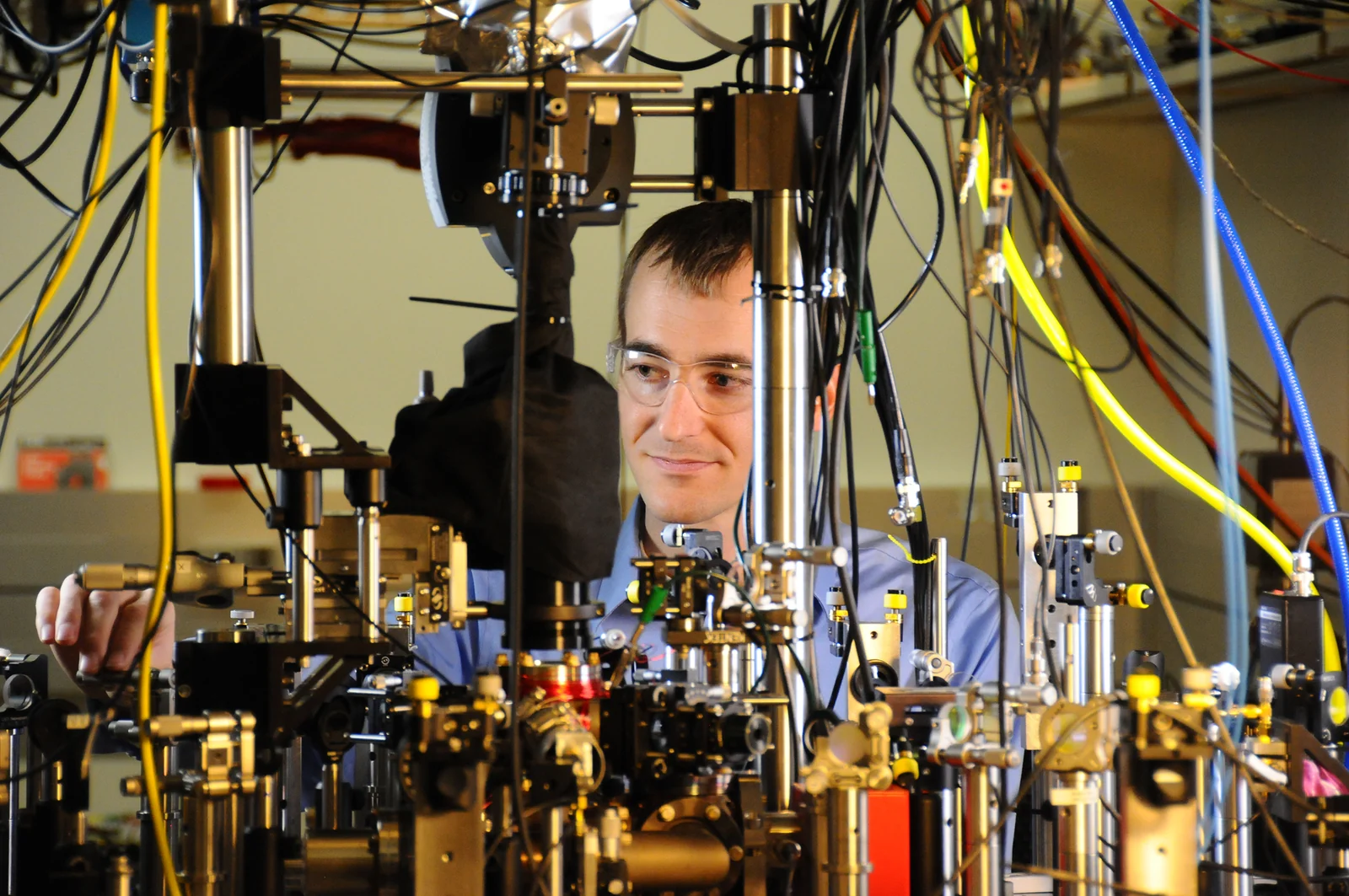
Stand upright and an extraordinarily small difference separates the rate at which time passes near your head from the rate near your feet. It is far too small to notice directly in everyday life. It is also not a metaphor. Differences in gravitational potential affect clock rates, and sufficiently precise instruments can measure the effect across remarkably small distances. In 2022, JILA researchers reported measurements of gravitational redshift across a millimetre-scale atomic sample. The result was an experiment involving an optical atomic clock, not two ordinary watches placed on opposite sides of a room. It remains a powerful way to explain why better timekeeping can become a way of investigating the physical world.[1]
That 2022 result still has contemporary relevance. Research and engineering around better clocks continue, from fundamental measurements to attempts to make specialised timing technology more usable outside a laboratory. Those developments connect to the same broad aim of better timekeeping, while involving different instruments and achievements.
A clock is a physical experiment
A clock does not measure time by consulting an invisible universal display. It counts a repeatable physical process. A pendulum swings, a quartz oscillator vibrates or an atomic system provides a reference associated with a particular transition. The practical challenge is to make the process stable and to understand what changes its rate. When a clock becomes more precise, effects that once looked negligible become measurable. Some are unwanted environmental disturbances. Others are precisely the physical effects researchers want to study. The distinction depends on the purpose of the experiment and on how well the influences can be separated.
That is why “a better clock” can mean more than a smaller error on a time display. It can mean a more sensitive comparison between locations or conditions. The clock becomes a measuring instrument whose output is a frequency comparison. A useful analogy is a musical note used as a reference pitch. If the note changes, you want to know whether the instrument drifted or the physical conditions changed. The analogy stops short of the atomic physics, but it captures the importance of separating the reference from the effect being measured.
The height difference is the point
The JILA experiment compared different regions within an atomic sample rather than relying only on widely separated clocks. It showed that the gravitational effect could be resolved over a very small vertical scale under carefully controlled conditions. This should not be paraphrased as “scientists watched a person age differently from head to toe”. The connection to a standing person is an explanatory consequence of the same physical principle, not a description of what the researchers measured. A laboratory demonstration and an everyday illustration belong in different sentences.[1]
Nor does a slower or faster clock rate imply that one person's experience of a second feels abnormal. The effect concerns comparisons between physical clocks in different conditions. Human intuition is poorly suited to differences this small, which is exactly why the instruments matter. The wonder comes from the scale of the measurement. A principle associated in popular culture with black holes and space travel can be investigated in a tiny laboratory sample. Relativity is not reserved for spectacular astronomical settings. Better measurement makes its quieter manifestations accessible.
Precision creates new responsibilities
An instrument that can resolve a tiny effect must also control or characterise other effects that might imitate it. Environmental influences, systematic shifts and comparison methods become part of the evidence. A headline about precision is incomplete without some account of how researchers know what they measured. For readers, that suggests a useful question: is the reported number a measure of stability, accuracy, uncertainty or some other property? Those words are related but not interchangeable. A clock may be very stable over a particular interval while still requiring corrections to establish its relationship to an agreed reference.
The same care applies to a claim that a clock would lose or gain a second over an enormous hypothetical span. Such a comparison can make a small fractional uncertainty intuitive, but it is not a report that the instrument has run unchanged for that length of time. It is an extrapolating illustration. The best science communication can use these comparisons while keeping their status visible. A memorable image should help the reader understand the measurement, not quietly replace it.
What a clock might tell us besides the time
Because clock rates are sensitive to gravitational potential, comparisons between sufficiently capable clocks can be relevant to measuring the world. Translating that possibility into a practical application requires suitable instruments, reliable links and a clear account of uncertainty. A beautiful laboratory result does not automatically become a field-ready mapping service. There are also distinct engineering goals within timekeeping. A compact clock that operates reliably in a demanding environment is not necessarily the same kind of instrument as a laboratory optical clock designed for exceptional precision. Miniaturisation, robustness, power consumption and ultimate performance can pull designs in different directions.
Two 2026 examples illustrate the breadth rather than proving a common capability. Oxford reported a commercialisation-related award for the Atomic Cloq team in September. Microchip announced an enhanced radiation-tolerant space-oriented atomic-clock product in August. An award and a product announcement answer different questions from the JILA experiment, and neither should be presented as a replication of its millimetre-scale result. Keeping those categories separate makes the industry more intelligible. Fundamental measurement, engineering development and commercial adoption can all be important without sharing a single performance ladder.[3][4]
The second itself is a scientific agreement
The definition of a unit is not the same thing as the best instrument currently available to realise or improve it. Work on optical clocks has implications for the future definition of the second, but a proposed or planned redefinition should not be reported as an already adopted change. For everyday readers, the key idea is that measurement standards are maintained through evidence and agreement. They are not arbitrary labels changed whenever a laboratory produces a striking result. A new standard must be reproducible and usable across the institutions that depend on it.[2]
That process is less dramatic than a single breakthrough, but it is part of why precision science can support ordinary infrastructure. Measurements become useful when other people can reproduce and compare them, not merely admire the best demonstration.
A small fact worth keeping
The difference between time at your head and time at your feet is not a reason to worry about standing up. It is a reason to appreciate how far measurement has progressed. A tiny effect that would once have been inaccessible can become a source of information when the instrument is good enough. The shareable version is simple: better clocks do not just tell us the time more accurately; they can help reveal differences in the world around them. The qualification belongs beside it: the most striking results depend on specialised instruments and carefully controlled comparisons. That combination is more interesting than a claim that time has been broken. Timekeeping has become precise enough to make an old theory visible on a very small stage.