Partial fault tolerance trades some protection for a smaller resource bill
A neutral-atom co-design study connects physical noise, logical operations and application costs. Its resource gains remain conditional simulation results.

How individually controlled atoms become programmable quantum systems.
Neutral-atom systems use light to trap and arrange atoms. Researchers can program their interactions for analog simulation or use controlled operations for digital circuits; those modes offer different capabilities.
Array size is only one part of the story. Useful comparisons examine control errors, atom loss, connectivity, supported operations and how a user can access the system. Logical-qubit experiments also need clear accounting of error detection and postselection.
Trapping and loading, rearranging an array, performing an entangling operation, measuring atoms and completing an encoded task describe different steps. A prepared array does not establish that every atom ran the same circuit. Motion is distinct from a logical gate. Follow the source’s actual protocol and selection conditions, including in the reconfigurable-array logical-processor paper. For encoded resources, continue to the error-correction guide.
The same physical ingredient can support different programming approaches. In analog Hamiltonian simulation, a controlled quantum system follows a specified energy-and-interaction model over time. In gate-based computation, the program specifies a sequence of operations. Amazon Braket’s definitions explain the distinction.
| Question | Analog example | Gate-based example |
|---|---|---|
| What is specified? | In the Braket tutorial: atom positions and driving-field amplitude, phase and detuning as functions of time. | A sequence of supported gates and measurements, mapped to the processor’s controls. |
| What is studied? | The evolution and measured configurations of an interacting spin model. | The output of the specified circuit, with its operation and encoding conditions. |
| What is the boundary? | A device’s available interactions limit which models it can implement directly. | A demonstrated circuit establishes its tested operations; a gate label alone establishes no complete fault-tolerant capability. |
The AWS tutorial maps a ring of spins to trapped atoms, then examines the resulting configurations. It distinguishes a local classical simulation from a run on Aquila. Simulated samples describe the selected model; physical measurements also involve the device and preparation conditions. Keep empty-site records and selection rules with any result.
For a different kind of evidence, the reconfigurable-array logical-processor paper, published 6 December 2023, reports programmable rotations, logical gates and readout in a research experiment. Its observations do not establish that a cloud analog device offers those same operations.
Operating mode, experimental status and user access are separate questions. Continue to the hardware-architectures guide to compare system functions, or physical versus logical qubits to understand the encoding boundary. This comparison ranks neither approach and reports no new hardware test.
A larger array, a protected memory and an encoded circuit test different capabilities. Keep the measured task beside the headline number. These experiments do not share a common performance score.
| Evidence | What was measured | Conditions and limits |
|---|---|---|
| Array scale and controlMore than 6,100 trapped atomsA tweezer array with 6,100 highly coherent atomic qubits ↗Source dated | Manetsch and colleagues trapped cesium atoms in approximately 12,000 optical-tweezer sites and tested imaging, coherence and global single-qubit control. | The reported 12.6-second coherence used dynamical decoupling: a control sequence that reduces dephasing. It is not a measured lifetime for an error-corrected logical memory. Not established: The zone-based computing architecture is a proposal. The array size does not establish a completed computation involving 6,100 entangled computational qubits. |
| Protected memoryFour rounds of error correctionA fault-tolerant neutral-atom architecture for universal quantum computation ↗Source dated | Bluvstein and colleagues compared distance-3 and distance-5 surface codes. In the four-round characterization, the larger code had about 2.14 times lower logical error per round with loss-aware machine-learning decoding. | Figure 2d uses no postselection: the comparison does not discard runs to improve the result. This qualification belongs to that comparison; other experiments in the paper use different selection rules. Not established: A finite error-suppression test does not establish indefinitely reliable storage or the throughput of a complete algorithm. Code distance, correction rounds and decoder are part of the result. Current journal text, Figure 2d and its discussion. The journal lists a publisher correction dated 19 January 2026. |
| Encoded circuitA 48-logical-qubit sampling circuitLogical quantum processor based on reconfigurable atom arrays ↗Source dated | A separate Bluvstein experiment encoded this circuit in 128 physical qubits. It included 228 logical two-qubit gates and 48 logical CCZ gates. | Cross-entropy benchmarking compares the sampled output distribution with the ideal distribution. Error-detection postselection improved the reported benchmark, so the fraction of accepted runs must stay attached. Not established: The tested circuit is not a generic application-speed comparison. Its 128 physical qubits are distinct from the apparatus maximum of 280, and its selection rules differ from the memory experiment above. Published online 6 December 2023; version of record 24 January 2024. Figure 5 and circuit implementation. |
A question to carry forwardIs the claim about controlling physical atoms, protecting encoded information, or completing a specified circuit?
Sources checked . This comparison explains published evidence; it does not report a new hardware test.
Read the research
Recent studies, explained in full. Each analysis keeps the measured result, the model and the remaining questions together.
An October 15 preprint develops a numerical implementation of an earlier quantum-instanton framework and applies it to two collective-spin models. It estimates leading exponential switching behavior and compares stationary and relaxation predictions with master-equation calculations and a solvable reference case. This is theoretical numerical work, not observed switching data from a new device. The key question is why identifying several stable-looking states is insufficient: the rare transitions between them determine their long-time weights and the timescale on which the system forgets its initial preparation. [1]
A metastable state can persist for a long time without being the final stationary state of a finite system. In a typical short observation, the system may appear settled because transitions out of that region are rare. Over a much longer interval, it can switch and spend time near another configuration. A deterministic mean-field model may identify both regions as attractors while omitting the fluctuations that connect them. To predict long-time behavior, one needs information about those rare connections as well as the locations of the attractors.
An original two-state rate model gives a compact example. Let the transition rate from A to B be 0.001 per second and the return rate be 0.009 per second. In the stationary distribution, B has probability 0.001 divided by 0.010, or 0.10. The mean residence times are 1,000 seconds in A and about 111 seconds in B. These invented rates are not quantum-spin data. They demonstrate why the more persistent region can dominate the long-time population even though both regions can look locally stable.
The same rate model separates residence from relaxation. The deviation of the population from its stationary value decays with the sum of the two rates, giving a relaxation time of 100 seconds in this example. That differs from either mean waiting time. The distinction becomes important when an experiment or simulation reports one timescale as though it characterized every aspect of metastability. A useful description states whether it measures a first switching event, a residence distribution or the approach of an ensemble average to stationarity.
Directly sampling extremely rare switches can be expensive because most simulated time contains no transition. An instanton method instead searches for a special trajectory associated with the dominant rare event in an appropriate mathematical description. Its action can determine the leading exponential dependence of a rate on system size or another large parameter. Leading exponential accuracy is powerful for comparing strongly suppressed processes, but it is not the same as knowing every prefactor needed for an absolute finite-system switching rate.
Quantum quasiprobability descriptions can encode dynamics in variables that resemble classical phase-space coordinates while retaining nonclassical structure. Truncating that structure can simplify a calculation, but rare events may be sensitive to terms that have little effect on ordinary fluctuations near an attractor. A method accurate for local variance can therefore misestimate a transition barrier. Comparing representations and truncations is especially valuable here because the observable of interest is controlled by an unusual path, rather than the most frequently sampled part of the distribution.
Numerically finding such a path is a boundary-value problem. A shooting method adjusts a starting condition and integrates toward the desired endpoint; a collocation method solves for a trajectory through constraints at multiple points. Both need checks for convergence and for selection of the physically relevant solution when several mathematical paths exist. Agreement with an independently computed small-system reference can test that selection. It also helps reveal the finite-size range in which an asymptotic barrier prediction becomes quantitatively useful for the original open quantum system.
The study advances the calculation of slow dynamics by focusing on the events that ordinary short trajectories rarely show. The next informative benchmark would compare predicted switching distributions and stationary weights across a sequence of sizes, including the prefactor sensitivity where accessible. Readers could then assess how far the rare-event approximation extends beyond locating a qualitative transition. That connection matters for programmable dissipative systems because a state that looks stable during preparation may still be only one temporary part of the system's eventual behavior.
Go beyond the headline
Follow the physical idea, work through a declared example and keep the limits attached. Research dates appear with each guide and lab.
Source research checked . Teaching calculations are ideal models.
An optical trap can shift both states of a qubit or clock transition while leaving the transition frequency nearly unchanged. The transition depends on the energy difference between those states, so equal shifts cancel in that difference. A magic wavelength is chosen to match the relevant light shifts under specified conditions. The name does not imply that light stops interacting with the atom or that the trap becomes free of perturbations. It identifies a cancellation in the quantity being measured. Understanding that cancellation helps readers separate confinement, common energy shifts and differential frequency errors.
In a leading-order description, each state's light shift is proportional to intensity and its dynamic polarizability at the trapping frequency. Their difference determines the intensity-dependent transition shift. If the two polarizabilities match, the first-order differential shift vanishes while a common trap potential remains. This allows an atom to be confined without making its transition frequency strongly dependent on where it samples the trap intensity. The important equality concerns the selected states and operating conditions. It need not hold for another transition, another polarization or every higher level involved in control and readout.
The spatial structure of a trap makes differential shifts especially consequential. An atom moving through a nonuniform intensity samples a time-dependent transition frequency when the two state shifts differ. An ensemble with different positions or motional energies can acquire a spread of phases. Reducing the leading differential response can therefore reduce sensitivity to motion and intensity variations together. It does not necessarily remove the motion itself. A magic-trap lesson should retain separate indicators for trap depth, motional distribution and transition shift, rather than implying that cancellation prepares an atom in a fixed location.
Higher-order effects remain. A differential shift can include intensity-squared terms, polarization dependence and other contributions that are absent from the simplest linear model. An operating point may cancel the slope of one term while retaining a nonzero offset or a curvature that becomes important at another intensity. The word magic should therefore be accompanied by the quantity canceled and the range over which the cancellation was tested. A measurement performed at one trap depth does not automatically characterize a much deeper tweezer or a different motional distribution.
Calibration benefits from varying a control that changes the suspected shift. An intensity sweep can estimate a differential slope, while changes in polarization or frequency can test the proposed cancellation mechanism. Correlated changes require care: adjusting trap intensity can also change temperature, confinement and which atoms remain in the sample. A fitted slope may then contain more than a pure light-shift coefficient. The uncertainty budget should identify the measured dependence, the extrapolation range and any hidden variables that move with the control. This makes a small observed shift scientifically interpretable.
The cancellation can be tested by changing intensity and measuring the transition frequency rather than inspecting either absolute level shift alone. Near a magic setting, the leading differential slope can vanish while both levels continue to move strongly together. Residual curvature then becomes visible over a larger intensity range, and motion through an inhomogeneous field can sample that curvature. A calibration at one intensity should not be extended indefinitely without checking the higher-order response. Polarization, magnetic conditions and the atomic state can also change the effective differential sensitivity. The benefit of magic trapping is a controlled reduction of a particular dependence. Its success is established through the transition response and its uncertainty over the actual range experienced by the trapped atom.
Inputs: I initial: 1; I final: 1.01; ground linear Hz: -1000; excited linear Hz: -1100; residual quadratic Hz: 0.2
delta_transition=(a_e-a_g)*delta_I; residual_change=b*(I_final^2-I_initial^2)
| Calculated quantity | Synthetic result |
|---|---|
| nonmagic change Hz | -1 |
| magic residual change Hz | 0.00402 |
Synthetic shift model: in frequency units, let the ground-state shift be -1000I Hz and the excited-state shift be -1100I Hz, where I is a dimensionless intensity scale. Their differential shift is -100I Hz, so increasing I from 1 to 1.01 changes the transition by -1 Hz. At an illustrative magic setting, make both linear coefficients -1000 Hz. The linear differential shift is then zero. If an unequal quadratic contribution of +0.2I² Hz remains, the same intensity change produces 0.2(1.01²-1)=0.00402 Hz. Common shifts remain large while the differential sensitivity is greatly reduced; it is not identically zero in the richer model.
The tempting conclusion: Magic trapping means the trapping laser no longer perturbs the atom.
What follows instead: It cancels a specified differential effect under specified conditions. Confinement, common shifts and other perturbations remain.
| Quantity or decision | What it means |
|---|---|
| Common level shift | Moves both energies together and cancels from the chosen transition difference in the model. |
| Differential linear shift | Creates first-order transition sensitivity to intensity; matching polarizabilities targets this contribution. |
| Residual curvature | Leaves intensity sensitivity beyond the leading cancellation and can matter at different trap depths. |
It cancels from the energy difference in the ideal model. It can still affect confinement or other transitions, so harmless is meaningful only for the specified observable.
No. The leading cancellation can leave higher-order terms, polarization effects and other dependencies that become visible outside the tested range.
Motion samples spatially varying intensity. A differential shift converts that sampling into phase variation, even if the average intensity is stable.
Intensity changes can alter temperature, trap occupation and the surviving sample. Those changes can contribute to the observed transition response unless controlled or modeled.
Magic conditions protect a difference between selected levels. Their practical value comes from specifying the canceled dependence and measuring what remains.
Magic trapping cancels the leading differential light shift by matching the two state shifts. Magic operation does not remove higher-order, polarization, thermal or other clock shifts.
Source research checked . Teaching calculations are ideal models.
Rydberg blockade relies on an interaction-induced shift that makes simultaneous excitation of nearby atoms off resonance. A finite shift suppresses an unwanted transition without removing it mathematically. The drive still has a strength and a duration, and the excited state still has a finite lifetime. These ingredients create competing tendencies. A slower operation can reduce off-resonant excitation while exposing the system to decay for longer. A faster operation can shorten that exposure while driving more strongly relative to the blockade shift. A useful gate design balances mechanisms instead of maximizing one control parameter.
The ratio between drive strength and blockade shift is a natural organizing variable. When the ratio is small, perturbative reasoning suggests that unwanted double-excitation probabilities contain terms of order the squared ratio, with protocol-dependent coefficients. Meanwhile, a fixed rotation angle often requires a duration inversely proportional to drive strength. A lifetime-related exposure can then decrease as the drive grows. Combining those tendencies yields an interior optimum in a simple cost model. The coefficients and even the detailed functional forms must come from the chosen protocol before the model can describe an actual gate.
This distinction matters because coherent leakage is not always a smooth probability curve. Amplitudes can leave an intended subspace and return with phases that depend on pulse timing. Pulse shaping, detuning and multilevel structure can change the final error substantially. An approximate sum of a decay term and a blockade term is useful for finding a design tension, but it should not be labeled a calibrated gate fidelity. The teaching value is the comparison between two mechanisms and the sensitivity of their balance, not a claimed universal optimum for every Rydberg implementation.
Atom position enters through the interaction. A distribution of separations produces a distribution of blockade shifts, so a setting optimized for one nominal geometry can perform differently across a thermal ensemble or a larger array. Directional dependence and nearby states can complicate the interaction further. A specification should therefore explain which geometry and atomic states support the modeled shift. Replacing a position distribution by its mean can hide weakly blockaded tails that contribute disproportionately to unwanted excitation. Robust operation may require optimizing an ensemble rather than a single pair at a single distance.
The practical comparison should also include the cost of preparing and restoring the atoms. A shorter Rydberg pulse may not shorten a complete cycle if cooling, state preparation, measurement or rearrangement dominates. Conversely, a slightly slower pulse with better robustness may reduce failed attempts or recalibration burden. The relevant objective follows the application: an entangling operation, repeated syndrome extraction or analog evolution can impose different constraints. Readers should ask which performance quantity is optimized and which time intervals are included before comparing two pulse durations.
An optimum derived from one nominal blockade shift should be tested against the distribution of shifts seen during operation. Position variation, unequal couplings or additional levels can make different atom pairs respond differently to the same pulse. A setting that minimizes a two-term proxy at the center of that distribution may perform poorly in its tails. Robustness therefore involves both the average response and the sensitivity to uncertain parameters. The relevant experimental quantity must also remain explicit: a leading-order error proxy, a population leakage fraction and a reconstructed gate fidelity are different claims. Optimizing the proxy can identify a useful region for more complete analysis, but only a validated dynamical and measurement model can convert that region into an operational gate-performance statement.
Inputs: a: 0.0002; b: 1; x values: [0.02, 0.1]
E=a/x+b*x^2; x_opt=(a/(2*b))^(1/3)
| Calculated quantity | Synthetic result |
|---|---|
| x opt | 0.046415888 |
| proxy at opt | 0.0064633041 |
| proxy at 0.02 | 0.0104 |
| proxy at 0.1 | 0.012 |
Synthetic optimization: define a dimensionless proxy E(x)=0.0002/x+x² for x=Ω/B, where the first term represents decreasing decay exposure and the second represents increasing finite-blockade error. Differentiating gives -0.0002/x²+2x=0, so x=(0.0001)^(1/3)=0.046416. The proxy there is 0.0064633. At x=0.02 it is 0.0104, and at x=0.1 it is 0.012. Faster driving improves the first contribution while eventually worsening the sum. The coefficients are invented and E is a restricted-range teaching proxy, not a derived physical gate infidelity or a probability model valid for arbitrary x.
The tempting conclusion: The strongest available drive is always the best Rydberg gate setting.
What follows instead: A finite blockade shift creates competing selectivity and lifetime effects, and the best setting depends on the complete protocol and variation.
| Quantity or decision | What it means |
|---|---|
| Decay exposure | Often favors shorter time in excited states, subject to the actual pulse population trajectory. |
| Finite-blockade selectivity | Often favors a drive small compared with the interaction shift in a perturbative picture. |
| Robust ensemble operation | Optimizes performance across position and parameter variation instead of only at one nominal point. |
For a fixed rotation angle it can shorten the time spent with excited-state population. The precise exposure depends on the pulse trajectory, not just its nominal duration.
It becomes less selective relative to a finite interaction shift. The unwanted transition is more strongly driven, with protocol-dependent leakage and phase effects.
No. It moves with lifetime, interaction strength, pulse shape, geometry and the metric optimized. The simple proxy demonstrates a tradeoff rather than a hardware prescription.
Some atom pairs can experience weaker blockade than the nominal separation predicts. Nonlinear error dependence means those pairs need not be represented well by a mean distance.
Finite blockade turns speed into a balance between mechanisms. A useful optimum states its model, geometry and objective, then survives checks beyond the toy approximation.
Finite blockade, finite lifetime and other errors enter a multilevel Rydberg-gate analysis. This explanation uses an illustrative two-term optimization, not the paper's fidelity model or numerical optimum.
Source research checked . Teaching calculations are ideal models.
Losing an atom and losing an unknown qubit state are physically serious events, but knowing where the loss occurred changes the inference problem for error correction. An erasure flag provides location information. That information can reduce the set of faults a decoder must consider. The benefit depends on the flag being accurate, timely and correctly associated with a data location. An empty-looking image is not automatically a perfect erasure record. Detection has missed events and false alarms, and the measurement used to detect loss can affect atoms that remain.
Three quantities need separate names. The physical loss probability describes how often the atom or encoded state leaves the intended space. Detection efficiency describes how often such an event is flagged. The false-positive rate describes how often a healthy location is marked. A decoder receiving a flag needs the conditional probability that the flagged location actually suffered the relevant event. That probability depends on the base rate of loss as well as detector performance. When losses are rare, even a small false-positive rate can create a noticeable fraction of misleading flags.
Unflagged events matter just as much. A highly credible flag can coexist with an unacceptable number of missed losses if the detector is insensitive. A reporting scheme should therefore retain both the flagged channel and the residual unlocated channel. Improving one number can worsen another when a detection threshold moves. The appropriate threshold depends on how the downstream code handles a false erasure, an unlocated error and additional measurement disturbance. Optimizing image classification in isolation may not optimize the logical operation that consumes its output.
Timing adds another dimension. A loss detected only after several operations may have affected neighbors before the location became known. The flag then identifies a history that is broader than a single missing atom at the final image. A useful interface associates the flag with a time interval and the operations that touched the location. Replacing an atom restores a physical carrier, but it does not recreate an unknown quantum state. Recovery must use the encoded information and syndrome history. This separates hardware replenishment from logical recovery while explaining why both are needed.
Not every detectable departure is literal atom loss. A system may identify population in an unwanted internal manifold or deliberately convert some leakage processes into a detectable state. Such conversion is valuable when it produces reliable information without excessive extra faults. Its scope must be stated: which errors are converted, which remain unlocated, and which detection operations are added. A proposal that converts a dominant channel does not imply that all noise has become erasure noise. Code simulations should use the measured mixture rather than assume a perfectly located channel because the hardware supports a flag.
The flag should be interpreted as a conditional statement about a physical event at a particular time. When loss is rare, even a small false-positive rate can account for a noticeable fraction of all flags. Among unflagged sites, a small missed-loss population can still matter if the next operation assumes every carrier is present. Reporting both conditioned groups helps a decoder designer understand what information the detector actually supplies. A prompt flag and a delayed flag with identical classification accuracy can lead to different propagated fault histories. Restoring occupancy later repairs the missing carrier, while logical recovery must use the remaining encoded information. These distinctions connect an optical image to the timed evidence required for a correction protocol.
Inputs: loss probability: 0.01; detection efficiency: 0.95; false positive: 0.001
P(loss|flag)=p*eta/(p*eta+(1-p)*f); P(loss|no_flag)=p*(1-eta)/(1-P(flag))
| Calculated quantity | Synthetic result |
|---|---|
| flag probability | 0.01049 |
| loss given flag | 0.9056244 |
| loss given no flag | 0.0005053006 |
Synthetic detector example: assume physical loss probability 0.01, loss-detection efficiency 0.95 and false-positive probability 0.001 on healthy sites. True loss flags occur with probability 0.0095; false flags occur with probability 0.99×0.001=0.00099. A flagged site therefore has loss probability 0.0095/0.01049=0.90562. Missed losses occur with probability 0.0005. Among the unflagged population, the loss probability is 0.0005/0.98951=0.0005053. Neither conditional number alone describes the complete channel. The example treats one isolated detection round and does not model neighbor faults, delayed flags or the logical-code response.
The tempting conclusion: Any visible loss detector turns the whole processor into a pure-erasure machine.
What follows instead: Detection applies to specified channels with finite efficiency and false alarms. A realistic decoder needs the remaining unlocated errors and the flag timing.
| Quantity or decision | What it means |
|---|---|
| Physical loss rate | How frequently the intended carrier or state is absent from its computational space. |
| Flag confidence | How likely a flagged location is to contain the specified event, conditional on prevalence and detector behavior. |
| Residual unlocated channel | Events that remain without usable location information and require a different decoding treatment. |
No. Replacement restores a carrier in a prepared state. Recovering an unknown encoded state uses redundancy, syndrome information and a valid recovery procedure.
Healthy sites can greatly outnumber lost sites. Their small individual false-positive rate can contribute a meaningful fraction of all flags.
Only if the circuit model justifies that simplification. Operations performed before discovery may spread or obscure consequences and should be represented in the history.
It addresses specified detectable channels. Residual Pauli errors, missed events and detector-induced faults remain unless separately established to be negligible.
An erasure flag is calibrated information. Its benefit depends on what it identifies, what it misses and when the decoder can use it.
Some detectable physical errors can be converted into location information for an erasure-aware decoder. A proposal does not establish that all atom loss is perfectly detected or that all errors become erasures.
Source research checked . Teaching calculations are ideal models.
Fluorescence imaging extracts information by collecting photons scattered from an atom. More detected photons generally make a bright state easier to distinguish from background, but scattering also perturbs the atom. Recoil, optical pumping and state-dependent light shifts can affect its motion or internal state. An image can therefore be accurate while the atom is lost, heated or left in the wrong state for reuse. The word nondestructive must identify what survives: physical occupancy, a selected internal state, or the coherence of a separate data qubit nearby.
Detection statistics and retention statistics answer different questions. A camera or photon counter produces a distribution of counts conditional on the prepared state. A threshold converts counts into a label. Separately, a subsequent check can ask whether the same atom remains in the trap after imaging. Combining these observations reveals joint outcomes: correctly identified and retained, correctly identified but lost, misidentified and retained, or misidentified and lost. Reporting only the conditional accuracy among atoms that survived can hide failures that matter to the complete circuit. The denominator should follow the intended operation.
A longer exposure increases information only under a model of how counts accumulate. In a simple stationary Poisson picture, signal and background means grow with time. A threshold can be chosen to balance the two types of classification error. Real imaging may include changing scattering rates, optical pumping, atom motion, camera effects and atom loss during the exposure. These can produce count distributions that differ from the simple model. A convincing classifier assessment should compare the observed distributions to its assumptions, especially in the tails where rare misassignments are inferred.
The optical design can reduce disturbance without making it disappear. Cooling during imaging can remove some recoil energy; state shelving or spatial selectivity can protect qubits that should not be measured. Those protections require their own checks. A dark spectator may still experience off-resonant shifts, and an atom retained after exposure may need recooling or reinitialization before a gate. Mid-circuit measurement is a complete protocol that includes preparation, exposure, discrimination and restoration. Its useful duration and error budget extend beyond the camera's exposure setting.
State-selective imaging also changes what is being preserved. Measuring whether the atom occupies one qubit basis state generally destroys coherence between the two basis alternatives. Retaining the atom does not undo that state measurement. Meanwhile, a separate data qubit should ideally preserve its information during an ancilla image. A clear report names the measured subsystem and the protected subsystem. Otherwise a successful occupancy-retention claim can be misread as preservation of an arbitrary state on the measured atom, or a target-only image test can overlook spectator disturbance.
Changing a classification threshold and changing illumination are different interventions. Moving the threshold reassigns the same photon records and trades one classification error against another. Increasing exposure changes the records themselves and can also alter survival, motional heating or disturbance of nearby qubits. A valid optimization should preserve these distinctions in its data table. Report the joint outcomes of decision quality and retention rather than multiplying unrelated marginal percentages without a dependence assumption. An atom that remains trapped can still be unready for the next gate, so reuse tests should include the relevant internal and motional state. Mid-circuit imaging succeeds when the measurement produces the required information and leaves the intended computational resources usable on schedule.
Inputs: bright mean: 12; dark mean: 0.5; bright threshold: 3
P_bright_to_dark=exp(-12)*sum(12^k/k!,k=0..2); P_dark_to_bright=1-exp(-.5)*sum(.5^k/k!,k=0..2)
| Calculated quantity | Synthetic result |
|---|---|
| bright to dark | 0.00052225805 |
| dark to bright | 0.014387678 |
Synthetic count example: let a bright preparation have Poisson mean 12 detected photons and a dark preparation mean 0.5. Calling counts of at least three bright gives a bright-to-dark error P(N<3|12)=e⁻¹²(1+12+72)=0.00052226 and a dark-to-bright error P(N≥3|0.5)=1-e⁻⁰·⁵(1+0.5+0.125)=0.014388. Moving the threshold changes this tradeoff but does not change the photons already scattered. Atom survival is deliberately absent from these equations and must be measured separately. The count distributions are invented stationary models; they do not represent a reported camera or neutral-atom processor.
The tempting conclusion: A retained atom proves that its measurement was nondestructive in every sense.
What follows instead: Retention concerns the carrier. Internal state, coherence, motion and spectators can change even when occupancy is preserved.
| Quantity or decision | What it means |
|---|---|
| Count discrimination | How well collected photons identify the prepared label under a threshold or other classifier. |
| Atom retention | Whether the carrier remains available after the illumination sequence. |
| Readiness for reuse | Whether motion, internal state and neighboring data support the next intended operation. |
No. The atom can remain trapped after its basis state was measured or optically changed. Preserving an arbitrary unknown state is a separate claim.
No. It changes the decision rule applied to recorded light. Altering the exposure or optical protocol changes the physical scattering process.
They can be failures of the intended reusable measurement. Excluding them without a separate unconditional yield makes the operation look more reliable than the complete protocol.
Test the information the circuit requires them to preserve, including coherence, under the same selective imaging sequence and timing.
A useful image must support the operation that follows. Information, retention and restored readiness require separate evidence even when they share the same illumination pulse.
State-selective and site-selective imaging can be designed to retain atoms for subsequent operations. No paper-specific imaging fidelity or survival probability is repeated.
Source research checked . Teaching calculations are ideal models.
A neutral-atom array can contain more loading sites than the final computation requires. Spares give the system a chance to select enough atoms even when individual loading is probabilistic. The relevant loading event is then at least the required number of occupied sites, rather than every site being occupied.
That change introduces a second stage. Selected atoms may need to survive movement into the target arrangement. The constructed model treats enough initial loading and survival of a fixed number of required moves as independent conditions. Increasing the number of loading sites raises the first probability while leaving the second unchanged. The result has a clear ceiling that extra empty traps cannot repair.
This simplified sequence gives readers a way to separate trap capacity, loading yield and assembled-register yield. It does not model a real rearrangement algorithm, where the number and length of moves depend on the initial pattern and many atoms may already be in useful positions. A strong follow-up article would report the distribution of loading patterns and movement costs, keeping a reliable final arrangement distinct from a large photograph of illuminated sites.
P(enough loaded) = sum_{j=k}^n C(n,j)p^j(1-p)^(n-j)
P(all required moves survive) = movement_survival^k
Assembly probability = P(enough loaded) × P(all moves survive)
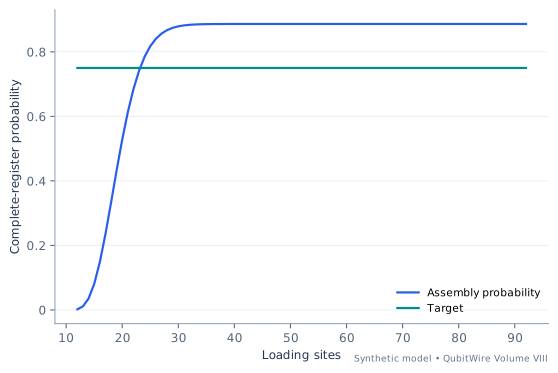
Each case uses invented inputs. The results follow from this model and do not describe measured hardware.
| Calculated quantity | Synthetic result |
|---|---|
| Probability enough atoms load | 0.5955987253122249 |
| All required moves survive | 0.8863848717161292 |
| Combined assembly probability | 0.5279296997301666 |
| No-spares complete-and-moved probability | 0.0019294669316492952 |
| Minimum sites meeting target in tested range | 24 |
| Movement-only ceiling as sites increase | 0.8863848717161292 |
The tested minimum is 24 loading sites. Extra sites fix loading shortages but cannot remove the movement ceiling 0.886385. Real rearrangement may require a variable number of moves; then its movement survival must be conditioned on the actual loading pattern.
| Calculated quantity | Synthetic result |
|---|---|
| Probability enough atoms load | 0.925330389694105 |
| All required moves survive | 0.7753304137431637 |
| Combined assembly probability | 0.7174367938906533 |
| No-spares complete-and-moved probability | 0.0006560288895928319 |
| Minimum sites meeting target in tested range | 37 |
| Movement-only ceiling as sites increase | 0.7753304137431637 |
The tested minimum is 37 loading sites. Extra sites fix loading shortages but cannot remove the movement ceiling 0.77533. Real rearrangement may require a variable number of moves; then its movement survival must be conditioned on the actual loading pattern.
| Calculated quantity | Synthetic result |
|---|---|
| Probability enough atoms load | 0.999997255392694 |
| All required moves survive | 0.6342994851361967 |
| Combined assembly probability | 0.6342977442331956 |
| No-spares complete-and-moved probability | 0.00676968033341188 |
| Minimum sites meeting target in tested range | Target unavailable in tested range |
| Movement-only ceiling as sites increase | 0.6342994851361967 |
No tested loading-site count reaches the target. Extra sites fix loading shortages but cannot remove the movement ceiling 0.634299. Real rearrangement may require a variable number of moves; then its movement survival must be conditioned on the actual loading pattern.
Try the reasoning: Compare the desired assembly probability with the movement-only ceiling before adding more loading sites.
A neutral-atom co-design study connects physical noise, logical operations and application costs. Its resource gains remain conditional simulation results.
The partnership adds algorithms and software expertise. A documented backend and reproducible workflow would show what developers can actually run.
A software-release analysis of Pasqal’s October 8 toolkit: it connects ideas to quantum hardware while leaving important scientific checks to the researcher.
An October 8 experiment-and-theory preprint uses QuEra’s Aquila to probe a frustrated-magnet model. The useful prospect is a sharper guide to materials experiments, with important tests still ahead.
Oratomic reports $775 million in cumulative financing. Its neutral-atom bet connects ambitious error-correction research to a machine that still needs to be demonstrated.
A new blueprint turns helium’s tiny mass into a computing resource. The surprising part is what the atoms would do—not what they would cool.
A new hardware test asks whether a different kind of quantum computer can benefit from the same software ideas.
A continuously replenished array held more than 3,000 atoms for over two hours. The hard part is replacing them without disturbing their neighbors.
Laser tweezers turn single atoms into movable quantum bits, and the resulting grid is something researchers can actually photograph.
A dedicated testbed recovered in 695 of 700 timed trials, according to QuEra's account of its Claude-assisted control pilot.
A photonic integrated circuit produced four rubidium-atom traps, with an approximately 27.5-second lifetime reported by the company.
A neutral-atom preprint tracks logical information through repeated measurement, lost-atom replacement and reservoir reloading.
The theoretical analysis is not a built processor, completed cryptographic attack or confirmation that every neutral-atom architecture meets the assumed conditions. Later financing does not validate it.
Traps ytterbium atoms and uses controlled gates, movement and measurement to run circuits and investigate logical encodings.
Research & evidence →Uses laser-controlled cesium atoms for digital circuits, with Superstaq compiling programs to the hardware’s operations.
Research & evidence →Arranges laser-trapped atoms and controls their collective interactions to study quantum dynamics or encode optimization problems. Pulser defines the pulse sequence submitted to a compatible device.
Research & evidence →Develops neutral-atom systems intended for integration with high-performance computing.
Research & evidence →Traps individual atoms with light and controls their interactions. Aquila programs a physical quantum evolution; Gemini uses gates and atom movement for digital and logical-qubit experiments.
Research & evidence →Selected organizations relevant to this topic. Inclusion is not a ranking.
Official QuEra Computing recording. Video details include the original YouTube link.
View video details →John Preskill's Quantum World Congress 2026 talk assesses the transition from noisy intermediate-scale quantum devices toward fault tolerance, including error-correction overhead, QLDPC codes, neutral atoms, cryogenic control and changing resource estimates. It is included as a fresh first-party conference research talk despite its early view count; the presentation is analysis and outlook, not evidence that fault-tolerant hardware has already arrived.
View video details →Startup CTO Gianvito Chiarella presents neutral-atom networking nodes intended to combine compute, memory and photonic entanglement distribution. This is a startup pitch and roadmap, not a validated production quantum network.
View video details →QuEra CEO Andy Ory gives a neutral-atom roadmap talk that explicitly acknowledges today's classical advantage while discussing error correction, AI control and near-term partnerships. It is a company roadmap, not evidence that useful quantum advantage has already arrived.
View video details →