
A Quantum Atom Array Tests What a Real Magnet Might Do Next
An October 8 experiment-and-theory preprint uses QuEra’s Aquila to probe a frustrated-magnet model. The useful prospect is a sharper guide to materials experiments, with important tests still ahead.
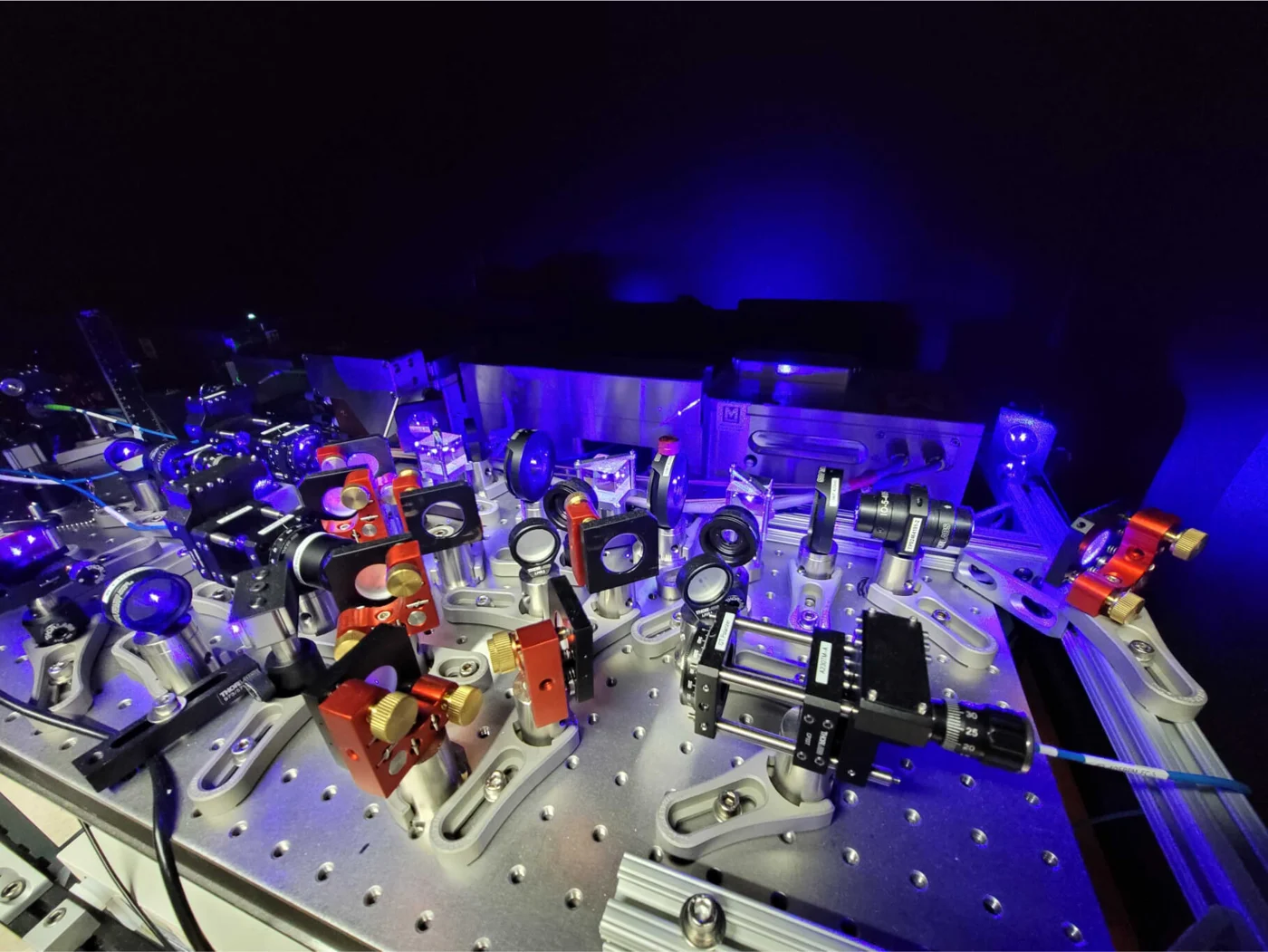

What if a quantum computer’s most useful output were a better laboratory experiment? An October 8 preprint explores that possibility with QuEra’s Aquila: more than 110 atoms produced magnetic-model signatures that qualitatively match calculations run on classical computers.[1][2]
A magnet with competing instructions
The problem is frustration. A magnetic interaction can favor one arrangement of neighboring spins while another favors an incompatible arrangement. Meeting one preference can upset another. Small changes can then matter enormously, because several competing patterns are close in energy. The Shastry–Sutherland lattice is a well-studied setting for exploring this competition.[4]
There is an established experimental starting point. In work published in PRX Quantum in 2020, researchers used a quantum annealer to study a 468-spin version of the Shastry–Sutherland Ising model. They recovered its phases and addressed finite-size effects through boundary conditions. That history matters: programmable quantum hardware was already being used to investigate this model before the new atom-array study.[4]
Make the model adjustable
Aquila offers a different set of controls. Its analog program specifies where atoms sit and how laser pulses drive them between a ground state and a highly excited Rydberg state. Moving the atoms changes their separations and therefore their interactions. The driving amplitude and supply further controls over the evolving system. AWS documents these as physical program parameters, rather than a sequence of ordinary digital logic gates.[3]
That is the practical attraction of an analog simulator: the experimenter programs an interacting physical system and measures its response. The controls are also constrained. AWS notes that users cannot choose the atomic levels or freely change the Rydberg interaction coefficient. A controllable model is useful precisely when the relevant physics fits those available controls; it is not an arbitrary replica of every material.[3]
The result comes in layers
The study’s calculations predict a quantum-stabilized 2/5-filling regime and a quantum-dimer regime. Filling means the fraction of atoms in the Rydberg state: 2/5 and 3/5 correspond to −1/5 and +1/5 of saturation magnetization. The dimer regime concerns paired local behavior; measured occupations alone do not establish quantum coherence.[2]
The main numerical calculations, run on classical computers, use finite 14-by-6 cylinders. Measurements show qualitative signatures across three boundary conditions, without determining the infinite-system phase diagram. Finite preparation time prevents a general guarantee of reaching the ground state. Neither quantum advantage nor a newly measured material phase is established.[2]
A better question for the laboratory
QubitWire’s analysis: a good comparison needs more than matching pictures. If different assumptions, preparation procedures or edge conditions produce similar signals, a persuasive-looking image may leave the underlying explanation unsettled. The useful question is which additional measurement would separate those explanations. That shifts attention from the size of the atom count to the strength of the proposed test.[2][4]
Direct dimer-coherence measurement is the key next test. Material predictions remain conditional: erbium tetraboride’s proposed transverse magnetic response is compatible with existing measurements, not established. Suggested experiments apply a transverse field to that compound or strain to thulium tetraboride.[2]
This suggests a practical way to judge progress: did the simulator narrow down what an experimentalist should measure, and did that measurement then discriminate between competing accounts? A faster computation would answer a different question. Here, a clear, falsifiable route from adjustable model to material would be valuable in its own right.[2][3][4]
Keep your reading trail
Keep up with these topics
Choose the subjects you want to find again in Your Updates.