NIST finalizes its post-quantum transition roadmap
The final report distinguishes sensitive federal systems from the broader migration timetable.

The migration of today’s systems to quantum-resistant cryptography.
Preparing a team briefing? Read the headline in three layers ↓
Post-quantum cryptography runs on conventional computers and is designed to resist both classical and quantum attacks. It is distinct from quantum key distribution, which uses physical quantum signals, and from quantum random-number generation.
Migration is a systems problem as well as an algorithm choice. Organizations need to identify where cryptography is used, check interoperability and update products as implementations and guidance evolve. Standards alignment does not automatically certify a particular product.
Zero trust concerns how access is continually evaluated. Post-quantum cryptography concerns classical cryptographic methods designed against quantum-capable attacks. Quantum key distribution concerns a different physical communication approach.
A company can work across these areas, but a development in one does not automatically establish progress in the others.
Go beyond the headline
Follow the physical idea, work through a declared example and keep the limits attached. Research dates appear with each guide and lab.
Source research checked . Teaching calculations are ideal models.
A sender can hide an arbitrary single-qubit state by applying one of four operations chosen with two secret random classical bits. An observer without the key sees a maximally mixed qubit, independent of the original state. The receiver who has the key can undo the operation. This is the quantum one-time pad. Its appeal is that secrecy comes from a precise transformation rather than a promise that the message is too complicated to understand. Its assumptions also matter: the key must be secret, appropriately random and used according to the protocol. The simple confidentiality calculation is not a complete authenticated communication system.
The four choices are the identity and the three Pauli directions, with irrelevant overall phases handled by a consistent convention. Averaging those choices cancels the components of the input Bloch vector. The resulting state is identity divided by two for every input. Someone who knows the choice does not average over it; they apply the inverse and recover the original ideal state. This is a clean example of why the observer's information belongs in a security description. The physical transmitted system can be the same while the key changes which conditional description the receiver can use.
The key is a separate classical resource. Without it, averaging over the four allowed operations produces the same maximally mixed description for every input. With the key, the authorized receiver can apply the correct inverse operation. Confidentiality and integrity remain different goals: a malicious alteration can require additional authentication even when the original message is hidden. This ideal cipher is a quantum-information example, not a consumer security recommendation. It encrypts quantum states; post-quantum public-key algorithms normally run on classical systems.
The quantum one-time pad gives a specific confidentiality statement. Averaging over the uniformly selected secret Pauli key makes the observer's ciphertext state independent of the input. The intended receiver, who knows the key, applies the appropriate inverse. That proof is valuable precisely because it states what the observer receives and what information the observer lacks.
A complete service has additional jobs. It must establish and protect the classical key, prevent unsafe key reuse under the chosen security model and decide how to handle tampering or loss. Those properties do not follow merely from the average ciphertext being maximally mixed. When assessing a proposed implementation, ask for the key assumptions and the separate mechanism supporting each claimed property. Calling a component secure should not collapse several different guarantees into one word. The four-operation calculation provides a concise example of how to make one strong statement while preserving its boundary.
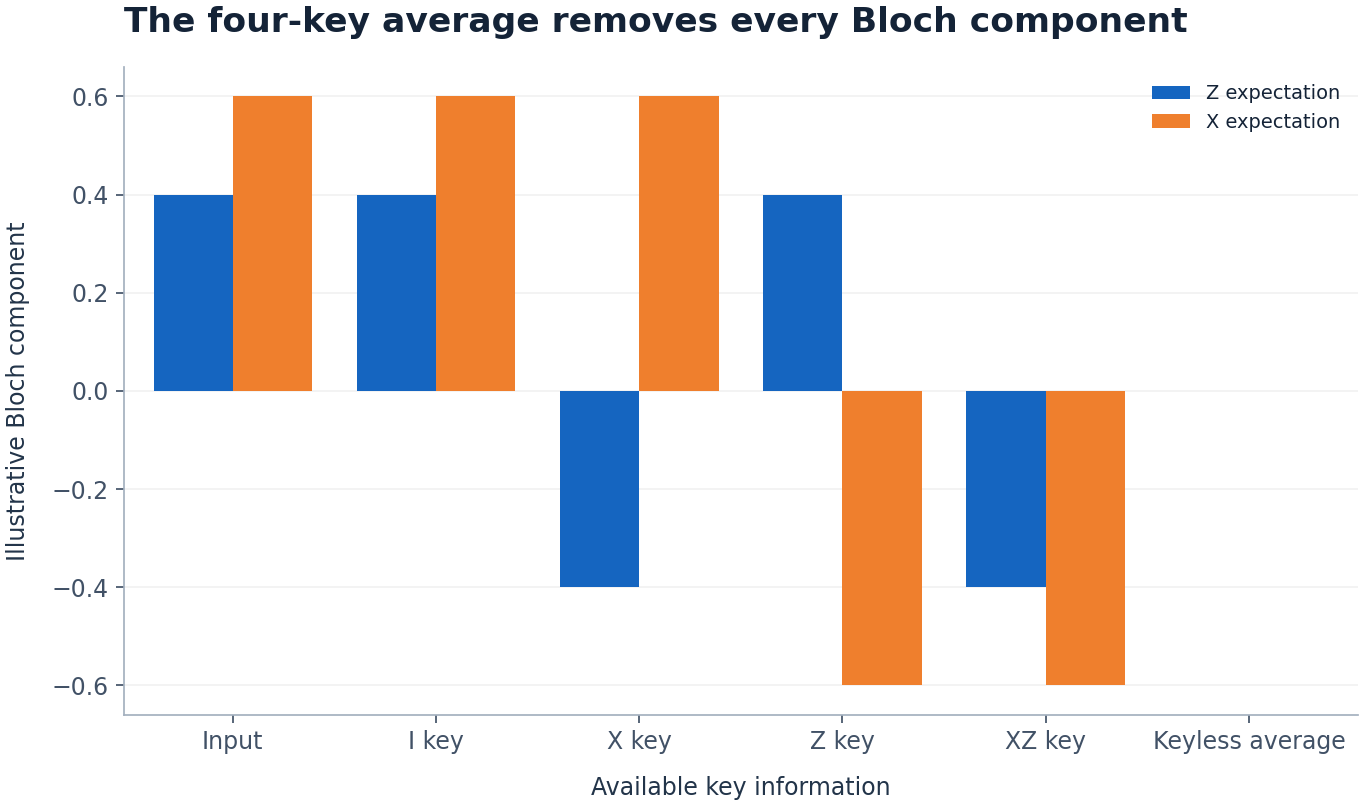
Inputs: Compare the original and Pauli-conditioned X and Z components for illustrative input X=0.6 and Z=0.4, then the uniform four-key average. Only these two components are plotted.
X-key signs: X unchanged, Z reversed; Z-key signs: X reversed, Z unchanged; the uniform I/X/Z/XZ average gives zero for both plotted components.
| Available key information | Z expectation | X expectation |
|---|---|---|
| Input | 0.4 | 0.6 |
| I key | 0.4 | 0.6 |
| X key | -0.4 | 0.6 |
| Z key | 0.4 | -0.6 |
| XZ key | -0.4 | -0.6 |
| Keyless average | 0 | 0 |
The useful distinction is between the state conditioned on knowing the key and the state available to an observer who lacks it. Randomization does not make the intended receiver forget the message; it changes the adversary’s available description. The security statement should therefore name the key assumptions and the information available to each party.
The tempting conclusion: A familiar-looking probability or resource count establishes the broader claim without checking its model.
What follows instead: Encryption alone does not prove that the received state was not altered. Confidentiality and integrity answer different questions.
It is a quantum-state encryption primitive. Post-quantum cryptography usually means classical algorithms designed to resist quantum attacks. The terms identify different technologies.
No. Confidentiality alone does not automatically provide authentication or integrity. Those properties require their own protocol and proof.
No. A hardware photograph can show apparatus. The state transformation needs an explicitly explanatory diagram and a stated model.
Both operations leave zero unchanged, so the average is still the zero projector. The two-operation scheme does not hide arbitrary inputs. The full four-Pauli average removes all three Bloch components.
Follow the complete derivation and reference calculation →
Primary scientific context for an original ideal teaching example. Source research checked 19 October 2026; site integration inspected 20 October 2026. These are different checks.
Source research checked . Teaching calculations are ideal models.
Encrypt a qubit by choosing uniformly among I, X, Z and XZ with a secret two-bit key. An observer without the key describes the ciphertext by averaging all four possibilities. The exercise concerns confidentiality of a one-qubit state under this ideal key model; it does not include authentication or key distribution.
The useful distinction is between the state conditioned on knowing the key and the state available to an observer who lacks it. Randomization does not make the intended receiver forget the message; it changes the adversary’s available description. The security statement should therefore name the key assumptions and the information available to each party.
Figure and table scope: Compare the original and Pauli-conditioned X and Z components for illustrative input X=0.6 and Z=0.4, then the uniform four-key average. Only these two components are plotted.
Derivation step 1: Write an arbitrary qubit density matrix or its Bloch-vector form. Conjugation by each Pauli operation changes selected signs of its nonidentity components.
Derivation step 2: Average the four conjugated matrices with weight one quarter. Every Bloch-vector component cancels and the result is I/2.
Derivation step 3: A receiver with the key applies the corresponding inverse and recovers the original state in the ideal model.
Derivation step 4: Reusing a key across messages creates a different security problem. Likewise, detecting a malicious alteration requires an authentication construction beyond this averaging argument.
Separate challenge: If the randomizer uses only I and Z on a zero-state input, what does a keyless observer see? Is that enough to hide every qubit?
Worked challenge answer: Both operations leave zero unchanged, so the average is still the zero projector. The two-operation scheme does not hide arbitrary inputs. The full four-Pauli average removes all three Bloch components.
X-key signs: X unchanged, Z reversed; Z-key signs: X reversed, Z unchanged; the uniform I/X/Z/XZ average gives zero for both plotted components.
Each case uses invented inputs. The results follow from this model and do not describe measured hardware.
| Reference | Prediction |
|---|---|
| Original declared example | All three Bloch-vector components cancel for a key-unknown observer. Given the selected Pauli operation, its inverse recovers the ideal input state up to an irrelevant global phase. |
| Available key information | Z expectation | X expectation |
|---|---|---|
| Input | 0.4 | 0.6 |
| I key | 0.4 | 0.6 |
| X key | -0.4 | 0.6 |
| Z key | 0.4 | -0.6 |
| XZ key | -0.4 | -0.6 |
| Keyless average | 0 | 0 |
The declared reference example predicts: All three Bloch-vector components cancel for a key-unknown observer. Given the selected Pauli operation, its inverse recovers the ideal input state up to an irrelevant global phase.
Try the reasoning: If the randomizer uses only I and Z on a zero-state input, what does a keyless observer see? Is that enough to hide every qubit?
Primary scientific context for an original ideal teaching example. Source research checked 19 October 2026; site integration inspected 20 October 2026. These are different checks.
Follow this topic in your RSS reader →
The final report distinguishes sensitive federal systems from the broader migration timetable.
The partners outline post-quantum work for Indian satellite platforms while leaving deployment schedules to future definition.
A cryptographic preprint offers a theoretical construction whose security depends on a post-quantum hardness assumption.
ML-DSA support starts with 1Password 8.12.44. Compatible websites are required and creation still has iOS and native macOS autofill limits.
Operation FlashHole illustrates an unexpected use for ML-KEM. The vendor’s disclosure concerns malware delivery, with activity evidence dating to July 2025.
New Database 19c guidance makes client compatibility and the negotiated connection central to the migration.
A historical-cipher study examines the acceptance rule inside Grover search. Its projected advantage is over random search, with no modern encryption break.
The workshop lists a paper on side-channel analysis. The public announcement is not evidence of a mathematical break of ML-KEM or an independently validated product claim.
Cloudflare’s PQC service is in closed beta. Its security boundary concerns where protected keys can be opened, while routing and traffic inspection remain separate controls.
The QSN announcement combines post-quantum cryptography, quantum key distribution and quantum randomness. Each addresses a different part of the security problem.
Black Kite has announced new third-party risk controls. Observable encryption signals are a starting point, not a complete security verdict.
A scan of 136,711 app binaries found little detectable post-quantum code. That measures one layer of a connection, with important limits.
Separate three questions: what was standardized, what was deployed and what evidence supports an attack claim. A change in one does not answer the other two.
Check NIST’s current status record. Source checked 24 September 2026.
A useful briefing sentence: “The source reports this specification milestone. Our deployment status and the evidence for any attack claim need separate checks.” This is a discussion aid, not an assessment of your systems or a migration plan.
Post-quantum cryptography runs on classical systems. It addresses attacks that include those enabled by a sufficiently capable quantum computer. It differs from quantum key distribution and quantum-generated randomness. A key-encapsulation mechanism establishes shared key material. A digital signature supports authentication and integrity; it does not make the signed message secret.
| Record | Role | Status |
|---|---|---|
| ML-KEM · FIPS 203 | Key encapsulation | Final · 13 August 2024 |
| ML-DSA · FIPS 204 | Digital signature | Final · 13 August 2024 |
| SLH-DSA · FIPS 205 | Stateless hash-based digital signature | Final · 13 August 2024 |
| FALCON · FIPS 206 work | Digital signature | In development |
| HQC | Key establishment | Selected for standardization · 11 March 2025 |
NIST’s FIPS 203 and 204 records include potential-update notes; their listed standards remain final. Check each original record for current errata.
A final algorithm standard, a protocol profile, a validated implementation and a completed deployment are different milestones. An announcement should identify which layer it covers. The claim and evidence records show how to keep a reported result with its conditions.
What this supports NIST approved FIPS 203, 204 and 205 in August 2024. They specify post-quantum key-establishment and digital-signature schemes. This is a standards milestone: a precise record of which specifications were published and when.
What it does not establish That announcement does not establish that an organization has migrated its systems or that a quantum attack has occurred. Selection, a draft and a final standard also describe different stages. Check the authority’s current record before repeating a status claim.
A standard, a deployment and an attack are different claims

What this supports: NIST approved FIPS 203, 204 and 205 in August 2024. They specify post-quantum key-establishment and digital-signature schemes. This is a standards milestone: a precise record of which specifications were published and when.

What it does not establish: That announcement does not establish that an organization has migrated its systems or that a quantum attack has occurred. Selection, a draft and a final standard also describe different stages. Check the authority’s current record before repeating a status claim.

NIST: Approval of FIPS 203, 204 and 205 (13 August 2024): https://csrc.nist.gov/News/2024/postquantum-cryptography-fips-approved

NIST: Post-quantum standardization status (Page updated 5 August 2026): https://csrc.nist.gov/Projects/Post-Quantum-Cryptography/Post_Quantum_Cryptography-Standardization

Context: https://qubitwire.com/topics/post-quantum-security#reality-card-standards

Source check: 24 September 2026. Version 1. Check the context link for updates.
Supplies equipment for distributing cryptographic keys and components for generating randomness. ID Quantique operates as an IonQ subsidiary following the May 2025 controlling-stake acquisition.
Research & evidence →Provides cryptographic building blocks that developers integrate into applications and devices to prepare for quantum-computer attacks. PQC runs on conventional computing hardware and does not require a quantum network.
Research & evidence →QuProtect discovers the cryptography used by network connections, manages algorithm changes and produces a cryptographic inventory. It applies post-quantum algorithms in conventional software.
Research & evidence →post-quantum security; AI-driven simulation; quantum sensing
Research & evidence →Selected organizations relevant to this topic. Inclusion is not a ranking.
Connected DMV introduces Rémi de La Vieuville’s discussion of AI, quantum cryptanalysis and post-quantum migration. The provider highlights changing attack-resource estimates and algorithm scrutiny; the recording does not establish that deployed cryptography has been broken.
View video details →IonQ CEO Niccolo de Masi presents the company’s resilience and full-stack strategy spanning compute, networking, sensing, security and manufacturing. Roadmap, performance and cryptography claims are IonQ’s, not independent validation.
View video details →Christopher Barnatt’s annual review brings several quantum-computing questions into one August 2026 overview: qubit technologies, cloud access, proposed applications and post-quantum cryptography. The creator also looks back across ten years of updates. Use the chapter markers to compare hardware progress with the separate question of what users can run today. Company roadmaps and application ambitions discussed in the video remain dated claims, not guaranteed delivery dates or proof that every proposed workload benefits from a quantum computer.
View video details →Qiskit walks through Shor's algorithm, phase estimation and a real-hardware factoring-15 demonstration. This is a pedagogical small-number example, not evidence that present quantum computers can threaten practical cryptography.
View video details →