Photonic quantum computing uses light to encode and process quantum information. Its engineering depends on sources, detectors, optical components and ways to connect them with sufficiently low loss.
A manufacturing milestone, a sampling experiment and a fault-tolerant computer demonstrate different things. Assess the complete optical system and its error assumptions, including the resources needed to turn physical components into useful logical operations.
Ask which attempts are counted
In a deliberately synthetic example, 100 attempts produce 50 accepted events, of which 49 pass a stated test. Acceptance is 50%; the pass fraction among accepted events is 98%; the pass fraction among all attempts is 49%. These are different denominators, and none is automatically quantum-state fidelity. Keep the acceptance rule with the metric. Use the claim-comparison worksheet to retain those conditions.
The detector is where an optical story becomes a record
Follow four separate jobs: source, optical route, detector and recorded outcome. Detector efficiency, false counts, timing, wavelength and temperature must keep their test conditions attached. Peak values measured in different conditions cannot be combined into one fictional specification.
NIST’s detector overview explains why these tradeoffs matter. It is general technology context, not a measured specification for a manufacturer’s proposed process. A warm optical pathway also does not imply that every detector operates without cooling.
Source prepares light
Route carries the relevant signal
Detector responds under stated conditions
Record supports the analysis
A question to carry forward: Was the reported number measured for a component, a complete optical route, or a computational task?
Light does not automatically mean quantum computing
Optical systems can perform useful classical processing. Quantum photonics depends on specific states, transformations and measurements, not merely on using lasers or waveguides.
This distinction makes both fields easier to appreciate without treating every optical-computing announcement as a quantum breakthrough.
Photonic hardware performs several different jobs. These examples show where a reported result belongs. They are separate experiments and technologies, not interchangeable parts of one machine.
A cavity changes photon emission from a quantum dot to improve interference between successively emitted photons.
Conditions and limits
Interference visibility describes how well photons behave alike in that test. Keep excitation, collection and acceptance conditions with the result.
Not established: Visibility, brightness, collection efficiency and computational success are different quantities. A source demonstration does not establish a complete quantum processor.
NIST explains how absorbing a photon changes the resistance of a cooled nanowire, producing an electrical signal.
Conditions and limits
Efficiency, wavelength, false counts, timing, recovery and photon-number resolution are separate specifications. Compare each under its stated conditions.
Not established: This is a technology explanation, not a specification for every commercial detector. A detector supplier is not automatically a universal quantum-computer provider.
NIST page update date; general detector technology context.
A programmable 12-mode interferometer processes single photons. The gate experiments encode information in optical paths.
Conditions and limits
The experiments use probabilistic protocols. Their heralding and postselection rules determine which attempts contribute to each reported result.
Not established: An interferometer that implements arbitrary transformations across its modes is not automatically a fault-tolerant universal quantum computer.
Source preparation, switching, links, measurement and decoding operated together in a small repetition-code experiment.
Conditions and limits
The demonstrator used crude approximations to the intended encoded optical states. Photon-number-resolving detectors required cooling.
Not established: The intended fault-tolerant architecture remains a separate target. Optical loss was a barrier; a connected demonstration is not proof that all scale-up requirements are met.
A question to carry forwardDoes the evidence describe one component, a connected optical path, or a complete computational task?
Sources checked . This comparison explains published evidence; it does not report a new hardware test.
An October 15 four-photon interference study retains all four arrival times instead of compressing the measurement immediately into a single visibility number. Relative delays form a three-dimensional coincidence record, allowing timing windows to be reconsidered in analysis. Narrowing a window changes which detections count; a cleaner interference feature can come with fewer accepted events.
The paper also examines how window choice and scan method affect the comparison. Read visibility together with count rate, timing rules and accidental coincidences. Post-processing a selection does not by itself improve the physical source.
Try this question: Were the timing window and accepted-event rate reported alongside visibility?
Recent studies, explained in full. Each analysis keeps the measured result, the model and the remaining questions together.
Interfering a weak field can change which photon-number paths surviveA theoretical optical study uses coherent interference to reshape photon-number and temporal correlations.Read the full analysis
Quantum-optics theory · Source dated · Checked
An October 15 theoretical preprint studies resonance fluorescence combined with a phase-locked coherent field. In the model, varying their relative amplitude changes the structure of temporal entanglement through photon-number-selective interference. The authors analyze crossovers between time-bin and energy–time descriptions and associated correlation tests. This is a proposed optical mechanism, not a new experiment or a loophole-free Bell demonstration. Its central idea is that interference can suppress one photon-number contribution while leaving another, changing which joint detection histories dominate the observed state.[1]
Resonance fluorescence is light emitted by a driven quantum emitter. Its statistical structure can differ from that of a classical coherent field. Combining the two at a controlled relative phase is more than adding their intensities: probability amplitudes for indistinguishable alternatives can interfere. The result depends on which alternatives lead to the same measured outcome. If phase information is lost, the cross terms responsible for cancellation can average away. Maintaining a phase relation is therefore part of the physical mechanism, not a cosmetic detail about optical alignment.
Photon-number components respond differently because their amplitudes are not all proportional to one common field coefficient. A setting that cancels a single-photon contribution need not cancel the two-photon contribution. This can make pairs relatively prominent in a selected detection record. Relative prominence should remain distinct from absolute source brightness. Suppressing an unwanted outcome can improve the structure of the accepted state while reducing the total event rate. A useful source must eventually be assessed through both its conditional correlations and how often the relevant outcomes are produced.
An original amplitude example illustrates the limited algebraic point. Let two indistinguishable single-photon paths have amplitudes a and minus a. Their sum is zero, so that contribution vanishes. Let a two-photon outcome instead have amplitudes b and c; its total is b plus c and need not vanish at the same setting. These letters are schematic and do not reproduce the paper's state. The example demonstrates selective cancellation only. By itself it proves neither entanglement nor a particular photon-pair production probability.
Time-bin descriptions distinguish alternatives such as emission in an early or late interval. Energy–time descriptions emphasize coherent uncertainty in emission time and correlated temporal behavior over a broader window. The appropriate state description depends on preparation, timing resolution and the interference measurement being performed. Similar-looking coincidence fringes can therefore require different interpretations. Readers should ask which alternatives remain indistinguishable and what phase relates them, rather than assuming that every two-photon temporal correlation belongs to the same entanglement resource.
An entanglement test must also match the measured sample. Coincidence selection, finite windows and detector response can change which events enter the statistic. A theoretical violation calculated for an ideal accepted state is valuable, but an experimental claim needs to account for the way that state is identified. A loophole-free Bell conclusion requires additional conditions beyond a favorable model value. The distinction does not diminish the optical proposal; it keeps state engineering, correlation analysis and a stronger foundational certification from being treated as one interchangeable result.
The control knob has to be calibrated in amplitude and phase, while many instruments naturally report power or intensity. Those quantities are related but not identical: doubling a field amplitude changes an ideal intensity by a factor of four. Relative amplitude noise can move the system away from a cancellation point, and phase drift can turn destructive interference into incomplete suppression. A practical robustness analysis should therefore vary both quantities and report the resulting state quality and useful event rate over a realistic operating range.
The study offers a compact route to changing the structure of emitted light through coherent control of interfering pathways. The next informative experiment would resolve photon-number and temporal statistics while sweeping the calibrated field ratio and phase, then compare the complete outcome model with the data. Readers could see whether the predicted crossovers survive detector limitations and drift. That evidence would connect an elegant interference mechanism with a usable entanglement source, without confusing a selective theoretical cancellation with an already demonstrated universal optical capability.
Follow the physical idea, work through a declared example and keep the limits attached. Research dates appear with each guide and lab.
Mechanism guideTwo photons interfere only to the extent that their alternatives overlapWhat does a Hong–Ou–Mandel dip actually measure about two photons?
Source research checked . Teaching calculations are ideal models.
When one photon enters each input of an ideal balanced beam splitter, the probability of detecting one photon at each output depends on whether the two input photons are distinguishable in unobserved degrees of freedom. For perfectly overlapping pure single-photon modes, the coincidence amplitudes cancel. The photons emerge together in one output or the other. This Hong–Ou–Mandel effect is a two-photon interference phenomenon. It cannot be explained by assigning each photon an independent fifty-fifty path choice and adding the resulting classical probabilities.
Indistinguishability is a statement about the complete modes relevant to the experiment. Arrival time, spectrum, polarization and spatial profile can all label the alternatives. Matching the mean color and nominal arrival time is insufficient if the wave packets have different shapes or correlations with another system. In the ideal pure-mode calculation, the coincidence probability is one half of one minus the squared mode overlap. This equation gives the dip a precise interpretation, but only after stating the source, beam splitter and detection assumptions that make the overlap formula applicable.
A delay scan varies one component of distinguishability while leaving others nominally fixed. At a sufficiently large delay, the photons become distinguishable in time and the balanced single-photon model gives a coincidence probability of one half. Near overlap, coincidence suppression reveals interference. An incomplete dip can arise from temporal mismatch, polarization mismatch, spectral impurity, background counts, multiple photons or an imperfect splitter. It does not uniquely identify one defective component. A useful diagnosis changes one control at a time and measures the source and detector properties that otherwise remain hidden in the coincidence total.
Loss deserves a separate treatment. Symmetric loss can reduce the number of accepted coincidence events without changing the ideal conditional interference shape, while unequal or mode-dependent loss can alter the selected population. A high visibility obtained after strong filtering may describe a cleaner but much smaller subset of emitted photons. That can be valuable, but the success rate and filtering conditions belong beside the visibility. For an application requiring many synchronized photons, the cost of obtaining the selected modes can dominate. Conditional quality alone cannot establish the rate of useful many-photon operations.
The dip is also not a universal certificate of every desired quantum property. Under the stated single-photon model it probes overlap, and other measurements may be needed to establish state purity, entanglement or absence of unwanted photon-number components. A good interference measurement should state what was prepared and which coincidences were counted. Accidentals subtracted from a plot should be reported separately from raw counts. Otherwise readers cannot distinguish a directly observed contrast from a model-assisted estimate whose value depends on background assumptions.
Mode overlap is a joint property of the two arriving fields. A source can emit individually pure photons that still fail to match another source in polarization, temporal shape or spectral phase. Filtering can improve the overlap of the accepted photons while reducing how often usable events arrive. The comparison should therefore include both the conditional interference visibility and the accepted event rate. Background counts and multipair emission require their own model because they can change the observed coincidence floor without changing the overlap of the intended single-photon wave packets. A deep interference dip is evidence about the selected optical alternatives under the measurement conditions. It does not, by itself, certify every property of the sources or the complete communication link.
Follow the mechanism
Prepare one photon in each input and define the temporal, spectral, spatial and polarization modes under comparison.
Transform the two-photon amplitudes through the balanced beam splitter, retaining the exchange alternatives responsible for coincidence cancellation.
Vary a distinguishability control and calculate or measure how the mode overlap changes.
Separate raw coincidences, background, filtering losses and source photon-number contamination before attributing a measured dip to one mechanism.
Synthetic worked example
One pure photon per input, factorable mode overlap, balanced splitter
Calculated results under the declared teaching model
Calculated quantity
Synthetic result
overlap squared
0.6075
coincidence probability
0.19625
aligned coincidence probability
0.095
Synthetic pure-mode example: suppose temporal/spectral overlap squared is 0.81 and the polarizations differ by 30 degrees. If these degrees of freedom factor, total overlap squared is 0.81 cos²(30°)=0.6075. An ideal balanced beam splitter then gives coincidence probability (1-0.6075)/2=0.19625. Aligning polarization raises the overlap squared to 0.81 and lowers coincidence probability to 0.095. Neither value includes detector noise, loss, multi-pair emission or accidental-count subtraction. The improvement comes from making two alternatives less distinguishable, not from increasing either photon’s transmission probability. A real visibility measurement must establish which assumptions support this interpretation.
A distinction to keep
The tempting conclusion: A shallow interference dip uniquely proves a timing problem.
What follows instead: Timing is one possible cause. Polarization, mode shape, photon-number contamination and detection backgrounds can produce similar coincidence changes.
Compare the quantities
Quantity or decision
What it means
Mode overlap
Controls ideal single-photon coincidence suppression at a balanced splitter.
Raw coincidence contrast
Includes source, detector, background and selection effects present in the measured record.
Accepted photon rate
Counts how often suitable photons reach the interference experiment after filtering and losses.
Does each photon choose an output independently?
That classical model predicts coincidence probability one half regardless of overlap. Indistinguishable two-photon amplitudes interfere, changing the joint outcomes.
Why can equal arrival times still give a shallow dip?
Other degrees of freedom can distinguish the photons. Their spectra, polarizations, spatial profiles or correlations with unobserved systems may differ.
Does high visibility guarantee a useful many-photon rate?
No. Filtering and losses can improve a conditional subset while reducing the probability of delivering all required photons. Report accepted rates with the visibility.
Does the dip alone prove entanglement?
It establishes a particular interference observation under a source and detector model. Entanglement and photon-number purity require the measurements appropriate to those separate claims.
Before interpreting a result
A justified single-photon and splitter model.
Raw delay-scan counts plus any background correction.
Source purity, mode matching and accepted-rate information.
Two-photon interference probes overlap between complete alternatives. A dip becomes useful evidence when source assumptions, backgrounds and accepted rates are visible.
Two-photon interference at a balanced beam splitter reveals temporal indistinguishability. The overlap model assumes one photon in each input and explicitly excludes background and multi-pair events.
Mechanism guideA brighter heralded source can produce a less reliable single photonWhy does increasing pair-generation strength create a tradeoff between herald rate and photon-number quality?
Source research checked . Teaching calculations are ideal models.
A heralded photon source uses a detection event in one optical arm to announce that a partner photon may be available in another. The detector click supplies useful information, but its meaning depends on the photon-number distribution and detector response. A threshold detector reports that at least one photon was detected; it does not necessarily report that exactly one pair was created. Increasing source brightness can increase the click rate while increasing the fraction of clicks associated with multiple emitted pairs. The source must therefore be described by conditional state quality and accepted rate together.
For a simple single-mode pair source, an idealized two-mode squeezed state has a geometric distribution of pair number. The vacuum component is largest at weak generation, while higher pair numbers become more important as the squeezing parameter grows. A heralding click removes some uncertainty about whether any pair was emitted, but a threshold detector cannot separate one pair from two or more. Even with perfect detection, increasing the probability of nonvacuum emission also increases the multipair fraction in the heralded ensemble. This is a source-statistics effect, not merely detector dark noise.
Finite detection efficiency changes the selection again. A pulse containing several herald-arm photons has more opportunities to produce at least one detected photon than a pulse containing one. Consequently, the accepted click ensemble can be enriched in multipair events relative to the emitted nonvacuum ensemble. Calculating herald rate by multiplying only a one-pair probability by detector efficiency misses this contribution. The correct threshold-click probability sums over pair numbers, with each term weighted by the chance that at least one of its photons is detected. This is a small but revealing example of conditional sampling.
Photon-number quality is only one dimension. Spectral correlations can leave the heralded photon mixed even when exactly one pair was produced. Filters or carefully engineered generation can improve mode purity, but filtering may reduce the accepted rate. Loss in the signal arm can also turn a correctly heralded preparation into vacuum at the application input. These mechanisms should not be compressed into one undefined source efficiency. A useful specification identifies the reference plane, photon-number probabilities, spectral mode quality and timing behavior that matter to the intended interference or communication task.
Multiplexing offers an additional design choice: attempt generation in several modes or time slots and route a successful event to the application. It trades more hardware, switching and control for a higher delivery probability. The switches and buffers can add loss, and simultaneous heralds require a selection rule. A calculation that treats every herald as a perfectly delivered pure photon overstates the benefit. The complete accounting follows a photon from generation through herald detection, routing and final delivery, while keeping the conditional state associated with that path.
A herald is evidence conditioned on a detector response, and the response determines which source events are accepted. A threshold detector cannot distinguish one detected photon from several, so increasing brightness can raise the click rate while increasing the multipair fraction within accepted events. Improving detector efficiency changes that conditioning but does not automatically eliminate higher-order emission. Loss in the signal arm adds another stage: a one-pair source event can deliver vacuum, while a multipair event can sometimes deliver one photon. The useful state should therefore be specified at the point of use, with its vacuum, single-photon and multiphoton contributions separated. A rising herald counter is valuable only when those delivered-state properties satisfy the task that consumes the photon.
Follow the mechanism
Specify the emitted pair-number distribution and distinguish threshold detection from number-resolving detection.
For each pair number n, weight the source probability by 1-(1-η)^n, the chance of at least one herald detection.
Normalize the accepted ensemble to calculate its one-pair and multipair composition.
Propagate the selected state through spectral filtering, signal-arm loss and routing before describing the delivered photon.
Synthetic worked example
Single-mode geometric pair number with inefficient threshold heralding
Calculated results under the declared teaching model
Calculated quantity
Synthetic result
click low
0.012096774
one pair low
0.97216
click high
0.13043478
one pair high
0.736
Synthetic single-mode model: let P(n)=(1-λ)λⁿ and use a threshold herald detector of efficiency η=0.6 with no dark counts. Summing all n gives P(click)=λη/(1-λ+λη). The probability that a click came from exactly one pair is (1-λ)(1-λ+λη). At λ=0.02, the click probability is 0.0120968 and the one-pair fraction is 0.97216. At λ=0.2, the click probability rises to 0.130435 while the one-pair fraction falls to 0.736. These are source-conditional pair-number statements before signal-arm loss. They are not single-photon delivery fidelities or an experimental performance claim.
A distinction to keep
The tempting conclusion: The source with the largest click rate necessarily supplies the best single photons.
What follows instead: Higher click rate can include more multipair events or a different selected mode population. Compare the delivered conditional state and usable rate together.
Compare the quantities
Quantity or decision
What it means
Herald probability
How often the detection system announces an accepted event per attempted pulse.
Conditional one-pair fraction
How often an accepted event arose from exactly one emitted pair under the source model.
Delivered single-photon state
Includes signal loss, mode purity and routing at a specified application reference plane.
Does a threshold click mean exactly one photon arrived?
It means the detector registered at least one event under its response model. Multiple incident photons can produce the same classical click.
Why does inefficient heralding favor multipair events?
A multipair pulse supplies more herald-arm photons, so it has more chances to trigger the threshold detector. Conditioning on clicks changes the pair-number distribution.
Is one-pair generation enough to guarantee a pure photon?
No. Spectral or other entanglement with the herald arm can leave the partner in a mixed mode after an unresolved detection.
Can multiplexing remove every tradeoff?
It changes the architecture by adding attempts and routing. Switch loss, timing, mode compatibility and the selected conditional state still determine usable delivery.
Before interpreting a result
Herald detector response, efficiency and dark-count treatment.
Photon-number and spectral-mode characterization of accepted events.
Delivery losses and the application reference plane.
Heralding is conditional inference about a source. A useful click rate must be paired with the photon-number and mode quality actually delivered to the application.
Higher-order pair emission and detection conditions constrain heralded single-photon preparation. The geometric single-mode calculation is an original idealized example, not a fitted source characterization.
Mechanism guideTime-bin coherence depends on relative phase across the alternativesWhy can early and late photons share one fiber yet still require phase-stable analysis?
Source research checked . Teaching calculations are ideal models.
A time-bin qubit encodes information in two separated temporal modes, often described as early and late. An arbitrary state can contain both a relative amplitude and a relative phase between these modes. A direct arrival-time measurement distinguishes early from late, but it does not reveal that relative phase. To measure a superposition basis, an analyzer brings appropriate path-time alternatives into temporal overlap so that they interfere. Sharing a transmission fiber can make some disturbances common, but the complete preparation and analysis sequence must still preserve the phase relationship relevant to that interference.
The distinction between common phase and relative phase is essential. Multiplying both time-bin amplitudes by the same phase has no observable effect on the isolated qubit. Giving the early and late alternatives different phase shifts changes the encoded state. A slowly varying disturbance may be nearly common across a short bin separation, while a rapidly varying disturbance or unequal analyzer paths can produce a differential phase. The relevant stability is therefore not simply the absolute phase of one optical field at all times. It is the stability of the phase combination that enters the measured alternatives.
An unbalanced interferometer can overlap an early photon taking a long path with a late photon taking a short path. Those alternatives contribute to a central arrival-time slot. Other path-time combinations can arrive in earlier or later slots and may carry different information. If a protocol conditions on the central slot, the accepted fraction must be reported with its interference contrast. High contrast in a selected slot does not imply every emitted photon participated in that measurement. The timing selection belongs in the measurement definition, especially when comparing different analyzer designs.
Random phase fluctuations wash out interference when many trials are averaged. For a Gaussian differential-phase distribution, the average complex phase factor decreases exponentially with half its variance. The mean fringe visibility therefore reveals a combination of phase stability and other imperfections. A low contrast can also result from amplitude imbalance, mode mismatch or background, so it does not uniquely measure phase noise. A phase-stability experiment needs either independent characterization of these effects or a model that states which contributions are being combined. Visibility is an output statistic, not a complete diagnosis.
Stabilization and calibration introduce their own reference questions. A reference beam can monitor an interferometer phase, but its wavelength, path and timing must be related to those experienced by the quantum signal. A stable reference reading is useful only insofar as it tracks the relevant differential phase. Environmental changes that affect the reference and signal differently can remain. The report should identify which phase combination is sensed, how corrections are applied and what residual variation is observed on the quantum interference itself. This makes the link between engineering control and encoded information explicit.
The central detection slot contains alternatives that can interfere only when no available record distinguishes them. The early-long and late-short paths must overlap in every relevant mode at the analyzer. A common phase applied to both alternatives does not move their relative fringe, while a fluctuating differential phase reduces contrast after averaging. Conditioning on the central slot also changes the denominator: its interference visibility is a property of accepted events, not automatically the efficiency of the entire analyzer. The unmatched early and late slots still belong in a complete rate budget. A reliable report therefore identifies the interfering alternatives, the conditioning rule and the phase reference. Those details determine what coherence the observed fringe actually tests.
Follow the mechanism
Define early and late modes and distinguish their common phase from the physically encoded relative phase.
Track all path-time alternatives through the analyzer and identify which ones overlap in the accepted measurement slot.
Average the relative-phase factor over a stated noise distribution to predict the ideal contrast reduction.
Report timing acceptance, mode matching and residual quantum interference along with the stabilization reference.
Synthetic worked example
Balanced accepted time-bin interference with Gaussian differential phase
Inputs: sigma phi radians: [0.2, 0.8]
V=exp(-sigma_phi^2/2); Pplus=(1+V)/2
Calculated results under the declared teaching model
Calculated quantity
Synthetic result
visibility 0.2
0.98019867
plus probability 0.2
0.99009934
visibility 0.8
0.72614904
plus probability 0.8
0.86307452
Synthetic phase-jitter model: prepare balanced time-bin amplitudes and let the differential phase be Gaussian with mean zero and standard deviation σφ. In an ideal accepted superposition-basis measurement, visibility is V=exp(-σφ²/2) and P(+)= (1+V)/2. For σφ=0.2 radians, V=0.980199 and P(+)=0.990099. For σφ=0.8 radians, V=0.726149 and P(+)=0.863075. These probabilities are conditioned on the intended analyzer outcome window. The example omits background, loss and mode mismatch, and it does not claim that a particular passive analyzer accepts every incoming photon.
A distinction to keep
The tempting conclusion: Time-bin encoding eliminates the need to control phase.
What follows instead: It can reject some common disturbances, but relative phase in preparation, transmission and analysis remains part of the encoded information.
Compare the quantities
Quantity or decision
What it means
Arrival-time basis
Distinguishes early and late populations without directly measuring their relative phase.
Interference basis
Combines selected alternatives to reveal relative-phase information.
Phase-stability evidence
Relates a control reference and residual fluctuations to the exact phase combination used by the quantum signal.
Why does a common phase not move the fringe?
It multiplies both alternatives equally and cancels from their relative phase. The interference depends on phase differences between alternatives that reach the same outcome.
Does one fiber guarantee complete phase protection?
No. Disturbances can differ across bin times, and the analyzer can add differential phase. The complete phase combination must be stable.
What does central-slot conditioning change?
It selects the events associated with particular interfering alternatives. Its accepted fraction and discarded outcomes belong in the measurement’s efficiency and interpretation.
Can visibility alone measure phase jitter?
Only under a model that excludes or quantifies other contrast losses such as imbalance, mode mismatch and background. Otherwise several mechanisms produce the same observed reduction.
Before interpreting a result
A definition of the accepted timing windows and their probabilities.
Residual phase-sensitive interference after stabilization.
Mode balance, background and the relationship between reference and signal paths.
Time-bin information lives in relative amplitudes and phases. A clear analyzer account tracks every timing alternative, the accepted subset and the phase combination that must remain stable.
Coherent early and late creation alternatives support time-bin interference when analyzed appropriately. Gaussian phase jitter and synthetic visibility are teaching assumptions, not source measurements or a security proof.
Mechanism guideAn interference experiment can lose its pattern when the path leaves a traceWhy does information about a path change what a detector sees?
Source research checked . Teaching calculations are ideal models.
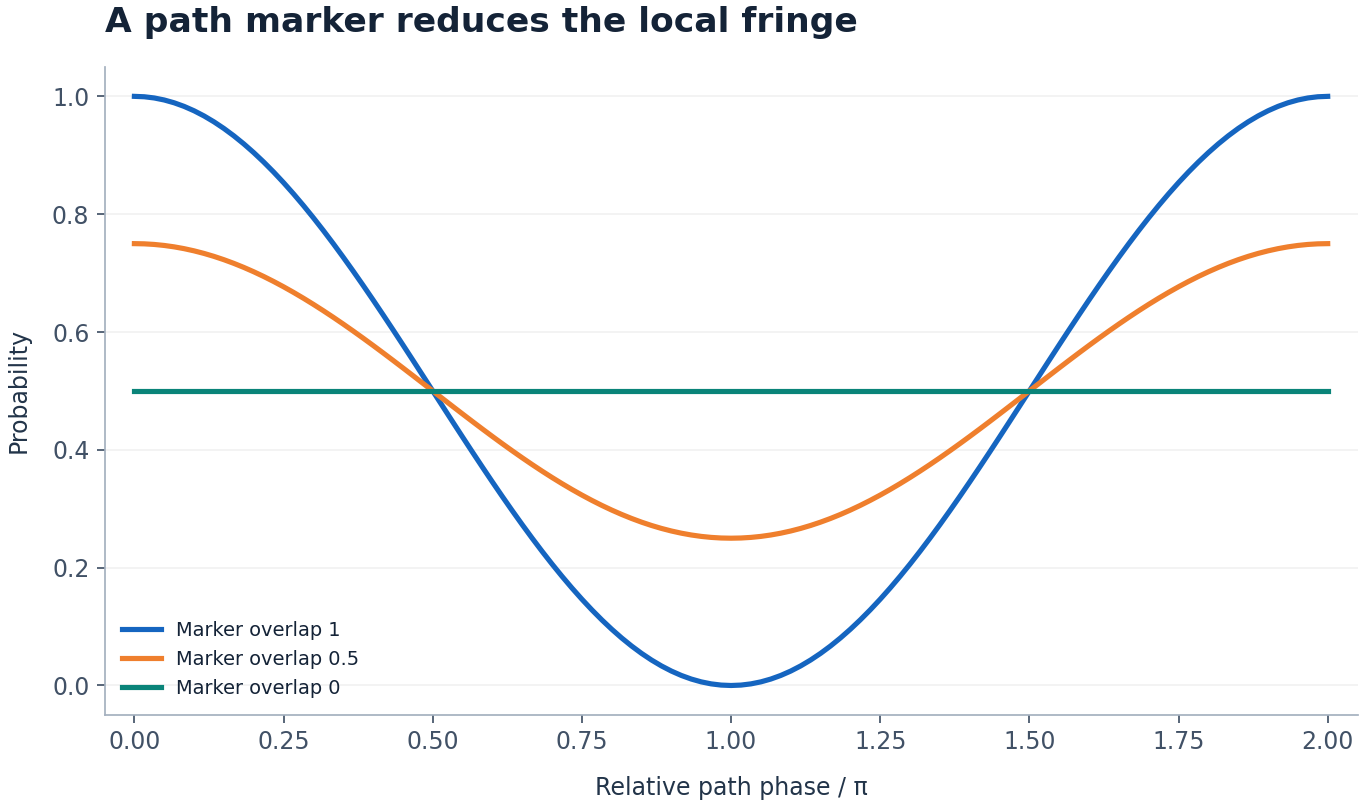
A two-path experiment becomes easier to understand when the path is treated as part of a larger system. If nothing else distinguishes the two alternatives, their amplitudes can combine into a clear interference pattern. If each path leaves a different state in a marker or environment, the alternatives become correlated with something outside the measured path degree of freedom. The pattern can weaken even when nobody reads the marker. The important event is the physical correlation, not a person's awareness of it. This makes a particularly useful visual explanation for readers who have encountered vague claims that consciousness creates quantum outcomes.
Write the combined state as an equal superposition of path zero with marker a and path one with marker b. The interference term in a path-only measurement is multiplied by the overlap between the marker states. Identical markers leave the full ideal coherence available. Orthogonal markers remove that term from the reduced path description. Intermediate overlap gives intermediate visibility under the symmetric ideal assumptions. The analysis does not require a classical record to be inspected. It requires that the marker states can carry information distinguishing the alternatives. Recovering interference in a conditional subensemble is a different task from restoring an unconditional pattern across all trials.
The marker-overlap parameter can change while both path populations remain fixed. The resulting interference contrast exposes the change in coherence. This overlap is an abstract parameter of the teaching model, not a physical control available in every optical setup. For a claim about recovered interference, identify the sorting rule, the retained fraction of trials and whether the unconditioned dataset changes. These distinctions clarify environmental disturbance, quantum erasers and which-path experiments without implying that a later choice rewrites an earlier measurement record.
An interference demonstration may sort its data according to a later marker measurement. A selected subensemble can reveal a pattern that disappears when all outcomes are combined. The selection rule is part of the analysis, so a picture of the selected pattern should travel with the probabilities of the selections and the full unsorted record.
This offers a disciplined way to discuss quantum eraser-style claims. Ask which systems carry path information, how strongly their marker states overlap and which outcomes were retained for the displayed plot. A conditional fringe does not by itself imply that a distant observer changed an already available unconditional record. In the present model, the marker overlap controls the coherence visible in the reduced path state. The original calculation is deliberately narrow, but its bookkeeping is broadly useful: always distinguish the joint state, the reduced state and the statistics after an explicitly stated selection.
Synthetic worked example
A path marker reduces the local fringe
Inputs: Sweep relative path phase φ from 0 to 2π. The plotted real nonnegative marker overlaps are fixed separately at r=1, 1/2 and 0.
P(port zero)=(1+r cos φ)/2 for the stated balanced-path model.
Calculated results under the declared teaching model
Relative path phase / π
Marker overlap 1
Marker overlap 0.5
Marker overlap 0
0
1
0.75
0.5
0.25
0.8535533905932737
0.6767766952966369
0.5
0.5
0.5
0.5
0.5
0.75
0.14644660940672627
0.32322330470336313
0.5
1
0
0.25
0.5
1.25
0.14644660940672616
0.3232233047033631
0.5
1.5
0.4999999999999999
0.49999999999999994
0.5
1.75
0.8535533905932737
0.6767766952966369
0.5
2
1
0.75
0.5
Information can leave a subsystem through correlations even when nobody has consciously read a detector. The operational question is which systems and outcomes the final analysis retains. Conditional subensembles can show patterns that disappear when all marker outcomes are combined. The bookkeeping matters more than a story about observation by a person.
A distinction to keep
The tempting conclusion: A familiar-looking probability or resource count establishes the broader claim without checking its model.
What follows instead: Loss of a local fringe does not imply that the global joint state has become classical or that information has been destroyed everywhere.
Must a person look at the marker?
No. Physical correlations with a distinguishable marker are enough to change the reduced path statistics. Awareness is not a variable in this calculation.
Can a quantum eraser change the past?
Conditional sorting can reveal correlations among recorded outcomes. The complete unconditioned earlier record is not rewritten by a later choice.
Does a faint fringe prove a quantum computer works?
No. A fringe is evidence for a defined interference experiment. Computing claims need the relevant gates, control, errors and task performance.
At c=0.4, find the largest and smallest zero probabilities. Calculate visibility using (maximum-minimum)/(maximum+minimum).
The probabilities range from 0.3 to 0.7. Their difference is 0.4 and sum is one, so visibility is 0.4. This equality relies on equal path weights and the stated model; unequal weights require a revised expression.
Primary scientific context for an original ideal teaching example. Source research checked 19 October 2026; site integration inspected 20 October 2026. These are different checks.
Primary scientific context for an original ideal teaching example. Source research checked 19 October 2026; site integration inspected 20 October 2026. These are different checks.
Mechanism guideSome quantum computers do their work by measuring a prepared webHow can measurements help perform a computation?
Source research checked . Teaching calculations are ideal models.
Measurement is often introduced as the last step that ends a quantum calculation. In measurement-based quantum computing, carefully chosen measurements are part of the computation itself. The process starts with an entangled resource state. Local measurement choices, together with classical handling of their outcomes, steer the logical transformation. This perspective can make photonic and cluster-state roadmaps much clearer to a newcomer. The important resource is not merely a large number of entangled objects. It is a structured state that can be prepared, measured and controlled in the way the intended calculation requires.
A small one-step example starts with an input qubit, a second qubit in plus and an entangling controlled-Z. Measuring the first qubit in an appropriate equatorial basis transfers a transformed version of the input to the second, up to an outcome-dependent correction. The measurement outcome is random, but the known correction or an updated frame keeps the logical operation interpretable. Chaining these primitives produces a computation whose later measurement choices can depend on earlier outcomes. The apparent consumption of measured qubits is part of the design. A full practical architecture must supply resource states, manage loss and maintain the classical feedforward path.
A chain of resource-state nodes can be consumed by successive measurements while a classical record carries the outcomes needed for correction. This graph is an abstract state pattern, not a wiring photograph. It helps explain why a photonic roadmap might emphasize source quality, fusion, detection and feedforward rather than an array of stationary gates. Ask which states have been produced, which measurements are available, which correction rule is used and how errors accumulate across the whole pattern. A resource-state result needs a connection to the computation it can support.
A convenient test state can make an incorrect implementation look successful. In the one-bit teleportation circuit, some inputs leave the two branches equivalent up to a global phase even if the X correction is omitted. Testing only one of those special cases would miss the control error.
Use a generic state or the plus input as well. Keep the measurement outcome and verify the appropriate corrected state in each branch, rather than checking only an average histogram. This is a practical lesson about quantum software validation: a test should be sensitive to the operation it is meant to check. The circuit also illustrates why a random measurement does not imply an uncontrolled final result. The recorded outcome identifies a known adjustment or frame update. A larger implementation must carry that record consistently and account for resource preparation and noise, but the small example makes the classical control obligation visible.
Synthetic worked example
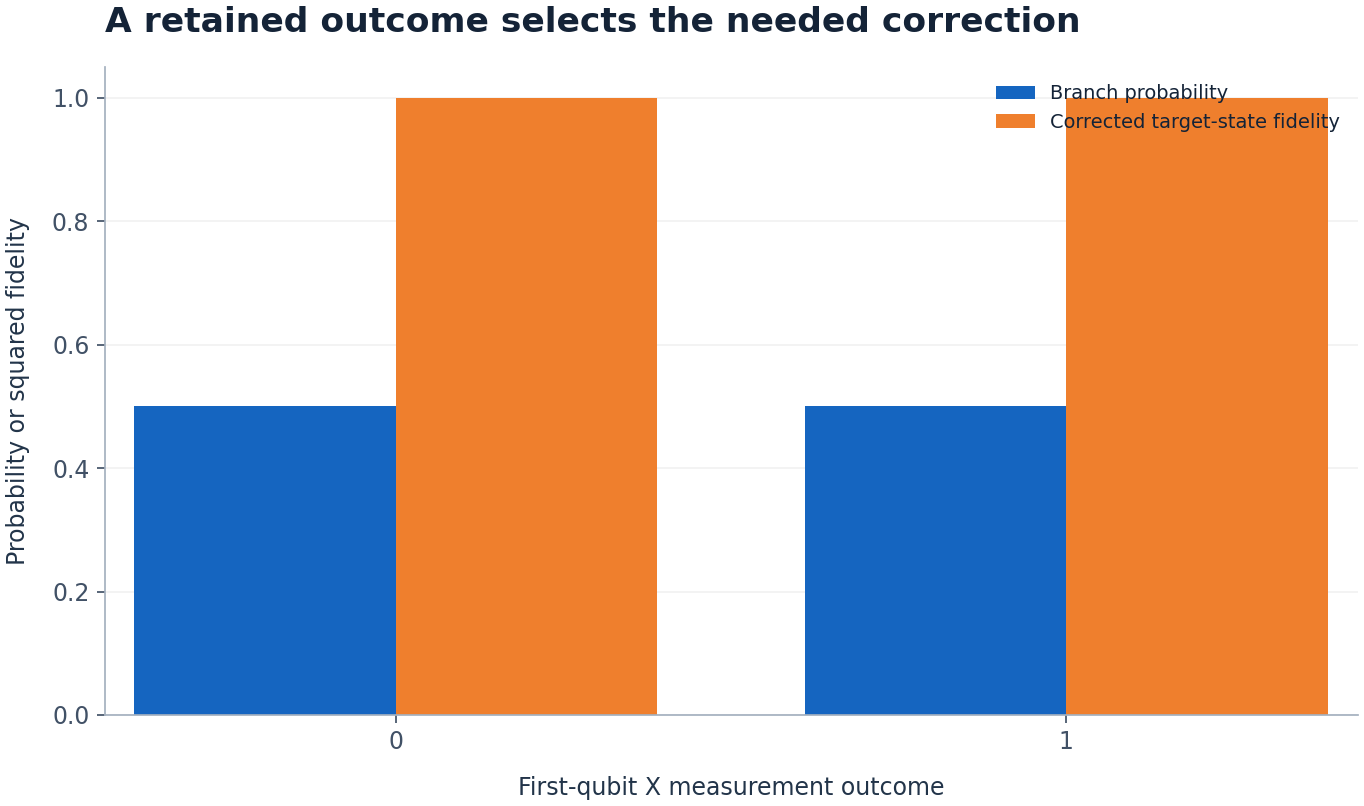
A retained outcome selects the needed correction
Inputs: Compare the two X-measurement branches of ideal one-bit teleportation for an arbitrary normalized pure input, retaining the outcome and applying its correction. These branch probabilities and corrected fidelities are input independent in this model.
P(m)=1/2; conditional output=X^m H|ψ>; after the X^m correction the squared fidelity with H|ψ> is 1.
Calculated results under the declared teaching model
First-qubit X measurement outcome
Branch probability
Corrected target-state fidelity
0
0.5
1
1
0.5
1
The random measurement result does not make the computational output uncontrollable. It determines a known correction. The crucial resource is a prepared entangled state plus classical information about the outcome. This two-qubit example explains the mechanism without suggesting that every measurement angle or larger cluster can be handled by the same single correction rule.
A distinction to keep
The tempting conclusion: A familiar-looking probability or resource count establishes the broader claim without checking its model.
What follows instead: Ignoring the measurement record and averaging both branches can erase the useful output. Random outcomes and deterministic corrected computation are compatible because the record is retained.
Does a random measurement make the computation random?
The physical outcome is random, but the protocol tracks the resulting byproduct and compensates appropriately. The intended logical operation can remain well defined.
Are graph edges always cables?
No. They often represent entanglement relations in an abstract resource state. Physical implementations can create those relations in different ways.
Does a large cluster prove fault tolerance?
No. Resource quality, loss handling, measurements, decoding and sustained logical operations all need evidence for the proposed architecture.
For input zero, calculate both conditional outputs before correction. Do they agree after applying the stated correction?
H|0> is plus. The m=0 branch is plus and the m=1 branch is X|+>, which is also plus. For this special input the correction has no visible effect. Test a generic input or input plus as well so this coincidence does not hide a coding mistake.
Primary scientific context for an original ideal teaching example. Source research checked 19 October 2026; site integration inspected 20 October 2026. These are different checks.
Photonics and sensingMore detector clicks can mean fewer clean single eventsHow many parallel channels help when the target is exactly one real signal?
Source research checked . Teaching calculations are ideal models.
Multiplexing creates more opportunities for a useful event, but it also creates more opportunities for extra signals and background clicks. Whether that is a benefit depends on the accepted event class. An experiment that needs one clean signal asks a different probability question from an experiment that counts any detector activity.
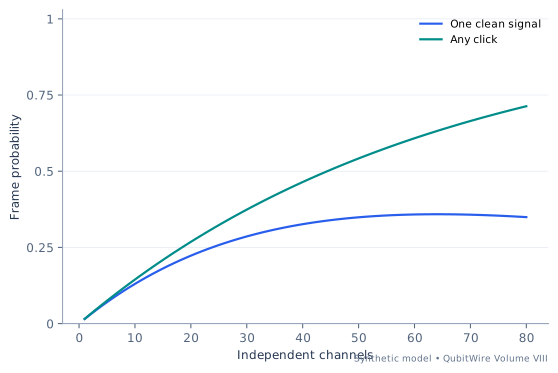
The model assigns every channel independent signal and background probabilities. It calculates exactly one signal with no backgrounds, any click of any origin, and background-only click frames. These quantities can move in different directions as more channels are added. A scan selects the largest clean-event probability within a declared range while keeping the much broader click probability visible.
The distinction is especially useful in an article about photon sources, heralded operations or detector arrays. A model can know the latent origin of every event while a real detector cannot. The clean-event calculation therefore does not assert that all clean events can be selected perfectly, or that false backgrounds can be identified in the data. That gap requires an explicit detection and validation model.
Synthetic decision model
Start with the assumptions
Signals and backgrounds are independent across and within channels.
A frame contains one binary opportunity of each type per channel.
Exactly one signal and no background defines the target class.
P(exactly one signal, no background) = m s (1-s)^(m-1)(1-b)^m
P(any click) = 1-(1-s)^m(1-b)^m
P(background only) = (1-s)^m[1-(1-b)^m]
Synthetic baseline case. Horizontal axis: Independent channels. Vertical axis: Frame probability. Curves show One clean signal, Any click. These are computed teaching examples, not measured hardware results.
Compare the input regimes
Each case uses invented inputs. The results follow from this model and do not describe measured hardware.
Baseline regime
Complete inputs
Signal probability per channel
0.015
Background probability per channel
0.0005
Maximum channels
80
Frames per second
1000
Exactly one signal among m independent channels has probability m s (1-s)^(m-1). Require zero independent backgrounds by multiplying by (1-b)^m.
The scan over 1 to 80 channels peaks at m = 64, with clean-event probability 0.3588.
Any click has probability 0.631856, which also includes unwanted multiplets and backgrounds. Background-only frames account for 1.895079% of click frames.
Baseline regime · synthetic calculated results
Calculated quantity
Synthetic result
Best tested channel count for one clean signal
64
One-signal, no-background probability
0.35880034788423176
Any-click probability at that channel count
0.631855893056283
Background-only probability
0.011974169898660951
Background-only share of all click frames
0.018950792467475403
Clean single-signal frames per second
358.80034788423177
The useful model rate is 358.800348 frames per second at 64 channels. More clicks do not necessarily mean more single-signal events. This calculation assumes the desired event class is physically meaningful; it does not assert that an ordinary detector can identify and reject every background-only frame.
Comparison regime
Complete inputs
Signal probability per channel
0.045
Background probability per channel
0.0025
Maximum channels
80
Frames per second
3500
Exactly one signal among m independent channels has probability m s (1-s)^(m-1). Require zero independent backgrounds by multiplying by (1-b)^m.
The scan over 1 to 80 channels peaks at m = 21, with clean-event probability 0.357002.
Any click has probability 0.639221, which also includes unwanted multiplets and backgrounds. Background-only frames account for 3.046199% of click frames.
Comparison regime · synthetic calculated results
Calculated quantity
Synthetic result
Best tested channel count for one clean signal
21
One-signal, no-background probability
0.3570016568785008
Any-click probability at that channel count
0.6392205478106157
Background-only probability
0.01947193166197464
Background-only share of all click frames
0.030461992701373022
Clean single-signal frames per second
1249.5057990747528
The useful model rate is 1,249.505799 frames per second at 21 channels. More clicks do not necessarily mean more single-signal events. This calculation assumes the desired event class is physically meaningful; it does not assert that an ordinary detector can identify and reject every background-only frame.
Extended regime
Complete inputs
Signal probability per channel
0.081
Background probability per channel
0.0049
Maximum channels
80
Frames per second
6500
Exactly one signal among m independent channels has probability m s (1-s)^(m-1). Require zero independent backgrounds by multiplying by (1-b)^m.
The scan over 1 to 80 channels peaks at m = 11, with clean-event probability 0.362716.
Any click has probability 0.625885, which also includes unwanted multiplets and backgrounds. Background-only frames account for 3.318567% of click frames.
Extended regime · synthetic calculated results
Calculated quantity
Synthetic result
Best tested channel count for one clean signal
11
One-signal, no-background probability
0.3627160777397321
Any-click probability at that channel count
0.6258854372134526
Background-only probability
0.02077042648041057
Background-only share of all click frames
0.03318566824766527
Clean single-signal frames per second
2357.6545053082586
The useful model rate is 2,357.654505 frames per second at 11 channels. More clicks do not necessarily mean more single-signal events. This calculation assumes the desired event class is physically meaningful; it does not assert that an ordinary detector can identify and reject every background-only frame.
Try the reasoning: Why can the any-click probability keep rising after the probability of exactly one clean signal has peaked?
Quantum information foundationsAn interference fringe remembers the path markerWhy does information about a path change what a detector sees?
Source research checked . Teaching calculations are ideal models.
A two-path system becomes correlated with two possible marker states. Choose equal path amplitudes and a marker overlap c that is real and nonnegative for this simple model. A controllable phase φ is added before recombination. The exercise tracks the joint state before considering what happens when the marker is ignored.
Information can leave a subsystem through correlations even when nobody has consciously read a detector. The operational question is which systems and outcomes the final analysis retains. Conditional subensembles can show patterns that disappear when all marker outcomes are combined. The bookkeeping matters more than a story about observation by a person.
Figure and table scope: Sweep relative path phase φ from 0 to 2π. The plotted real nonnegative marker overlaps are fixed separately at r=1, 1/2 and 0.
Derivation step 1: Write the joint state as [|0>|m0>+exp(iφ)|1>|m1>]/√2. The marker states have overlap c=<m0|m1>.
Derivation step 2: Trace out the marker. The path density matrix keeps diagonal entries one half, while the off-diagonal coherence is multiplied by the marker overlap.
Derivation step 3: Recombine the paths with a Hadamard. The zero probability is [1+c cos φ]/2 for the chosen real-overlap convention.
Derivation step 4: The fringe visibility is c in this ideal family. Orthogonal marker states remove the local fringe when the marker is ignored; identical marker states preserve full contrast.
Separate challenge: At c=0.4, find the largest and smallest zero probabilities. Calculate visibility using (maximum-minimum)/(maximum+minimum).
Worked challenge answer: The probabilities range from 0.3 to 0.7. Their difference is 0.4 and sum is one, so visibility is 0.4. This equality relies on equal path weights and the stated model; unequal weights require a revised expression.
Synthetic decision model
Start with the assumptions
Balanced paths, pure markers, ideal recombination and no additional dephasing. Visibility is not a universal substitute for entanglement or a complete state description.
P(port zero)=(1+r cos φ)/2 for the stated balanced-path model.
Sweep relative path phase φ from 0 to 2π. The plotted real nonnegative marker overlaps are fixed separately at r=1, 1/2 and 0. Original ideal teaching calculation. Not measured hardware data.
Compare the input regimes
Each case uses invented inputs. The results follow from this model and do not describe measured hardware.
Reference example with separately scoped figure
Complete inputs
reference scenario
Use equally weighted paths and pure normalized marker states with overlap magnitude c. Compare c=1, c=1/2 and c=0.
separate figure scope
Sweep relative path phase φ from 0 to 2π. The plotted real nonnegative marker overlaps are fixed separately at r=1, 1/2 and 0.
Reference example with separately scoped figure · synthetic calculated results
Reference
Prediction
Original declared example
The ideal visibilities are 1, 1/2 and 0 while the path populations remain 1/2 each. The example isolates the marker-overlap effect from unequal intensity and detector noise.
Separate figure table: Sweep relative path phase φ from 0 to 2π. The plotted real nonnegative marker overlaps are fixed separately at r=1, 1/2 and 0.
Relative path phase / π
Marker overlap 1
Marker overlap 0.5
Marker overlap 0
0
1
0.75
0.5
0.25
0.8535533905932737
0.6767766952966369
0.5
0.5
0.5
0.5
0.5
0.75
0.14644660940672627
0.32322330470336313
0.5
1
0
0.25
0.5
1.25
0.14644660940672616
0.3232233047033631
0.5
1.5
0.4999999999999999
0.49999999999999994
0.5
1.75
0.8535533905932737
0.6767766952966369
0.5
2
1
0.75
0.5
The declared reference example predicts: The ideal visibilities are 1, 1/2 and 0 while the path populations remain 1/2 each. The example isolates the marker-overlap effect from unequal intensity and detector noise.
Try the reasoning: At c=0.4, find the largest and smallest zero probabilities. Calculate visibility using (maximum-minimum)/(maximum+minimum).
Primary scientific context for an original ideal teaching example. Source research checked 19 October 2026; site integration inspected 20 October 2026. These are different checks.
Primary scientific context for an original ideal teaching example. Source research checked 19 October 2026; site integration inspected 20 October 2026. These are different checks.
Quantum information foundationsA measurement moves a quantum state through a tiny clusterHow can measurements help perform a computation?
Source research checked . Teaching calculations are ideal models.
Place an arbitrary input |ψ>=a|0>+b|1> on the first qubit and plus on the second. Apply controlled-Z, then measure the first qubit in the X basis. The conditional state of the remaining qubit illustrates one-bit teleportation, a primitive used in measurement-based computation.
The random measurement result does not make the computational output uncontrollable. It determines a known correction. The crucial resource is a prepared entangled state plus classical information about the outcome. This two-qubit example explains the mechanism without suggesting that every measurement angle or larger cluster can be handled by the same single correction rule.
Figure and table scope: Compare the two X-measurement branches of ideal one-bit teleportation for an arbitrary normalized pure input, retaining the outcome and applying its correction. These branch probabilities and corrected fidelities are input independent in this model.
Derivation step 1: After controlled-Z, the joint state is a|0>|+>+b|1>|->.
Derivation step 2: Projecting the first qubit onto plus gives an unnormalized remaining state (a|+>+b|->)/√2 = H|ψ>/√2.
Derivation step 3: Projecting onto minus gives (a|+>-b|->)/√2 = XH|ψ>/√2. Each outcome has probability one half for a normalized input.
Derivation step 4: With outcome bit m, the remaining state is X^m H|ψ>. Apply X^m, or track it consistently in a Pauli frame, to obtain the intended H|ψ> output.
Separate challenge: For input zero, calculate both conditional outputs before correction. Do they agree after applying the stated correction?
Worked challenge answer: H|0> is plus. The m=0 branch is plus and the m=1 branch is X|+>, which is also plus. For this special input the correction has no visible effect. Test a generic input or input plus as well so this coincidence does not hide a coding mistake.
Synthetic decision model
Start with the assumptions
Ideal two-qubit resource, ideal X measurement and known outcome. This primitive is not a complete fault-tolerant cluster-state architecture.
P(m)=1/2; conditional output=X^m H|ψ>; after the X^m correction the squared fidelity with H|ψ> is 1.
Compare the two X-measurement branches of ideal one-bit teleportation for an arbitrary normalized pure input, retaining the outcome and applying its correction. These branch probabilities and corrected fidelities are input independent in this model. Original ideal teaching calculation. Not measured hardware data.
Compare the input regimes
Each case uses invented inputs. The results follow from this model and do not describe measured hardware.
Reference example with separately scoped figure
Complete inputs
reference scenario
Prepare an arbitrary input on qubit A and plus on qubit B. Apply controlled-Z and measure A in the X basis.
separate figure scope
Compare the two X-measurement branches of ideal one-bit teleportation for an arbitrary normalized pure input, retaining the outcome and applying its correction. These branch probabilities and corrected fidelities are input independent in this model.
Outcome m in {0,1}: output on B is X^m H|psi>, up to normalization and a global phase.
Reference example with separately scoped figure · synthetic calculated results
Reference
Prediction
Original declared example
The logical Hadamard is transferred to the remaining qubit. The outcome selects whether an X correction or an equivalent frame update is needed.
Separate figure table: Compare the two X-measurement branches of ideal one-bit teleportation for an arbitrary normalized pure input, retaining the outcome and applying its correction. These branch probabilities and corrected fidelities are input independent in this model.
First-qubit X measurement outcome
Branch probability
Corrected target-state fidelity
0
0.5
1
1
0.5
1
The declared reference example predicts: The logical Hadamard is transferred to the remaining qubit. The outcome selects whether an X correction or an equivalent frame update is needed.
Try the reasoning: For input zero, calculate both conditional outputs before correction. Do they agree after applying the stated correction?
Primary scientific context for an original ideal teaching example. Source research checked 19 October 2026; site integration inspected 20 October 2026. These are different checks.
The published experiment achieves full optical contrast. Its sub-400-femtotesla figure is a photon-shot-noise limit, with technical noise still separating that limit from a practical instrument.
Business + Policy · Published · Source report · Sources checked
An analysis of small entangled photon states tracks false heralds and distinct error channels. Conditional state quality alone does not measure useful output.
Research · Published · Source report · Sources checked
Indra and SETT back the Barcelona company’s Series A first close. The next useful evidence is what the capital changes in chip production and system delivery.
Read the claim with its limits
BREAKTHROUGH LEDGER · government funding announcement
Canada announced C$195 million for Xanadu’s C$893 million research and manufacturing project.
Supported observation
The August 28 announcement identifies federal support through the Strategic Response Fund for expanded research facilities and advanced manufacturing in Canada.
Conditions
Planned capabilities include packaging, testing, assembly and integration of photonic and semiconductor components for quantum systems. These are announced funding and project amounts, not measured quantum-computer performance.
Not established
The announcement does not establish completed facilities, industrial production or demonstrated fault-tolerant computing. Project delivery remains prospective.
Encodes quantum information in photons and aims to connect manufactured photonic components into an error-corrected system. Construct helps developers design algorithms and estimate the resources future machines would require.
Processes optical states using photonic chips, detectors and fiber links; Aurora tests how these components work together. An October 6, 2026 multi-year partnership with GlobalFoundries targets industrial production of silicon-nitride photonics and superconducting nanowire single-photon detectors on a 300 mm line in Malta, New York.
Quantum Motion CEO James Palles-Dimmock explains why the company is using foundry-compatible CMOS silicon spin devices and integrating cryogenic control near the qubits. The QWC 2026 talk connects its NQCC system, manufacturing partners and scale-up plan. It is a company presentation, not an independent demonstration that million-qubit fault tolerance has been achieved.
Connected DMV presents a discussion of the engineering between a sensitive laboratory instrument and a field-ready quantum sensor: stability, ruggedization, size, power, manufacturing and user needs. The provider also highlights navigation and imaging applications.
Photonic cofounder Stephanie Simmons discusses scaling quantum computers across connected processors, including optically linked spin-qubit modules. The talk explains why networking and error correction need to be considered together. Proposed architectures and cited milestones remain attributed conference claims.
Startup CTO Gianvito Chiarella presents neutral-atom networking nodes intended to combine compute, memory and photonic entanglement distribution. This is a startup pitch and roadmap, not a validated production quantum network.