
For Quantum Light, Matching Matters as Much as Making Photons
A cavity changes how a quantum dot releases light, improving photon interference while separating the useful signal from the excitation laser.
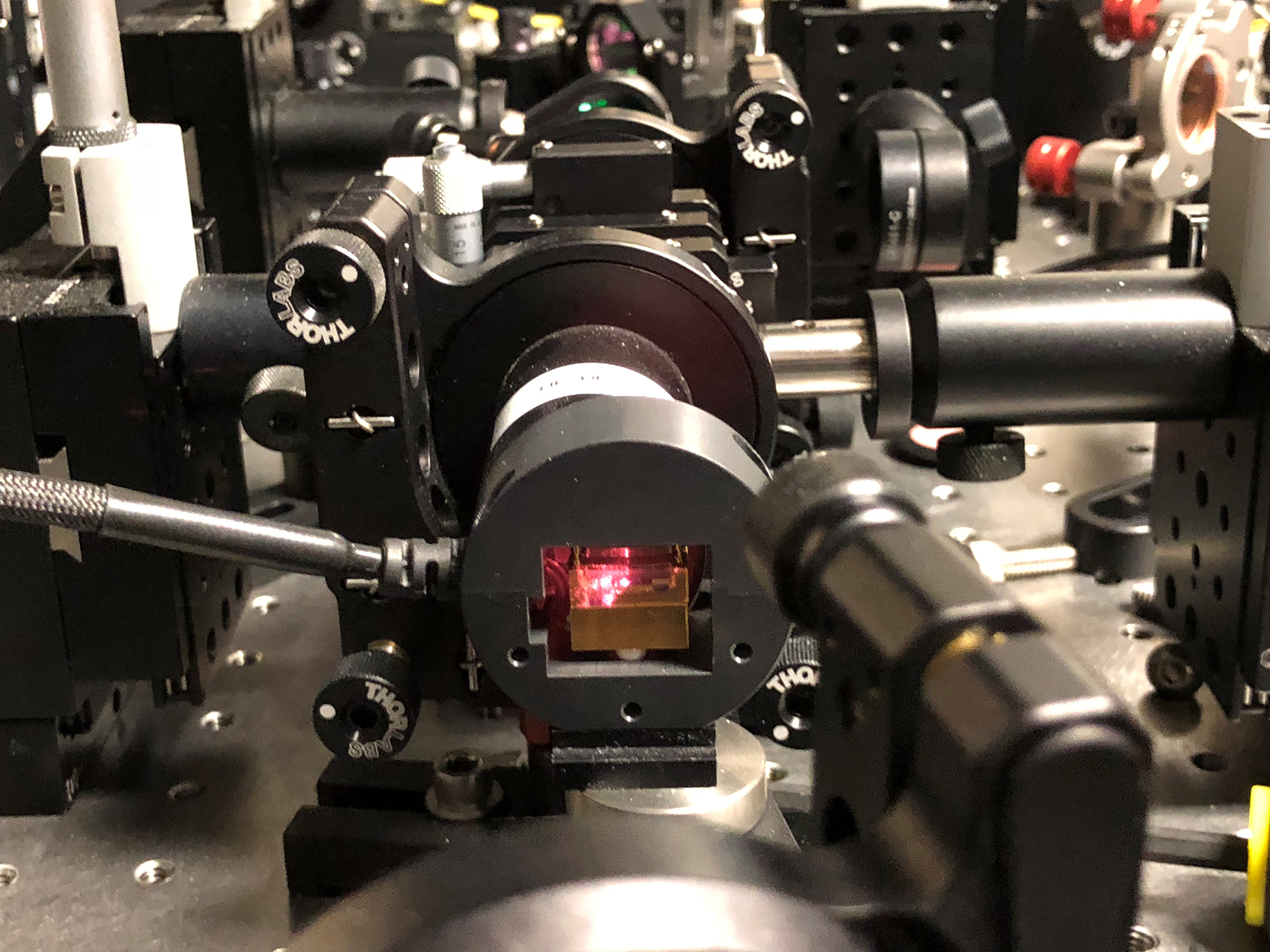
Making a photon is only part of the job. Quantum photonic systems also need successive photons to interfere as though no measurement can distinguish which source event produced them. A quantum dot can release two photons in a cascade, but the timing link between those emissions normally reduces their coherence.[2]
A Basel, Paderborn and Bochum team used an optical cavity to accelerate the first step selectively. The earlier experiment reports interference visibility of 94 ± 2% for the biexciton photon and 82 ± 6% for the exciton photon. Paderborn's October 1 update summarizes the improvement as roughly 60% to 90% indistinguishability.[1][4]
The September 29 companion paper explains another practical attraction: exciting the dot through a two-photon process and collecting the cavity-enhanced emission separates the excitation laser from the useful photon spectrally. That avoids a common source-design compromise and suppresses re-excitation, which can produce unwanted extra photons.[3]
The limits remain measurable. The PRL paper reports 98% photon purity, with phonons feeding the cavity setting a remaining constraint. Indistinguishability and purity describe different errors; neither percentage is a count of photons successfully delivered through a complete quantum computer. This is a source advance, with larger optical systems still to build.[2][3]
For photonic computing, the next challenge is combining source quality with efficient collection and stable interference across many components. Better purity and matching help those architectures, but a useful system must retain both as it grows. The results identify specific improvements to test at that larger scale. Source improvements alone do not establish computational advantage.[2][3]
Which percentage answers which question?
Indistinguishability measures how well alternatives overlap in the relevant interference experiment. Collection efficiency concerns how much light reaches the next stage; brightness concerns supply rate; purity concerns unwanted extra photons. These properties can improve separately or trade off. A source’s interference visibility is therefore not a universal score for the whole device or network.[1]
Why source quality is not arrival probability
A collection, transmission and detection model can estimate a simple chain of photon losses. Indistinguishability cannot simply be inserted into that chain as another independent chance that a photon arrives. Its effect on a network operation depends on the protocol and the way distinguishability changes interference. The model has to match the question being asked.[1]
What would a stronger network test add?
A useful next comparison would show interference between independently operated sources over longer periods while reporting brightness, collection, detection and drift. Stable matching across separate devices would answer a different question from improving one source. Reporting those conditions together would help another team judge whether the gain survives inside its own optical system.[1]