
A no-click branch becomes a controllable optical filter
A photonic analog experiment makes the surviving state and the probability of reaching it part of the same story.
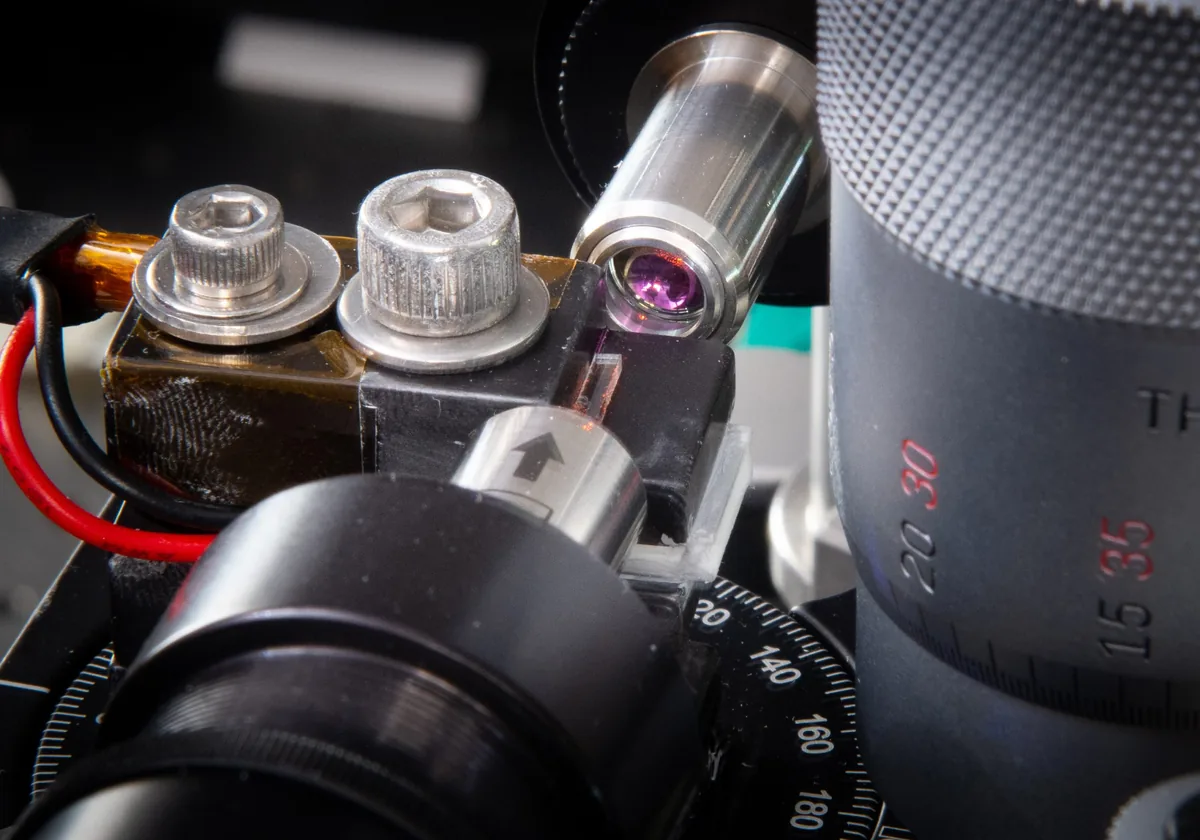
An October 15 preprint studies periodic conditional measurements using a three-dimensional photonic chip. Its main text describes a classical-light optical simulation of quantum dynamics: propagation through waveguides represents evolution, and selected amplitude is removed at repeated stages. The researchers examine surviving states and detection statistics through bright and dark modes. That implementation distinction matters. The experiment makes a conditional-evolution model accessible in optics; it should not be presented as evidence of a many-body quantum-computing advantage or an unspecified stream of measured single photons.[1]
The idea begins with an apparently uneventful outcome: a detector does not register the selected event. In a conditional model, that absence changes which possibilities remain compatible with the record. Repeating the procedure can progressively favour components that avoid the measured location. The final state and the probability of reaching it therefore come from the same filtering process. Describing only the normalized surviving state would leave out how much of the initial preparation was removed along the way.
Classical waves can make this mechanism visible because their complex amplitudes interfere. Light propagating through a suitable array of coupled waveguides can obey the same mathematical evolution equation as a restricted quantum model. A waveguide that routes one component away implements the corresponding removal of amplitude. This is a useful analog simulation. The physical medium supplies access to a mathematical structure, while the interpretation still needs to say which quantum features are represented and which require resources beyond classical coherent light.
The time between filters changes the result. During that interval, amplitudes move and acquire relative phases. A component that avoids a monitored location at one interval may reach it at another. A dark mode is therefore defined relative to the evolution and measurement arrangement, not by an intrinsic label attached to a piece of light. Bright modes lose some weight when the filter is applied. Repetition magnifies the difference between the components that survive well and those that are progressively removed.
Consider an original two-mode toy model with orthogonal components. Start with half the probability weight in each. One component survives every step unchanged; the other has amplitude multiplied by 0.8 at each step. After five steps the second component's probability is multiplied by 0.8 to the tenth power, about 0.107. The total remaining weight is about 0.554, and the unchanged component accounts for about 90.3% of the normalized survivors. A cleaner conditional state has emerged while nearly half the initial weight has been lost.
That calculation also shows why the measurement record is useful. The discarded weight does not simply vanish from the accounting; its distribution across steps tells us how the filter interacts with the evolution. Two arrangements can leave similar final survivors while producing different detection-time distributions. Measuring both provides a stronger test of the model than examining the final output alone. In a physical experiment, losses unrelated to the intended filter also need to be separated from the modeled detection channel.
The connection to quantum information should remain precise. A linear optical analog can illuminate conditional dynamics without providing every resource used by a scalable quantum computer. Encoding a large quantum state into individual classical optical modes may itself demand a large apparatus. The useful claim is consequently about the dynamics studied and controlled, not an automatic reduction of computational complexity. This boundary makes the experiment more intelligible: its value lies in showing how repeated filtering and coherent evolution jointly shape the state and its observation record.
A strong next comparison would vary the interval, input and monitored location while retaining a complete intensity and loss account. Agreement in the survivor distribution and the time-resolved removed weight would test more than a visually appealing final pattern. For readers, the result offers an unusual lesson about measurement: the outcome that did not occur can still organize the state that remains. Understanding that organization requires both the conditional answer and the probability of ever obtaining it.