
A Quantum Light Pattern Survives After Entanglement Fades
An October 12 experiment transfers skyrmion topology between quantum states. The pattern survives a finite range of noise; a practical communication advantage still needs its own test.
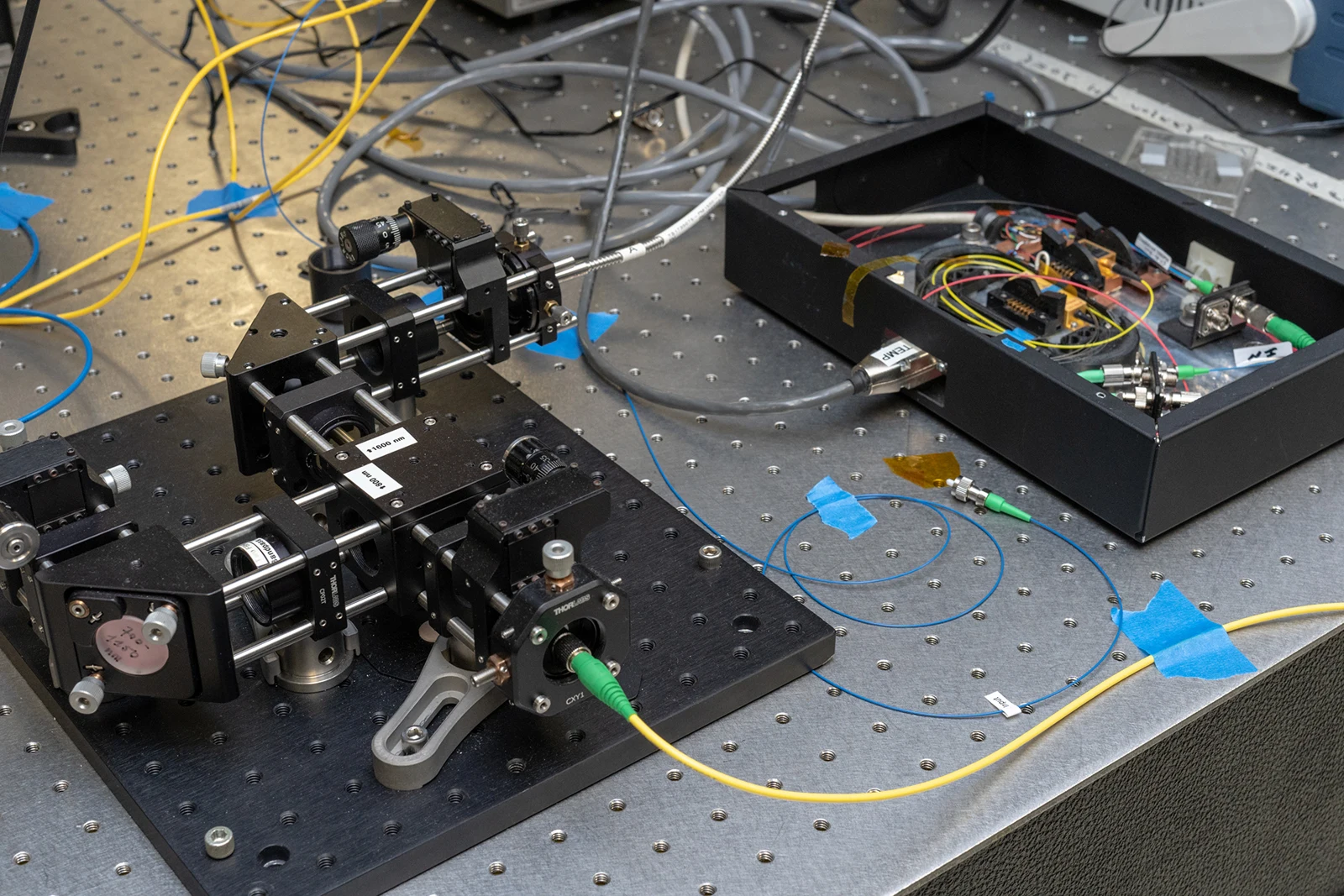
A University of Pennsylvania-led team has transferred a winding pattern of light from a single-photon state into correlations between two photons. In its October 12 Nature Physics paper, the researchers report that the pattern can remain identifiable after noise erases the measured .[1][2]
What the chip preserves
That pattern is a photonic skyrmion. Across a beam, its polarization directions wrap around the set of possible polarizations; the skyrmion number counts those wraps. Silicon-nitride microrings shape the light, interferometers route it, and a Bell-state measurement connects the local pattern to the two-photon state.[2]
In controlled noise tests, the transferred topological number survived over a finite range after concurrence, the study’s entanglement measure, fell to zero. Quantum discord, a broader measure of quantum correlations, remained nonzero in that regime.[2]
The authors explicitly stop short of claiming an operational advantage for quantum state transfer. A surviving winding number describes one property of the state. The result does not establish preservation of arbitrary quantum information, and the pattern itself eventually breaks down as noise increases.[2]
A separate test of reading the pattern
Readout is another part of the problem. A separate Wits University study, published in Nature Communications on October 7 after a December 2025 preprint, used a trained optical network to identify skyrmion topology. Its two processing channels sort the light’s orbital angular momentum, allowing the topological class to be inferred from the detected outputs.[3][4]
That experiment classified 81 light configurations within the family tested and reconstructed an encoded image. It used classical laser beams. Single-photon operation remains future work, and the authors say realistic transmission disturbances need further testing. This supplies a concrete readout approach to investigate alongside quantum topology transfer, without establishing that the two systems already work together.[3]
The useful comparison comes next
QubitWire’s analysis: robustness becomes useful only when the property that survives is the property an application needs. A preserved label might help a receiver distinguish messages, yet a protocol still has to specify which messages are allowed and how they are recovered. That is a more informative question than asking whether a quantum state simply survived.[2][3]
A decisive next experiment would encode a defined set of messages, send them through controlled disturbances, and measure successful recovery at the receiver. It should count lost photons, preparation attempts, measurement time and processing overhead, then compare those costs with a suitable alternative at the same error rate. This is a proposed evaluation, not a result reported by either team.[2][3]
The practical attraction is selectivity: an application may need a stable feature without requiring every detail of the original state. The hard engineering work is to show exactly what that feature buys. Keeping the encoding, channel and receiver in the same accounting would make a future advantage both easier to explain and harder to overstate.[2][3]