
An Entangled-Photon Source Made From Off-the-Shelf Parts Faces a Familiar Tradeoff
An October 6 preprint demonstrates a fiber-connected telecom photon source. More pump power brings more pairs, but their quantum-state quality falls.
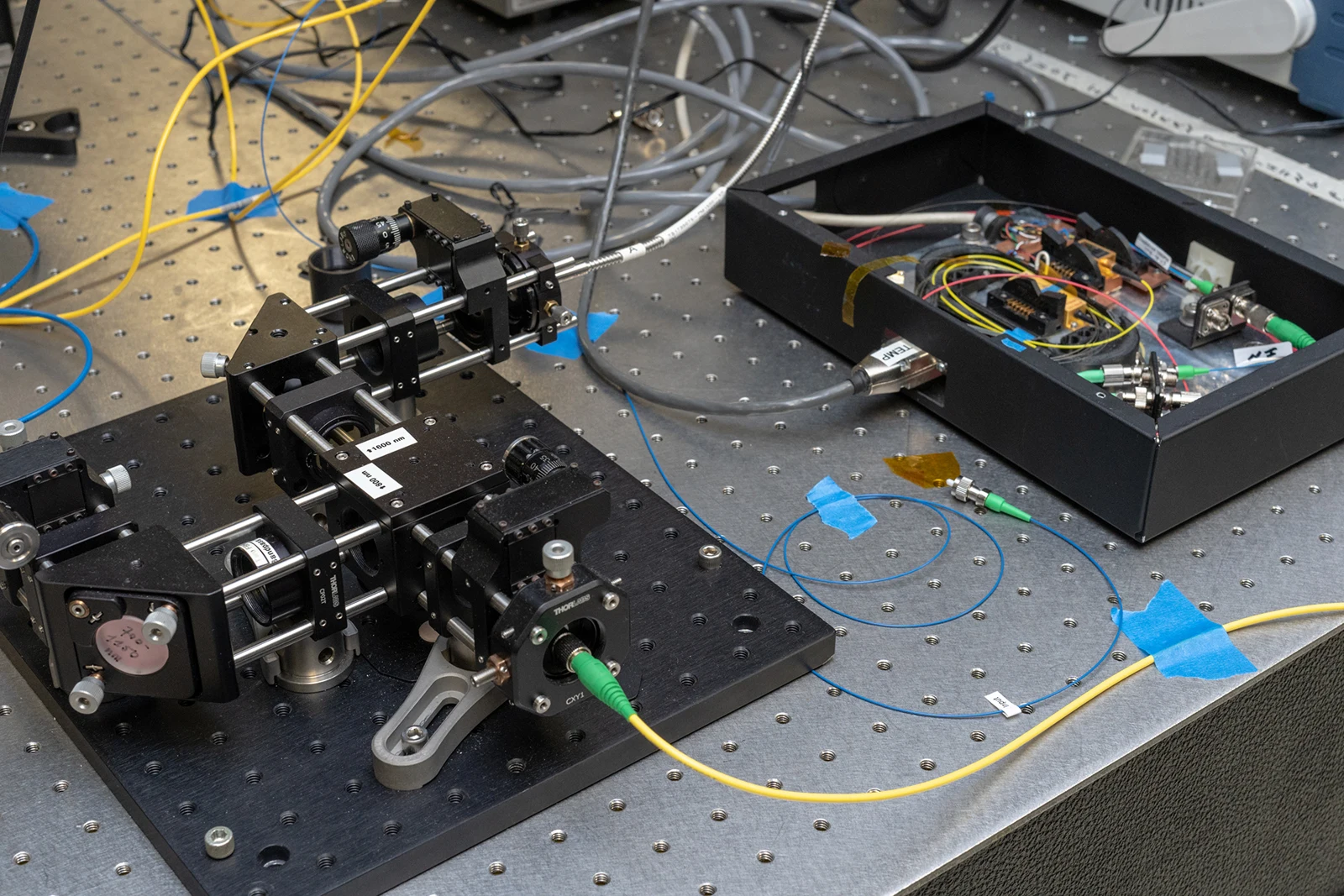
A useful quantum link needs a dependable supply of photons, and an October 6 preprint tests a practical way to make them from commercially available optical parts. Researchers affiliated with KTH, RISE and Quantum Scopes report an all-fiber generation loop producing entangled photon pairs at telecom wavelengths. At low pump power, their reconstructed state has 85% fidelity to the chosen Bell state. The experiment is a photon-source demonstration; it does not demonstrate teleportation, a multiuser network or a distributed quantum computer.[1][2]
A practical source with a precise boundary
The attraction is engineering accessibility, not the invention of fiber-based entanglement. A separate 2017 study by Vergyris and colleagues already demonstrated a guided-wave source combining a lithium-niobate waveguide with a Sagnac interferometer, then converted polarization entanglement into energy-time entanglement. That earlier experiment is a relevant engineering baseline, not a directly comparable score or a replication of this source. The October paper adds a particular practical implementation and detailed analysis of its measured state and brightness tradeoff. Familiar optical connections reduce some assembly work without abolishing the constraints that make entanglement fragile.[1][2][4]
The design places a periodically poled lithium-niobate waveguide inside a Sagnac interferometer. A pump laser feeds two alternatives that travel around a loop in opposite directions. Photon pairs can be generated through either alternative, and the paths recombine to create polarization entanglement. The essential requirement is that the alternatives remain indistinguishable in the ways that matter. If another physical degree of freedom records which alternative occurred, the useful polarization coherence can be reduced even when the detector still registers both photons.[1][2]
The phrase all-fiber needs its own boundary. The authors apply it to the generation loop, which uses a fiber-connected waveguide, polarization beam splitter and wavelength-routing components. Their polarization analyzers also contain free-space optics. Characterization uses superconducting nanowire detectors and their cryogenic equipment, separate from the source hardware. The paper's affordability objective concerns the source; it is not evidence that the entire measurement system is inexpensive, room-temperature or ready for installation by an ordinary telecom customer.[1][2]
Three numbers, three different questions
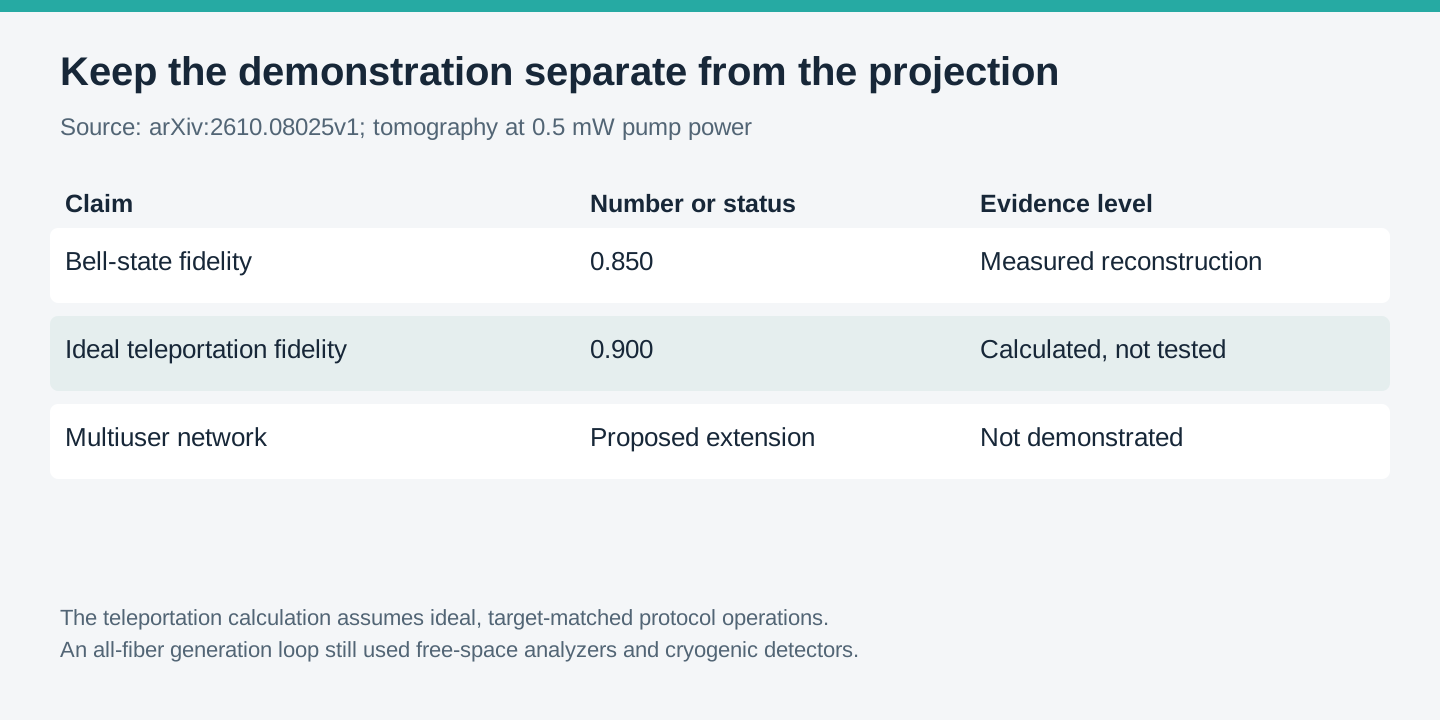
At 0.5 milliwatts of pump power, the reconstructed state has Bell-state fidelity 0.850, purity 0.836 and concurrence 0.782. These numbers describe different features of a two-photon state, rather than three interchangeable accuracy scores. Fidelity measures its match to a selected target, purity measures how mixed the state is, and concurrence quantifies entanglement for two . Reading them together helps distinguish a target mismatch that may be corrected from a loss of useful quantum structure that cannot be removed by a simple adjustment.[1][2]
A separate CHSH measurement gives 2.3301 ± 0.0075, above the relevant classical bound of 2. The authors explicitly treat this as characterization of measured polarization correlations. They select coincident detections, so this is not a loophole-free Bell test. The stated uncertainty describes counting statistics. Elsewhere in the experiment, variation beyond the fitted counting-noise model means the quoted error bars do not capture full experimental reproducibility. A precise number is useful only when its uncertainty budget is equally clear.[1][2]
One result that could easily escape its qualification is the teleportation calculation. With the measured Bell-state fidelity, the ideal target-matched protocol gives an average teleportation fidelity of (2 × 0.850 + 1) / 3 = 0.900. The paper supplies that theoretical benchmark. No unknown input state was teleported in the reported experiment. The calculation says something about the measured state as a potential resource under ideal operations; it does not include the losses, imperfect operations and scheduling of a working teleportation system.[1][2]
Why a better phase setting cannot fix everything
The state reconstruction supplies a particularly useful diagnosis. Roughly 96.7% of the population lies in the intended pair of polarization components, yet the Bell-state fidelity is 85%. Having most of the population in the right components is therefore insufficient. Their relative balance, phase and coherence also matter. The source is not simply losing a large fraction into the wrong polarization labels; the relationship between the desired alternatives is part of the remaining problem.[1][2]
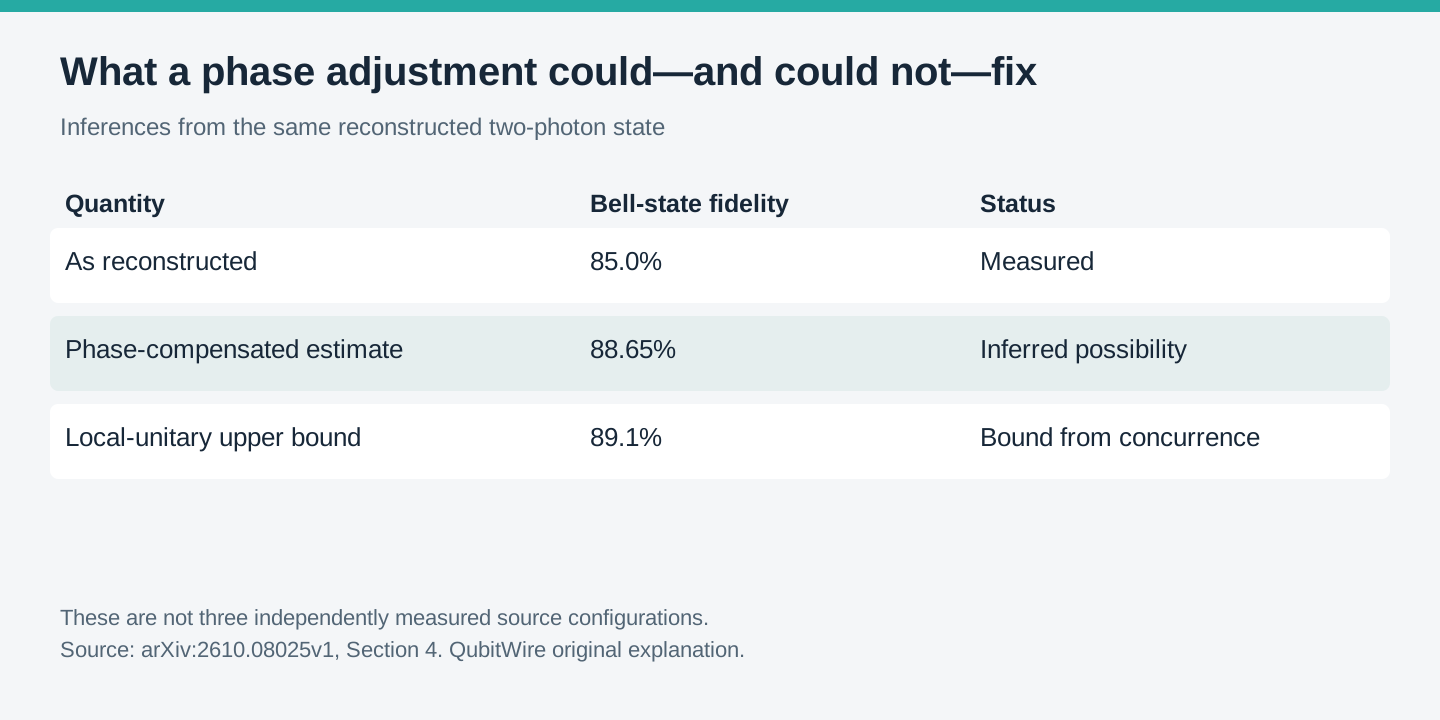
Using the measured concurrence, the authors bound the Bell-state fidelity achievable through local unitary adjustments at 89.1%. Their reconstructed matrix suggests phase compensation could raise it to about 88.65%. Those are inferred possibilities, not reported improvements from a retuned source. The limited headroom is the useful message. Better polarization settings may recover some mismatch, but they cannot erase every form of mixedness or distinguishability. A convenient control knob should not be mistaken for a universal repair.[1][2]
The broadband spectrum makes timing especially consequential. Different spectral or temporal modes can distinguish the two generation alternatives on timescales much shorter than a detector's coincidence window. Accepting two detections as simultaneous does not make the optical states identical. The paper explores a sub-picosecond delay as an illustration, but does not establish that such a delay caused the observed coherence loss. The engineering question is therefore how to identify and control the mismatch, rather than assuming that faster detection alone solves it.[1][2]
Brighter is useful only if the pairs remain useful
Turning up the pump exposes another tradeoff. Across the measured range from 0.5 to 8 milliwatts, the corrected pair rate rises roughly linearly, while fidelity, purity and concurrence decrease overall. The authors report a pair-rate slope of 0.918 ± 0.040 million pairs per second per milliwatt. That is a fitted, corrected source metric, not an end-to-end entanglement delivery rate. The observations are consistent with additional higher-order pairs and accidental coincidences; they do not uniquely isolate one microscopic cause.[1][2]
QubitWire's interpretation is that the right operating point depends on the task after photon generation. Maximizing detected counts can be counterproductive if the state quality drops below what the downstream protocol can tolerate. A realistic comparison should report useful delivered pairs at a stated quality requirement, alongside optical loss and detection assumptions. This paper provides enough information to reveal the tradeoff, but does not establish an optimal operating point for every quantum-network application.[1][2]
Wavelength routing offers an appealing extension. The source produces pairs in different telecom bands, allowing suitable wavelength-division multiplexers to send correlated channels to different users. The paper presents that as a route toward a multiuser platform. It does not report several users simultaneously receiving usable entanglement. Each selected channel pair would need the appropriate passbands and preserved polarization entanglement, followed by verification after real fiber propagation. The quality of one reconstructed source state cannot substitute for that network-level evidence.[1][2]
From a source to a network
The decisive next experiment would therefore connect the source to the intended fiber links, measure each delivered channel pair and report stability over time at several pump settings. A later teleportation or network protocol would need its own measured result and complete accounting of accepted and rejected events. For now, the result is a practical source and an unusually instructive list of constraints. Making more entangled photons is valuable; making enough of the right entangled photons reach the intended users is the harder specification.[1][2]