
Skip to content
RESEARCH · RESEARCH / PHOTONIC STATE GENERATION

A photonic design study asks when a success signal is misleading

An analysis of small entangled photon states tracks false heralds and distinct error channels. Conditional state quality alone does not measure useful output.
Published Source report Sources checked
My reading list
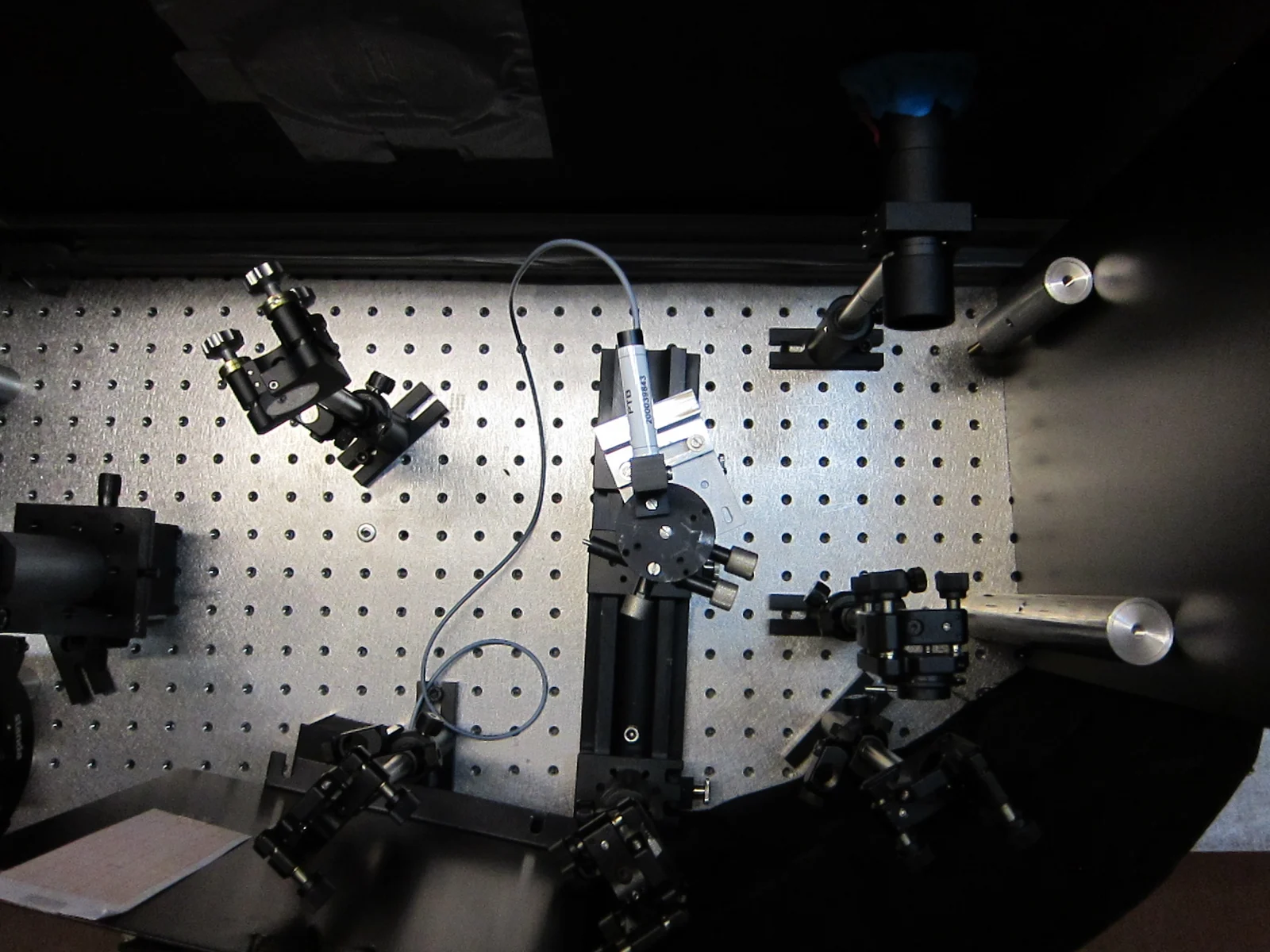
Top-down view of an optical table covered with mirrors, mounts, lenses and cables.
An optical laboratory photographed by Giorgio Brida in 2010. Archival photonics context; this is not the seed-state preparation apparatus or a measurement from the preprint.Photo: Optics Laboratory (top view) · Giorgio Brida · CC BY 2.0Full image credit

What changed

A photonic computer can begin by preparing small states, with detector patterns announcing when preparation succeeds. A new preprint analyses what happens when that announcement is misleading. Its framework separates physically different error mechanisms and follows how they alter the state accepted after a success signal.[1]

The authors identify circuit designs in which interference prevents selected detector errors from falsely heralding success at first order. Their examples include Bell-state generators protected against detector loss and detector noise within that approximation. This is an analytical design result, rather than a newly demonstrated operating quantum computer.[1]

What the result establishes

The qualifier first order matters. It describes the leading response when error probabilities are small. It does not mean all detector faults disappear, and the paper explains that larger state-preparation constructions can leave that approximation sooner. Conditional output properties also depend on which events the heralding rule accepts.[1]

A useful way to read the work is to keep two questions beside each other: how often does the source announce success, and what has actually been prepared when it does? Improving one can leave the other unchanged. An impressive quality number needs its acceptance rule and production rate.

For example, a stricter selection rule could discard more attempts while improving the surviving sample. That general accounting example is not a numerical result from this study. It explains why rejected trials belong in a practical comparison, alongside source behavior, detector response and the resources needed for another attempt.

The next useful test

The next engineering test would compare complete sources under matched component assumptions and report useful-state throughput as well as accepted-state errors. QubitWire’s interpretation is that this paper makes such a comparison more informative: the error type and its destination can matter as much as one average fidelity.

Keep your reading trail

Your Updates →

Evidence & context

1 linked source

Research preprint

How to read the evidence and dates

An announcement records what an organization stated. An experiment reports an observation. A simulation or resource estimate depends on its assumptions. QubitWire’s analysis connects these sources; the labels are not quality scores.

Published is the article’s first QubitWire publication. Updated marks a substantive content change. Sources checked records a review of the underlying evidence. An older paper can support a new explanation, and another press release about the same work is not independent replication.

QubitWire take

Analytical, leading-order model; suppression of particular heralding errors is not immunity to all faults or demonstrated useful-state throughput.

Sources

  1. Beyond Fidelity: Resolving Errors in Photonic Seed State Generation — version 1

    Preprint dated 2026-10-19. Reviewed 2026-10-20: Section III.4: interpreting conditional response coefficients; Section V: intrinsic removal of detector errors; Section VI.3: S6 Bell-state generator; Section VII: realization and approximation limits. Methods and limitations checked; no independent reproduction.

READ NEXT

Continue exploring

All Research stories
  1. More on photonics

    NIST’s bigger photon detectors have a quieter way to see

    Superconducting rails help detectors reach 0.1 millimetres in width while reducing false signals—a useful step toward larger optical sensors.

    Published · Source report
  2. More on photonics

    A no-click branch becomes a controllable optical filter

    A photonic analog experiment makes the surviving state and the probability of reaching it part of the same story.

    Published · Source report · Sources checked
THE QUANTUM BRIEFING

A clearer signal.
Read the latest edition.

A little perspective on a fast-moving field.

Read the on-site briefing →

Read selected quantum coverage in the on-site briefing, or register your interest below.