A decoder proposal targets the slow cases in error correction
DAWG reduces reliance on an extra correction stage in numerical tests. Its hardware latency remains an estimate.

From fragile qubits to reliable computation.
What does the memory result establish? Read the Reality Card ↓
Quantum error correction encodes information so that some errors can be detected and managed without directly reading the encoded state. Many schemes distribute a logical qubit across several physical qubits. A logical qubit is the encoded information, rather than a separate physical device.
A useful comparison asks whether increasing protection actually lowers errors, what resources it costs and which operations were demonstrated. A long-lived memory, a decoder benchmark and a complete fault-tolerant computation are different achievements.
Suppression, mitigation and correction address different parts of the error problem. Follow what is protected, the resources it costs and the operations actually demonstrated.
An erasure flag identifies a location; it does not recover the information by itself. Recovery depends on an actual encoding, allowed operations and an error model. Reset prepares a known output and solves another task.
A model of a phase-flip channel between two Hadamard gates does not simulate erasure recovery, preserve a logical qubit or implement a hardware reset. These are distinct tasks.
A question to carry forward: Is the task locating a loss, preserving an unknown state, or preparing a known one?
Compare ideal reset with state preservation →A later explanation can make an earlier result easier to understand. It does not necessarily describe a new experiment.
The qLDPC paper linked below was submitted on 17 July 2026 and revised on 30 July. It studies logical-operation protocols through numerical simulations under stated code and workload assumptions. A later commentary should retain that research identity and date.
Read the research
Recent studies, explained in full. Each analysis keeps the measured result, the model and the remaining questions together.
A preprint submitted on October 14 introduces a Readout Error Decoder that uses repeated binary measurement records to separate error channels. The authors demonstrate it on fluxonium and transmon devices and test its response with controlled error injections. The channels include wrong state assignments, flips within the computational subspace and leakage outside it. The contribution is diagnostic: similar overall readout scores can arise from different physical processes, and those processes may require different changes to the measurement system. [1]
Start with a distinction between the state and its reported label. A qubit might remain in the same state while noisy electronics place its signal on the wrong side of a decision threshold. Alternatively, the act of measurement or an intervening process might change the qubit itself. Both situations can produce a surprising bit in the recorded sequence. Improving the classifier can address the first situation while leaving the second untouched. The correct intervention depends on which layer of the measurement chain produced the error.
Leakage adds a third possibility. A physical device used as a qubit can possess states beyond the two chosen computational levels. If population enters one of those states, a binary output still forces the readout into one of two labels. The record can look like an ordinary bit error even though the physical system has left the intended subspace. Returning it to that subspace may require a different operation from correcting a mistaken label or reversing a transition between the two qubit levels.
An invented seven-check record illustrates the ambiguity: 0001000. One explanation is a single wrong assignment in the middle. Another is a physical transition followed by a return before the next check. A longer-lived excursion could produce a run of unusual labels instead. The pattern alone does not prove its cause. It becomes informative when combined with a timing model, prepared initial states and controlled changes between measurements. That is the difference between treating a trace as a suggestive picture and using it as evidence in a diagnostic model.
Repeated experiments can be designed to challenge those alternatives. Insert a known operation, vary an idle interval or deliberately alter the assignment process, then ask which features of the record respond. If a proposed diagnostic attributes every change to the same channel, it has not achieved the intended separation. Controlled injections are valuable because the intervention is known even when the internal state is not observed directly. They reveal whether the analysis responds specifically to the kind of fault it claims to identify.
Timing controls which distinctions remain visible. An excursion that lasts much longer than the interval between checks can leave a recognizable sequence. One that decays rapidly may resemble an isolated assignment error. Changing the interval can therefore be a physical test of the diagnosis. The appropriate model must also account for the measurement itself, including any state transitions it induces. Calling a readout repeatable does not remove these dynamics; it states an empirical property under the particular repeated-measurement protocol.
For an engineer, a resolved error budget is useful because it directs effort. If labels dominate, improving signal separation or classification may help. If state disturbance dominates, changing pulse power, duration or spectral content may matter more. If leakage is important, preparation and reset procedures enter the discussion. These are general intervention classes, not recommendations established for every device in the paper. Their value is that they turn one aggregate number into a set of experimentally distinguishable questions.
The next informative result would show that a targeted change reduces the identified channel and improves a relevant operating sequence. That would connect diagnosis to an engineering outcome. It would also test whether the error model remains useful as conditions drift or devices change. The paper gives readers a reason to look beyond a single fidelity figure: measurement quality is not only about how often the reported answer is wrong, but also about what happened to the physical system while that answer was being obtained.
Patchwork, an October 15 preprint, connects lattice-surgery circuit construction with partitioned decoding. It compiles multi-qubit Pauli measurements on a narrow-corridor surface-code layout, including logical Y operations. Numerical tests support full effective distance for the tested constructions, while staged decoding of a ten-logical-qubit example approaches a monolithic decoder's failure probability over the evaluated parameters. The work is a compiler and simulation study. It does not establish a deployed real-time hardware decoder, and the tested distance preservation should not be generalized beyond the examined constructions without evidence. [1]
Surface-code logical information lives in a pattern of physical measurements and constraints spread across a patch. Lattice surgery performs logical operations by changing how patches are joined and measured over time. The resulting operation is more than a static drawing of neighboring rectangles. The sequence of checks determines which faults can combine into a logical mistake. A compiler must therefore generate both a geometrically valid arrangement and a schedule whose time-dependent error structure preserves the intended protection during the operation.
Multi-qubit measurements can create a decoding region much larger than one memory patch. Classical processing then has to interpret a stream of detection events across that merged region. Dividing the work can reduce the burden on any single decoder, but the division itself creates a boundary problem. An error chain can cross a computational partition even when no physical boundary exists there. Treating each partition as completely isolated can force a locally plausible explanation that is inconsistent with evidence just outside the assigned region.
Consider an original schematic example with two detection events on opposite sides of a software partition. One possible explanation is a single error chain crossing the partition. If each decoder sees only its own event, it may independently connect that event to an artificial edge. The combined corrections can then differ from the globally supported explanation. This is a conceptual example, not a simulated failure rate. It shows why partitioning needs shared context or a carefully defined protocol for resolving decisions near the cut.
A buffer supplies some of that context. A decoder can examine a region larger than the one in which its decisions are immediately committed. The extra information helps interpret errors near the committed region's edge, while later stages retain responsibility for unresolved areas. This creates a trade-off between parallelism, overlap and latency. A wider buffer can improve context but costs additional processing and may delay a final decision. The design has to connect those costs to the physical rate at which syndrome information arrives.
Scheduling matters because error correction is a space-and-time process. A measurement fault can produce a pattern extending between rounds, while a gate fault can spread through the local circuit. Partitioning only the spatial layout would miss this temporal structure. The appropriate detector model describes which observed events a fault can produce throughout the operation. When local corrections are combined, their effect on later syndrome data and logical observables must remain consistent. Otherwise, distributing the calculation can silently change the meaning of the global correction record.
Code distance is one measure of protection, but it should retain its operational definition. A schedule can shorten the smallest harmful fault pattern even when the patch looks large enough on paper. Checking effective distance at the circuit level helps reveal those weaknesses. Failure probability under a chosen noise model provides complementary evidence about typical errors. Neither measure alone reports runtime. A real-time claim additionally needs measured decoding throughput, latency and backlog behavior for the same kinds of operations and error records the compiler generates.
The important contribution is a connection between two engineering tasks that are often discussed separately: constructing logical operations and organizing the classical inference they require. The next useful demonstration would execute the generated schedules with a decoder implementation whose resource use is measured under a sustained syndrome stream. Readers could then follow the path from logical intent through physical checks to timely classical decisions. That complete path, including its partition boundaries, determines whether an apparently scalable logical layout can support a working computation.
An October 15 preprint studies normalized quantum-LDPC code-projector states under local Pauli noise. Its bounds describe conditional mutual information across separating regions in weak- and strong-noise regimes, with partition-dependent geometric and uniformity assumptions. The main text includes a counterexample showing that basic LDPC conditions alone are insufficient for some subsystem partitions. This is a mathematical study of mixed-state structure. It does not supply a universal decoder threshold or demonstrate that arbitrary encoded information remains recoverable throughout every regime in which its correlation measure decays. [1]
A code space contains more than one possible encoded state. The normalized projector onto that space treats all its basis directions equally, producing a mixed reference state. Studying that object can reveal structural properties shared by the code without selecting a particular logical message. A memory experiment asks a different question: whether an initially encoded state can be recovered after a specified noisy process. The two questions can inform one another, but a statement about the reference mixture should not silently become a claim about storing every logical input.
Conditional mutual information asks how much correlation remains between two regions after a middle region is taken into account. For regions A, B and C, its quantum expression combines the entropies of AB, BC, B and ABC. This differs from simply measuring a two-point correlation between A and C. The buffer can contain information that explains their apparent dependence. In a geometric setting, examining how the quantity changes as the buffer widens provides a way to characterize the range of information that cannot be resolved locally.
A classical example illustrates the conditioning. Let B be a fair random bit, and let A and C each copy B perfectly. Without knowing B, A and C share one bit of information. Once B is supplied, neither copy reveals anything further about the other, so their conditional mutual information is zero. The three variables remain strongly correlated. This invented example is not a quantum-code construction, but it makes clear why zero conditional information does not mean that every ordinary correlation has disappeared.
In quantum theory, small conditional mutual information is connected with approximate recovery from suitable reduced information. That statement concerns the existence and quality of a recovery relation under its mathematical definition. It does not automatically specify a fast, physically local, fault-tolerant circuit for a device. Implementing a recovery map can require additional resources and assumptions. The distinction resembles the difference between proving that information is reconstructible in principle and supplying an operational decoder that keeps pace with a stream of noisy measurements.
Geometry also carries information. A separating buffer may or may not support a logical operator, and that possibility changes what can remain correlated across it. Full-system partitions and partitions of a smaller subsystem need not satisfy the same conditions. Local sparsity of checks constrains how many qubits participate in each relation, but it does not determine every global feature of the code. A theorem's partition and uniformity assumptions therefore belong in its interpretation, especially when moving between geometrically local codes and more general sparse-check constructions.
Weak and strong noise can both simplify a correlation measure for different reasons. At weak noise, a state can remain close to a structured reference. At very strong noise, information can be washed out so thoroughly that distant dependence becomes short ranged. Similar-looking decay bounds at those two ends do not imply equivalent computational usefulness. The behavior between them can be the scientifically important region. A reader should ask which property persists, which property is lost and whether the mathematical diagnostic distinguishes the operational phases relevant to the intended task.
The value of the work is a more precise language for noisy many-body code states. It identifies which assumptions connect local errors, geometry and conditional information, while exposing where simple generalization fails. A useful next step would compare these bounds with explicitly defined recovery tasks on the same families of codes. That would show where a phase diagnostic predicts an engineering benefit and where it instead describes structural behavior with no direct memory guarantee. Keeping those meanings separate makes the theorem more informative, not less significant.
An October 14 preprint studies charge sharpening in monitored circuits with readout errors and incomplete postselection. Numerical results retain a transition signature while noise leaves a finite fluctuation contribution. The authors separate within-trajectory quantum fluctuations from between-trajectory mixing and explain why independent assignment errors can produce history-dependent effects in the conditioned ensemble. This is a theoretical and simulation study, not a hardware mitigation demonstration. Its central distinction is between mislabeling a final outcome and corrupting a measurement record that determines which evolving quantum histories are grouped together. [1]
A monitored circuit includes measurements during its evolution. Each outcome conditions the state and becomes part of a trajectory record. Even if later gates are not chosen adaptively, selecting runs by that record changes the ensemble used to compute an observable. A wrong recorded bit can therefore place a run in the wrong group. Correcting the final histogram alone does not necessarily undo the mistake because the error has altered the conditioning information accumulated throughout the circuit, not merely the label attached to its last measurement.
A conserved charge gives one way to study what the record reveals. The dynamics can preserve the total charge while the initial quantum state contains uncertainty over charge sectors. Measurements gradually provide information that narrows that uncertainty in a conditioned trajectory. Charge sharpening refers to this increasing definiteness under the relevant monitored dynamics. If the record is incomplete or wrong, the observer can remain uncertain about which sharply defined trajectory actually occurred, leaving a mixed description even when each ideal record would identify a narrower state.
An original two-trajectory example isolates that difference. Suppose one selected history has exactly charge zero and another exactly charge two, each with equal weight. Within either history the charge variance is zero. If a corrupted record merges them, the combined mean is one and the second moment is two, giving variance one. These invented charge values are not simulation data. They show how uncertainty between histories can survive after quantum uncertainty within each history has disappeared, so a nonzero total fluctuation need not mean that neither history sharpened.
The decomposition follows the law of total variance in the appropriate conditioned description: total variance contains an average of within-group variances plus the variance of the group means. In a monitored quantum setting, those terms distinguish quantum uncertainty in a conditioned state from classical uncertainty over the possible trajectories. The labels are useful only when the grouping is defined consistently. Estimating the terms from imperfect data requires a model for which records could have produced the observed one, rather than assuming that the visible label uniquely identifies the underlying state.
More frequent measurement can have competing effects. It can reveal more about the system while also creating more opportunities for assignment errors in the accumulated record. The useful balance depends on the dynamics and the conditioning procedure. A minimum in total fluctuations can therefore reflect competition between information gained and mixtures introduced by an imperfect record. Such a feature is a diagnostic to analyze across sizes and error rates, not automatic proof that the ideal transition point is known exactly from one noisy finite-system curve.
Independent detector errors need not make the final conditioned ensemble history-free. The physical evolution relates outcomes at different times, so alternative hidden records can carry different weights after conditioning on the observed record. These correlations arise from the inference problem even when the individual label flips were generated independently. Distinguishing detector independence from trajectory independence avoids a common modeling shortcut. A simple independent-noise correction at the final time can miss information retained in the earlier measurement history and its relationship to the surviving state.
The study explains why mid-circuit readout needs its own mitigation language. The next useful experiment would vary a calibrated record-error process, measure the relevant fluctuations and compare the full-history analysis with a final-output-only correction. Readers could then assess which transition signatures remain accessible and which depend on unrecovered conditioning information. That would connect a theoretical distinction to a concrete measurement practice: preserving or reconstructing the record is part of learning the quantum dynamics, because the record determines which ensemble the experiment is claiming to describe.
Go beyond the headline
Follow the physical idea, work through a declared example and keep the limits attached. Research dates appear with each guide and lab.
Source research checked . Teaching calculations are ideal models.
An error location is information. If a decoder knows which qubit was lost, it can restrict its search to damage on that qubit instead of considering every possible location. The missing quantum state is still unavailable; the flag does not contain a copy of it. Recovery becomes possible because the encoded state distributes the protected information across a larger system. A quantum erasure is therefore a channel with a location record, not a gentle error and not a classical replacement value that can simply be inserted into the computation.
Code distance makes this distinction precise. For a code of distance d, an arbitrary error on t unknown locations and s additional known erased locations is guaranteed correctable when 2t+s<d under the ideal code model. An unlocated error costs twice as much in this worst-case condition because the recovery must distinguish competing explanations with errors in different places. A located erasure has already supplied part of that distinction. The rule concerns arbitrary errors within a defined coding framework; it is not a statement that every combination of physical faults in a syndrome-extraction circuit behaves as independent damaged data qubits.
A failed inequality means that the universal guarantee has ended. It does not prove that every larger pattern causes a logical failure. Some particular patterns can remain distinguishable or harmless, depending on code geometry, degeneracy and the chosen recovery. Conversely, satisfying a data-error counting rule does not rescue a decoder with an incorrect measurement model. Real records include faulty checks, time-dependent flags and the possibility that an erased qubit participated in gates before its loss was discovered. Those earlier interactions must be represented in a circuit-level model rather than hidden inside one final flag count.
Detection quality changes the effective mixture of located and unlocated faults. A missed loss leaves the decoder without information it was promised. A false flag can consume recovery capacity even when the underlying data were present. Timing adds another variable: learning a location immediately can avoid subsequent interactions with the missing qubit, while learning it many rounds later leaves a longer interval of uncertain behavior. A useful hardware report therefore gives conditional probabilities and detection latency, not only an overall flag accuracy. The code-level benefit must be evaluated with the actual record the hardware produces.
Replacement and recovery also need separate language. Loading a new atom, resetting an ancilla or reinitializing a memory site restores a physical carrier. It does not reconstruct an arbitrary unknown data state by itself. A protocol must use the remaining encoded information and a compatible operation sequence to restore the logical state or continue computation. This is why a replenishment demonstration is valuable engineering evidence without automatically being a demonstration of quantum error correction. The relevant outcome is preservation of the protected information across the complete detection, replacement and recovery cycle.
The most informative comparison holds the total physical error process fixed while changing the quality of the location record. Readers can then see why erasure conversion is attractive without assuming perfect detection. Start with a distance guarantee to identify the information advantage, then move to a realistic decoder and timed fault model to estimate performance. Report which claims come from algebra, which come from simulation and which are measured. That separation prevents a favorable abstract bound from being mistaken for a hardware threshold, while preserving the central insight: knowing where damage occurred can be a powerful computational resource.
Inputs: distance: 5; patterns: [t: 1; s: 2, t: 1; s: 3]
guaranteed_correctable = (2*t+s < d)
| Calculated quantity | Synthetic result |
|---|---|
| first score | 4 |
| first guaranteed | Yes |
| second score | 5 |
| second guaranteed | No |
Abstract synthetic example: suppose a code has distance d=5 and the ideal recovery model contains one arbitrary unlocated data error plus two additional located erasures. The quantity 2t+s is 2×1+2=4, which is below 5, so the distance condition guarantees recovery. With one unlocated error and three erasures, it becomes 5 and the universal guarantee no longer applies. This second statement does not mean that every such pattern fails. The example assumes exact location information, compatible recovery and no additional measurement faults. A missed erasure must be reclassified according to the actual resulting error model, not silently left in the known-location column.
The tempting conclusion: A distance-five code always fails whenever 2t+s reaches five.
What follows instead: The sufficient universal guarantee ends at that boundary. Failure of a particular pattern requires analysis of the code, noise and recovery.
| Quantity or decision | What it means |
|---|---|
| Unknown-location error | Recovery must infer both the error action and its location from redundant quantum information and measurements. |
| Located erasure | Recovery receives a location record but still has to reconstruct the protected information. |
| Distance guarantee | A sufficient worst-case coding statement; it is distinct from an empirical logical error rate under a circuit-level noise model. |
No. It identifies where information became unavailable. Recovery obtains the protected information from the remaining encoding, not from a classical description of the erased state.
No. It removes a worst-case guarantee. Particular patterns can remain correctable, and the decoder and code geometry determine their behavior.
It can restore the carrier, but recovering logical information requires an encoded recovery protocol. Loading alone does not reconstruct an arbitrary state.
A missing or leaked carrier may affect later gates before a flag arrives. The decoder needs the time interval and resulting correlations, not just a final location.
Error locations reduce uncertainty for recovery. Distance explains the ideal advantage, while flag quality, timing and the complete recovery circuit determine how much of that advantage survives in an experiment.
Known error locations change the information available for quantum error correction. The distance-five example is abstract and does not assert a particular physical code or decoder implementation.
Source research checked . Teaching calculations are ideal models.
A noise bias is a comparison between error channels in a specified basis. Saying that dephasing dominates is incomplete unless the basis, observation interval and operating conditions are defined. A memory experiment can exhibit frequent Z errors and rare X or Y errors, yet a gate sequence may rotate those errors or introduce different mechanisms. A code tailored to the memory bias benefits only to the extent that its syndrome extraction, logical operations and decoder use a noise model that still describes the computation. The relevant resource is structured information about errors, not an attractive ratio quoted without context.
Conjugating a Pauli error by an ideal gate illustrates the issue without requiring a hardware model. A Hadamard maps Z to X and X to Z, while changing only the irrelevant global sign of Y. Total error probability is unchanged, but the preferred axis is rotated. This is not necessarily a loss of exploitable structure. If the compiler and decoder retain the position-dependent frame, they can describe a locally rotated bias. Trouble appears when an analysis averages incompatible frames into one probability table or assumes that every location retains the same Z-dominated channel.
Codes such as XZZX use a check structure that can exploit specified noise asymmetry. Their checks mix Pauli axes, and the resulting decoding geometry differs from that of a uniformly described unbiased channel. The mechanism should be understood through which error strings create which syndrome defects, rather than through a threshold number detached from its assumptions. A statement about one stochastic Pauli model does not automatically cover coherent overrotations, leakage, temporally correlated faults or measurement errors. Each added process can alter the decoder evidence and the cost of extracting it.
Bias preservation is therefore an architectural question. A native operation may approximately preserve a preferred error direction, whereas a synthesized operation can add rotations and noisy intermediate steps. Measurement and reset can contribute their own asymmetries. Ancilla faults can propagate through check circuits into correlated data errors even when idle data noise is strongly biased. A useful analysis follows errors through the actual circuit and identifies where their support, axis and correlation change. It also accounts for the price of implementing a gate set that preserves the desired structure.
Characterization should retain enough context to test the decoder assumptions. Separate idle, driven and measured intervals; report the Pauli-frame convention; and examine whether neighboring operations change the channel. A single averaged randomized-benchmarking number cannot reconstruct this structure. Even a fitted Pauli table is a model, so evidence for non-Pauli or time-correlated behavior deserves attention. The aim is not to demand a complete description of every environmental degree of freedom. It is to test the particular simplifications responsible for the predicted coding benefit.
An instructive comparison starts from the same biased channel and applies different frame bookkeeping. A correctly tracked local rotation preserves the information about which errors are likely. Forgetting the frame can erase the aggregate preference for Z over X and lead to an inappropriate decoder, even though Y errors remain rarer. A genuinely noisy physical rotation can add further faults, which is a separate effect. Frame bookkeeping preserves knowledge of structure; changing the physical channel requires an actual intervention in the implemented operation or environment. A persuasive architecture proposal explains both the noise bias supplied by hardware and the operations that retain or transform it.
Inputs: pZ: 0.009; pX: 0.0005; pY: 0.0005; fraction rotated: 0.5
H Z H=X; H X H=Z; mixed_pZ=mixed_pX=(.009+.0005)/2
| Calculated quantity | Synthetic result |
|---|---|
| initial Z bias | 9 |
| mixed pZ | 0.00475 |
| mixed pX | 0.00475 |
| mixed pY | 0.0005 |
| mixed Z bias | 0.9047619 |
| total error probability | 0.01 |
Synthetic Pauli channel: pZ=0.009, pX=0.0005 and pY=0.0005 give Z-bias pZ/(pX+pY)=9 and total error probability 0.01. Conjugating by an ideal Hadamard swaps pZ and pX without changing the total. If half the locations use each frame and their labels are discarded, the averaged table has pZ=pX=0.00475 and pY=0.0005. Its apparent Z-bias is 0.00475/0.00525=0.904762. This bookkeeping example does not show that a bias-aware code fails: retaining the frame labels can let a suitable decoder exploit the local structure. Additional physical gate noise would require another channel model.
The tempting conclusion: A large idle Z-bias automatically applies at every location of the fault-tolerant circuit.
What follows instead: Operations can rotate errors, introduce new channels and spread faults. The applicable bias must be established for the complete circuit and decoder model.
| Quantity or decision | What it means |
|---|---|
| Physical bias | An asymmetry in the actual error process under stated operating conditions. |
| Frame transformation | A tracked change in how an error axis is represented through ideal operations. |
| Decoder assumption | The probability and correlation model used to interpret the measured syndrome record. |
It rotates the preferred Pauli axis under ideal conjugation. The structure remains usable if the analysis tracks that rotation; physical gate noise is a separate contribution.
Syndrome extraction and logical gates can introduce or propagate different faults. The code operates through those circuits, not only through the idle channel.
Yes. Averaging locations with different known frames can conceal useful local structure. It can also hide time-dependent or correlated errors that a simple Pauli model omits.
Only with its full noise, decoder and circuit assumptions. Practical comparisons also need logical operations, extraction schedules and the cost of preserving the bias.
A useful noise bias has a basis, an operating context and a decoder that understands both. Track transformations and added faults separately before converting a favorable memory ratio into an architecture claim.
A code and decoder can exploit a specified biased noise structure. No threshold, overhead or experimental performance value is reproduced; bias transformations are independent Pauli algebra.
Source research checked . Teaching calculations are ideal models.
A subsystem code separates the encoded state into protected logical information and additional gauge degrees of freedom. The gauge subsystem is allowed to change without carrying the information the computation intends to preserve. This freedom can make some measurements easier to implement. Instead of directly measuring a large stabilizer operator, a protocol may measure smaller gauge operators and infer a stabilizer from their products. The distinction is algebraic and operational: a fluctuating gauge outcome is not automatically a logical fault, but the measurement schedule still has to preserve the protected subsystem and produce interpretable error information.
Consider four qubits arranged in a square. Take horizontal X-pair operators X1X2 and X3X4, and vertical Z-pair operators Z1Z3 and Z2Z4. The product of the two X pairs is X1X2X3X4; the product of the two Z pairs is Z1Z2Z3Z4. These weight-four operators commute with every generator in this toy gauge group. They are central stabilizer quantities. Some individual X-pair and Z-pair generators anticommute because they overlap on one qubit with different Pauli axes. Their separate outcomes cannot all be treated as simultaneous permanent classical labels.
This noncommutation explains why a gauge measurement can disturb another gauge value without disturbing the stabilizer product. Measuring Z1Z3 can randomize an earlier X1X2 value and its partner X3X4 value. It commutes with their product, so the global X stabilizer remains definite in an ideal experiment that started in its eigenspace. The individual signs can change together consistently with that product. Saying that they must deterministically flip would be incorrect: projective measurement changes the compatible probability distribution, and the later outcomes are sampled from the resulting state.
Time ordering is consequently part of syndrome interpretation. Multiplying two outcomes gives a stabilizer value only when the protocol establishes that the measurements represent the appropriate compatible information. Interleaving anticommuting gauge measurements can change that interpretation. Real faults add another layer: measurement errors can corrupt a product, and data faults between gauge measurements can change the relevant stabilizer over time. A decoder must understand which observations were taken in which round and how their products relate to the protected checks. An unordered list of local signs is not a complete syndrome record.
The attraction of lower-weight measurements must be compared with the entire extraction workload. A weight-two gauge interaction can be simpler than a direct weight-four measurement, but more measurements, additional rounds or a more involved decoder may be needed. Locality, ancilla reuse and fault propagation also matter. The toy four-qubit algebra demonstrates the distinction between gauge and stabilizer information; it does not establish a scalable threshold or claim that every subsystem code has a lower total overhead. Those questions require a code family and an explicit circuit-level implementation.
A decoder can use gauge observations without pretending that each is a persistent stabilizer. Its task is to connect compatible products across time and distinguish data faults from uncertain local measurements. That distinction is a property of the extraction protocol as well as the static operator group.
Gauge freedom is particularly useful as a bridge between abstract code definitions and visible hardware actions. A reader can watch local outcomes change while a central product remains fixed, then introduce a data error that changes the protected syndrome. This separates harmless changes in a disposable subsystem from evidence of damage to encoded information. It also clarifies why gauge fixing is an operation on a chosen encoding structure rather than arbitrary relabeling. The core question is always which information must remain protected, which degrees of freedom may be sacrificed and which measured relations survive the complete chronological protocol.
Inputs: X gauges: [X1X2, X3X4]; Z gauges: [Z1Z3, Z2Z4]; initial X pair signs: [1, -1]
S_X=(X1X2)(X3X4); S_Z=(Z1Z3)(Z2Z4)
| Calculated quantity | Synthetic result |
|---|---|
| initial S X | -1 |
| Z1Z3 anticommutes with each X pair | Yes |
| Z1Z3 commutes with S X | Yes |
| Z1 error flips S X | Yes |
Ideal four-qubit algebra: let the measured X-pair signs be g1=+1 for X1X2 and g2=-1 for X3X4. Their product gives the stabilizer eigenvalue sX=-1. A subsequent measurement of Z1Z3 anticommutes with each X-pair operator but commutes with their product X1X2X3X4. Later X-pair outcomes can therefore differ from the earlier individual signs while their product remains -1 in this fault-free setting. The exercise does not assign deterministic flips to a projective measurement. Introducing a Z error on qubit 1 anticommutes with the global X stabilizer and changes that product, which is a different effect from harmless gauge rearrangement.
The tempting conclusion: A changed local gauge outcome proves that the logical state was damaged.
What follows instead: Gauge values may change under ideal allowed measurements. Damage must be assessed through the protected stabilizers, logical observables and the full protocol.
| Quantity or decision | What it means |
|---|---|
| Gauge generator | An operator whose measurement can alter an unprotected subsystem while contributing useful syndrome information. |
| Central stabilizer | A compatible product that commutes with the gauge group and labels the protected code sector. |
| Logical observable | Information the computation preserves and transforms; it must not be confused with a disposable gauge outcome. |
No. Some gauge measurements disturb other gauge observables. Protected stabilizers and logical information, not every local gauge sign, define the preservation requirement.
The intervening operation may anticommute with each factor while commuting with their product. It can change the factor outcomes in a correlated way that preserves the product eigenvalue.
Only if the measurement protocol and fault model justify that inference. Intervening noncommuting measurements or data faults can change what those signs represent.
No. Additional gauge measurements, rounds, ancillas and decoding can offset simpler local interactions. The full extraction schedule determines the cost.
Subsystem coding protects selected information while allowing gauge freedom. The useful evidence lies in compatible products and their timing, so changing local signs must be interpreted through the code algebra rather than treated as automatic failures.
Subsystem codes distinguish protected logical information from gauge degrees of freedom. The four-qubit gauge-algebra exercise is illustrative and does not establish a fault-tolerant implementation.
Source research checked . Teaching calculations are ideal models.
A low-density parity-check description limits how many qubits participate in each check and how many checks touch each qubit as the code family grows. That sparsity is valuable, but it is a statement about an interaction graph. A physical processor also has a geometry, a native gate set, limited communication channels and a schedule. Two qubits adjacent in a check graph may be far apart in the machine. A useful quantum LDPC comparison must explain how abstract edges become reliable operations, and then include the resources consumed by that translation.
The Tanner graph separates data nodes from check nodes, with an edge for each participation in a check. Bounded degrees can control the amount of direct syndrome work per node. They do not by themselves bound wire length, routing congestion or the time needed to execute all edges on a particular layout. A platform with movable atoms, optical links or flexible interactions faces different constraints from a strictly nearest-neighbor fixed array. None of these descriptions is cost-free: motion, link generation, switching and added ancillas bring their own errors, timing and control requirements.
Syndrome extraction turns an edge count into a circuit. One must specify the ancilla preparation, sequence of data interactions, measurement and reset. Concurrent operations can compete for the same data qubit or control channel, requiring multiple layers. Fault propagation depends on order and on how an ancilla interacts with several data sites. If nonlocal edges are implemented with extra gates, those gates introduce additional fault locations. A sparse abstract code can therefore have a denser physical workload than its check matrix first suggests. Counting only data qubits omits this distinction.
Storage time is another part of the workload. While a slow check or communication link finishes, other encoded information may remain exposed to noise. A design with fewer stored qubits can still require more rounds or longer operations, depending on the task. Conversely, flexible connectivity can make a sparse code particularly attractive when its required interactions match the platform. The comparison should use a common logical workload and a compatible noise model, not compare a memory-only qubit count on one side with a complete computation on the other.
Decoder requirements also follow the extraction process rather than only the static code. Measurement faults create a history of observations, and correlations from gate circuits can change the most likely explanations. Decoder accuracy, latency and throughput may all matter, especially when later operations require a timely decision. A fast decoder tested on an idealized data-noise model is not automatically a complete solution for a noisy measurement circuit. The evidence should state which correlations and missing observations are included, and how the computation behaves when decoding cannot finish on schedule.
A missing link can also change a check schedule rather than simply add one independent error. If a required interaction is skipped or delayed, the decoder needs to know which observation was unavailable and when. Availability and timing records belong beside the nominal graph when evaluating a communication-dependent architecture.
The strongest way to teach a code architecture is to show three connected views: the check graph, the physical layout and the timed circuit. A reader should be able to trace one abstract edge into its implementation and see the resulting operations and delays. Favorable asymptotic properties then become meaningful design inputs instead of a substitute for engineering. Sparse checks can reduce important costs, but the delivered advantage depends on where the edges go, how their faults are contained and what complete logical task the machine can finish with the required reliability.
Inputs: checks: 80; weight: 6; routed fraction: 0.4; extra two qubit operations per routed edge: 2
abstract=checks*weight; physical=abstract+abstract*routed_fraction*extra
| Calculated quantity | Synthetic result |
|---|---|
| abstract interactions | 480 |
| routed edges | 192 |
| extra operations | 384 |
| physical two qubit operations | 864 |
| count multiplier | 1.8 |
Synthetic syndrome workload, not a proposed valid code: suppose 80 checks each require six data–ancilla couplings, giving 480 abstract interactions. In a chosen layout, 40% of these interactions require routing, so 192 edges incur two additional two-qubit operations each. The physical count becomes 480+2×192=864 two-qubit operations per extraction schedule. This is 1.8 times the abstract count before adding preparation, measurement or reset. The exercise deliberately does not assign a code distance or logical error rate. It shows why a sparse incidence matrix alone cannot determine a platform-specific gate budget.
The tempting conclusion: A sparse check matrix directly specifies a low-cost local hardware layout.
What follows instead: Sparsity and geometry are separate. Routing, interaction scheduling and fault containment determine the physical cost of implementing the graph.
| Quantity or decision | What it means |
|---|---|
| Code graph | States which data qubits participate in which checks and how those degrees scale. |
| Physical embedding | States how the platform realizes each required interaction and handles geometric constraints. |
| Timed extraction circuit | Determines parallelism, fault propagation, idle exposure and the record supplied to decoding. |
No. It constrains degrees in the code graph. Geometric locality is an additional property that must be established for the physical implementation.
That ratio omits operation duration, syndrome ancillas, routing, logical gates and target failure probability. It is useful only as one part of a declared workload comparison.
It can make required edges easier to realize, but its links or motion still have timing, calibration and fault costs. Those costs belong in the architecture model.
No. The interaction count is deliberately a workload example. Commutation, distance and a recovery procedure would be required to establish a quantum code.
Sparse checks describe a promising interaction structure. To assess an architecture, translate that structure into physical paths, timed circuits and decoder evidence, then compare complete logical tasks under explicit reliability assumptions.
Quantum low-density parity-check codes require a combined analysis of sparse checks, architecture and syndrome extraction. The synthetic interaction count is not a constructed code and does not copy published code parameters.
Source research checked . Teaching calculations are ideal models.
A parity measurement asks whether two binary observables agree. It need not reveal either value separately. This restricted question can preserve coherence inside each parity subspace, which is precisely the information that two individual measurements would destroy. The distinction is central to understanding logical joint measurements and lattice surgery. A parity outcome is not a compressed report of a more detailed measurement that was physically performed and then forgotten. The interaction itself must avoid leaking the extra which-value information if the protocol is to retain the corresponding quantum coherence.
For two ideal qubits, measuring Z⊗Z separates the even subspace spanned by 00 and 11 from the odd subspace spanned by 01 and 10. The projectors are (I+Z⊗Z)/2 and (I−Z⊗Z)/2. Applying them to an initial ++ state produces an even or odd Bell state with equal probability. The measurement has created correlations while preserving the superposition within the selected subspace. The classical outcome tells an observer whether the bits agree, but not whether the even result contains 00 or 11. That remaining ambiguity is coherent, not merely ignorance about a hidden classical bit string.
Compare this with measuring both qubits individually in Z, then keeping only the parity of the two recorded bits. The apparatus has already distinguished 00 from 11. Erasing the detailed classical record does not restore their relative phase. Conditional on even parity, the resulting state is an incoherent mixture if those individual results are ignored. Both procedures produce the same parity probabilities, yet they differ in phase-sensitive observables such as X⊗X. This is a useful operational test of whether a measurement really implemented a joint projector or merely discarded part of a more destructive record.
Encoded lattice surgery translates the parity idea into operations on code patches. Boundary measurements and changes in the check structure are arranged so that their combined record reveals a desired logical product. Repeated rounds and decoding are needed to handle faulty observations and data errors in spacetime. The logical result is inferred from this protected record, not assumed to equal one perfect physical two-qubit measurement. The patch geometry, boundary type, order of interactions and number of rounds all contribute to how errors can propagate and which logical information remains protected.
The outcome often determines a known correction or a change in the tracked Pauli frame. Tracking that correction can avoid immediately applying a noisy physical operation, but it requires later gates and measurements to interpret the frame consistently. A parity bit is therefore both a quantum measurement outcome and a control input. The protocol must state when the result is needed, whether decoding has completed and what happens if an operation depends on an unresolved frame. The abstract projector alone does not supply those timing and reliability guarantees.
The outcome record can reveal more information than intended through an unintended analog signature even when the final software exports only one parity bit. A measurement validation should therefore test coherence within the selected subspace, not rely solely on the data format or the name assigned to the readout operation.
A strong explanation connects the algebra, the code boundary and the measurement history without conflating them. Begin with the two-qubit distinction between coherent parity projection and individual readout. Then show which boundary checks encode the logical product and why repeated evidence is necessary. Finally, explain how the decoded result updates later operations. This progression makes the purpose of surgery understandable: it performs a controlled information-gathering task while preserving other encoded information. Counting merged patches or drawing an attractive boundary is insufficient unless the measurement protocol and error model establish that protection.
Inputs: initial state: |++>
P_even=(I+ZZ)/2; P_odd=(I-ZZ)/2
| Calculated quantity | Synthetic result |
|---|---|
| even probability | 0.5 |
| odd probability | 0.5 |
| XX even joint projection | 1 |
| XX even individual readout ignored | 0 |
Ideal algebraic example: prepare |++>=(|00>+|01>+|10>+|11>)/2 and measure ZZ. Even parity occurs with probability 1/2 and leaves (|00>+|11>)/√2, whose XX expectation is +1. Odd parity also occurs with probability 1/2 and leaves (|01>+|10>)/√2. By contrast, individual Z measurements followed by forgetting their separate values leave the even-conditioned mixture (|00><00|+|11><11|)/2, with XX expectation 0. The parity distribution is identical in both cases, but coherence is not. This is an unencoded teaching calculation; a lattice-surgery implementation must additionally protect its boundary-check record against physical faults.
The tempting conclusion: Measuring both logical values and retaining only their parity is equivalent to a logical parity measurement.
What follows instead: The physical information leakage differs. Individual readout can destroy coherence that a genuine joint measurement preserves.
| Quantity or decision | What it means |
|---|---|
| Joint parity projection | Reveals agreement or disagreement while preserving coherence inside the selected parity subspace ideally. |
| Individual readout plus discarded detail | Reveals more information physically and generally destroys within-subspace coherence even if the report is shortened. |
| Fault-tolerant logical parity | Uses an encoded measurement history and decoding to realize the intended logical information transfer under physical faults. |
The apparatus already carried away information that distinguished states within one parity subspace. Deleting a classical label does not restore the lost coherence.
A phase-sensitive observable within the parity subspace, such as XX in the ideal example, can distinguish a coherent Bell state from an incoherent mixture.
Generally it is inferred from multiple check outcomes and repeated noisy rounds. The protected logical result depends on the complete measurement and decoding protocol.
A known correction can often be represented in classical bookkeeping. Later operations and measurements must use that frame correctly, so the result still has timing and control consequences.
A logical parity measurement is defined by the information it reveals and the coherence it preserves. Its fault-tolerant realization needs protected boundary measurements, timed decoding and consistent control of the resulting frame.
Boundary operations and repeated check measurements can implement encoded joint measurements. The Bell-state exercise demonstrates parity projection on two ideal qubits; it is not a complete surgery circuit.
Source research checked . Teaching calculations are ideal models.
An oscillator has a continuous phase space, but it can encode a discrete logical qubit. The Gottesman–Kitaev–Preskill construction arranges ideal code states on a repeating grid in two conjugate quadratures. Small displacements shift that pattern. A syndrome measurement identifies the displacement modulo the grid spacing, allowing a correction that returns the state toward a compatible lattice point without directly reading the logical value. The protection comes from a structured relationship between continuous shifts and discrete logical alternatives, not from making the oscillator behave like an ordinary two-level system.
Conventions matter because the numerical grid spacing depends on how quadratures are normalized. With dimensionless operators satisfying [q,p]=i, a common square-grid convention places ideal logical-zero q peaks at 2s√π and logical-one peaks at (2s+1)√π for integer s. The syndrome identifies q displacement modulo √π. A shift smaller in magnitude than √π/2 lies inside the central nearest-grid correction interval. An analogous structure exists in p, with the two quadratures together defining the encoded information and its error correction. Mixing a convention with vacuum variance one half and another with a different normalization changes numerical thresholds unless all quantities are converted consistently.
The ideal comb states are mathematical limits. Infinitely sharp peaks extending indefinitely across phase space are not normalizable finite-energy states. Physical preparations have finite peak width and an envelope, which introduce their own uncertainty and resource requirements. Error-correction operations also use finite-quality ancillary states and noisy measurements. A calculation that assumes perfect grid states and perfect modular readout can clarify the geometry, but it cannot establish the performance of a finite-energy oscillator code. Preparation quality, readout noise and repeated-round behavior must all enter a practical estimate.
Even the phrase logical displacement error needs care. The probability that a Gaussian shift leaves the central correctable interval is easy to calculate. It is not identical to the full logical error probability because more distant shifts can differ by stabilizer translations or by logical translations. The parity of the inferred grid displacement matters. Combining q and p noise introduces joint events, and correlations can change the result. A central-interval tail is therefore a transparent diagnostic or bound ingredient, provided it is labeled precisely and not relabeled as a complete decoder outcome.
Physical noise channels may also depart from independent additive displacement. Photon loss changes an oscillator state through an open-system process, and its effective description depends on the operations used around it. Calibration drift, finite measurement range and nonlinearities can introduce structured distortions. A useful experiment should identify which channel model is being tested and how syndrome records support it. An apparent improvement in one quadrature width does not by itself demonstrate improved logical preservation across both quadratures and repeated correction cycles.
Syndrome wrapping is an inference problem with aliases. Two displacements separated by the measurement period can yield the same modular record while differing in their logical effect. A prior over the physical shifts, together with repeated observations where available, determines which recovery is most plausible; the displayed modular value alone cannot resolve every ambiguity.
The clearest visual explanation shows a finite envelope of peaks, a displaced grid and a modular measurement that reports an offset while hiding the logical parity. It should distinguish the ideal lattice geometry from a realizable state. Readers can then understand why extra squeezing, better ancillary states or improved correction timing can help in different ways. The design question is not simply how narrow one peak becomes. It is how the complete preparation, noise and recovery process preserves the encoded qubit with a counted energy, hardware and measurement budget.
Inputs: sigma: [0.2, 0.4]; commutator: [q,p]=i; half interval: 0.88622693
P_outside=erfc(sqrt(pi)/(2*sqrt(2)*sigma))
| Calculated quantity | Synthetic result |
|---|---|
| sigma 0.2 | 9.3738539e-06 |
| sigma 0.4 | 0.02672115 |
Synthetic one-quadrature model: use [q,p]=i and a zero-mean Gaussian displacement u with standard deviation σ. The probability of leaving the central interval |u|<√π/2 is erfc[√π/(2√2σ)]. It is 9.37385×10⁻⁶ for σ=0.2 and 0.0267211 for σ=0.4. These values describe central-interval escape only. They are not full GKP logical failure probabilities: distant intervals have different logical and stabilizer meanings, and p shifts, finite-energy preparation and imperfect syndrome readout are omitted. Doubling σ therefore illustrates a rapidly growing tail under a declared distribution, not a measured code threshold or a complete oscillator-memory forecast.
The tempting conclusion: The Gaussian tail outside one correctable interval is the complete logical error rate of a GKP qubit.
What follows instead: It is a restricted diagnostic. Logical interval parity, the second quadrature, finite-energy states and recovery imperfections must also be included.
| Quantity or decision | What it means |
|---|---|
| Ideal grid geometry | Defines modular syndrome periods and logical translations in a declared quadrature convention. |
| Finite-energy state quality | Describes peak widths, envelopes and preparation imperfections of realizable oscillator states. |
| Logical recovery performance | Includes the noise channel, syndrome quality, both quadratures and the decoder over complete correction cycles. |
No. Perfectly sharp infinite combs are limiting mathematical states. Physical versions have finite peak widths and an envelope, with finite energy and additional imperfections.
It reports an offset shared by the logical grid alternatives rather than identifying which logical parity is occupied, provided the implemented measurement has the intended information restriction.
No. More distant translations can have different stabilizer or logical effects. A complete decoder calculation must sum the relevant intervals and account for both quadratures.
Only under a justified effective model and protocol. Loss is an open-system channel, and additional transformations or approximations are needed to connect it to a displacement description.
Grid encoding turns continuous displacement into a modular inference problem. Its practical value depends on finite-energy states and complete recovery, so geometric tail calculations must retain their exact scope and quadrature convention.
A grid encoding in oscillator phase space can protect information against sufficiently small displacement errors. A one-quadrature Gaussian tail is only a central-interval escape probability, not a full finite-energy logical error calculation.
Source research checked . Teaching calculations are ideal models.
Leakage occurs when a physical carrier leaves the subspace used to represent its qubit. A transmon can occupy an unwanted level, an atom can enter an unaddressed state or another platform can leave its intended encoding manifold. The resulting behavior need not look like an ordinary Pauli error acting inside the qubit space. If the leaked carrier is reused in later operations, one event can influence multiple rounds or several partners. For repeated error correction, the entry probability matters together with the residence time and the effect of interactions while leakage persists.
A population model makes the distinction concrete. A small new-leak probability each round can accumulate into a larger stationary leaked fraction when removal is slow. This fraction is neither the entry probability nor the logical error rate. It describes how often the carrier is outside the intended subspace under a stated recurrence. A decoder may suffer more or less than that fraction suggests depending on which carrier leaked, what gates it participates in and whether a reliable flag is available. The model is useful because it exposes the time dimension that a single final leakage percentage can hide.
Ancillas and data require different remedies. A measured ancilla that is ready for reuse can often be reset without preserving an unknown quantum state on that carrier. A data qubit cannot generally be reset casually, because the reset would erase the information the code is trying to protect. Leakage-reduction protocols for data must transfer, recover or otherwise preserve the encoded information through an appropriate fault-tolerant procedure. The physical ability to empty an unwanted level is therefore only one ingredient. The complete protocol must also protect the logical state and contain faults introduced during the cleanup.
Detection timing affects both control and inference. An immediate flag can stop a leaked ancilla from interacting with additional data qubits. A delayed flag may still help a decoder reinterpret earlier observations, but the likely correlated error pattern can span a longer interval. A detector can also miss leakage or confuse a valid computational state with an unwanted level. Its usefulness depends on these conditional probabilities, the interaction history and whether the recovery can act in time. A statement that leakage is detectable does not establish that every event becomes a perfect located erasure.
Cleanup itself has a budget. More frequent resets can reduce residence time while adding duration, heating, crosstalk or ordinary errors. An aggressive procedure can improve one leakage metric and worsen total logical performance. Experiments should compare complete schedules with the same logical task, including preparation and reuse readiness. Measuring only the final leaked population can favor a protocol that removes population after it has already damaged neighboring data. A convincing assessment records when leakage occurs, how long it survives and which protected observables remain correct afterward.
Readers should therefore examine leakage as a stateful process rather than a one-shot label. A timeline can display healthy, leaked, detected and restored states, with separate transitions for new leakage and cleanup. Overlaying subsequent gates shows why long residence can create correlated faults. This view connects a multilevel hardware mechanism to decoder assumptions and scheduling choices. The goal is not merely an empty leakage level at the end of an experiment. It is reliable preservation of the encoded information throughout the sequence, with every cleanup operation and its side effects included.
Inputs: entry probability: 0.002; cleanup probabilities: [0.1, 0.9]
L_next=(1-r)*(L+(1-L)*ell); L_star=(1-r)*ell/(1-(1-r)*(1-ell))
| Calculated quantity | Synthetic result |
|---|---|
| r = 0.1 | 0.017681729 |
| r = 0.9 | 0.00022217285 |
Synthetic reusable-ancilla model: each round gives a healthy ancilla a new leakage probability ℓ=0.002. At the end of the round, cleanup removes existing leakage with probability r. If L is the leaked fraction just after cleanup, the next value is (1-r)[L+(1-L)ℓ]. The stationary value is (1-r)ℓ/[1-(1-r)(1-ℓ)]. It is 0.0176817 for r=0.1 and 0.000222173 for r=0.9. These are post-cleanup population fractions, not logical failure probabilities. The model concerns an ancilla whose prior information is no longer needed; it does not authorize resetting an unknown data state or account for cleanup-induced faults.
The tempting conclusion: Removing leaked population at the end proves that leakage caused no computational damage.
What follows instead: Earlier interactions may already have propagated faults. Timing and logical observables are needed alongside the final population measurement.
| Quantity or decision | What it means |
|---|---|
| Entry probability | The chance a currently healthy carrier leaves the computational subspace during a specified interval. |
| Residence or occupancy | How long leakage persists and how often the carrier is leaked at a defined point in the schedule. |
| Logical consequence | The effect on protected information after propagation, detection and recovery are included. |
Yes. Persistent events accumulate until cleanup balances new entries. The stationary fraction depends on residence time as well as the per-round entry probability.
A measured ancilla can be disposable once its required record is obtained. An unknown data state carries protected information that a bare reset would destroy.
No. The flag may be delayed or imperfect, and the carrier may already have propagated faults. A circuit-level model must describe those effects.
Yes. Extra operations can add time, crosstalk or ordinary errors. Logical performance must include those costs rather than optimizing leaked population alone.
Leakage is a process with memory. Assess entry, residence, propagation and recovery together, and judge cleanup by the protected information it preserves rather than the final population it removes.
Leakage faults require an explicit treatment beyond errors confined to the computational subspace. The ancilla population recurrence is independently constructed and does not predict a logical threshold.
Source research checked . Teaching calculations are ideal models.
A transversal operation acts separately across corresponding positions of encoded blocks. Its appeal is fault containment: a local fault should not fan out through many data qubits within one block during that operation. For a suitable encoded gate, coupling position j of one block to position j of another can move an error between blocks while leaving at most a limited number of affected positions in each. This structural property is useful because a code corrects patterns within its blocks. It is not a guarantee against arbitrary correlated hardware faults or a statement that every desired logical gate has a transversal implementation.
Pauli propagation through a controlled-NOT illustrates the difference between spreading across blocks and spreading within a block. An X error on the control propagates to X on both control and target; a Z error on the target propagates to Z on both. If these qubits occupy corresponding positions in two separate blocks, the propagation reaches one position in each block. A shared ancilla that controls a sequence of gates to several data qubits can instead spread one X fault to multiple positions in the same block. The gate algebra is the same, but the interaction pattern changes the coding consequence.
The allowed transversal logical operations depend on the code. A physical layer of identical gates does not become a valid encoded operation merely because it is easy to parallelize. It must map the code space appropriately and implement the intended action on logical observables. The analysis should check stabilizers and logical operators, not only the appearance of a circuit diagram. Fault tolerance also requires compatible preparation, measurement and error-correction procedures. A protected gate is one part of a complete protocol whose other steps can introduce their own propagation paths.
The Eastin–Knill result explains a fundamental limitation under its assumptions: a fixed finite-dimensional exact quantum error-correcting code that detects arbitrary local errors cannot obtain a universal encoded gate set entirely through transversal gates. The statement does not say universal fault-tolerant computation is impossible. It identifies a restriction on one way of implementing the gates. Nor should it be extended without qualification to approximate encodings, infinite-dimensional constructions or protocols that use measurements and additional resources outside the assumed transversal set.
Architectures respond with operations such as state injection, distillation, code switching or gauge fixing, depending on the code and gate set. These methods introduce resources and procedures that must be counted explicitly. For example, a special ancillary state can supply a logical operation through a measurement protocol, but preparing that state with adequate quality can require substantial work. Changing codes can expose a different convenient gate set while adding conversion steps that must themselves preserve the information. The resource burden moves; it does not disappear because the final logical gate is represented by a compact symbol.
This is why a useful fault-tolerant resource estimate identifies both its easy gate family and its costly exceptions. It follows errors through the implementation, counts the states or conversions required by the workload and includes the schedule that delivers them. Readers can then see how a mathematical restriction shapes a physical machine without treating it as a pessimistic verdict. Transversality provides a valuable method of containment. Universal computation combines that method with other carefully protected operations, and the engineering challenge is to make the complete combination reliable and affordable.
Inputs: transversal block position: 2; shared ancilla targets: 3
CNOT: X_control -> X_control X_target; Z_target -> Z_control Z_target
| Calculated quantity | Synthetic result |
|---|---|
| paired gate affected positions per block | 1 |
| shared ancilla possible affected data positions | 3 |
Ideal propagation example: a CNOT from position 2 in block A to position 2 in block B maps a pre-gate X on the control to X on both participating qubits. Only position 2 is affected in each block. Now use one ancilla as control for three sequential CNOTs to three data positions in the same block. An X fault on that ancilla before the sequence can propagate X to all three data positions. This contrast demonstrates why interaction topology matters. It does not assert that every code admits transversal CNOT or that a three-qubit error always causes failure; those claims require the selected code and recovery.
The tempting conclusion: A universal quantum computer is impossible because no exact code has a universal transversal gate set.
What follows instead: The restriction applies to a particular gate implementation method. Universal fault-tolerant architectures use additional operations and resources outside that wholly transversal set.
| Quantity or decision | What it means |
|---|---|
| Transversal structure | Limits how local faults spread among positions within encoded blocks for an appropriate implementation. |
| Logical gate validity | Requires the operation to preserve the encoding and act correctly on the protected logical observables. |
| Universal architecture | Combines its convenient gate family with additional protected resources and protocols for the remaining operations. |
Yes, for example between corresponding positions of different blocks. Its structural benefit is limiting spread within each block under the assumed local fault model.
No. The layer must preserve the code space and implement the intended logical transformation. Parallel execution alone does not establish that property.
No. It restricts wholly transversal universal gate sets for exact finite-dimensional codes under stated error-detection assumptions. Additional protected protocols enable universal computation.
Their preparation and delivery can dominate resources even when the logical gate consuming them is compact. A workload estimate must include their quality, rate and associated measurements.
Transversal gates offer controlled fault propagation within an encoded architecture. Their gate-set limits explain why universal machines need additional protected resources, whose preparation, timing and error behavior belong in the full computation budget.
Exact finite-dimensional error-correcting codes face restrictions on universal transversal encoded gate sets. The scope of the theorem is stated; approximate codes and protocols with nontransversal resources are not ruled out.
Source research checked . Teaching calculations are ideal models.
A quantum memory can fail in more than one way. An excited state can relax toward a lower-energy state, changing the populations measured in an energy basis. A relative phase can also become uncertain, weakening interference even when those populations stay the same. Treating these as a single lifetime hides useful information about both the device and the task. A memory designed to preserve an arbitrary qubit needs to preserve the relevant populations and coherence. Which process dominates depends on the hardware, operating conditions and experiment.
A simple Markovian amplitude-damping model reduces the excited population by a factor one minus gamma and the off-diagonal coherence by the square root of that factor. Pure dephasing can instead reduce off-diagonal terms while leaving populations unchanged. Combining exponential relaxation and an additional pure-dephasing process gives the familiar relation one over T2 equals one over twice T1 plus one over Tphi. The relation belongs to the stated model; it is not an excuse to turn every measured lifetime into a universal property of a qubit. Nonexponential noise, sequence-dependent filtering and calibration changes can require a more detailed description.
Starting from the same state, amplitude damping moves population toward the lower level, while phase damping reduces interference contrast without changing those populations. A combined model can contain both processes. For a memory result, ask which coherence was measured, with what sequence and under what control. A long-lived population does not automatically provide a long-lived arbitrary quantum state. Conversely, an echo sequence can improve the response to a particular noise process without changing every operating condition a calculation will encounter. The tested protocol belongs with the time scale.
Amplitude damping can change both populations and coherence. A basis-state test and a superposition test therefore reveal different aspects of the same declared channel. The plus-state example is useful because its output has both an altered diagonal distribution and reduced off-diagonal entries, so the model cannot be summarized completely by one population histogram.
For a real device, ask which measurements were used to fit the channel and how well other measurements agree with its predictions. A convenient model is not established simply because one dataset resembles one of its curves. Energy relaxation, pure dephasing and other processes may need separate parameters or a more appropriate description. The stated relation among T1, T2 and pure-dephasing time belongs to its exponential model assumptions. Keep that condition attached when applying it. The educational value of a small channel calculation is that it shows exactly what is predicted and leaves a clear place for testing the model against evidence.
Inputs: Sweep amplitude-damping parameter γ from 0 to 1 for a plus-state input. This figure does not plot the separate phase-damping channel.
Excited population=(1−γ)/2; X expectation=√(1−γ).
| Amplitude-damping parameter γ | Excited population | X expectation |
|---|---|---|
| 0 | 0.5 | 1 |
| 0.12 | 0.44 | 0.938083151964686 |
| 0.25 | 0.375 | 0.8660254037844386 |
| 0.37 | 0.315 | 0.7937253933193772 |
| 0.5 | 0.25 | 0.7071067811865476 |
| 0.62 | 0.19 | 0.6164414002968976 |
| 0.75 | 0.125 | 0.5 |
| 0.87 | 0.065 | 0.36055512754639896 |
| 1 | 0 | 0 |
Relaxation is directional: it moves population toward the chosen ground state. Depolarizing noise has a different geometry, so one scalar error number cannot describe both processes. An explanatory chart can show population and coherence separately, making clear why a Z-only measurement misses part of the channel’s action.
The tempting conclusion: A familiar-looking probability or resource count establishes the broader claim without checking its model.
What follows instead: Do not interpret the channel parameter as an experimentally measured gate infidelity without a derivation linking the definitions and the physical operation.
Only if the stated exponential model applies and there is no additional pure dephasing. Extra dephasing makes T2 shorter in that model.
No. A sequence filters particular temporal structures and may introduce its own control errors. The sequence and noise assumptions matter.
The relevant experiment depends on the operation or memory task. A single preferred lifetime cannot replace task-specific evidence.
At complete damping the output is the ground-state projector, independent of the input. At zero damping the output equals the input. These endpoint identities are strong implementation checks because they test both population transfer and coherence handling.
Follow the complete derivation and reference calculation →
Primary scientific context for an original ideal teaching example. Source research checked 19 October 2026; site integration inspected 20 October 2026. These are different checks.
Primary scientific context for an original ideal teaching example. Source research checked 19 October 2026; site integration inspected 20 October 2026. These are different checks.
Source research checked . Teaching calculations are ideal models.
An error-mitigated estimate can move closer to a reference on one run and farther away on another. That variation is expected when the procedure amplifies sampling noise. Judging the method by a single favorable estimate confuses chance with a repeatable improvement. A planning calculation needs a loss function that accounts for both the systematic offset and the spread.
Mean squared error supplies a simple choice: variance plus squared bias. This lab stipulates a raw bias, a smaller residual bias after mitigation and a variance multiplier. With few shots, the added variance can dominate. With enough shots, a reduction in persistent bias can become more valuable. Equating the two expressions gives a transparent crossover rather than an unconditional claim that mitigation helps or hurts.
The assumed biases are the difficult inputs. They cannot normally be read directly from an unknown quantum answer. A trusted smaller problem, a controlled noise study or an independently justified model may provide evidence about them. The example therefore belongs beside a discussion of validation. It explains what would have to be known to choose a sample budget, while keeping the synthetic crossover separate from an experimentally established accuracy gain.
MSE_raw = b² + v/N
MSE_mitigated = b_m² + gamma v/N
N_cross = (gamma-1)v/(b²-b_m²), when the denominator is positive
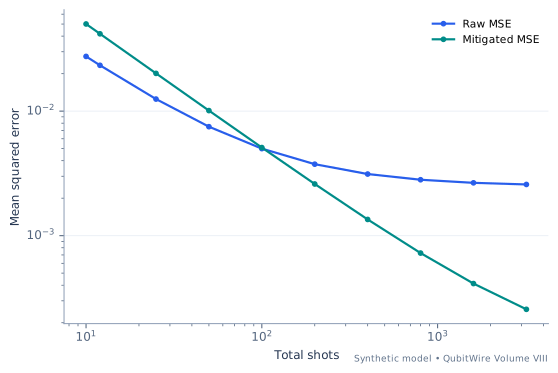
Each case uses invented inputs. The results follow from this model and do not describe measured hardware.
| Calculated quantity | Synthetic result |
|---|---|
| Raw mean squared error | 0.005000000000000001 |
| Mitigated mean squared error | 0.0051 |
| Raw root mean squared error | 0.07071067811865477 |
| Mitigated root mean squared error | 0.07141428428542851 |
| Continuous crossover shots | 104.16666666666664 |
At 100 shots, the raw estimate has lower modeled MSE. This is an accuracy comparison over repeated hypothetical experiments, not a judgment based on whichever single answer looks closer to an expected result. Biases must be independently characterized before using the model to plan an experiment.
| Calculated quantity | Synthetic result |
|---|---|
| Raw mean squared error | 0.0025781250000000006 |
| Mitigated mean squared error | 0.00055625 |
| Raw root mean squared error | 0.05077524002897476 |
| Mitigated root mean squared error | 0.02358495283014151 |
| Continuous crossover shots | 119.04761904761904 |
At 3,200 shots, mitigation has lower modeled MSE. This is an accuracy comparison over repeated hypothetical experiments, not a judgment based on whichever single answer looks closer to an expected result. Biases must be independently characterized before using the model to plan an experiment.
| Calculated quantity | Synthetic result |
|---|---|
| Raw mean squared error | 0.0025012207031250007 |
| Mitigated mean squared error | 0.0010276621093749999 |
| Raw root mean squared error | 0.05001220554149757 |
| Mitigated root mean squared error | 0.03205716939118299 |
| Continuous crossover shots | 338.75338753387524 |
At 204,800 shots, mitigation has lower modeled MSE. This is an accuracy comparison over repeated hypothetical experiments, not a judgment based on whichever single answer looks closer to an expected result. Biases must be independently characterized before using the model to plan an experiment.
Try the reasoning: At what shot budget does the lower modeled bias repay the extra variance? Explain why a single favorable estimate cannot establish that crossover.
Error-mitigation methods target expectation-value errors using techniques such as noise extrapolation and quasiprobability sampling. The MSE lab is an independently derived decision model; it does not attribute its assumed residual biases or variance multipliers to this paper.
Source research checked . Teaching calculations are ideal models.
A small logical error probability is meaningful only beside the number of opportunities for failure. A memory experiment, a short logical operation and a large algorithm can tolerate very different per-round rates. Choosing a code distance therefore starts with a workload and an explicit accounting convention, rather than a desired number of decimal places.
The model assigns a simple distance-dependent logical error and makes each logical operation consume a number of correction rounds proportional to distance. Increasing distance improves one factor while increasing the exposure count, footprint and serial duration. The calculation then selects the smallest tested odd distance meeting a stated union-bound target. A union bound adds event probabilities and does not require the events to be independent, although the assumed per-location probabilities remain a strong physical modeling choice.
This is an accounting exercise, not a surface-code resource estimate for a named algorithm. A real implementation must also count factories, routing, boundaries, correlated faults, logical gate constructions and recovery behavior. Moving from per-location protection to complete-workload protection requires an explicit exposure count. The footprint must also state which resources it excludes.
p_L(d) = A × ratio^((d+1)/2)
Counted locations = logical_registers × base_operations × d
Workload union bound = min(1, counted_locations × p_L)
Toy patch footprint = logical_registers × (2d²-1)
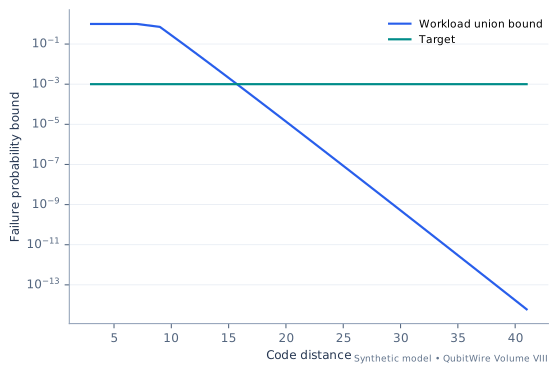
Each case uses invented inputs. The results follow from this model and do not describe measured hardware.
| Calculated quantity | Synthetic result |
|---|---|
| Smallest passing tested distance | 17 |
| Chosen-distance logical error per location | 2.0639121407999993e-10 |
| Counted fault locations | 1360000 |
| Union-bound workload failure | 0.0002806920511487999 |
| Illustrative physical-qubit footprint | 4616 |
| Serial operation time, seconds | 0.17 |
| Distance | Per-location error | Counted locations | Workload failure bound | Physical qubits | Seconds |
|---|---|---|---|---|---|
| 3 | 0.000576 | 240000 | 1 | 136 | 0.03 |
| 5 | 0.00006911999999999999 | 400000 | 1 | 392 | 0.05 |
| 7 | 0.000008294399999999998 | 560000 | 1 | 776 | 0.07 |
| 9 | 9.95328e-7 | 720000 | 0.71663616 | 1288 | 0.09 |
| 11 | 1.1943935999999997e-7 | 880000 | 0.10510663679999997 | 1928 | 0.11 |
| 13 | 1.4332723199999996e-8 | 1040000 | 0.014906032127999996 | 2696 | 0.13 |
| 15 | 1.7199267839999996e-9 | 1200000 | 0.0020639121407999995 | 3592 | 0.15 |
| 17 | 2.0639121407999993e-10 | 1360000 | 0.0002806920511487999 | 4616 | 0.17 |
| 19 | 2.476694568959999e-11 | 1520000 | 0.00003764575744819199 | 5768 | 0.19 |
| 21 | 2.9720334827519992e-12 | 1680000 | 0.000004993016251023359 | 7048 | 0.21 |
| 23 | 3.5664401793023986e-13 | 1840000 | 6.562249929916414e-7 | 8456 | 0.23 |
| 25 | 4.2797282151628786e-14 | 2000000 | 8.559456430325757e-8 | 9992 | 0.25 |
| 27 | 5.135673858195453e-15 | 2160000 | 1.1093055533702179e-8 | 11656 | 0.27 |
| 29 | 6.162808629834545e-16 | 2320000 | 1.4297716021216143e-9 | 13448 | 0.29 |
| 31 | 7.395370355801452e-17 | 2480000 | 1.8340518482387603e-10 | 15368 | 0.31 |
| 33 | 8.874444426961742e-18 | 2640000 | 2.3428533287178998e-11 | 17416 | 0.33 |
| 35 | 1.064933331235409e-18 | 2800000 | 2.981813327459145e-12 | 19592 | 0.35 |
| 37 | 1.277919997482491e-19 | 2960000 | 3.7826431925481733e-13 | 21896 | 0.37 |
| 39 | 1.533503996978989e-20 | 3120000 | 4.784532470574446e-14 | 24328 | 0.39 |
| 41 | 1.8402047963747867e-21 | 3280000 | 6.0358717321093e-15 | 26888 | 0.41 |
Distance 17 is the smallest tested odd distance meeting the stated target. The gate count alone is not the exposure count: this model makes each logical operation last d rounds. Its scaling prefactor and threshold ratio are invented. No threshold theorem or device forecast is inferred from the scan.
| Calculated quantity | Synthetic result |
|---|---|
| Smallest passing tested distance | 29 |
| Chosen-distance logical error per location | 2.7513843128286442e-11 |
| Counted fault locations | 31320000 |
| Union-bound workload failure | 0.0008617335667779314 |
| Illustrative physical-qubit footprint | 30258 |
| Serial operation time, seconds | 2.61 |
| Distance | Per-location error | Counted locations | Workload failure bound | Physical qubits | Seconds |
|---|---|---|---|---|---|
| 3 | 0.002401 | 3240000 | 1 | 306 | 0.27 |
| 5 | 0.0005882449999999999 | 5400000 | 1 | 882 | 0.45 |
| 7 | 0.00014412002499999998 | 7560000 | 1 | 1746 | 0.63 |
| 9 | 0.000035309406125 | 9720000 | 1 | 2898 | 0.81 |
| 11 | 0.000008650804500625 | 11880000 | 1 | 4338 | 0.99 |
| 13 | 0.000002119447102653125 | 14040000 | 1 | 6066 | 1.17 |
| 15 | 5.192645401500155e-7 | 16200000 | 1 | 8082 | 1.35 |
| 17 | 1.272198123367538e-7 | 18360000 | 1 | 10386 | 1.53 |
| 19 | 3.116885402250468e-8 | 20520000 | 0.639584884541796 | 12978 | 1.71 |
| 21 | 7.636369235513648e-9 | 22680000 | 0.17319285426144954 | 15858 | 1.89 |
| 23 | 1.8709104627008436e-9 | 24840000 | 0.046473415893488954 | 19026 | 2.07 |
| 25 | 4.5837306336170665e-10 | 27000000 | 0.01237607271076608 | 22482 | 2.25 |
| 27 | 1.1230140052361812e-10 | 29160000 | 0.0032747088392687043 | 26226 | 2.43 |
| 29 | 2.7513843128286442e-11 | 31320000 | 0.0008617335667779314 | 30258 | 2.61 |
| 31 | 6.740891566430178e-12 | 33480000 | 0.00022568504964408235 | 34578 | 2.79 |
| 33 | 1.6515184337753934e-12 | 35640000 | 0.00005886011697975502 | 39186 | 2.97 |
| 35 | 4.046220162749714e-13 | 37800000 | 0.000015294712215193918 | 44082 | 3.15 |
| 37 | 9.913239398736799e-14 | 39960000 | 0.000003961330463735225 | 49266 | 3.33 |
| 39 | 2.428743652690516e-14 | 42120000 | 0.0000010229868265132453 | 54738 | 3.51 |
| 41 | 5.950421949091763e-15 | 44280000 | 2.634846839057833e-7 | 60498 | 3.69 |
Distance 29 is the smallest tested odd distance meeting the stated target. The gate count alone is not the exposure count: this model makes each logical operation last d rounds. Its scaling prefactor and threshold ratio are invented. No threshold theorem or device forecast is inferred from the scan.
| Calculated quantity | Synthetic result |
|---|---|
| Smallest passing tested distance | No tested distance passes |
| Chosen-distance logical error per location | 1.3508247196523e-10 |
| Counted fault locations | 147600000 |
| Union-bound workload failure | 0.01993817286206795 |
| Illustrative physical-qubit footprint | 100830 |
| Serial operation time, seconds | 10.332 |
| Distance | Per-location error | Counted locations | Workload failure bound | Physical qubits | Seconds |
|---|---|---|---|---|---|
| 3 | 0.006241000000000001 | 10800000 | 1 | 510 | 0.756 |
| 5 | 0.0024651950000000003 | 18000000 | 1 | 1470 | 1.26 |
| 7 | 0.0009737520250000003 | 25200000 | 1 | 2910 | 1.764 |
| 9 | 0.00038463204987500006 | 32400000 | 1 | 4830 | 2.268 |
| 11 | 0.00015192965970062505 | 39600000 | 1 | 7230 | 2.772 |
| 13 | 0.0000600122155817469 | 46800000 | 1 | 10110 | 3.276 |
| 15 | 0.000023704825154790025 | 54000000 | 1 | 13470 | 3.78 |
| 17 | 0.00000936340593614206 | 61200000 | 1 | 17310 | 4.284 |
| 19 | 0.000003698545344776114 | 68400000 | 1 | 21630 | 4.788 |
| 21 | 0.0000014609254111865652 | 75600000 | 1 | 26430 | 5.292 |
| 23 | 5.770655374186932e-7 | 82800000 | 1 | 31710 | 5.796 |
| 25 | 2.2794088728038384e-7 | 90000000 | 1 | 37470 | 6.3 |
| 27 | 9.003665047575162e-8 | 97200000 | 1 | 43710 | 6.804 |
| 29 | 3.556447693792189e-8 | 104400000 | 1 | 50430 | 7.308 |
| 31 | 1.4047968390479147e-8 | 111600000 | 1 | 57630 | 7.812 |
| 33 | 5.548947514239264e-9 | 118800000 | 0.6592149646916245 | 65310 | 8.316 |
| 35 | 2.191834268124509e-9 | 126000000 | 0.27617111778368814 | 73470 | 8.82 |
| 37 | 8.657745359091812e-10 | 133200000 | 0.11532116818310294 | 82110 | 9.324 |
| 39 | 3.419809416841266e-10 | 140400000 | 0.048014124212451374 | 91230 | 9.828 |
| 41 | 1.3508247196523e-10 | 147600000 | 0.01993817286206795 | 100830 | 10.332 |
The tested distance range does not meet the target. The gate count alone is not the exposure count: this model makes each logical operation last d rounds. Its scaling prefactor and threshold ratio are invented. No threshold theorem or device forecast is inferred from the scan.
Try the reasoning: Double the number of stored logical registers. Which costs and failure opportunities increase even if the serial operation count stays fixed?
Surface-code computation requires physical layouts, repeated stabilizer information and logical operation constructions with resource costs. Only architectural context is used. All scaling coefficients and workload values in the lab are invented, and the toy footprint excludes substantial resources.
Source research checked . Teaching calculations are ideal models.
A quantum computation may need a special resource in bursts while its production machinery works at a steadier pace. Total production can exceed total demand and still fail to serve the schedule, because the resource arrives after the moment it was needed. A supply-rate number by itself cannot settle that timing question.
The constructed schedule treats production and demand as tokens at discrete boundaries. Three slots have no production, and repeated demand bursts create deficits. The smallest initial reserve is determined by the deepest cumulative deficit. After adding that reserve, the highest resulting inventory gives a boundary-capacity requirement. This makes two design questions visible: how much stock must exist before the computation starts, and how much can accumulate later.
If the tokens represent quantum states, the classical balance is only a first layer. States may age, occupy protected qubits, fail a quality test or be consumed by failed operations. The example therefore belongs beside a resource factory explanation with its scope stated clearly. It offers an exact demand-planning calculation without implying that quantum states are interchangeable durable objects in a warehouse.
Cumulative net supply at slot t = sum_{i<=t}(supply_i-demand_i)
Minimum initial reserve = max(0, -minimum cumulative net supply)
Boundary capacity = maximum(initial reserve + cumulative net supply), including time zero
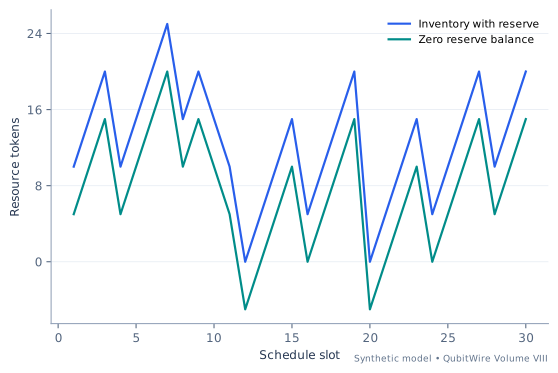
Each case uses invented inputs. The results follow from this model and do not describe measured hardware.
| Calculated quantity | Synthetic result |
|---|---|
| Total produced tokens | 270 |
| Total requested tokens | 255 |
| Minimum initial reserve | 5 |
| Required capacity at slot boundaries | 25 |
| Final inventory with that reserve | 20 |
| Supply-minus-demand over campaign | 15 |
| Slot | Supply | Demand | Inventory with reserve |
|---|---|---|---|
| 1 | 10 | 5 | 10 |
| 2 | 10 | 5 | 15 |
| 3 | 10 | 5 | 20 |
| 4 | 10 | 20 | 10 |
| 5 | 10 | 5 | 15 |
| 6 | 10 | 5 | 20 |
| 7 | 10 | 5 | 25 |
| 8 | 10 | 20 | 15 |
| 9 | 10 | 5 | 20 |
| 10 | 0 | 5 | 15 |
| 11 | 0 | 5 | 10 |
| 12 | 10 | 20 | 0 |
| 13 | 10 | 5 | 5 |
| 14 | 10 | 5 | 10 |
| 15 | 10 | 5 | 15 |
| 16 | 10 | 20 | 5 |
| 17 | 10 | 5 | 10 |
| 18 | 10 | 5 | 15 |
| 19 | 10 | 5 | 20 |
| 20 | 0 | 20 | 0 |
| 21 | 10 | 5 | 5 |
| 22 | 10 | 5 | 10 |
| 23 | 10 | 5 | 15 |
| 24 | 10 | 20 | 5 |
| 25 | 10 | 5 | 10 |
| 26 | 10 | 5 | 15 |
| 27 | 10 | 5 | 20 |
| 28 | 10 | 20 | 10 |
| 29 | 10 | 5 | 15 |
| 30 | 10 | 5 | 20 |
The toy schedule needs 5 stored tokens before it begins, even though net production across the campaign is 15. A reserve addresses timing, not state quality. If tokens represent prepared quantum resources, finite storage lifetime and extra storage qubits require a separate physical model.
| Calculated quantity | Synthetic result |
|---|---|
| Total produced tokens | 297 |
| Total requested tokens | 360 |
| Minimum initial reserve | 63 |
| Required capacity at slot boundaries | 83 |
| Final inventory with that reserve | 0 |
| Supply-minus-demand over campaign | -63 |
| Slot | Supply | Demand | Inventory with reserve |
|---|---|---|---|
| 1 | 11 | 7 | 67 |
| 2 | 11 | 7 | 71 |
| 3 | 11 | 7 | 75 |
| 4 | 11 | 7 | 79 |
| 5 | 11 | 7 | 83 |
| 6 | 11 | 37 | 57 |
| 7 | 11 | 7 | 61 |
| 8 | 11 | 7 | 65 |
| 9 | 11 | 7 | 69 |
| 10 | 0 | 7 | 62 |
| 11 | 0 | 7 | 55 |
| 12 | 11 | 37 | 29 |
| 13 | 11 | 7 | 33 |
| 14 | 11 | 7 | 37 |
| 15 | 11 | 7 | 41 |
| 16 | 11 | 7 | 45 |
| 17 | 11 | 7 | 49 |
| 18 | 11 | 37 | 23 |
| 19 | 11 | 7 | 27 |
| 20 | 0 | 7 | 20 |
| 21 | 11 | 7 | 24 |
| 22 | 11 | 7 | 28 |
| 23 | 11 | 7 | 32 |
| 24 | 11 | 37 | 6 |
| 25 | 11 | 7 | 10 |
| 26 | 11 | 7 | 14 |
| 27 | 11 | 7 | 18 |
| 28 | 11 | 7 | 22 |
| 29 | 11 | 7 | 26 |
| 30 | 11 | 37 | 0 |
The toy schedule needs 63 stored tokens before it begins, even though net production across the campaign is -63. A reserve addresses timing, not state quality. If tokens represent prepared quantum resources, finite storage lifetime and extra storage qubits require a separate physical model.
| Calculated quantity | Synthetic result |
|---|---|
| Total produced tokens | 351 |
| Total requested tokens | 450 |
| Minimum initial reserve | 99 |
| Required capacity at slot boundaries | 129 |
| Final inventory with that reserve | 0 |
| Supply-minus-demand over campaign | -99 |
| Slot | Supply | Demand | Inventory with reserve |
|---|---|---|---|
| 1 | 13 | 7 | 105 |
| 2 | 13 | 7 | 111 |
| 3 | 13 | 7 | 117 |
| 4 | 13 | 7 | 123 |
| 5 | 13 | 7 | 129 |
| 6 | 13 | 55 | 87 |
| 7 | 13 | 7 | 93 |
| 8 | 13 | 7 | 99 |
| 9 | 13 | 7 | 105 |
| 10 | 0 | 7 | 98 |
| 11 | 0 | 7 | 91 |
| 12 | 13 | 55 | 49 |
| 13 | 13 | 7 | 55 |
| 14 | 13 | 7 | 61 |
| 15 | 13 | 7 | 67 |
| 16 | 13 | 7 | 73 |
| 17 | 13 | 7 | 79 |
| 18 | 13 | 55 | 37 |
| 19 | 13 | 7 | 43 |
| 20 | 0 | 7 | 36 |
| 21 | 13 | 7 | 42 |
| 22 | 13 | 7 | 48 |
| 23 | 13 | 7 | 54 |
| 24 | 13 | 55 | 12 |
| 25 | 13 | 7 | 18 |
| 26 | 13 | 7 | 24 |
| 27 | 13 | 7 | 30 |
| 28 | 13 | 7 | 36 |
| 29 | 13 | 7 | 42 |
| 30 | 13 | 55 | 0 |
The toy schedule needs 99 stored tokens before it begins, even though net production across the campaign is -99. A reserve addresses timing, not state quality. If tokens represent prepared quantum resources, finite storage lifetime and extra storage qubits require a separate physical model.
Try the reasoning: Would the same reserve suffice if each slot demanded its tokens before new supply arrived? State the within-slot ordering explicitly.
Source research checked . Teaching calculations are ideal models.
Apply an ideal amplitude-damping channel with parameter γ to a plus state. The parameter is the probability of relaxation from the excited basis state in this model. It is not a universal error rate for a physical processor and does not include every source of dephasing or leakage.
Relaxation is directional: it moves population toward the chosen ground state. Depolarizing noise has a different geometry, so one scalar error number cannot describe both processes. An explanatory chart can show population and coherence separately, making clear why a Z-only measurement misses part of the channel’s action.
Figure and table scope: Sweep amplitude-damping parameter γ from 0 to 1 for a plus-state input. This figure does not plot the separate phase-damping channel.
Derivation step 1: Use Kraus operators E0=diag(1,√(1-γ)) and E1=√γ |0><1|. Their adjoint products sum to identity, preserving total probability.
Derivation step 2: For an input matrix [[a,b],[b*,d]], the output is [[a+γd,√(1-γ)b],[√(1-γ)b*,(1-γ)d]].
Derivation step 3: For plus and γ=0.36, the output is [[0.68,0.4],[0.4,0.32]]. The excited population falls and off-diagonal coherence shrinks.
Derivation step 4: The output remains positive and trace one. Its Bloch coordinates in this real-input example are x=0.8, y=0 and z=0.36, which lie inside the unit sphere.
Separate challenge: At γ=1, what state emerges from any normalized input? At γ=0, what should a correct implementation do?
Worked challenge answer: At complete damping the output is the ground-state projector, independent of the input. At zero damping the output equals the input. These endpoint identities are strong implementation checks because they test both population transfer and coherence handling.
Excited population=(1−γ)/2; X expectation=√(1−γ).
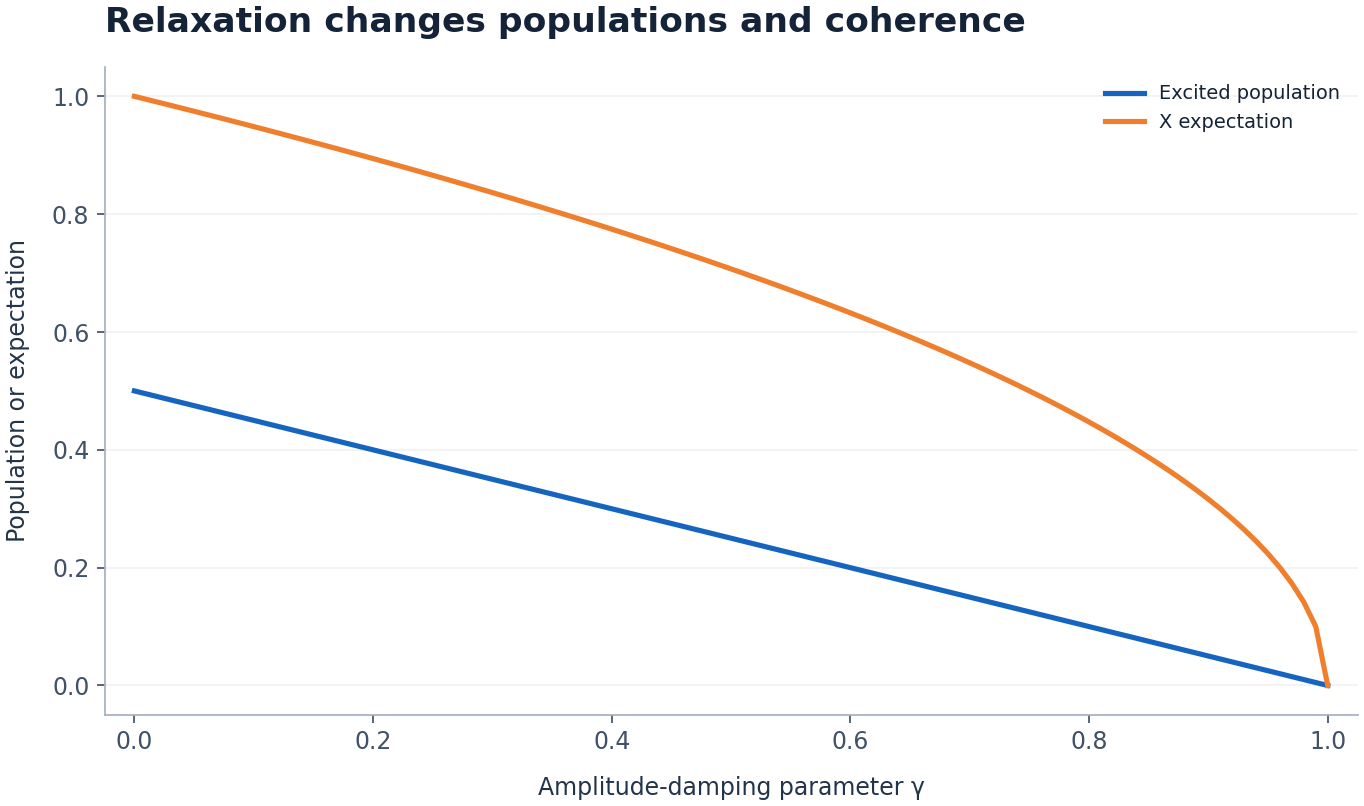
Each case uses invented inputs. The results follow from this model and do not describe measured hardware.
| Reference | Prediction |
|---|---|
| Original declared example | The excited population becomes 0.32, the ground population 0.68 and the real off-diagonal entry 0.40. Pure dephasing with the same 0.40 coherence would instead retain equal populations. |
| Amplitude-damping parameter γ | Excited population | X expectation |
|---|---|---|
| 0 | 0.5 | 1 |
| 0.12 | 0.44 | 0.938083151964686 |
| 0.25 | 0.375 | 0.8660254037844386 |
| 0.37 | 0.315 | 0.7937253933193772 |
| 0.5 | 0.25 | 0.7071067811865476 |
| 0.62 | 0.19 | 0.6164414002968976 |
| 0.75 | 0.125 | 0.5 |
| 0.87 | 0.065 | 0.36055512754639896 |
| 1 | 0 | 0 |
The declared reference example predicts: The excited population becomes 0.32, the ground population 0.68 and the real off-diagonal entry 0.40. Pure dephasing with the same 0.40 coherence would instead retain equal populations.
Try the reasoning: At γ=1, what state emerges from any normalized input? At γ=0, what should a correct implementation do?
Primary scientific context for an original ideal teaching example. Source research checked 19 October 2026; site integration inspected 20 October 2026. These are different checks.
Primary scientific context for an original ideal teaching example. Source research checked 19 October 2026; site integration inspected 20 October 2026. These are different checks.
Follow this topic in your RSS reader →
DAWG reduces reliance on an extra correction stage in numerical tests. Its hardware latency remains an estimate.
A transformer decoder reaches journal publication with promising surface-code simulations. The headline percentage describes code-capacity noise, not a hardware gate-error allowance.
Initial experiments have begun at IQCC. Decoder integration remains ahead, and the company says real-time correction has not yet been demonstrated.
Three demonstrators bring core error-correction operations onto hardware. The company explicitly says its logical error rate is not yet below threshold.
A distributed simulation models a 104-qubit protocol with a smaller evolving representation. Memory, runtime and noise assumptions define the result.
A theory study separates locally corrected errors from the phase revealed when two memories are compared. References and readout define the claim.
A company benchmark accelerates training. Complete calibration and live feedback require separate measurements.
The NVQLink proof of concept connects control electronics to GPU decoding. It does not yet perform real-time error correction.
Oratomic reports $775 million in cumulative financing. Its neutral-atom bet connects ambitious error-correction research to a machine that still needs to be demonstrated.
An October 5 preprint gives exact polynomial-time simulation for a restricted non-Clifford circuit class. Its benchmarks reveal why the best simulator depends on the workload and sampling budget.
An October 5 preprint tests a hardware-screening method across ten quantum processors. Its strongest question is whether cheaper checks can identify where logical-memory experiments will work best.
An October 2 preprint reports modular neural decoding of IBM memory and lattice-surgery experiments. Reusing the architecture reduces redesign, but live processing speed remains unmeasured.
This small experiment does not establish sustained streaming performance for larger codes. Mean decoding time is not a worst-case guarantee or full feedback latency.
The 90-cycle result does not demonstrate indefinitely accurate computation or universal fault tolerance. Lower error for the larger code in short runs must not be generalized to the deep-run results.
This is not a demonstrated large error-corrected processor. Error behavior worsens at greater repeated-gate depth; the surface-code simulation assumes perfect erasure checks and restricted noise models.
This does not demonstrate uninterrupted execution of a long algorithm. The reported decoder steering has real-time scaling limitations; large-code scaling and continuous steering are studied in simulation.
What this supports Google Quantum AI and collaborators reported below-threshold surface-code quantum memories. Under the experiment’s conditions, increasing the code distance reduced logical errors. The paper studies protecting stored quantum information and discusses the additional work needed for logical computation.
What it does not establish This memory result does not demonstrate that an arbitrary useful application can run fault-tolerantly. Read the methods and resource conditions before comparing it with an application claim. The April 2026 correction amends labels and keys in Figure 3a; both the paper and correction are linked here.
Protecting a memory is one part of reliable computation

What this supports: Google Quantum AI and collaborators reported below-threshold surface-code quantum memories. Under the experiment’s conditions, increasing the code distance reduced logical errors. The paper studies protecting stored quantum information and discusses the additional work needed for logical computation.

What it does not establish: This memory result does not demonstrate that an arbitrary useful application can run fault-tolerantly. Read the methods and resource conditions before comparing it with an application claim. The April 2026 correction amends labels and keys in Figure 3a; both the paper and correction are linked here.

Google Quantum AI and Collaborators: Quantum error correction below the surface code threshold (Published online 9 December 2024): https://www.nature.com/articles/s41586-024-08449-y

Nature: Author correction to the surface-code memory paper (28 April 2026): https://www.nature.com/articles/s41586-026-10559-8

Context: https://qubitwire.com/topics/error-correction#reality-card-memory

Source check: 24 September 2026. Version 1. Check the context link for updates.
A physical qubit is part of the hardware. A logical qubit is quantum information encoded in physical hardware using an error-correcting code, often across multiple physical qubits. It is an encoding, not an additional piece of hardware. The goal is to preserve information more reliably despite imperfect components.
| Count | What it tells you |
|---|---|
| Physical qubits | The hardware resources. The count alone does not specify their errors, connectivity or usable operations. |
| Logical qubits | The encoded information. Interpret the count alongside the code, logical error rate and operations demonstrated. |
There is no universal conversion ratio. Resource requirements depend on the code, the hardware’s noise and the reliability needed for the task. Error correction adds work as well as qubits. Logical qubits can still fail; “logical” does not mean error-free. IBM’s explanation of encoding and overhead sets out these tradeoffs.
Preserving encoded information is one task. Performing reliable logical gates is another: gates, measurements and correction steps can introduce or spread errors themselves. A memory result should therefore be read within its demonstrated scope. IBM’s fault-tolerance lesson explains why protection must continue while operations are performed.
In a 2023 surface-code experiment, Google Quantum AI compared logical performance at different code sizes. The study illustrates the central test: whether added protection outweighs the extra opportunities for error. It is a dated experiment, not a statement of today’s complete computing capability.
When comparing claims, look for the noise assumptions, measured logical error, repeated correction cycles, operations tested and total resource cost. Keep hardware measurements, simulations and future resource estimates separate. A larger headline count cannot answer those questions on its own.
A reported count may include only data qubits, or also measurement ancillas and other support qubits. A complete computational estimate can additionally depend on routing, state preparation, factories, spare capacity and simultaneously active logical operations. Before comparing numbers, ask whether they count the same things. The 101-physical-qubit memory example illustrates one particular boundary.
The encoding matters too. Bosonic codes can encode a logical qubit in the states of an oscillator rather than only distributing it across two-level physical qubits. The 2020 oscillator grid-state experiment illustrates that distinction; control and measurement hardware still belong in its resource count.
Follow the classical processing too. A decoder may be evaluated on stored data, in a streaming pipeline or in a feedback loop. Work completed per round and the time until a feedback action is available are different measurements. Record where each timing interval begins and ends.
A journal paper and an earlier preprint can report different model values. Use the version that supports the number being quoted; do not blend values or treat a model threshold as a hardware measurement. Compare the qLDPC memory journal paper with its version 2 preprint. Surface codes are themselves qLDPC codes; comparisons with other constructions need their connectivity, decoder and noise assumptions.
Primer sources checked . Explanatory comparison, not a hardware ranking.Use the fair-comparison worksheet →
Develops quantum hardware and error-correction methods, while selected research partners use Willow for programmable scientific experiments.
Research & evidence →Plaquette lets hardware teams compare error-correcting codes and architectures under device-specific noise, including leakage and coherent errors that simpler noise models can miss.
Research & evidence →QESEM characterizes device noise, optimizes circuit execution and combines additional measurements with classical processing to estimate observables with uncertainty bars.
Research & evidence →Provides programmable trapped-ion computers and tools for circuits with mid-circuit measurement, reset and classical feedback, alongside emulators for development.
Research & evidence →Builds the classical processing that interprets repeated quantum error-check measurements. Deltaflow connects decoding hardware to a quantum control system; Deltakit supplies software for designing, simulating and analyzing QEC experiments.
Research & evidence →Selected organizations relevant to this topic. Inclusion is not a ranking.
IBM and IBM Research tour cryogenic infrastructure and modular engineering being developed for Starling. The video describes work toward a large-scale fault-tolerant computer; it does not establish that Starling is complete. Published October 23, 2026. Opens on the official provider.
View video details →Short supporting clip linked from Quantinuum’s October 19 Helios research article. Open the original provider clip; this is not a full talk.
View video details →Qiskit explains how parity checks, stabilizer measurements and combinations of checks can flag suspect quantum-computing runs so they can be discarded. The lesson introduces post-selection, with useful context for understanding error-correction research. The important trade-off is that rejecting runs reduces the number of usable samples; this is an error-detection approach, not a demonstration of full fault-tolerant computation or quantum advantage.
View video details →John Preskill's Quantum World Congress 2026 talk assesses the transition from noisy intermediate-scale quantum devices toward fault tolerance, including error-correction overhead, QLDPC codes, neutral atoms, cryogenic control and changing resource estimates. It is included as a fresh first-party conference research talk despite its early view count; the presentation is analysis and outlook, not evidence that fault-tolerant hardware has already arrived.
View video details →