
Alice & Bob’s GPU Decoding Test Uses Synthetic Errors
The NVQLink proof of concept connects control electronics to GPU decoding. It does not yet perform real-time error correction.
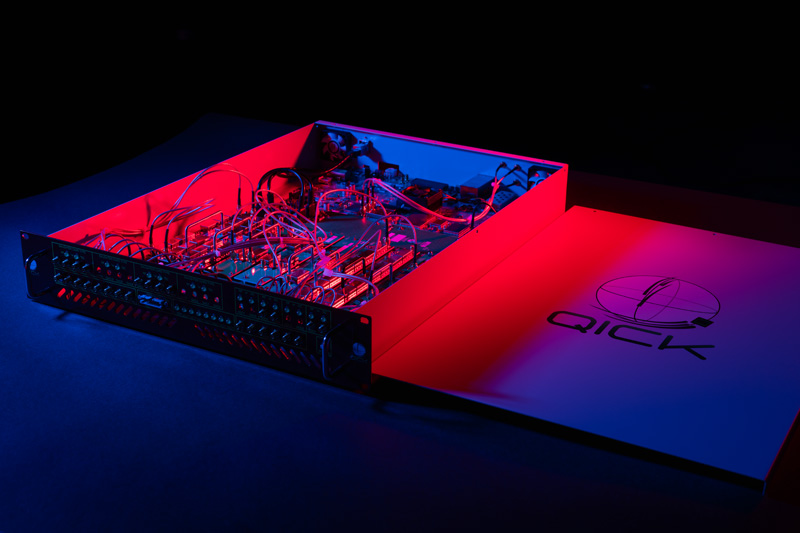
Alice & Bob reported an October 13 test of GPU decoding for its LDPC-cat codes using NVIDIA NVQLink and Quantum Machines’ OPX1000 controller. The input was synthetic data. The company explicitly says the implementation is not real-time decoding.[1]
The code family targets a particular kind of quantum hardware. Cat suppress bit-flip errors, leaving phase errors as the principal correction task. The January 2025 architecture paper combines that bias with low-density parity-check codes to reduce qubit overhead. Those modeled resource savings do not establish the speed of an implemented decoder.[2]
The interface is the new engineering focus. In Quantum Machines’ documented workflow, a controller streams measurement records to a classical accelerator, which calculates corrections and returns information for subsequent control. The vendor reports communication below four microseconds for an OPX1000–GraceHopper pairing. This is a link specification, not a measured Alice & Bob decoding response time.[3]
Alice & Bob reports greater efficiency when several error records are decoded together. Its announcement supplies no end-to-end latency or decoder-accuracy benchmark table. The stated next step is pipeline optimization. Synthetic inputs and batch processing leave a live feedback demonstration outstanding.[1]
A useful comparison is a separate June 2026 Riverlane–Rigetti experiment. Its FPGA decoder and superconducting processor completed a nine-round feedback test with a measured 9.6-microsecond response. That is a different code, processor and accelerator; it illustrates an end-to-end measurement, not an interchangeable performance target.[4]
QubitWire’s analysis: the practical advance to look for is a decoder becoming a working part of a control system. Three checks should remain separate: whether records arrive correctly, whether the inferred correction is reliable, and whether the returned decision arrives when the quantum program needs it. Passing one does not establish the other two.[3][4]
The next informative test would publish the exact code and workload, then use measured quantum error records to report accuracy and complete response-time distributions. Transfer, queueing, computation and return traffic should all be counted. A same-workload comparison against an existing decoder would show what the GPU integration actually buys.[3][4]
Keep your reading trail
Keep up with these topics
Choose the subjects you want to find again in Your Updates.