
Riverlane and Rigetti Demonstrate Fast Live Error Decoding
An eight-qubit experiment reports mean decoding below one microsecond per round, with complete feedback measured separately.
A decoder average is not the whole feedback loop
- Reported
- Caune and colleagues report mean decoding below one microsecond per round in an eight-qubit stability experiment.
- Supported observation
- The measured mean ranged from 0.44 to 0.79 microseconds over 5–25 decoding rounds. A separate feedback experiment measured 9.6 microseconds for nine measurement rounds, including communication and control.
- Conditions
- A Collision Clustering FPGA decoder operated at 156.25 MHz within Rigetti Ankaa-2. The stability-8 circuit omitted the central X stabilizer. The per-round figure is a mean; some runs exceeded one microsecond.
This small experiment does not establish sustained streaming performance for larger codes. Mean decoding time is not a worst-case guarantee or full feedback latency.
- Demonstrating real-time and low-latency quantum error correction with superconducting qubitsNature Communications · Peer-reviewed primary research paper · Source published Source checked

Riverlane and Rigetti researchers have demonstrated real-time error decoding in an eight- stability experiment on Rigetti's Ankaa-2, published in Nature Communications. Decoding has to keep pace with incoming measurements; otherwise, an system can accumulate a backlog while the quantum hardware keeps running.
The experiment reaches 25 decoding rounds with mean decoding below one microsecond per round. A separate nine-round feedback path takes 9.6 microseconds, including communication and control.
The sub-microsecond number is an average, not a worst-case bound or the time for the complete feedback loop. It comes from a small experiment. Its relevance to larger codes depends on sustained throughput, the spread of decoding latencies and the performance of that full control loop.
Read the deeper explanation · about 6 min
This estimate covers the explanation below, separate from the overview. Optional depth was added in this reading edition. The article keeps one canonical address and its original chronology. Source review: . The relevant source dates and limitations are recorded below.
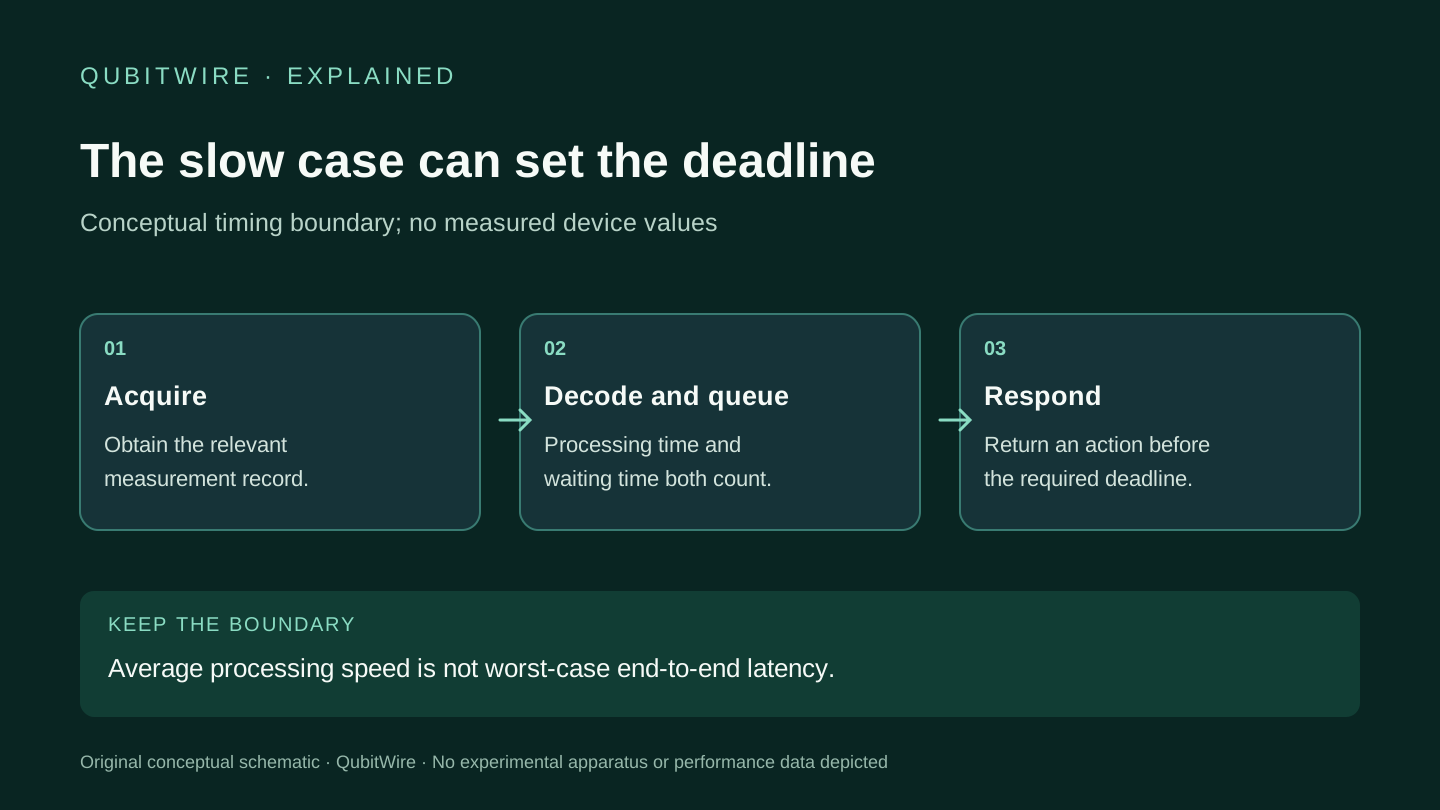
A quantum computer can have a problem even when the software knows how to handle its errors. The answer might arrive too late. That timing constraint is one reason error correction is not only a mathematical achievement. It is also a demanding exercise in real-time systems engineering.
The popular account usually stops after explaining that fragile physical qubits can be organized to protect a logical qubit. The next step is less photogenic. Measurements produce a continuing stream of information about possible errors. A classical process interprets that information. The machine must then use the interpretation in a way that remains consistent with the computation. A backlog can become a computing bottleneck even when the underlying inference method is accurate.[1]
The computer does not simply inspect its answer
Quantum error correction cannot work by repeatedly reading the protected quantum information as though it were an ordinary saved file. The design instead measures suitable properties that reveal information about errors without directly learning the logical state in the prohibited way. The resulting measurement information is often discussed in terms of a syndrome.[1]
A decoder uses those observations, together with the code and an error model, to infer how the computation should be interpreted or corrected. There may be several plausible explanations for what was measured. The decoder is solving an inference problem under physical and architectural constraints. It is not consulting a hidden perfect copy of the intended quantum state.[1]
This distinction matters when reading claims of automated correction. The phrase can refer to very different levels of integration. A paper might analyze stored data after an experiment. Another system might process a live measurement stream. A third might include feedback that affects later operations during the same run. Each can be important, but they are not interchangeable demonstrations.
Throughput and latency answer different questions
Throughput describes how much work a system can process over time. Latency describes how long an individual piece of work takes to produce a usable response. A decoder may look good on one measure while creating difficulties on the other.
Imagine an explicitly illustrative service desk. It can process a thousand requests over a day, but sometimes leaves one request waiting for an hour. That may be acceptable for a task with no immediate consequence. It is not acceptable for every real-time control task. The analogy does not reproduce quantum hardware. It simply shows why an average processing rate cannot, by itself, establish that deadlines are met.
A quantum system also needs to account for bursts and difficult instances. How often does decoding take much longer than usual? What happens when an unusual error pattern appears? Is there a defined fallback? Does the measurement stream continue to accumulate while a decision is pending? These questions are especially important when the claim extends beyond an isolated benchmark to a sustained operating system.
Not every decision has the same deadline
It would be misleading to conclude that every inferred correction must immediately produce a physical pulse. Quantum computing can track some corrections in a classical description, often called a frame, rather than applying a physical correction after every event. Which decisions can be deferred depends on the code, the operations and the control scheme.[1]
That flexibility is important engineering, not a reason to ignore timing. Some later operations require the system to know how earlier events should be interpreted. The relevant question is therefore not simply whether a decoder is faster than a single hardware cycle. It is whether the complete schedule can accommodate the decisions the computation actually needs.[1]
A careful report should identify this dependency. What event starts the clock? What output ends it? What must wait for that output? Are communication, buffering and format conversion included? A timing figure becomes meaningful only when its measurement boundary is clear. Otherwise, two groups can report different numbers while measuring different parts of the process.
The decoder depends on the machine it is decoding
An algorithm that performs well for one assumed noise model is not automatically the best choice for every device. Physical errors can be biased, correlated or time dependent. Measurement errors also matter. The code layout and the available operations shape the inference problem. A useful decoder must be evaluated against the conditions its target system is expected to encounter.[1]
This does not mean a decoder needs a perfect model of reality. That is rarely available. It means a performance claim should state the assumptions under which it was established and examine important departures from those assumptions. A comparison that gives one method privileged information or a different workload is difficult to interpret fairly.[1]
For readers, the useful checklist is short: which code, which noise model, which hardware assumptions, which accuracy measure and which timing boundary? These five questions do more to clarify a decoding claim than a league table containing only a speed number. The answers also help explain why apparently competing approaches may solve different parts of the problem.
The unglamorous journey from measurement to decision
Between a physical measurement and a decoding decision sits an implementation. Signals must be acquired, converted into a representation, transported and processed. The result must then reach the part of the control system that needs it. A fast mathematical routine can be surrounded by slow or unreliable plumbing.
This is why the supporting hardware and software deserve attention. Memory movement, network behavior, processor allocation, interface stability and observability can change sustained performance. Error handling is part of the design as well. A dropped message or a restarted process must not silently be interpreted as a successful clean experiment.
The strongest integrated demonstrations explain what happens outside the normal path. Can the system detect a backlog? Does it reject a run whose records are incomplete? Can an operator see which component missed a deadline? A machine that reports failure honestly is more useful than one that produces an attractive result without exposing gaps in its control history.
What a convincing improvement would show
A new decoding result becomes easier to assess when it reports both statistical performance and operating behavior. Readers should look for the probability of a logical failure under stated conditions, the amount of data processed, the duration of sustained operation and the distribution of response times. Not every study can address every dimension, but its scope should be explicit.[1][2]
A useful comparison should also include the resources required. Was the result obtained with a specialized accelerator, a general-purpose processor or a cluster? Was the experiment live or replayed? Were communication costs included? Was the code size held constant? These details do not diminish a result. They tell other engineers how to build on it.
The practical milestone is not that a decoder has become generically fast. It is that an identified computation can proceed without an unacceptable error rate or an unmanageable decision backlog. That is a system-level statement, and it deserves system-level evidence.
Why this changes the quantum story
Error correction is often described as the point at which quantum computing becomes dependable. The more complete picture is a chain: suitable physical operations, a useful code, informative measurements, effective inference and an implementation that keeps up. Improving any one link can help. Ignoring a weak link can prevent the gains elsewhere from becoming usable computing.[1]
The stopwatch is therefore not a secondary concern to be dealt with after the science is finished. It is one of the things that turns the science into an operating machine. The next announcement to watch is not only a lower logical error rate or a faster isolated decoder. It is evidence that the protected computation and the control system can run together, within the deadlines they impose on one another.
Evidence for this explanation
- Quantum Error Correction for Quantum Memories — version 7
Historical research review first submitted in 2013; complete current version checked October 11, 2026. Syndrome inference, Pauli frames and operation-dependent deadlines. It does not establish the performance of a current commercial decoder.
- Suppressing quantum errors by scaling a surface code logical qubit
Primary author preprint first submitted July 13, 2022, revised July 20; journal publication in 2023. Historical error-correction context, not a present-day latency ranking.