
IonQ Preprint Tests MegaQuOp Decoding on One Laptop CPU
A simulated trapped-ion architecture kept decoding delay below 12% across three compiled workloads, but no fault-tolerant quantum computer ran the experiment.
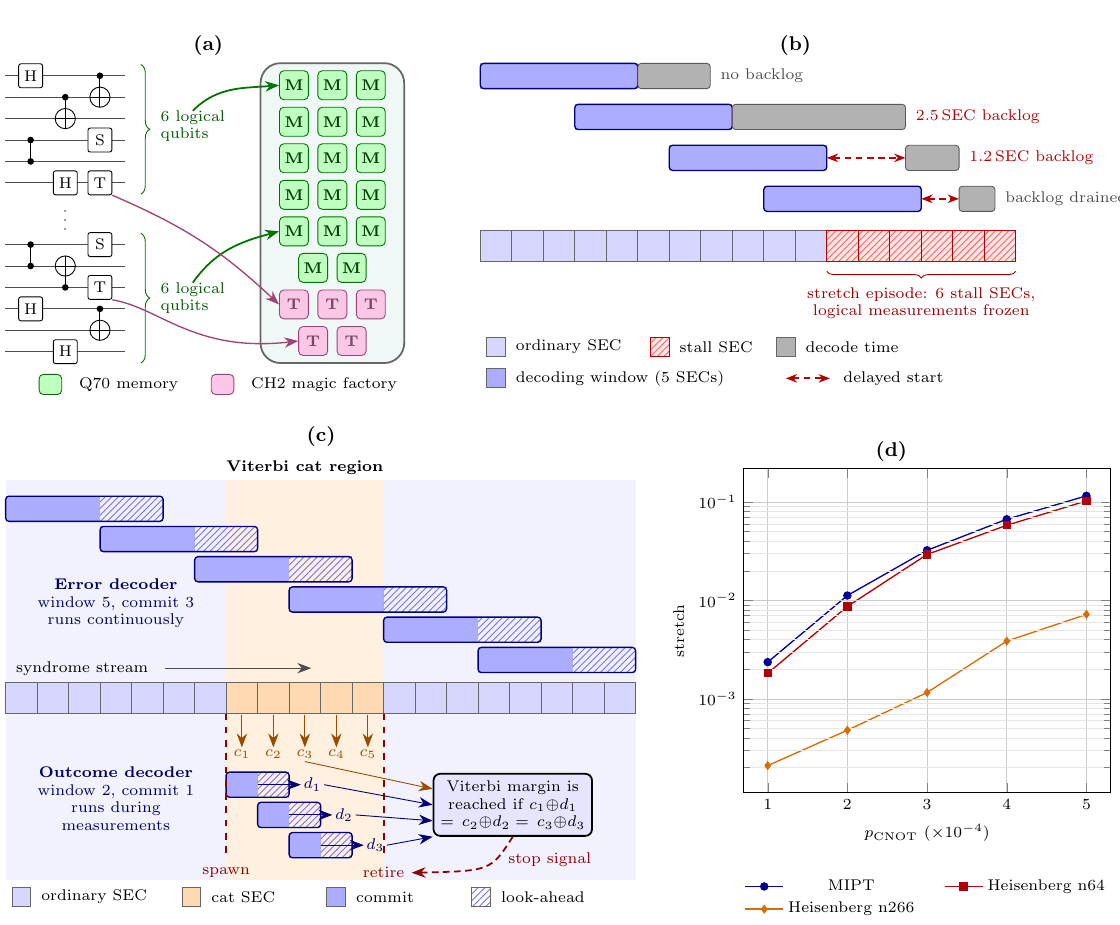
IonQ researchers used one laptop processor to test whether classical error-correction decoding could keep pace with a proposed large fault-tolerant machine. Their September 3 preprint update reports an end-to-end software benchmark on a 2024 Apple M4 Max using 12 CPU cores. IonQ publicized the same research in a September 22 announcement; that announcement did not report a new test on a physical fault-tolerant quantum computer.
Fault-tolerant quantum computers must interpret a continuous stream of syndrome measurements quickly enough to avoid stalling scheduled operations. The team’s walking-cat trapped-ion architecture keeps memory-block checks regular and splits work between always-on error decoders and lower-latency outcome decoders.
Across three compiled simulations spanning 102 to 408 , the largest setup modeled 11,680 . With assumed 1–5 millisecond syndrome cycles, decoder-induced schedule stretch stayed below 0.3% at a physical CNOT error probability of 10^-4 and below 12% at 5×10^-4.
Those numbers are not measurements from a fault-tolerant quantum computer. Quantum hardware and workloads were simulated, controller timing was excluded, and the magic-state factory replaced the physical |H> state with a stabilizer substitute. Rare convergence failures, which require a restart, also sit outside the stretch metric. The paper is an unreviewed preprint without identified independent replication.
The useful next test is a physical system that includes the full control stack, measures restart rates and verifies logical output quality under natural hardware noise. The authors have released their BeamSearchDecoder code, giving other teams a concrete route to reproduce or challenge the classical benchmark.