
Merlin Makes More Quantum Error-Correction Circuits Practical to Simulate
An October 5 preprint gives exact polynomial-time simulation for a restricted non-Clifford circuit class. Its benchmarks reveal why the best simulator depends on the workload and sampling budget.
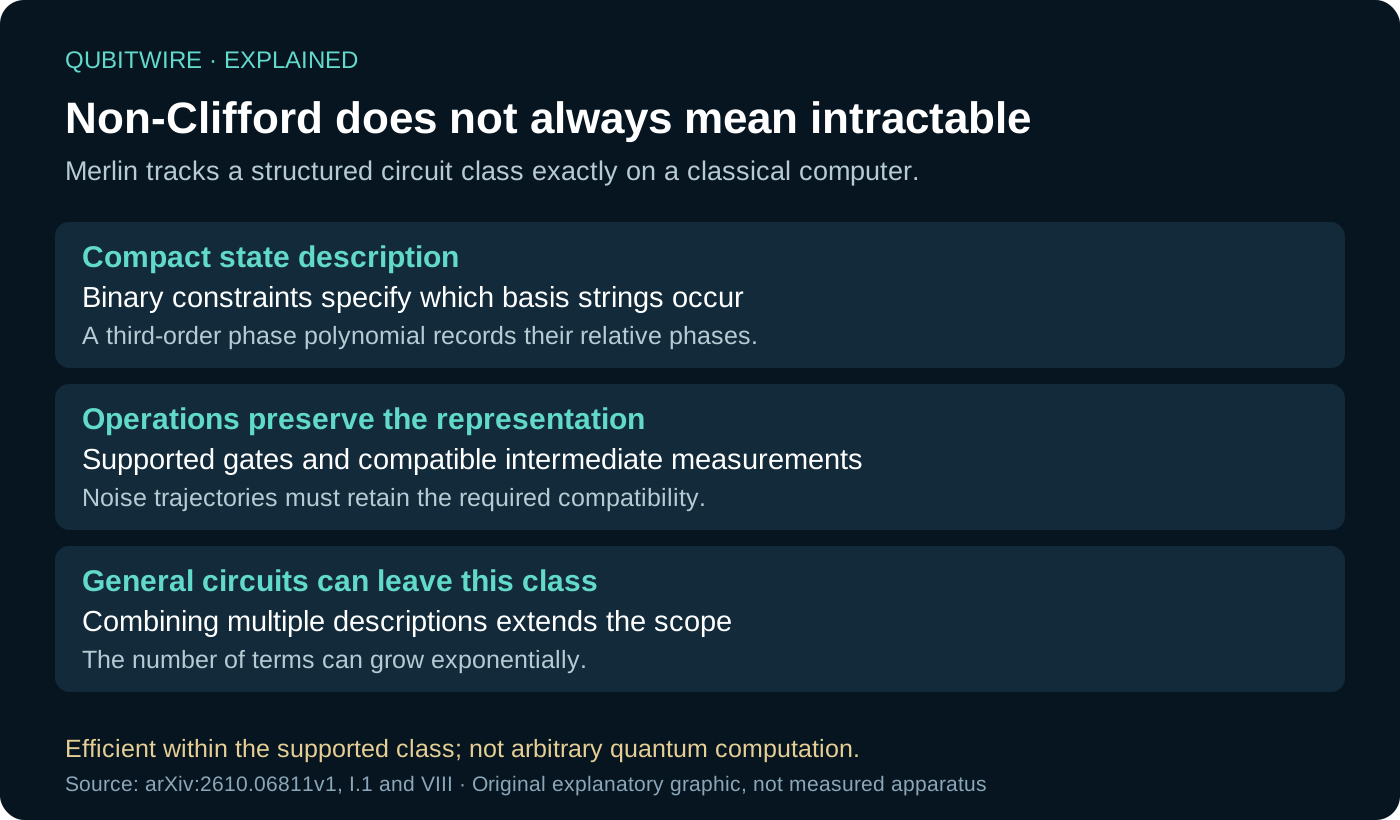
A new classical simulator could make an important part of quantum-computer design easier to test: the circuits that prepare and protect resources for non-Clifford operations. An October 5 preprint by Serban Cercelescu, Mark Koch and Arthur Pesah introduces Merlin and an exact polynomial-time simulation framework for a restricted but useful class of these circuits. The restriction is essential. This is not an efficient simulator for arbitrary quantum computation. It is a way to evaluate more of the machinery that a fault-tolerant computer needs before running that computation.[1][2]
Designers need such simulations because a clean logical circuit diagram does not reveal what happens after physical faults, repeated measurements and conditional corrections are included. Some circuits fit the stabilizer framework and are comparatively tractable to simulate. Non-Clifford operations often complicate that calculation. Preparing a magic state, for example, introduces the sort of resource required to move beyond Clifford computation. The engineering challenge is to determine whether the preparation works reliably under noise without making its classical evaluation prohibitively expensive.[2]
Compact bookkeeping beyond ordinary stabilizers
Merlin exploits structure rather than assuming every quantum state needs a huge table of amplitudes. The authors identify states whose occupied basis strings form a space described by binary linear constraints, with phases captured by a third-order polynomial. They also supply an equivalent description using diagonal-Clifford-and-Pauli stabilizers, abbreviated DCP. These descriptions retain enough information to update the conditional state efficiently as supported gates and measurements occur. The result extends the kind of compact bookkeeping that makes ordinary stabilizer simulation useful.[2]
The supported operations include Pauli, CNOT and T gates, together with specified preparations and measurements. Z-type Pauli measurements are supported, while X-type measurements must satisfy compatibility conditions that keep the state inside the represented class. Those conditions are part of the algorithm's power, not a technical footnote to discard. A simulator can contain non-Clifford gates and still handle a restricted family efficiently. Whether a particular circuit qualifies depends on its full sequence of operations and measurements, including the branches produced by noise.[2]
For relevant error-correction protocols, the paper gives sufficient conditions on the ideal circuit that guarantee compatibility along noisy trajectories. Stochastic Pauli faults can then be sampled while the conditional quantum state is tracked exactly. That wording separates two issues: exact evolution within the represented model and statistical estimation from repeated sampled runs. An exact simulator does not make a finite sample of rare failures statistically exact. It also does not establish that an assumed stochastic noise model describes every coherent or correlated effect in a physical device.[2]
Scaling matters, but so does the workload
The implementation is compared with Tsim, Xtim, Clifft and SymFT on magic-state preparation examples. One focus is Bravyi-Haah distillation as the number of logical outputs grows. Existing methods can be especially effective when the non-stabilizer description stays small, but that favorable situation can disappear as more outputs are prepared together. The paper reports smoother runtime and memory growth for Merlin on this family, consistent with the polynomial scaling of its representation. This is a scaling result for specified workloads, not a universal software speed ranking. Bravyi and Haah’s original 2012 construction supplies the 3k+8-input, k-output family used to make that growing-output comparison meaningful.[2][3]
Another example uses a code-switching circuit based on an [[81,3,5]] code. In this notation, the code uses 81 to encode three at distance five. Merlin completes the tested simulation while the other tested implementations exceed the study's memory allowance or encounter runtime errors. The distinction between those failure modes matters. A program error is not a mathematical impossibility result, and a 20 GB memory cutoff is a stated experimental budget, not proof that no larger classical machine could finish the job.[2]
Two timing columns can tell different stories
The timing table also contains a useful surprise. For 1,000 attempted shots of the 15-to-1 distillation example, Merlin's reported total time is about 12.52 milliseconds versus 57.67 milliseconds for SymFT. Yet the average time per shot, excluding preprocessing, is about 9.62 microseconds for Merlin and 0.184 microseconds for SymFT. The total and the repeated-run measurements favor different methods because their upfront preparation costs differ. Reporting only one column could give readers the wrong answer to their own workload question.[2]
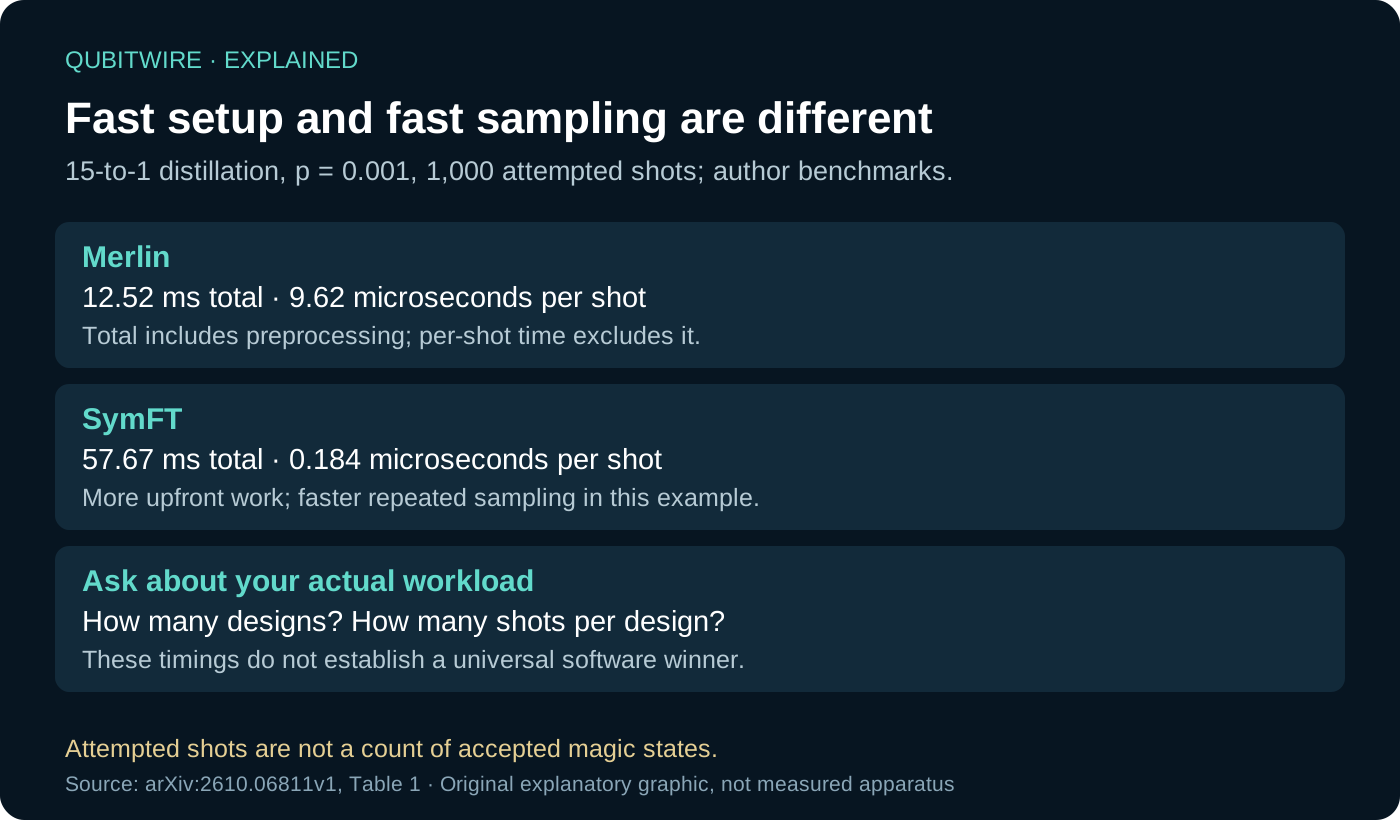
QubitWire's analysis: the right simulator depends on both the circuit family and how much repeated sampling the task needs. A team changing circuit designs frequently may value low setup cost. A team estimating a very rare logical failure on one fixed circuit may instead spend almost all its time collecting shots after preprocessing. The study makes this distinction visible, while also showing cases where memory feasibility matters before speed. A method that fits the workload in memory opens a different door from a method that shaves microseconds off an already easy case.[2]
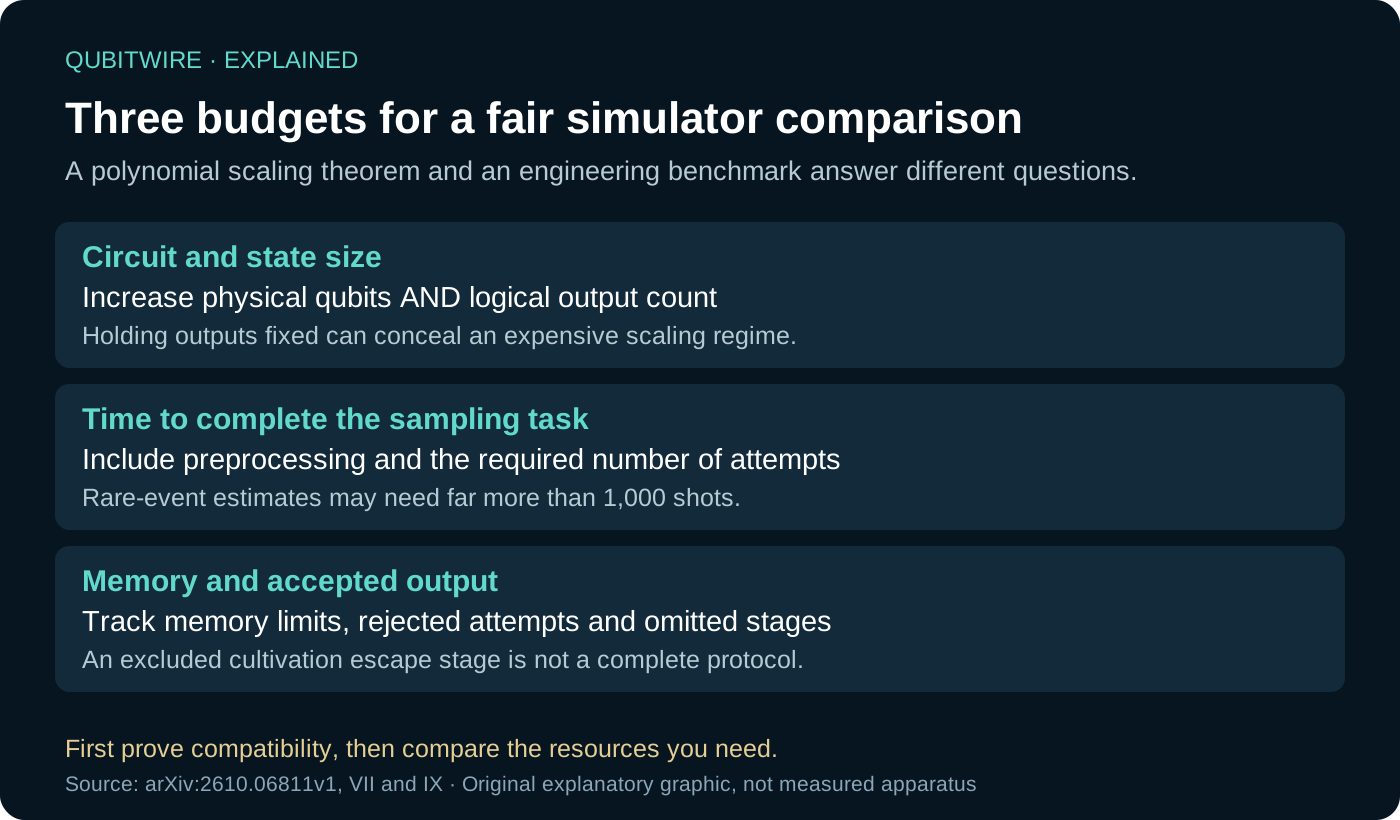
The published benchmark uses a noise parameter of 0.001 and 1,000 attempted shots per circuit. Attempted shots should not silently become 1,000 accepted magic states: postselection can reject outcomes. The cultivation examples also exclude the escape stage. These details determine what has actually been timed. A complete resource estimate for producing usable states would need to account for the omitted stages, accepted-output statistics and any decoding work required by the intended protocol, rather than multiplying an isolated timing by a desired output count.[2]
The important boundary is compatibility
This is particularly relevant to high-rate designs that prepare many logical resources at once. A simulation method can be efficient when the number of logical outputs is held fixed while still becoming expensive when that number grows. Merlin's stated polynomial guarantee covers physical system size and circuit size without imposing a small fixed logical-output count inside the supported class. That changes which candidate designs may be practical to compare. It does not tell us in advance which candidate has the best logical error rate or lowest implementation overhead.[2]
The boundary remains important. Some measurement gadgets fall outside the paper's sufficient conditions and need their own compatibility analysis. Hadamard-based protocols cannot simply be declared covered because a convenient change of basis exists for one operation; the entire transformed circuit must qualify. The authors discuss extending the method to universal simulation by combining multiple DCP states, but the required number of terms can grow exponentially. That extension therefore does not turn the restricted polynomial-time result into a claim that general quantum computation has become easy to simulate.[2]
For a reader assessing the tool, three questions are more informative than asking whether Merlin is the fastest simulator. Does the complete noisy protocol satisfy the compatibility conditions? Which resource becomes limiting as physical qubits, logical outputs and sample count grow? Does the benchmark include preprocessing, rejected attempts and the stages needed to deliver the intended logical resource? These questions connect a mathematical guarantee to an actual design decision. They also make comparisons fair to specialized simulators that remain very fast in the regimes they were built to handle.[2]
The next useful evidence is independent reproduction on explicit circuits, followed by comparisons that pair simulation with suitable decoders and measure logical failures, acceptance and complete resource cost. QubitWire has inspected the paper's methods and benchmark definitions but has not rerun those software benchmarks. For now, Merlin's promise is concrete: a larger, well-defined set of non-Clifford error-correction designs can be studied with efficient exact state tracking. Better classical tools for testing quantum machinery can help engineers choose what to build, even while the useful computation itself remains outside the easy simulation class.[2]
Keep your reading trail
Keep up with these topics
Choose the subjects you want to find again in Your Updates.