JIJ and Mitsubishi Electric put a hybrid solver into an industrial test program
The companies will evaluate a concrete engineering workflow and its computational costs.

Where quantum processors fit alongside CPUs, GPUs and supercomputers.
A hybrid workflow combines classical processing with quantum operations. Classical machines prepare jobs, optimize parameters and interpret measurements, while the quantum processor performs a particular part of the calculation.
The relevant measure is the end-to-end workload. Shorter circuits or faster hardware can help, but data movement, queueing, sampling and classical processing can change the overall result.
Follow the work between a proposed use case and an operational decision: define the problem, choose a fair baseline and account for the complete workflow.
A useful workflow includes the stages needed to obtain the same answer: input preparation, classical and quantum work, communication, measurement and interpretation. A faster kernel can leave the complete task almost unchanged.
The calculation below uses invented fractions and overhead. It is an accounting exercise, not a prediction for the exploratory Quobly–SiPearl agreement. A fair real comparison must keep task, output quality and the counted resources alike.
A question to carry forward: Which fraction of the original job changed, and what extra work did the change introduce?
Work through the complete-job calculation →A resource model defines which operations are expensive and which resources are available. A better result under one model is not a universal statement about elapsed time.
Look for the input, output, workspace and acceptance condition before comparing two expressions.
Worked example: A leading gate-count ratio is not a stopwatch →
Account for the rest of the workload →
Before comparing a workflow, identify where the circuit ran. Use the execution-environments visual, then estimate one dense state array with the statevector-memory calculator. The calculator excludes working overhead and other simulator representations.
AWS: Amazon Braket developer guide ↗A dense statevector stores 2ⁿ complex amplitudes for n qubits. A dense density matrix stores 4ⁿ complex entries and represents mixed states directly. At 16 bytes per complex entry, these are raw array counts; buffers and software add overhead. The statevector memory calculator counts the first representation without allocating it.
Stabilizer methods efficiently handle a restricted family of states and operations, including some entangled circuits. Tensor-network cost depends on structure, connectivity, contraction and accuracy. Neither a large qubit count nor entanglement alone proves classical difficulty. A dense array estimate is not a lower bound on every simulation method.
The Qiskit Aer method documentation distinguishes statevector, density-matrix, stabilizer and matrix-product-state methods. Amazon Braket’s local-simulator documentation distinguishes its statevector and density-matrix backends. These are explanations of representations, not a claim that an SDK was executed here.
| Output | What to retain | What it establishes |
|---|---|---|
| Exact model probabilities | State representation, precision, operations and model. | Behavior in that mathematical model. Numerical approximation remains; finite-shot uncertainty does not apply. |
| Synthetic sampled counts | Model, shot count, software and random seed where used. | Samples from the implemented model. A noisy simulator is still a simulator. |
| Physical measured counts | Device, executed circuit, shots, time, calibration and job record where available. | Evidence about the tested implementation, including possible drift and correlated errors. |
Use the execution-environments diagram to keep provenance visible. Similar-looking histograms do not make these outputs interchangeable.
This deliberately constructed dataset has 620 outcomes labeled 0 and 380 labeled 1. Its observed zero frequency is 0.62. With Z eigenvalues +1 for 0 and −1 for 1, the estimated Z expectation is 2 × 0.62 − 1 = 0.24. These are estimates from synthetic counts, not device measurements or an exactly known probability.
For independent Bernoulli trials, let p̂ = k/n and choose z = 1.96. The Wilson interval has center (p̂ + z²/(2n))/(1 + z²/n) and half-width z√(p̂(1−p̂)/n + z²/(4n²))/(1 + z²/n). For k = 620 and n = 1,000, the approximate 95% interval is [0.589510, 0.649571].
The corresponding Z interval is [2 × 0.589510 − 1, 2 × 0.649571 − 1], or approximately [0.179020, 0.299142]. The estimated standard errors are about 0.01535 for the frequency and 0.03070 for Z.
The confidence interpretation concerns repeated use of the procedure. It does not assign a 95% probability to the fixed unknown parameter in this realized interval. More shots can reduce sampling uncertainty while leaving calibration bias unresolved. Drift, correlated outcomes and choosing a stopping time after inspecting results can invalidate the stated trial procedure. Zero observed successes does not prove zero probability.
NIST’s Wilson interval derivation explains the score method and its assumptions. The independent-trials calculator answers a different question: the chance of at least one success for a known fixed probability.
No. It quantifies sampling uncertainty under the chosen model. A systematically biased classifier can produce a precise estimate of the wrong rate.
With a fixed sample of N independent trials and the same failure probability p in each, the chance of observing zero failures is (1 − p)ᴺ. Setting it to α gives the one-sided upper confidence limit pᵤ = 1 − α^(1/N), where confidence is 1 − α.
At 95% confidence, zero failures in 10,000 trials gives an upper limit of approximately 0.000299528. To put that limit at or below 0.00005 requires 59,914 zero-failure trials. This procedure does not assign a 95% probability to the fixed unknown p.
Define a trial and retain excluded attempts. Drift, dependent failures and stopping after inspecting results require another analysis. The NIST binomial-interval explanation gives the tail-inversion context; the zero-event formula above follows directly from the displayed probability.
A synthetic teaching model. Inputs stay in this page; no device, account or remote computation is used. The worked example remains readable without JavaScript.
For independent estimates combined as 3X₁ − 2X₂ + X₃, with per-shot variance 1, the reconstructed variance is 9/N₁ + 4/N₂ + 1/N₃. Signs affect the mean; squared coefficients determine this variance. They are not probabilities.
With 1,200 shots, [400,400,400] gives variance 0.035 (standard error 0.187083); [600,400,200] gives 0.030 (standard error 0.173205). The second allocation minimizes this model’s variance at fixed total cost. Unequal per-shot variances or costs change the allocation.
Qiskit’s circuit-cutting explanation describes quasiprobability reconstruction and sampling overhead. This calculation is a synthetic linear-estimator exercise, not a circuit cutter or an executed SDK experiment. Lower modeled variance does not establish unbiasedness or validate the reconstruction or noise model.
A synthetic teaching model. Inputs stay in this page; no device, account or remote computation is used. The worked example remains readable without JavaScript.
Work through quantum information and control calculations, or follow a three-stop reading route. Read the physical and logical qubit comparison before interpreting a resource estimate.
Educational models and source passages checked 1 October 2026. No physical-device result or independently replicated experiment is claimed.Read the research
Recent studies, explained in full. Each analysis keeps the measured result, the model and the remaining questions together.
Sparse-QITE, a preprint submitted on October 14, adds regularization to quantum imaginary-time evolution so that its effective generator uses fewer Pauli terms. The authors test spin-chain models and describe adaptive variants. Large reductions in transpiled gate counts occur in selected numerical comparisons, with results depending on the domain and accuracy requirement. This is an algorithm and simulation study, not a demonstrated hardware speedup. The central question is how much of a mathematically available local control basis is actually needed to reproduce a useful step toward a low-energy state. [1]
Imaginary-time evolution is a filtering operation. An energy eigenstate with energy E receives a factor proportional to exp(-E times tau), so higher-energy components are suppressed more strongly as the imaginary-time parameter increases. The result must then be normalized. This filtering can favor the ground state when the initial state has a nonzero overlap with it. The operation is generally not unitary, which means it cannot simply be applied as an ordinary deterministic quantum gate to an arbitrary unknown state without additional structure or resources.
A two-level example shows the filtering clearly. Set the lower energy to zero and the upper energy to two in arbitrary units. Begin with equal probabilities in the two levels. At imaginary time one, the upper amplitude receives exp(-2), so its unnormalized probability receives exp(-4). After normalization, the upper-level probability is exp(-4) divided by one plus exp(-4), approximately 0.018. These invented values illustrate the ideal filter. They do not give the cost or accuracy of a gate sequence that approximates it on a physical processor.
Quantum imaginary-time methods can approximate a small filtering step through a unitary chosen for the current state and a suitable local region. This is a state-dependent approximation, not an identity that turns every nonunitary map into a free gate. A larger region can offer more expressive controls, but it also enlarges the candidate operator basis. A complete Pauli basis on D qubits has 4 to the power D elements. Increasing D from four to eight therefore changes the basis size from 256 to 65,536 before exploiting any additional structure.
Sparsity asks whether the useful direction can be represented with far fewer active coefficients. A regularization penalty discourages a dense generator while the optimization still tries to reproduce the intended state change. This creates a trade-off: a penalty that is too weak may retain unnecessary terms, while one that is too strong may remove a contribution needed for accurate evolution. The appropriate comparison holds the target accuracy fixed. Otherwise, a short control sequence can appear efficient simply because it is allowed to solve the problem less well.
Several errors must remain conceptually separate. A finite local region may fail to capture correlations needed for the ideal update. A sparse representation can add another approximation inside that region. Finite step size and a decomposition into implementable gates introduce further differences. Finally, estimated expectation values can be noisy. Reducing one error does not necessarily reduce the others. For example, retaining more Pauli terms may improve a noiseless calculation while demanding additional measurements whose uncertainty undermines the final physical state preparation.
Gate count is a useful resource measure, but it does not by itself specify runtime. Terms can have different support, require different routing or admit different parallel schedules. Learning their coefficients also consumes classical computation and measurement data. A convincing practical comparison should connect the sparse representation to the complete preparation task under a common accuracy target. That includes checking whether the state remains in the desired low-energy sector, rather than relying only on a favorable local fit during individual optimization steps.
The study offers a concrete way to challenge a common assumption: expanding the mathematical search space need not require using all of it in the final control. The next question is where that compression survives noisy measurements and less structured problems. A useful result would map the energy error and total experimental cost together as the domain and sparsity change. Readers would then see whether a larger model supplies helpful flexibility while a smaller active generator keeps the actual operation manageable.
Recent context: an October 7 preprint combines reduced-memory quantum models of stationary stochastic processes with conditional-probability estimation. The authors analyze how quantum representations can reduce memory-induced bias while retaining an amplitude-estimation sampling advantage under the algorithm's assumptions. This is an algorithmic study, not a validated earthquake forecast, financial prediction service or general ability to foresee events. Its useful question is how errors from an impoverished process model differ from errors caused by drawing too few samples from that model. [1]
A conditional prediction depends on what is known about the past. A process can emit the same recent symbol while having different future probabilities depending on an older hidden state. A model must retain enough predictive information to distinguish those situations. If memory compression merges histories with different futures, the model changes the conditional distribution it generates. Drawing more samples from the compressed model can estimate that altered distribution more precisely, but it cannot restore the information that the representation discarded.
An original probability example makes the difference concrete. Suppose the actual conditional event probability is 0.40, but a compressed model assigns 0.25. With more independent simulations, the sampling uncertainty around the model's estimate can shrink toward zero. The estimate still approaches 0.25, leaving an error of 0.15 relative to the stipulated target. These invented values do not describe a real forecast. They show why a very precise estimate can remain inaccurate when the model being sampled is systematically different from the process of interest.
Quantum memory can encode predictive states that are not perfectly distinguishable from one another. That flexibility can sometimes represent the future statistics in a smaller-dimensional system than a direct encoding of mutually distinguishable classical memory labels. The task is to generate the correct conditional outputs, not to read out every detail of the original history. This distinction is important: a compact quantum representation does not provide free retrieval of an arbitrary classical record. Its benefit is tied to the particular future statistics that the model has been designed to preserve.
Amplitude estimation addresses a different resource. Given suitable coherent access to a state-preparation procedure and a way to mark the target event, it can reduce the number of calls needed for a specified probability-estimation accuracy in the ideal query model. That does not make each call free. Preparing the model, retaining or uncomputing auxiliary information and implementing the event test can require substantial gates. A complete comparison must distinguish fewer oracle calls from lower total runtime on a fault-tolerant or noisy physical implementation.
The event horizon also consumes resources. A model that advances one time step at a time may need additional registers or reversible bookkeeping to evaluate a property of an entire future sequence. Reducing the internal memory does not automatically reduce every output or history register. Some event tests can be computed incrementally; others require more information. The useful algorithmic resource statement therefore identifies the memory state, generated outputs, control depth and event oracle separately, rather than summarizing all of them with one qubit count.
Model validity remains outside the sampling theorem. A stationary-process assumption can fail when the environment changes, and a learned transition model can be wrong because the available data do not capture the relevant behavior. A quantum algorithm can faithfully process that wrong model. Independent predictive validation is therefore necessary before interpreting a computational improvement as better real-world forecasting. The comparison should use the same information about the process and should include strong classical compression methods, so that any advantage is attributed to the representation and algorithm rather than unequal modeling effort.
The study supplies a useful joint perspective on two error sources that are often discussed separately. The next practical result would measure memory distortion, sampling uncertainty and implementation cost for the same well-defined process and event. Readers could then see whether quantum compression improves the relevant conditional distribution enough to make the sampling saving useful. That would be a specific computational advance, with no need to imply that faster arithmetic resolves uncertain data, changing dynamics or the fundamental challenge of choosing an adequate model of the world.
Go beyond the headline
Follow the physical idea, work through a declared example and keep the limits attached. Research dates appear with each guide and lab.
Source research checked . Teaching calculations are ideal models.
A quantum simulation begins with a model of a physical system, then implements a procedure for extracting something from that model. Accuracy at the second step does not establish adequacy at the first. A circuit can approximate its specified Hamiltonian very well while the Hamiltonian omits an interaction that matters to the intended scientific question. Conversely, a global state error can look large while one robust observable remains accurate. A useful simulation claim identifies the physical question, model, prepared state, evolution and measured observable before compressing performance into an error bar.
Model discrepancy is the difference between the mathematical description and the physical target. Implementation error is the difference between the intended mathematical evolution and the realized operation. Statistical uncertainty comes from finite measurements of the realized output. These contributions have different remedies. More shots can reduce sampling uncertainty, but they do not automatically repair a missing Hamiltonian term. A deeper simulation algorithm can reduce a numerical approximation while accumulating more physical noise. Improving hardware can faithfully implement a model that still excludes the environmental effect relevant to the application.
Norm bounds provide one way to connect these layers conservatively. In units with ħ=1, two Hamiltonians differing by a bounded operator δH produce unitary evolutions whose distance is at most time multiplied by the operator norm of δH in a simple time-independent setting. For a bounded observable, a corresponding expectation-value difference is bounded by twice the observable norm times that unitary distance. These are worst-case statements. They can overestimate a particular experiment because they ignore the input state, observable structure and cancellations. Their value is a transparent guarantee under explicit assumptions.
Observable-specific analysis can be much sharper. A perturbation that commutes with the measured quantity may have little or no effect on that quantity for a chosen preparation, even while changing phases elsewhere in the state. Another observable can be highly sensitive to the same perturbation. This is why validating only a conserved quantity does not certify every dynamical prediction. Conservation checks, small-instance comparisons and symmetry tests probe useful failure modes, but their coverage must be described. A certificate for a restricted state-preparation class likewise should not be generalized to arbitrary dynamics or to the relevance of its Hamiltonian.
Application validity requires a bridge back to the scientific decision. If the desired output is a reaction-energy difference, a transport coefficient or a correlation length, the error budget should be expressed in the tolerance that matters for that output. Model parameters may have correlated uncertainties, and a sensitive observable can amplify them. Comparing plausible model variants is often more informative than reporting another decimal place of the same calculation. The result should explain which conclusions survive those variants and which depend on assumptions that need better experimental or theoretical support.
A model-discrepancy test should vary a neglected physical term while holding the numerical solver fixed. A solver-convergence test should instead refine the implementation of one fixed model. Combining these interventions in a single sweep makes it difficult to identify whether disagreement comes from the intended physics or its computational realization.
An application claim becomes stronger when its conclusion survives plausible changes in the physical model as well as improvements in the numerical implementation. If a predicted ordering reverses after a small uncertain interaction is restored, more precise sampling of the original model will not resolve the scientific ambiguity. If the ordering remains stable while individual energies move, the decision may be robust despite imperfect absolute predictions. Reporting those two behaviors separately gives the reader useful information about the next experiment or calculation. Validation is therefore a chain of conditional claims: the implemented operation, the represented physics and the requested conclusion each need evidence appropriate to their own source of uncertainty.
Inputs: epsilon s inverse: 0.002; time s: 10; observable norm: 1
X=cos(2*epsilon*t); error=1-X; conservative_bound=2*t*abs(epsilon)
| Calculated quantity | Synthetic result |
|---|---|
| X expectation | 0.99920011 |
| actual difference | 0.00079989334 |
| conservative expectation bound | 0.04 |
Synthetic one-qubit example: choose target H=0, implemented H′=εZ, ε=0.002 s⁻¹ in ħ=1 units, initial state |+⟩ and observable X. After t=10 s, the target expectation is 1 and the implemented expectation is cos(2εt)=cos(0.04)=0.9992001. The actual difference is 0.0007999. A simple norm bound gives ||U′-U||≤t||δH||=0.02 and hence an X-expectation difference no larger than 0.04. The bound is valid but conservative. A thousand additional shots would refine the measured value without removing ε. This example concerns an abstract bounded Hamiltonian, not a hardware frequency-drift benchmark.
The tempting conclusion: A narrow numerical error bar proves that the simulated physical prediction is correct.
What follows instead: It may describe only sampling or algorithmic approximation. Physical-model assumptions and their effect on the requested observable need separate support.
| Quantity or decision | What it means |
|---|---|
| Model discrepancy | Concerns whether the mathematical description represents the physical system and question adequately. |
| Implementation accuracy | Concerns how closely the device or algorithm follows that chosen mathematical description. |
| Output uncertainty | Concerns the particular estimated observable, including sampling and propagated model sensitivity. |
No. More shots estimate the output of the implemented model more precisely. An omitted interaction requires a changed model or evidence that it is irrelevant to the requested observable.
A worst-case norm bound protects all allowed states and observable directions. A particular preparation and observable may respond much less strongly.
It checks one important constraint. Different evolutions can conserve the same energy while producing different correlations or phases.
Vary assumptions that could change the scientific decision, propagate them to the target output and identify whether the conclusion is stable over a justified range.
Simulation accuracy is meaningful only relative to a model, observable and physical decision. Keep those links explicit so more precise computation does not conceal an unsupported assumption.
Certification statements concern a specified preparation class, measurements and assumptions. The cited protocol concerns a restricted ground-state setting; it is not asserted to certify arbitrary dynamics or the relevance of a physical model.
Source research checked . Teaching calculations are ideal models.
A qubit occupation register looks deceptively similar to a list of fermionic mode occupations. Both can use zero and one labels. The similarity hides a crucial algebraic difference: fermionic creation and annihilation operators anticommute on different modes, while ordinary qubit operators on different sites commute. A mapping must preserve the signs associated with exchanging fermionic operations. Jordan–Wigner does this by attaching a parity string to the local occupation change. The string is part of the encoded operator, not a physical trail left by an electron moving through the processor.
Choose an ordering of modes and write a basis as |n0 n1 n2 ...⟩, with the leftmost label explicitly denoting mode zero. An annihilation operator on mode j changes an occupied mode to empty and contributes a sign determined by the occupations before j in the chosen order. The qubit lowering operator performs the local change, while a product of Z operators on earlier qubits supplies the parity sign. Each occupied earlier mode contributes a minus sign. This construction makes the qubit operator reproduce the fermionic action on every occupation-basis state.
The ordering is a representation choice. Changing it does not change the underlying physics when states, Hamiltonians and observables are transformed consistently. It can change the lengths and locations of parity strings, which affects circuit implementation on constrained hardware. A mapping comparison should therefore include the interaction graph of the physical problem and the connectivity of the processor. A short mathematical expression can become an expensive routed circuit, while a different ordering may shorten the strings needed most often. Qubit count alone cannot reveal that cost.
Number-conserving terms provide a useful example. A hopping operator moves occupation between two modes, but its sign can depend on occupations between them in the selected ordering. Replacing it with an ordinary qubit swap loses that dependence. On some input states the replacement can accidentally give the expected result, making a single basis-state test misleading. Tests should include states with different intervening parity and superpositions where a sign changes interference. The algebraic anticommutation relations provide a compact independent check that a mapping has preserved the correct structure.
Measurement must use the same mapping. An energy estimator combines mapped occupation and hopping terms; a particle-number constraint is represented by its own qubit operator. A result can be numerically precise yet describe the wrong observable if the state and operator conventions are inconsistent. Bit order in software adds another layer: displayed strings may place the least significant qubit on the right even when a mathematical derivation numbers modes from the left. A clear example declares its convention and avoids silently translating a textbook basis into a library display format.
Mode ordering also affects the interpretation of stored results. A bit string must be translated through the declared occupation convention before particle number or a correlation function is inferred. Reordering operators and relabeling output bits are related changes, but performing only one of them can silently assign a correct numerical result to the wrong physical observable.
The parity string becomes observable when a process compares paths through different occupation patterns. A hopping amplitude can change sign according to the modes between its endpoints, even though the same particle appears to move between the same two locations. Dropping that sign changes interference in the many-particle problem. The encoding is therefore more than a list of occupied qubits: it defines a consistent algebra for how those occupations can change. A useful verification applies mapped operators to several basis states with different intervening parity and checks their anticommutation. Matching particle counts on one state is insufficient to establish that the encoded dynamics represent fermions.
Inputs: basis order: n0 n1 n2 left to right; operator: c2† c0; states: [100, 110]
c_j includes (-1)^(sum of occupations before j)
| Calculated quantity | Synthetic result |
|---|---|
| 100 output | +001 |
| 110 output | -011 |
Synthetic three-mode example uses |n0 n1 n2⟩ with mode zero on the left. Apply c2†c0, moving occupation from mode zero to mode two. On |100⟩, c0 first gives |000⟩ and c2† then gives |001⟩ with positive sign. On |110⟩, c0 gives |010⟩; creating mode two crosses one occupied earlier mode, so the result is -|011⟩. An ordinary qubit occupation transfer that ignores parity would miss the second minus sign. The sign is observable when these components participate in a superposition. The example declares a mathematical mode order and is not a literal software bitstring convention.
The tempting conclusion: A fermionic hopping term is always just an ordinary qubit swap.
What follows instead: Its action can contain occupation-dependent parity signs. Ignoring them can change interference and the simulated Hamiltonian.
| Quantity or decision | What it means |
|---|---|
| Occupation labels | Record whether each chosen fermionic mode is occupied. |
| Parity strings | Supply signs required by fermionic anticommutation in the qubit representation. |
| Routing overhead | Implements the resulting mapped operations on the actual processor graph and schedule. |
No. It enforces the algebra of the chosen encoding. Its qubit operations can have hardware cost, but that does not mean an electron physically visits those processor sites.
It should not when every state and operator is transformed consistently. It can change implementation cost and the appearance of occupation strings.
A parity sign can be positive for one occupation pattern and negative for another. Superpositions reveal relative signs that a limited population-only test can miss.
A display convention can reverse the visual ordering of labels without changing the mathematics. Explicitly aligning modes, qubits and displayed bits prevents silent operator mismatches.
Jordan–Wigner encodes fermionic algebra through parity. Correct signs, consistent conventions and hardware cost must all survive the translation from modes to qubits.
Fermionic operators are mapped to qubit operators; Jordan–Wigner preserves their anticommutation through parity strings. This explanation uses symbolic algebra rather than version-dependent API code.
Source research checked . Teaching calculations are ideal models.
An active-space calculation retains selected electronic degrees of freedom and treats the rest through a chosen approximation. This can make a quantum calculation manageable, but the scientific question often concerns a small difference between large energies. A reaction energy, barrier or excitation gap can depend on how errors differ across states, not only on how accurate each total energy appears. Good cancellation can make a modest representation useful. Uneven improvement can also make a larger representation produce a worse energy difference. The target observable must guide validation.
It helps to separate solver error from representation error. Solver error measures how closely an algorithm solves the Hamiltonian it was given. Representation error comes from the basis, active-space choice, frozen degrees of freedom and other physical approximations used to construct that Hamiltonian. An exact eigensolver inside a small active space can remove solver error while retaining a substantial representation error. Increasing shots or optimizer iterations then refines a result for the same restricted model. Assessing the physical energy difference requires changing or independently checking the representation as well.
Variational reasoning has a precise scope. For a fixed Hamiltonian and nested trial subspaces, the exact minimum energy cannot increase when the subspace is enlarged. That theorem concerns each individual minimum. It does not make the difference between two independently improving energies monotonic. Nor does it automatically apply when changing active spaces also changes effective Hamiltonians or other approximations. A careful explanation states which quantities are comparable under one variational problem and which involve a changed model. The word converged should always identify the axis along which convergence was tested.
Balanced treatment across geometries or electronic states is especially important. An orbital choice well suited to one geometry may omit correlation that becomes important elsewhere. A discontinuous change in selected orbitals can create artificial features in an energy curve. Tracking orbital character and testing a family of relevant geometries helps distinguish a physical barrier from a representation artifact. The objective is not to force identical numerical errors, which are usually unknown, but to gather evidence that differential errors are controlled where the scientific conclusion is sensitive.
An uncertainty discussion should therefore include several comparisons. Solve small cases accurately where possible, vary the active space or basis in a chemically motivated way, and inspect how the desired difference changes. Keep any classical correction or embedding assumption visible. Agreement between two approximations is encouraging only if they do not share the same dominant omission. A predicted ordering that changes under a modest justified representation change should be reported as sensitive, even if every individual energy estimate has a tiny sampling interval. This is a model-validation issue rather than a failure of arithmetic.
Balanced errors can disappear when the physical question changes. A basis that cancels representation error between two nearby geometries may behave differently along a dissociation path. Testing several separations or electronic characters probes that balance more directly than reporting one favorable difference at the geometry used to choose the active space.
A reliable difference estimate should be accompanied by a balanced comparison of its constituent calculations. Track which orbitals, symmetries and reference conditions change between the two states, then inspect whether improvements affect both sides similarly. If an active space is selected using only one geometry, its apparent efficiency may rely on error cancellation that does not persist elsewhere. Conversely, a small consistent representation can sometimes predict a robust trend while retaining imperfect total energies. The practical conclusion follows from the stability of the difference under justified model changes. An attractive downward trend in each total energy is useful evidence about its variational approximation, but it cannot alone certify the chemical quantity obtained by subtracting them.
Inputs: reference energies hartree: [-75, -74.98]; small errors: [0.03, 0.031]; large errors: [0.01, 0.005]
difference_error=error_B-error_A
| Calculated quantity | Synthetic result |
|---|---|
| reference difference | 0.02 |
| small difference | 0.021 |
| small difference error | 0.001 |
| large difference | 0.015 |
| large difference error | -0.005 |
Synthetic energy table, with no real molecule implied: reference energies are E_A=-75.000 and E_B=-74.980 hartree, so E_B-E_A=0.020. A smaller variational representation has errors +0.030 and +0.031, giving energies -74.970 and -74.949 and difference 0.021; the difference error is +0.001. A larger nested representation reduces the individual errors to +0.010 and +0.005. Its energies are -74.990 and -74.975, but their difference is 0.015, with error -0.005. Both total energies improved while the energy difference became less accurate. The example isolates cancellation and does not claim that enlargement usually worsens chemistry predictions.
The tempting conclusion: If both variational total energies improve, their difference must improve too.
What follows instead: Their residual errors can change unequally. The difference depends on error cancellation, which is not guaranteed to improve monotonically.
| Quantity or decision | What it means |
|---|---|
| Solver convergence | Approach to the solution of a fixed represented Hamiltonian. |
| Representation convergence | Sensitivity to retained orbitals, basis and omitted physical degrees of freedom. |
| Difference convergence | Stability of the specific reaction, barrier or excitation quantity used for the scientific conclusion. |
It can solve the chosen restricted Hamiltonian accurately. Degrees of freedom and approximations excluded from that Hamiltonian remain a separate source of physical-model error.
It constrains individual energies under specified nested-subspace conditions. Subtracting two upper bounds does not create a corresponding one-sided or monotonic bound on their difference.
Abrupt changes in the representation can create artificial features or unequal correlation treatment. Following orbital character helps interpret convergence of an energy curve.
It establishes precision of the measured estimator under its sampling assumptions. It does not quantify all basis, active-space or embedding approximations.
Application accuracy often lives in a difference. Validate that difference across justified model choices, even when each individual solver result is precise and variationally improved.
Active-space approximations reduce represented degrees of freedom but can leave representation errors. No published molecular energies, qubit savings or method performance are reproduced; the energy table is synthetic.
Source research checked . Teaching calculations are ideal models.
A symmetry can divide a quantum problem into independent sectors that do not mix under the Hamiltonian. If the target state is known to lie in one sector, redundant information about that symmetry label can sometimes be removed from the qubit representation. This is the idea behind symmetry tapering. The reduction can be exact within the chosen sector. It is not permission to discard a qubit without recording which eigenvalue of the symmetry was assumed. A smaller Hamiltonian can be solved perfectly and still answer the wrong question if its sector is wrong.
Consider a symmetry operator S that commutes with H and has eigenvalues plus or minus one. States in the two eigenspaces evolve independently. A change of basis can expose the symmetry label as a qubit degree of freedom, after which fixing its eigenvalue produces a reduced operator on the remaining qubits. The transformation must also be applied to state preparation and measured observables. Tapering is therefore a coordinated representation change, not merely deletion of terms containing a selected qubit. Its correctness comes from the invariant subspace and consistent operator mapping.
The physical target determines the sector. Particle-number parity, spin-related symmetries or other conserved labels may identify the relevant states. The globally lowest eigenvalue across all sectors need not be the desired energy if the application fixes a particle number or another physical constraint. Conversely, selecting a sector because it produces the most favorable result is not a valid substitute for defining the problem. The sector decision should be recorded before interpreting the reduced calculation, together with the evidence that the preparation and intended dynamics remain inside it.
Observables can make the issue more subtle. An operator commuting with the symmetry can often be represented within a fixed sector. An operator that connects sectors requires a treatment that preserves the appropriate transitions; simply evaluating it in one reduced block may discard the process of interest. Dynamic correlation functions can involve intermediate states in another sector even when the initial state is fixed. The reduction must be designed around the complete task, not only the Hamiltonian spectrum. This is especially important when moving from an energy calculation to a response or spectroscopy calculation.
Noise adds another distinction. The mathematical reduced model can be exact, while a physical implementation or state-preparation procedure can violate assumptions used in a full-space encoding. Symmetry checks on hardware are useful diagnostics, but they should not be confused with the algebraic proof of tapering. In a reduced register, some removed-sector information is no longer directly represented. A verification strategy must explain what can still be measured and which errors the chosen encoding maps into the remaining degrees of freedom. Fewer qubits change the available diagnostics as well as the resource count.
A symmetry label can also carry physical preparation information. If the experiment conserves a quantity and begins in one sector, the accessible ground state may differ from the global minimum across all sectors. A report should identify whether it seeks that prepared-sector minimum or a global ground state before comparing numerical energies.
Tapering should leave an auditable map from the full problem to the reduced answer. Record the symmetry generators, their fixed eigenvalues, the basis transformation and the transformed observables. A reader can then reconstruct which states the reduced spectrum describes and which transitions it cannot represent alone. If the application later changes from a ground-state energy to a correlation function, that map identifies whether another sector must reenter the calculation. The resource saving is earned by using known physical constraints. It remains exact only for the task and sector covered by those constraints, so consistent preparation and observable interpretation matter as much as the number of qubits removed.
Inputs: a: 1; b: 0.7; c: 0.2
E_even=±sqrt((a+b)^2+c^2); E_odd=±sqrt((a-b)^2+c^2)
| Calculated quantity | Synthetic result |
|---|---|
| even ground | -1.7117243 |
| odd ground | -0.36055513 |
Synthetic Hamiltonian: H=1.0Z0+0.7Z1+0.2X0X1, commuting with S=Z0Z1. In the even basis {|00⟩,|11⟩}, it becomes H_even=1.7Z+0.2X, with energies ±sqrt(2.93)=±1.711724. In the odd basis {|01⟩,|10⟩}, it becomes H_odd=0.3Z+0.2X, with energies ±sqrt(0.13)=±0.360555. If the physical task requires odd parity, the correct minimum is -0.360555 even though the full Hamiltonian has a lower even-sector energy. Both reductions are exact within their declared bases. The example uses dimensionless synthetic energy units and does not represent a particular molecule.
The tempting conclusion: The sector with the lowest computed energy is always the sector the chemistry problem needs.
What follows instead: Physical constraints determine the target sector. Choosing it after seeing favorable energies can change the problem being solved.
| Quantity or decision | What it means |
|---|---|
| Algebraic symmetry | A commuting relationship that creates invariant subspaces of the ideal model. |
| Sector choice | Physical information selecting which invariant subspace contains the requested states. |
| Task preservation | Consistent treatment of preparation and observables, including any cross-sector response. |
The task may constrain the system to a particular symmetry sector. A lower state in another sector is outside that physical problem.
An observable that connects sectors may require additional representation or separate blocks. The reduction must preserve the complete measurement task.
It can be exact when valid symmetries are fixed and operators are transformed consistently. Incorrect symmetry assumptions or sector selection create a different problem.
The original operator, symmetry generators, chosen eigenvalues, basis transformation and mapped observable conventions are needed to interpret and reproduce the result.
Symmetry tapering spends known physical information to save representation cost. The chosen sector and transformed observables are part of the answer, not optional metadata.
Known symmetries can remove redundant degrees of freedom while restricting a Hamiltonian to a symmetry sector. The two-qubit example is independently constructed and not a molecular benchmark.
Source research checked . Teaching calculations are ideal models.
A dynamical quantum simulation may estimate a correlation function at a sequence of times and transform those values into a spectrum. The spectrum is therefore inferred from a finite, noisy time record. Its appearance depends on the physical dynamics and on choices made during reconstruction. A sharp peak can broaden because the record ends, and nearby features can merge because the observation time is short. These effects must be separated from physical decay or lifetime broadening. Otherwise a numerical processing choice can be mistaken for a property of the simulated material.
The total observation duration sets a characteristic Fourier feature scale of order one divided by that duration. This is a useful nonparametric resolution scale, not an absolute theorem that two closer frequencies can never be estimated. A strong model, high signal-to-noise ratio and appropriate inference can sometimes extract parameters more finely, but then the result depends on those assumptions. The claim should distinguish a directly resolved feature from a fitted frequency difference. Longer evolution times can improve spectral discrimination while exposing the quantum computation to more implementation error or reducing useful signal contrast.
The time step controls a different limitation. Uniform sampling cannot uniquely distinguish arbitrary frequency content above its Nyquist range without additional assumptions. Increasing the number of output frequency points by zero padding does not change the underlying time samples or remove aliasing. It makes the plotted Fourier curve smoother through interpolation. A visually dense spectrum can therefore contain no more information than a sparse one built from the same record. The relevant metadata are the actual time points, their uncertainties and the reconstruction method, not merely the number of plotted bins.
Windowing trades one artifact for another. Abruptly truncating a record produces sidelobes that can obscure a weaker nearby feature. A smooth window reduces some sidelobes but broadens the central response and changes noise weighting. The preferred window depends on whether the task is locating a dominant peak, separating unequal peaks or estimating integrated spectral weight. The chosen normalization must preserve the quantity being compared. A spectrum normalized differently after each processing choice can hide lost weight or make a broad feature appear more significant than the underlying data support.
Uncertainty propagation should begin in the time domain. Correlation values at different times can have unequal variances and shared systematic errors. A common calibration bias can create structured spectral artifacts rather than independent bin noise. Bootstrap or covariance-based analysis should preserve relevant correlations instead of treating every transformed point as an independent experiment. Comparing reconstructions from different time ranges and windows can reveal sensitivity, but agreement among similar processing choices is not proof that the physical Hamiltonian is correct. It establishes robustness only within the tested reconstruction family.
Frequency units should remain attached to the reconstruction. A transform using exp(−iωt) reports angular frequency, while one using exp(−2πift) reports cycles per unit time. The corresponding axis conversion changes numerical linewidths and peak positions by 2π; zero padding or a window choice cannot repair an inconsistent convention.
A reported spectral peak should therefore carry the acquisition window and reconstruction assumptions that produced it. Two nearby frequencies can generate a slowly varying beat that is poorly sampled by a short record, even when a finely padded frequency grid looks smooth. A stronger parametric model can sometimes infer frequencies below a simple Fourier bin spacing, but that gain depends on the assumed line structure, noise and identifiability. It should be validated against model mismatch rather than described as information created by interpolation. The useful distinction is between a denser display of the same data, a longer physical record and additional prior structure used by an estimator.
Inputs: N: 100; dt s: 0.0001; padded N: 1000; long record s: 0.1
T=N*dt; bin_spacing=1/T; Nyquist=1/(2*dt); padded_grid=1/(padded_N*dt)
| Calculated quantity | Synthetic result |
|---|---|
| T s | 0.01 |
| bin spacing Hz | 100 |
| Nyquist Hz | 5000 |
| padded grid Hz | 10 |
| long record scale Hz | 10 |
Synthetic sampling example: record 100 correlation samples at spacing Δt=0.1 ms. The DFT window length NΔt is 10 ms, the bin spacing is 100 Hz and the Nyquist frequency is 5 kHz. Zero padding this same record to 1000 points produces a 10-Hz plotted grid, but the original observation duration and information remain unchanged. Two tones separated by 50 Hz are closer than the 100-Hz basic Fourier scale; resolving them requires more time or an explicitly justified parametric method. Extending the actual record to 100 ms changes the basic scale to 10 Hz. This is signal-analysis arithmetic, not a statement that a quantum device can sustain those times.
The tempting conclusion: A spectrum with ten times more plotted bins has ten times better experimental resolution.
What follows instead: Bin density can come entirely from zero padding. Resolution and uncertainty depend on actual observations and inference assumptions.
| Quantity or decision | What it means |
|---|---|
| Longer actual record | Adds temporal information and narrows the characteristic Fourier scale, subject to evolution accuracy. |
| Smaller time step | Expands the frequency range that can be sampled without aliasing under the stated model. |
| More zero padding | Interpolates the transform on a denser grid without adding time-domain information. |
It provides a finer interpolation grid for the transform. It does not extend the measured record or add independent information about closely spaced frequencies.
No. It is a characteristic Fourier resolution scale. Finer parametric inference can be possible, but it requires a justified model and uncertainty analysis.
It can reduce sidelobes caused by truncation, helping reveal weak features near strong ones. It also broadens responses and changes weighting, so the tradeoff must be visible.
Yes. A common or slowly varying error transforms into structured spectral effects. Treating bins as independent can understate uncertainty or exaggerate apparent evidence.
A reconstructed spectrum contains the imprint of its observation window. Report the real time record and inference assumptions so processing artifacts are not mistaken for physical dynamics.
Quantum simulation can estimate correlation functions from controlled quantum evolutions and measurements. The Fourier-window exercise is independent signal analysis and does not reproduce a paper figure.
Source research checked . Teaching calculations are ideal models.
A model of an open quantum system describes how a density matrix changes when the system interacts with an environment. It must preserve more than the trace and a few population curves. A physical output density matrix has nonnegative eigenvalues, and a valid channel must remain physical even when the system is entangled with an untouched reference. This stronger requirement is complete positivity. A rule that adjusts populations independently of coherence can fit a relaxation curve while producing an impossible quantum state. Such a rule cannot safely be used to predict arbitrary experiments.
Amplitude damping provides a concrete example. Excited-state population moves toward the ground state, but the off-diagonal coherence changes in a related way. In the standard qubit channel, a damping probability p reduces excited population by a factor of one minus p and coherence by the square root of that factor. The two changes arise from one consistent interaction with an environment. Keeping the original coherence while shrinking the excited population can violate the positivity inequality that bounds an off-diagonal element by the geometric mean of the populations.
Kraus operators offer one constructive representation of a physical channel. Their action is summed over unobserved environmental alternatives, and a completeness relation preserves trace. A Markovian master equation provides another description under appropriate assumptions. The Lindblad form constrains the generator so that the resulting semigroup evolution is completely positive and trace preserving. This does not mean every environment is Markovian, or that every fitted differential equation is automatically safe. Memory, initial correlations and approximation choices can require a richer model or a carefully restricted interpretation.
Numerical integration introduces a second layer. Even when the continuous equation defines a physical evolution, a crude time-discretization step can leave the allowed state space. A negative eigenvalue may therefore indicate a numerical problem rather than an exotic physical effect. Reducing the time step, using a structure-preserving method or comparing with an exact channel in a small case can diagnose the issue. Simply clipping negative eigenvalues and renormalizing changes the computed dynamics. If such a correction is used, its impact must be examined rather than hidden as cosmetic cleanup.
Validation should cover observables sensitive to both populations and coherences. A population-only data set may leave dephasing rates or correlated channels poorly identified. Different models can fit the same decay while predicting different interference behavior. Complete positivity restricts possibilities but does not identify the true environment uniquely. The useful workflow combines physically constrained model construction, independent measurements and uncertainty about poorly determined parameters. When the application involves an entangled input, channel validation must also address behavior beyond isolated basis-state preparations.
Trace preservation provides another independent check. Renormalizing an invalid output matrix can force its trace to one without repairing negative eigenvalues or a nonphysical extension to an entangled reference. Numerical validation should therefore inspect trace, Hermiticity and positivity while retaining the stronger complete-positivity requirement at the channel level.
Physical-channel structure is a useful constraint on both simulation and inference. A numerical method that occasionally produces negative populations can be signaling an integration problem, an unconstrained fit or an approximation outside its valid range. Clipping those populations after the calculation changes the predicted map and can hide the cause. A more informative repair identifies the mathematical structure the model should preserve, chooses a compatible representation or numerical method and checks its behavior on states beyond the fitted example. An apparently plausible decay curve is insufficient: coherence, entangled-reference consistency and trace behavior constrain whether the process can describe a quantum system at all.
Inputs: p: 0.36; initial rho: [[0.5, 0.5], [0.5, 0.5]]
rho11=(1-p)/2; rho00=(1+p)/2; rho01=sqrt(1-p)/2
| Calculated quantity | Synthetic result |
|---|---|
| valid rho | [[0.68, 0.4], [0.4, 0.32]] |
| valid determinant | 0.0576 |
| invalid determinant | -0.0324 |
Synthetic channel example: start from |+⟩⟨+|, whose entries are all 0.5, and apply amplitude damping with p=0.36. The consistent output has populations 0.68 and 0.32 and coherence 0.5√0.64=0.4. Its determinant is 0.68×0.32-0.4²=0.0576, so with trace one it has nonnegative eigenvalues. A population-only edit that leaves coherence at 0.5 instead has determinant 0.2176-0.25=-0.0324 and a negative eigenvalue. Both matrices display the same population decay, but only the first is a physical output of the stated channel. The example does not fit a real relaxation data set.
The tempting conclusion: A noise model is valid if its T1 curve matches the measured populations.
What follows instead: Population agreement is necessary for that data set but does not establish coherent or entangled-state behavior, nor guarantee complete positivity.
| Quantity or decision | What it means |
|---|---|
| Population fit | Checks selected diagonal observables and can leave coherence behavior undetermined. |
| Physical channel structure | Ensures the transformation is consistent with quantum states, including entangled references. |
| Numerical integration | Must accurately preserve the intended evolution and avoid artifacts from discretization. |
Density-matrix eigenvalues are probabilities in a suitable basis. A negative value means the matrix is not a physical quantum state under the ordinary state description.
No. A matrix can have trace one while one eigenvalue is negative. Hermiticity and positivity are also required.
It gives a physical Markovian semigroup structure under its assumptions. Non-Markovian memory and other situations may need a different description.
It can produce a valid matrix at one step, but it changes the evolution and does not establish a valid channel. Investigate the approximation or integration that caused the problem.
A quantum noise model must preserve the structure of physical states. Population agreement alone cannot establish a valid channel or an adequate description of coherence.
Completely positive Markovian semigroup generators have a constrained form, supporting physical open-system evolution. The example concerns a finite-dimensional amplitude-damping channel and does not imply all environments are Markovian.
Source research checked . Teaching calculations are ideal models.
Adiabatic state preparation changes a Hamiltonian so that a system initially in one eigenstate approximately follows its evolving counterpart. The word slow describes the change relative to the spectrum and couplings encountered along that path. A large total runtime can still be poorly allocated if the control moves rapidly through a sensitive avoided crossing and spends most of its time elsewhere. The relevant object is the schedule as a function of the path parameter, together with the spectral structure. A single duration or endpoint gap cannot describe the whole process.
An avoided crossing illustrates the mechanism. Two energy branches approach and repel because a coupling mixes the underlying basis states. Near the narrowest gap, the instantaneous eigenvectors can change rapidly with the control parameter. Moving through that region too quickly creates transitions between the branches. The risk depends on the gap and on the matrix element of the Hamiltonian derivative between the states. A small gap with negligible coupling to the changing control can behave differently from a similarly small gap with strong mixing. The full adiabatic theorem requires carefully stated regularity and path assumptions.
A commonly used local diagnostic compares the rate of Hamiltonian change between eigenstates with the squared energy gap, in consistent ħ=1 units. It conveys why a reduced gap can demand slower passage, but it is not a universal sufficient-error formula. Endpoint derivatives, multiple levels, long paths and accumulated contributions can matter. A page that turns the heuristic into an exact failure probability risks giving readers a false guarantee. The diagnostic is best used to identify potentially sensitive regions that deserve a more complete calculation or experimental sweep.
Schedule shaping allocates time according to that sensitivity. Slower motion near a narrow avoided crossing and faster motion in less sensitive regions can improve a fixed-time protocol. Yet an optimal isolated-system schedule may not be optimal in an open system. Longer exposure can permit thermal transitions, dephasing or other noise. The preparation objective should therefore combine nonadiabatic transitions with environmental effects where they are relevant. A successful ground-state preparation is an output to measure, not a consequence inferred solely from choosing a smooth-looking control curve.
Scaling claims require additional care. A runtime observed for a small instance does not establish how the minimum relevant gap and transition matrix elements behave as the problem grows. The gap may depend on the instance, boundary conditions or representation. A comparison across sizes should state how schedules were selected and whether prior knowledge of the solution informed them. Otherwise time spent finding a favorable schedule can disappear from the reported resource count. The preparation cost includes the knowledge and calibration needed to choose the path as well as the final evolution.
An endpoint gap alone does not describe the difficult part of a path. Two schedules can share the same initial and final Hamiltonians while passing through different avoided crossings. Comparing their interpolation, derivative couplings and time allocation is necessary before attributing a success difference to total runtime alone.
The schedule should be assessed through the prepared state, not only through a plot of its control parameter. Compare final populations or relevant observables across several durations and path shapes, retaining the cost of discovering those shapes. A plateau can indicate successful adiabatic following, environmental relaxation or a measurement limitation, so the interpretation requires more than increasing runtime until one outcome stops changing. The local gap diagnostic identifies where nonadiabatic mixing deserves attention. A complete conclusion combines that diagnostic with the evolution model, the observed output and the uncertainty in the spectrum along the path. Time is useful when it is spent where the physical preparation actually needs it.
Inputs: longitudinal scale A s inverse: 1; g values s inverse: [0.1, 0.05]; speed s inverse: 0.001
gap_min=2*g; local_ratio=2*A*speed/(2*g)^2
| Calculated quantity | Synthetic result |
|---|---|
| gap for g0.1 | 0.2 |
| ratio for g0.1 | 0.05 |
| gap for g0.05 | 0.1 |
| ratio for g0.05 | 0.2 |
Synthetic avoided crossing: H(s)=A(1-2s)Z+gX with A=1 s⁻¹ in angular-frequency units and 0≤s≤1. The gap is Δ(s)=2√[A²(1-2s)²+g²], so its minimum is 2g at s=0.5. There, |<1|∂H/∂s|0>|=2A. For uniform speed v=ds/dt=0.001 s⁻¹, the dimensionless local ratio is 2Av/(2g)². It equals 0.05 when g=0.1 s⁻¹ and 0.2 when g=0.05 s⁻¹. The numerator and denominator both have units s⁻². The fourfold increase signals greater local sensitivity; neither number is an exact transition probability or a sufficient runtime guarantee.
The tempting conclusion: The inverse square of the minimum gap is an exact universal runtime formula.
What follows instead: Gap-based heuristics omit path derivatives, multilevel structure and other conditions in rigorous bounds. They identify sensitivity, not a complete universal runtime guarantee.
| Quantity or decision | What it means |
|---|---|
| Hamiltonian path | Which operators and spectra are traversed between preparation and target. |
| Time schedule | How quickly each part of that path is traversed. |
| Preparation outcome | The final state under both nonadiabatic transitions and any environmental processes included. |
Smoothness helps define a controlled path but does not establish slowness relative to the relevant gaps and couplings. The system response still needs analysis.
It can reduce some nonadiabatic effects, but longer exposure can increase environmental errors. The complete preparation objective determines the useful tradeoff.
They quantify how the changing Hamiltonian couples instantaneous eigenstates. Gap size alone does not describe that coupling.
No. Larger instances can have different gaps and path sensitivity, and schedule-search cost can grow. Scaling evidence must track those quantities and the selection procedure.
Adiabatic preparation is a path-and-schedule problem. The gap informs where caution is needed, while the complete dynamics and final-state evidence determine whether preparation succeeded.
Adiabatic error bounds depend explicitly on spectral gaps and Hamiltonian variation. No simple inverse-gap rule is presented as a universal sufficient runtime theorem.
Source research checked . Teaching calculations are ideal models.
A finite quantum simulator has a finite number of constituents and a specified boundary. Its observables can change sharply as a control parameter varies, but a thermodynamic phase transition is a statement about an appropriate large-system limit. Finite-size analysis connects those levels by examining how distributions and observables change across sizes. A dramatic curve at one size is not sufficient. The analysis must identify a scaling hypothesis, boundary conditions and corrections that could explain or distort the observed trend. The aim is a tested extrapolation rather than a visual impression of sharpness.
Order-parameter distributions can contain more information than their mean. In a symmetry-preserving finite system, the mean of a signed order parameter can vanish even when the distribution concentrates around two nonzero values. The second and fourth moments reveal aspects of that shape. A commonly used dimensionless cumulant-like ratio is U=1-⟨m⁴⟩/[3⟨m²⟩²] for a scalar order parameter under a stated convention. It distinguishes a Gaussian-like centered distribution from a symmetric two-peak distribution in simple examples. Its value is a shape diagnostic, not a probability or a universal percentage of order.
Dimensionless ratios are useful because scaling curves for different sizes can approach a crossing near a critical point under appropriate conditions. Real finite data can show drifting or imperfect crossings due to irrelevant scaling corrections, boundaries, anisotropy, temperature or preparation dynamics. The crossing location can change as smaller sizes are excluded from a fit. This sensitivity should be examined rather than hidden by drawing a single vertical line through a plot. A good analysis reports the size range, fitting assumptions and how conclusions respond to plausible corrections.
Moment estimation introduces statistical complications. The fourth moment is sensitive to rare tails, and the ratio is a nonlinear function of estimated moments. Plugging noisy estimates into the formula can create bias, especially when the second moment is small. Samples can also be correlated within an experimental sequence or numerical trajectory. Resampling should preserve those dependencies, and uncertainty bands should reflect the complete estimation procedure. Treating a cumulant value as if it were a simple binomial fraction misunderstands both its possible range and its sampling distribution.
Quantum experiments add preparation and measurement choices. A nonequilibrium sweep can produce domains or defects whose size depends on ramp rate, so varying system size while changing the preparation protocol may mix two effects. Readout errors can reshape the order-parameter distribution in a size-dependent way. The measured observable and any correction should therefore be defined consistently across sizes. An equilibrium critical interpretation needs evidence that the preparation and analysis support it; a dynamical scaling study should state its own quantities and should not quietly inherit an equilibrium claim.
Sampling uncertainty in moment ratios can be asymmetric, especially when the estimated second moment is small. Propagating only separate standard errors for the numerator and denominator can miss their correlation because both come from the same configurations. Resampling complete configurations retains that dependence under its stated sampling assumptions.
A crossing that drifts as larger sizes are added contains information about the limits of the present inference. It may reflect finite-size corrections, an unsuitable observable or a crossover rather than the proposed asymptotic behavior. Fit choices and omitted sizes should therefore be reported, especially when they were selected after inspecting the data. A credible finite-size analysis tests whether its conclusions survive reasonable changes of range and correction terms. The dimensionless cumulant is a useful organizer of this evidence because it compares distribution shape, but no isolated crossing replaces that analysis. The physical claim concerns a limiting family of systems, while each measured distribution belongs to one finite system.
Inputs: w values: [1, 0.5, 0.25]; m values: [-1, 0, 1]
m2=w; m4=w; U=1-1/(3*w), w>0
| Calculated quantity | Synthetic result |
|---|---|
| U w1 | 0.66666667 |
| U w0.5 | 0.33333333 |
| U w0.25 | -0.33333333 |
| w0 status | undefined |
Synthetic distribution: let m take values -1, 0 and +1 with probabilities w/2, 1-w and w/2. Then ⟨m²⟩=w and ⟨m⁴⟩=w, giving U=1-1/(3w). For w=1, U=2/3; for w=0.5, U=1/3; for w=0.25, U=-1/3. All three distributions are valid, so a negative U is not a negative probability. It reflects a different distribution shape. At w=0 the ratio is undefined because the second moment vanishes. These examples do not establish a critical point or universality class; they explain the statistic that a finite-size analysis might use.
The tempting conclusion: A crossing of two finite-size curves is a complete certificate of a phase transition.
What follows instead: It is a diagnostic feature that needs additional sizes, correction analysis and consistent preparation and observable definitions.
| Quantity or decision | What it means |
|---|---|
| Single-size feature | Describes a finite system and can be sharp without establishing a thermodynamic transition. |
| Dimensionless distribution ratio | Summarizes shape and can support cross-size scaling tests under a declared convention. |
| Scaling inference | Extrapolates using a hypothesis whose corrections and fit sensitivity must be examined. |
A finite symmetric ensemble can place equal weight at positive and negative values. Its distribution and even moments reveal structure that the signed mean cancels.
Not necessarily. The ratio is not a probability; valid distributions with strong central weight and tails can yield negative values under this convention.
It supports a scaling interpretation only with justified assumptions and stability across sizes and corrections. Finite-size or protocol effects can shift apparent crossings.
Rare large values contribute strongly, and the nonlinear ratio adds estimator bias. Correlations and small denominators require careful uncertainty treatment.
Finite-size analysis tests a limiting story with finite evidence. Distributional diagnostics, correction sensitivity and consistent protocols make that story assessable.
Finite-size scaling uses dimensionless distribution information and size dependence to study critical behavior. Synthetic moment distributions illustrate a diagnostic; no exponent or critical point from a physical experiment is reproduced.
Source research checked . Teaching calculations are ideal models.
Precision is a resource only after the error metric and target task are defined. A rotation-synthesis tolerance can be an operator-norm distance between two unitaries. An energy estimate can have a standard uncertainty in energy units. A logical computation can have a probability of an uncorrectable fault. These quantities are not interchangeable entries in one sum. A useful budget starts from the final claim, chooses compatible intermediate metrics and shows how each approximation or random error affects that claim. Otherwise, an apparently careful decimal allocation can combine numbers that describe different mathematical objects.
For a sequence of ideal unitaries and their approximations, a telescoping expansion gives a simple worst-case composition rule. If each corresponding pair differs in operator norm by at most εj, the complete products differ by at most the sum of those εj values. Unitarity prevents the surrounding exact factors from amplifying the norm in this bound. The result does not require the errors to point in random directions. That is its strength and its conservatism: aligned coherent errors can accumulate, while cancellations that happen in one circuit are not assumed to persist for every input or workload.
Root-sum-square addition belongs to a different set of assumptions. Independent zero-mean fluctuations contribute variances that add. Deterministic synthesis errors are not automatically independent zero-mean random variables, and a coherent control error can accumulate systematically. If an analysis uses statistical cancellation, it must identify the randomization, distribution and quantity being averaged. A bound on the worst possible state deviation answers a different question from the typical deviation under randomly selected circuits. Reporting both can be informative, but replacing one by the other without explanation makes the precision claim ambiguous.
The final observable provides another conversion. For a normalized initial state and unitaries differing by operator norm at most ε, the difference of expectation values of an observable with norm at most one is bounded by 2ε. This is a conservative estimate obtained by separating the change in the bra and ket. An observable with physical units carries its own norm into the bound. Sampling uncertainty then adds a statistical layer around the biased or approximated expectation. A confidence interval based only on finite shots does not automatically include the deterministic approximation error.
Allocation affects cost because different tolerances have different resource curves. Tightening every synthesized rotation equally can waste resources when some operations occur many times or have different implementation costs. A compiler can assign a total synthesis allowance across occurrences, combine repeated structure or exploit a stronger task-specific analysis when justified. The accounting must still use the complete number of implemented approximations. A local tolerance that looks tiny can produce a substantial worst-case sum across a long computation. Conversely, a very conservative bound can be much larger than an observed task error without being mathematically wrong.
A reviewable estimate therefore keeps a chain from the desired output to each counted approximation. State which bounds are deterministic, which uncertainties are statistical and which failures are modeled probabilistically. Show the composition rule and the sensitivity of resource cost to each allocation. If a tighter analysis replaces a simple sum, explain the assumptions that make it valid. This turns precision from a decorative target into an auditable design choice: the reader can see what accuracy is promised, where it is spent and which operation would become cheaper or more reliable if the allocation changed.
Inputs: stage bounds: [0.003, 0.004, 0.003]; synthesis occurrences: 10000; observable norm: 1
epsilon_total<=sum(epsilon_j); expectation_difference<=2*norm(O)*epsilon_total
| Calculated quantity | Synthetic result |
|---|---|
| unitary bound | 0.01 |
| expectation bound | 0.02 |
| equal per rotation bound | 3e-07 |
Synthetic unitary budget: allocate operator-norm bounds 0.003 to all rotation synthesis, 0.004 to a simulation approximation and 0.003 to another unitary approximation stage. Their telescoping worst-case sum is 0.010. For a norm-one observable on the same normalized input, the resulting expectation difference is bounded by 0.020. If the synthesis allowance covers 10,000 occurrences with equal per-occurrence bounds, each receives 3×10⁻⁷. These quantities are deterministic bounds, not measured standard deviations. An independently computed shot-noise confidence interval describes uncertainty around the implemented expectation and should be reported with, rather than silently substituted for, the approximation bound.
The tempting conclusion: A synthesis tolerance, a standard error and a logical failure probability can be added as if they were the same error.
What follows instead: They use different metrics and sometimes different units. A defensible budget first derives how each contributes to the final output claim.
| Quantity or decision | What it means |
|---|---|
| Deterministic approximation bound | Limits a specified distance for every allowed input or instance under its theorem assumptions. |
| Statistical uncertainty | Describes variability of an estimator under a sampling and covariance model. |
| Physical failure probability | Describes a modeled event that can invalidate computation; it must be connected explicitly to the task-level criterion. |
Quadrature addition requires a variance model with appropriate independence or covariance. Coherent deterministic approximation bounds do not satisfy those assumptions merely because their values are small.
Yes. It protects against worst-case alignment and may exceed a task-specific error. A tighter claim needs a proof or a declared statistical model, not an unexplained replacement.
Ordinarily it covers sampling around the implemented distribution. A deterministic difference between that distribution and the target requires separate treatment.
A tolerance assigned to one approximation can contribute every time the approximation is used. The complete sequence, not the number of distinct gate types, controls a generic composition bound.
An accuracy budget becomes useful when every term has a defined metric and a valid route to the final output. Keep deterministic approximation, sampling variability and physical failure distinct, then optimize the costs they actually control.
Approximating continuous rotations by a discrete gate set makes precision a synthesis resource. This explanation derives generic operator-norm composition bounds and does not reproduce a synthesis benchmark or assume one universal cost formula.
Source research checked . Teaching calculations are ideal models.
A block encoding represents a target operator as part of a larger unitary acting on the system and ancillary registers. If the selected block is H/λ, the positive normalization λ makes that block compatible with unitarity. A Hamiltonian-simulation algorithm can then use structured operations on this representation. The representation is powerful, but it comes with assumptions about how the unitary and ancillary state are implemented. Treating the block encoding as a free black box can hide much of the real workload. The relevant question is how both λ and the cost of accessing the encoded operator arise from the chosen problem representation.
A linear combination of unitaries provides a transparent construction. Write H as a sum of coefficients aj times unitary operators Uj. A common normalization is λ=Σ|aj|. An ancillary preparation weights index j by the square root of |aj|/λ, while a controlled selection applies Uj with the appropriate coefficient phase. Unpreparing the index exposes H/λ in the chosen ancillary block. The coefficient signs and phases are essential; replacing every coefficient by its magnitude would encode a different operator. This construction explains why the sum of absolute coefficients enters even when cancellations make the norm of H much smaller.
Equivalent algebra can therefore have unequal representation costs. Adding a large positive identity term and an exactly canceling negative identity term leaves H unchanged but inflates a naive absolute-coefficient sum. A competent preprocessing step should combine those terms. More subtle factorizations can trade normalization against the complexity of preparing indices or selecting operations. A smaller λ is attractive, yet it does not automatically minimize total gates if the new decomposition is much harder to implement. Resource estimation has to examine the pair: normalization and oracle implementation cost.
Time also needs consistent units. With ħ set to one and H expressed as angular frequency, λ has units of inverse seconds and λt is dimensionless. This normalized evolution scale appears in the query analysis of simulation methods such as qubitization. It is not an exact number of gates or even necessarily an integer query count. Precision requirements and algorithm details add further terms, and each query may expand into many logical operations. Restoring physical units or changing a Hamiltonian energy scale must be done before comparing the resulting resource estimates.
The selected block should not be confused with a claim that every algorithm simply postselects one ancillary outcome and discards the rest. Block-encoding algorithms use the larger unitary coherently in specified ways. Their success, approximation and ancillary requirements follow from the full construction. Similarly, knowing the spectral norm of H does not prove that a chosen implementation achieves that minimal normalization efficiently. A representation can be mathematically valid but operationally expensive. The useful estimate shows the preparation, selection, inverse operations and any required arithmetic at the level where their costs can be counted.
Readers can learn this distinction with a small Pauli Hamiltonian whose spectrum is exactly known. Compare its operator norm with the absolute-coefficient normalization, then deliberately insert canceling terms to expose wasted representation weight. Finally, attach a nonzero cost to each preparation and selection operation. This exercise reveals why algebraic preprocessing is part of quantum algorithm engineering. The same physical dynamics can be encoded through different computational routes, and the best route balances normalized evolution length, precision, ancillary workspace and the actual complexity of the operations used to access the Hamiltonian.
Inputs: X coefficient per s: 0.6; Z coefficient per s: 0.8; canceling identity coefficients per s: [5, -5]; time s: 5
norm(H)=sqrt(.6^2+.8^2); lambda=sum(abs(coefficients))
| Calculated quantity | Synthetic result |
|---|---|
| operator norm per s | 1 |
| lambda original per s | 1.4 |
| lambda redundant per s | 11.4 |
| original lambda t | 7 |
| redundant lambda t | 57 |
| normalized scale ratio | 8.1428571 |
Synthetic Hamiltonian in angular-frequency units: H=0.6X+0.8Z s⁻¹ has norm √(0.6²+0.8²)=1 s⁻¹ because X and Z anticommute. The simple absolute-coefficient normalization is λ=1.4 s⁻¹. For t=5 s, λt=7. If a redundant decomposition adds +5I and -5I s⁻¹ without combining them, H is unchanged but the naive λ becomes 11.4 s⁻¹ and λt becomes 57. The ratio 57/7≈8.14286 compares normalized evolution scales only. It is not a measured runtime multiplier or an exact query count; state preparation, SELECT cost and target precision remain to be specified.
The tempting conclusion: Two decompositions of the same Hamiltonian must have the same simulation cost.
What follows instead: They can differ in normalization, ancillary preparation, controlled selection and arithmetic. Equivalent physics does not imply equivalent computational implementation.
| Quantity or decision | What it means |
|---|---|
| Hamiltonian norm | A property of the target operator under stated units. |
| Encoding normalization | A scale associated with a particular unitary representation of that operator. |
| Oracle implementation cost | The gates, arithmetic and workspace needed to prepare and access the representation in the chosen architecture. |
The sum of coefficient magnitudes ignores cancellations and noncommuting geometry. It is a convenient construction parameter, not always the smallest possible normalization.
Not if obtaining it requires much more expensive state preparation or controlled operations. Both normalization and per-query implementation cost must be counted.
No. It is a dimensionless evolution scale in the algorithmic analysis. Precision terms, integer rounding and the internal gate cost of each query remain.
No. Algorithms use the larger unitary coherently according to their construction. A selected matrix block is a mathematical representation, not a complete execution protocol.
A block encoding is an implemented representation with a normalization, not a free description of a Hamiltonian. Compare the evolution scale and the cost of accessing that representation before translating algorithmic complexity into machine resources.
A projected unitary representation supports Hamiltonian simulation with an explicit normalization and oracle model. The Pauli-sum example is original; query complexity is not equated to physical gate count or runtime.
Source research checked . Teaching calculations are ideal models.
A quantum workspace qubit is reusable when it is returned to a known state without retaining unwanted correlations with the computation. Merely setting its visible value to zero is insufficient if the procedure transfers distinguishing information to an environment. Uncomputation uses the reversible structure of the calculation to remove temporary results coherently. It is central to arithmetic circuits, oracle construction and resource estimation because intermediate values can occupy many qubits. The benefit is not free erasure of arbitrary information. It is the ability to reverse a known computation after its required effect has been used.
Suppose a reversible circuit computes a classical function f into an initially zero register while preserving its input x. On a superposition of inputs, it creates a coherent sum of |x>|f(x)>. The temporary register is generally entangled with the input. If the desired function value is copied into a separate computational-basis output register, running the original circuit backward can return the temporary workspace to zero while leaving the intended input–output correlations. This does not clone an arbitrary unknown quantum state. The copied object is a basis-defined function value produced by a known reversible computation.
A phase oracle gives an even sharper example. Compute a predicate into an ancilla, apply a phase conditioned on that predicate, then reverse the computation. The ancilla returns to zero, but the input components retain their intended relative phases. Those phases can drive later interference. Resetting the ancilla after the predicate calculation instead leaks which-predicate information and generally removes coherence between the corresponding input sectors. A classical truth table alone cannot expose this failure; the circuit must be tested on superpositions and its output coherence examined.
Workspace choices create time–space tradeoffs. Keeping many intermediate values can avoid recomputation but occupy more qubits for longer. Recomputing a value when needed can reduce storage at the cost of extra gates and depth. A reversible dependency graph shows which values must remain available to undo later steps. Deleting an intermediate too early may prevent clean reversal, while retaining every intermediate indefinitely can make the quantum memory budget unnecessarily large. Resource estimates should state which intermediate values are live at each point, not only the size of the final arithmetic result.
Not every ancilla has the same contract. A clean ancilla begins in a specified state, commonly zero, and must be restored as required by its later use. A borrowed or dirty ancilla can start in an unknown state, potentially correlated with another system, but a valid borrowing protocol must restore that state and its correlations. The latter is a stronger condition than returning a convenient measurement outcome. Measurement-assisted uncomputation can sometimes reduce selected gate costs, but its allowed corrections and classical records must be part of the proof. It does not justify resetting arbitrary entangled workspace.
A practical compiler view should track data dependencies alongside entanglement obligations. Mark where a temporary value is computed, where its useful effect is transferred and where reversal becomes possible. Count the forward and reverse operations under the actual gate model, including any measurement-based alternatives and their conditions. This makes the hardware implications visible: a reduction in live workspace may increase runtime, while an efficient cleanup may reduce both storage pressure and later routing. The correct comparison asks whether the final logical map is preserved and every reused register satisfies its required state contract.
Inputs: input state: (|00>+|11>)/sqrt(2); ancilla initial: |0>
compute AND; apply Z to ancilla; inverse compute
| Calculated quantity | Synthetic result |
|---|---|
| unitary cleanup input XX | -1 |
| reset cleanup input XX | 0 |
| ideal Toffoli count | 2 |
| ideal Z count | 1 |
| unitary cleanup ancilla state | |0> |
Ideal phase-oracle example: start the two input qubits in (|00>+|11>)/√2 and a workspace ancilla in |0>. A Toffoli computes the input AND into the ancilla, producing (|00>|0>+|11>|1>)/√2. Apply Z to the ancilla, then the same Toffoli again. The result is (|00>-|11>)/√2 tensored with ancilla |0>, and the input XX expectation is -1. Replacing the final Toffoli by an irreversible ancilla reset leaves the inputs in a mixture of 00 and 11 with XX expectation 0. This exercise counts two ideal Toffolis and one Z; it does not assign a platform-specific T count or reset cost.
The tempting conclusion: A workspace register is safe to reuse whenever measurement reports zero.
What follows instead: Reuse requires the correct state and correlations, not just one classical outcome. An irreversible cleanup can leave the data dephased even when the workspace is zero.
| Quantity or decision | What it means |
|---|---|
| Uncomputation | Reverses a known dependency structure while retaining the intended output or phase effect. |
| Irreversible reset | Returns a carrier to a standard state but can export information and destroy correlations. |
| Workspace scheduling | Balances live intermediate values, recomputation, depth and the restoration contract of borrowed registers. |
It can transfer which-value information to the environment and dephase superposed inputs. A known zero output alone does not prove that the input coherence survived.
No. It copies a computational-basis function value through a known reversible map. It does not produce independent copies of an arbitrary unknown quantum state.
Its original unknown state and any correlations with other systems. Returning one expected measurement value is not enough.
Discarding stored intermediates through clean reversal can require later recomputation. The live-value schedule trades storage against additional reversible operations.
Uncomputation restores reusable workspace while preserving the computation’s intended correlations. Count its dependencies and operations explicitly; a reset that produces zero is not automatically a coherent replacement.
Temporary computational results and their uncomputation affect fault-tolerant arithmetic resources. This explanation uses an elementary exact Toffoli exercise, not the paper’s optimized T counts or a claim of cost-free arbitrary erasure.
Source research checked . Teaching calculations are ideal models.
Circuit cutting decomposes a target calculation into experiments that fit smaller quantum resources, then reconstructs selected results classically. It can reduce the width or connectivity demanded by any one execution. The original coherent interaction is not physically restored between independently run fragments. Instead, a mathematical decomposition expresses the target observable through a collection of measurable quantities. The method is valuable when the reduced hardware burden compensates for the added sampling, circuit variants and classical processing. A width reduction alone therefore does not establish an end-to-end saving.
Signed coefficients explain an important part of the statistical cost. Suppose a target expectation is written as a sum of coefficients qj times accessible expectations μj. Some qj can be negative, so the reconstruction is not an ordinary mixture of physical probabilities. Let γ be the sum of their absolute values. One unbiased sampling construction chooses term j with probability |qj|/γ and multiplies its bounded outcome by γ times the sign of qj. The mean is the desired signed sum, while the rescaled samples can fluctuate over a wider range than the original ±1 measurement outcomes.
For outcomes bounded in magnitude by one, that construction has second moment at most γ² and a corresponding variance bound. Reaching a fixed statistical precision can therefore require a sampling budget that scales with the square of the coefficient norm in this simple estimator. This is a bound and a method-dependent comparison, not an exact universal overhead for every circuit cut. Actual variances, optimized allocations, correlated reconstructions and reusable information can change the cost. The decomposition itself must also be valid for the target operation and observables; choosing small convenient coefficients does not prove a physical cut identity.
Several independent decompositions can multiply their coefficient norms, making a seemingly modest per-cut cost expensive across many cuts. The circuit structure matters: a good partition can reduce the number or difficulty of severed interactions, and the observable may allow simplifications that a full-state reconstruction would not. Planning should therefore begin with the requested output, not with a fixed desire to minimize fragment width. A narrower fragment with many expensive boundaries can be less useful than a slightly larger fragment with a much simpler reconstruction.
Hardware noise adds a separate bias question. The reconstruction identity applies to the specified fragment operations. If physical executions are noisy, the estimator can be unbiased for a combination of noisy fragment expectations while differing from the ideal large-circuit target. Signed coefficients can amplify those systematic differences as well as shot noise. Error mitigation or calibration may help under their own assumptions, but circuit cutting alone is not a general noise-removal theorem. A fair evaluation reports the reconstructed observable error, its statistical uncertainty and the complete preparation and execution cost.
Classical reconstruction can also be numerically sensitive when large positive and negative contributions nearly cancel. Retaining adequate numerical precision and uncertainty for each contribution prevents cancellation from being mistaken for certainty. The conditioning of the final weighted sum deserves attention alongside the number of quantum fragment executions.
Readers should see a cutting proposal as an exchange between resources rather than a literal reconnection of separated quantum states. Show which interaction is replaced, which experiments are required, how their signed outcomes combine and how many total samples are used. Compare the same target observable and accuracy against the best feasible uncut or classical route. This makes the decision concrete: cutting is useful when the full resource exchange improves the task under real constraints, with its decomposition, estimator and remaining bias all open to inspection.
Inputs: coefficients: [1.5, -0.5]; outcome bound: 1; independent decompositions: 2
gamma=sum(abs(q)); p_j=abs(q_j)/gamma; Y=gamma*sign(q_j)*x
| Calculated quantity | Synthetic result |
|---|---|
| gamma | 2 |
| sampling probabilities | [0.75, 0.25] |
| single second moment bound | 4 |
| product gamma | 4 |
| product second moment bound | 16 |
Synthetic signed-estimator example, not a physical cut identity: let μ=1.5μ1-0.5μ2 for two accessible expectations with outcomes in [-1,1]. Then γ=|1.5|+|-0.5|=2. Sample term 1 with probability 0.75 and term 2 with probability 0.25, returning Y=2 sign(qj)x. Its expectation is μ and its second moment is at most 4, so Var(Y)≤4. If two independent decompositions each have γ=2, their product construction has γ=4 and second-moment bound 16. These are conservative estimator bounds. The example does not show that the synthetic coefficients implement any particular gate or wire cut, nor that actual variance reaches the bound.
The tempting conclusion: Running each small fragment once and joining the outputs recreates the original entangled computation.
What follows instead: The method reconstructs selected quantities through a valid weighted experiment set. It does not physically restore the missing coherent interaction between independent runs.
| Quantity or decision | What it means |
|---|---|
| Quantum-resource reduction | Smaller or less connected fragments can fit hardware constraints more easily. |
| Reconstruction overhead | Additional experiments and signed rescaling increase statistical and classical work. |
| Remaining output bias | Imperfect fragment operations can shift the reconstructed result even when the estimator is statistically unbiased for those executed fragments. |
No. They are classical reconstruction weights. The sampling probabilities use absolute values, while signs enter the rescaled estimator.
No. It is a useful bound or scaling for a specified estimator. Actual outcome variance and optimized sampling can differ.
Not by itself. Noisy fragments can produce a biased estimate of the ideal target, and reconstruction weights can amplify their discrepancies.
Estimating a small set of observables can permit simplifications that reconstructing a complete state would not. The requested output changes the useful partition and cost.
Circuit cutting exchanges quantum hardware demands for a larger statistical and classical workload. Judge the exchange using a valid decomposition, complete execution counts and the final observable’s uncertainty and bias.
Circuit decomposition can trade quantum memory for classical reconstruction and sampling resources. Signed estimator coefficients are synthetic and are not presented as a valid decomposition of a particular physical cut.
Source research checked . Teaching calculations are ideal models.
A coherent error is a small unintended unitary change, such as an overrotation that points in the same direction every time a gate is applied. Repeating it can add amplitudes systematically. The resulting task error may grow much faster than a model that treats each gate as an independent stochastic failure would predict. Randomized compiling introduces compensated random choices into a circuit so that the ideal logical operation remains the same while the error is transformed across realizations. The aim is to change harmful accumulation, not to claim that noise disappears or that random gates are automatically beneficial.
Compensation is the defining requirement. A randomly inserted operation must be paired, propagated or absorbed into neighboring operations so that the intended circuit is preserved in the ideal limit. The chosen randomizing set and the structure of the circuit determine how this can be done. If one simply applies untracked random rotations to the data, the computation changes. A valid implementation keeps a record of the random choices and verifies the logical equivalence of each compiled realization. That bookkeeping is part of the algorithm, not optional metadata for a later plot.
A simple rotation model shows the accumulation mechanism. Repeating a Z overrotation by angle θ for m steps gives a net angle mθ. An initial plus state then acquires a wrong X-basis outcome probability sin²(mθ/2). If the error angle is independently assigned signs ±θ with equal probability while the ideal operation remains fixed, the ensemble coherence becomes (cos θ)^m. The corresponding averaged wrong-outcome probability is [1−(cos θ)^m]/2. For small θ in the appropriate regime, these expressions exhibit quadratic coherent accumulation versus approximately linear accumulated stochastic behavior.
The model also shows what randomization does not promise. An individual random sequence can have an unfavorable net angle. The guarantee concerns a specified ensemble and noise assumptions, not every realization separately. A finite number of random circuits adds another sampling layer beyond repeated measurement shots on one circuit. More shots on a single randomization do not necessarily replace sampling enough randomizations. Report the number of compiled variants and the allocation of shots among them so readers can understand the observed uncertainty and the extent of the ensemble averaging.
Physical gates can complicate the ideal tailoring picture. Randomizing operations may have gate-dependent errors, calibration drift or crosstalk. A control system may absorb some changes virtually while others require additional pulses. Temporally correlated noise can interact with the randomization schedule, and leakage is not generally captured by a simple Pauli channel. The appropriate claim is tied to a theorem or an experimental characterization with those limitations stated. A reduction in one circuit’s output error does not by itself demonstrate a universal improvement in every workload or a complete correction of non-Markovian noise.
A stored seed makes a randomization reproducible but does not make its outcome representative. Selecting only seeds that performed well on the evaluation data reintroduces selection bias. The randomization ensemble and any selection rule should be fixed before the result used for the final comparison is inspected.
A useful evaluation compares logically equivalent circuits under matched time and measurement budgets, with a recorded randomization procedure. Examine both average task error and variability across realizations, and retain a coherent-error diagnostic when possible. The goal is to learn whether the randomization makes the effective noise easier to predict and less damaging for the task being run. This connects compilation to experimental design: preserving the ideal calculation, sampling the random ensemble and testing the actual noise assumptions are all necessary to turn a promising averaging mechanism into a credible performance claim.
Inputs: theta rad: 0.02; steps: 50
p_fixed=sin(m*theta/2)^2; p_random=(1-cos(theta)^m)/2
| Calculated quantity | Synthetic result |
|---|---|
| fixed wrong X probability | 0.22984885 |
| random ensemble wrong X probability | 0.0049754132 |
Synthetic identity-task model: begin in |+>, apply m=50 unwanted Z rotations of θ=0.02 radians, then measure X. Identical signs give wrong-outcome probability sin²(50×0.02/2)=0.229849. Independently choosing each error sign ± with equal probability gives ensemble-averaged probability [1-cos(0.02)⁵⁰]/2=0.00497541. These are exact values for this idealized single-axis model. They are not gate fidelities, not a guarantee for every random sign sequence and not predictions for a processor. A randomized-compiling implementation would also have to preserve the ideal circuit and account for the errors and cost of its compensating operations.
The tempting conclusion: Adding random gates always removes coherent errors from each circuit execution.
What follows instead: Only a valid compensated protocol preserves the task, and its improvement is an ensemble statement under stated noise assumptions. Individual realizations and unmodeled channels can behave differently.
| Quantity or decision | What it means |
|---|---|
| Coherent repetition | The same small unitary error can add in a consistent direction through a sequence. |
| Compensated randomization | Changes the effective error orientations while preserving the ideal logical calculation. |
| Ensemble evaluation | Measures both mean task behavior and variability over recorded compiled realizations. |
Uncompensated random operations change the computation. The method must preserve the intended logical map while changing how errors are represented or accumulated.
No. A particular sequence can be unfavorable. The useful statement concerns an ensemble under specified noise and compilation assumptions.
Not generally. They reduce measurement noise for that realization but do not fully sample variability across the randomization ensemble.
The simple Pauli-tailoring picture does not automatically cover leakage. Leakage and other departures from the assumed noise model require explicit treatment.
Compensated randomization can change systematic error accumulation while preserving the intended calculation. Its value depends on the sampled ensemble, physical control costs and a noise model that matches the experiment.
Compensated randomization can transform the effective averaged noise while preserving the intended logical circuit under stated assumptions. The exact random-sign rotation example does not assert that arbitrary physical noise is removed or that each random realization improves.
Source research checked . Teaching calculations are ideal models.
A parameter-shift rule is an identity for derivatives of expectation values under a specified circuit parameterization. For a gate exp(−iθP/2) with a Pauli generator P, a suitable expectation derivative can be written as half the difference between expectations at θ+π/2 and θ−π/2. The formula avoids the small-step truncation error of an ordinary finite difference. It does not provide those expectations without measurement. Finite shots, drift, observable decomposition and the physical response of the control system still determine the uncertainty and bias of the gradient estimate used by an optimizer.
The generator and parameter placement are part of the identity. A different eigenvalue spacing changes the shift and coefficient. If the same parameter appears in several gates, the total derivative generally combines contributions from those occurrences through the chain rule. Shifting every occurrence together by π/2 is not automatically the same two-term rule. A compiler or differentiation library must retain the parameterization and derivative structure of the actual circuit. A mathematically exact identity applied to the wrong circuit is still an incorrect gradient.
Sampling makes the coefficient matter. If two expectation estimators are combined as g=(f+−f−)/2, their variance is [Var(f+)+Var(f−)−2Cov(f+,f−)]/4. Independent estimates have zero covariance under the stated model. Shared calibration fluctuations or a deliberately paired classical estimation procedure can produce covariance, but it must be established rather than invented to obtain a favorable error bar. Positive common fluctuations can cancel in a difference; parameter-dependent drift can instead mimic a derivative or introduce a systematic offset. Timing and randomized acquisition order help diagnose these possibilities.
Finite differences illustrate a separate tradeoff. Dividing a noisy difference by 2h amplifies its variance by a factor proportional to 1/h² when the underlying estimate variances stay fixed. Reducing h improves the local approximation error while worsening sampling sensitivity. A parameter-shift identity uses a fixed finite displacement determined by the generator, so it avoids that particular small-h compromise for the ideal expectation. It still may require many circuit executions, especially when the objective is a sum of many measured terms or the parameter has many occurrences.
Hardware noise can also affect what derivative is being estimated. If the implemented noise channel is independent of the shifted parameter and satisfies the assumptions of the derivation, an appropriate rule may remain useful for the noisy expectation. If pulse duration, leakage or calibration changes with θ, the physical objective has additional parameter dependence. The ideal gate identity alone does not account for it. A credible experiment should compare the derivative prediction with controlled checks of the implemented response and state clearly whether optimization targets the ideal mathematical objective or the actual noisy device objective.
Objective rescaling changes gradient units and the optimizer step size. Multiplying an energy objective by a constant multiplies both its gradient and its gradient uncertainty by that constant. Comparing raw gradient magnitudes across differently normalized objectives can therefore confuse a change of units with a change in trainability.
The final optimization step should therefore carry both a value and an uncertainty model. Count all shifted circuits, basis settings, repeated occurrences and calibration work. Examine whether the optimizer’s stopping criterion is meaningful when the gradient is comparable to its uncertainty. A small reported gradient can indicate convergence, insufficient samples or a weak measurement response. The practical benefit of an analytic rule is precise structure for the derivative. Reliable learning from that structure still requires a measurement design that resolves the relevant direction without confusing statistical variation, parameter-dependent bias and genuine lack of sensitivity.
Inputs: sigma plus: 0.04; sigma minus: 0.04; shared covariance: 0.0008
Var(g)=(Var(f_plus)+Var(f_minus)-2*Cov(f_plus,f_minus))/4
| Calculated quantity | Synthetic result |
|---|---|
| independent variance | 0.0008 |
| independent standard uncertainty | 0.028284271 |
| correlated variance | 0.0004 |
| correlated standard uncertainty | 0.02 |
Synthetic estimator example: let f+ and f− each have standard uncertainty 0.04. For g=(f+−f−)/2 and independent estimates, Var(g)=(0.04²+0.04²)/4=0.0008, so its standard uncertainty is 0.0282843. If a separately justified shared-noise model instead gives covariance 0.0008 while retaining each variance 0.0016, Var(g)=(0.0032-0.0016)/4=0.0004 and the standard uncertainty is 0.02. The covariance matrix is positive definite in this example. The lower uncertainty cannot be claimed merely by pairing unrelated quantum shots; a real common source or valid estimator construction must support the covariance and any residual bias.
The tempting conclusion: An exact parameter-shift formula gives an exact gradient after two hardware shots.
What follows instead: It relates expectation values. Estimating those values requires enough measurements, and the correct circuit parameterization and physical-response assumptions must still hold.
| Quantity or decision | What it means |
|---|---|
| Exact derivative identity | Specifies the mathematical combination of expectations for a defined generator and parameterization. |
| Finite-sample gradient estimate | Combines noisy measurements whose coefficients and covariance determine statistical uncertainty. |
| Implemented objective response | Includes physical parameter dependence that can differ from the ideal circuit model. |
No. The identity can be exact for expectation values while finite samples make their estimates uncertain. It removes a particular approximation error, not measurement noise.
Not generally. Multiple occurrences require the appropriate derivative decomposition or a generalized rule for the combined generator structure.
When the two estimates share positively correlated fluctuations that cancel in their difference. The joint sampling or noise model must justify the covariance.
The implemented noise may depend on the parameter through pulse shape, duration or calibration. That additional dependence is not automatically included in the ideal generator identity.
An exact shift identity supplies the derivative structure. A trustworthy optimization step also needs correct parameter bookkeeping, counted measurements and an uncertainty model that includes covariance and hardware response.
Parameter-shift identities can estimate exact expectation derivatives for specified gate generators. Finite-sample uncertainty and covariance are independently derived; the two-shift identity is not claimed for every parameterization.
Source research checked . Teaching calculations are ideal models.
An energy or other objective is often a weighted sum of several observable expectations. When compatible observables are measured together, one shot can produce information about multiple terms. The outcomes are then correlated because they come from the same prepared state and measurement record. Those correlations enter the uncertainty of the weighted sum. Counting the number of measurement groups alone misses this mechanism. A useful grouping strategy considers the covariance, the coefficients, the basis-change circuit and the cost of preparing and measuring each group.
For one jointly measured group, define a per-shot random variable Y=Σci xi, where xi is the outcome assigned to observable Pi. The variance of Y contains both Σci²Var(xi) and twice the sum of ci cj Cov(xi,xj) over distinct pairs. Covariance can reinforce or cancel the fluctuations in the target sum. Its sign alone is not enough: the coefficient signs determine whether a correlation helps. The resulting uncertainty concerns the requested combined observable, so optimizing each individual term’s variance independently can miss a useful cancellation or an expensive reinforcement.
Compatibility also has levels. Pauli strings that commute can share an eigenbasis, but that basis need not be obtainable through separate single-qubit rotations. For example, XX and ZZ commute on two qubits while their local Pauli factors differ on each qubit. A joint eigenbasis measurement can require an entangling basis change. That operation introduces duration and possible noise absent from two simpler separate settings. Qubit-wise commuting groups can have a different implementation cost. A grouping algorithm should therefore distinguish algebraic compatibility from the actual hardware procedure used to read the joint observables.
Comparisons need a common budget. Saying that a group uses N shots while each separate term uses N shots gives the separated method more total preparations. Conversely, assuming every grouped shot costs the same as a simple local measurement can favor a demanding basis-change circuit unfairly. Use a declared cost unit or measured duration that includes the relevant preparation, control and readout work. Then compare the uncertainty of the same weighted sum at equal total cost. A covariance that appears favorable at equal shot counts may not compensate for an expensive measurement transformation.
Covariance estimates themselves come from data. A small pilot run can suggest a grouping or allocation, but it introduces uncertainty and potential selection bias if the same fluctuations are used to choose and validate the strategy. Retain the joint outcome records, not just separately averaged means, so the covariance can be recomputed. Noise in the basis-change circuit can also alter both means and correlations. An estimator with a small variance can still be biased relative to the ideal target. Precision and accuracy must therefore remain separate in the measurement report.
The covariance matrix must be physically and statistically consistent. Arbitrary independently chosen pairwise correlations can produce a matrix with negative eigenvalues when many observables are grouped. Estimating covariance from complete joint records automatically preserves the relevant sample structure more reliably than assembling unrelated pairwise summaries.
The practical lesson is to organize measurements around the quantity the reader wants to know. Show the joint outcome distribution, calculate the per-shot weighted sum and attach a real execution cost to the basis. Compare candidate groups with independent validation when their design was tuned from noisy data. This approach can reveal substantial benefits from shared information, but it can also explain why a seemingly compact grouping underperforms. The decisive quantity is the final observable’s uncertainty and bias for the available budget, not the smallest possible number of labels in a grouping table.
Inputs: observable pair: [XX, ZZ]; means: [0, 0]; variances: [1, 1]; covariances: [0.8, -0.8]; budget units: 1200; group cost per shot: 3; separate cost per shot: 1
Var(Y)=2+2*cov; Var(group_mean)=Var(Y)/400; Var(separate_sum)=1/600+1/600
| Calculated quantity | Synthetic result |
|---|---|
| group shots | 400 |
| separate shots per term | 600 |
| positive covariance group SE | 0.09486833 |
| negative covariance group SE | 0.031622777 |
| separate SE | 0.057735027 |
Synthetic two-observable comparison: jointly measure commuting XX and ZZ with zero means, unit variances and covariance +0.8 or -0.8. For E=<XX>+<ZZ>, per-shot variance is 2+2covariance, giving 3.6 or 0.4. Suppose a grouped shot costs three arbitrary work units and each separate measurement costs one. A total budget of 1,200 units permits 400 grouped shots or 600 shots for each separate term. Grouped standard uncertainties are √(3.6/400)=0.0948683 and √(0.4/400)=0.0316228. Separate independent estimates give √(1/600+1/600)=0.0577350. Both covariance signs are realizable by suitable mixtures of the common Bell eigenstates. The costs and states are invented and exclude systematic measurement bias.
The tempting conclusion: The measurement grouping with the fewest settings always gives the most precise energy estimate.
What follows instead: Settings alone omit covariance, coefficient signs, basis-change costs and bias. The best choice depends on the final observable and a matched total budget.
| Quantity or decision | What it means |
|---|---|
| Algebraic compatibility | Determines whether observables admit a common measurement basis. |
| Statistical covariance | Determines how their joint fluctuations combine in the requested weighted observable. |
| Physical measurement cost | Determines how many useful joint or separate samples fit the available execution budget. |
No. Globally commuting Pauli strings can require an entangling joint eigenbasis measurement. Qubit-wise commutation is a stronger implementation-friendly condition.
It increases the variance of a sum with same-sign coefficients, but can reduce the variance of a difference. The coefficient products determine its contribution.
Separate means discard the information needed to estimate covariance and the variance of the weighted per-shot sum. Joint records permit a complete uncertainty calculation.
Yes. Expensive basis changes or unfavorable covariance can outweigh fewer settings. The final observable precision must be compared using a matched execution budget.
Grouped measurements share information and fluctuations. Evaluate their joint covariance, physical basis cost and remaining bias against the precision of the complete target observable at an equal total budget.
Measurement organization must account for basis-change circuits and the cost of estimating a molecular observable. The covariance examples use invented outcome distributions and relative cost units, without copying molecular data or performance gains.
Source research checked . Teaching calculations are ideal models.
A quantum circuit is often described as reversible, but reversible does not mean that every gate is its own undo button. A rotation must usually be reversed by a rotation in the opposite direction. Some especially familiar gates happen to undo themselves, which can make an introductory circuit misleading. The distinction becomes important when readers encounter echo sequences, mirror circuits and attempts to check a calculation by running it backwards. A return to the starting measurement outcome can be useful evidence, but only after the intended inverse and the complete measurement task have been defined.
Take an ideal phase rotation that changes the one component of a qubit by a relative angle. Applying that operation twice adds the angles. Applying its adjoint subtracts the angle and recovers the starting state. Hadamard is a special example whose ideal inverse is itself. A general sequence also reverses order when it is inverted: if the forward process applies A then B, the undo process applies the inverse of B and then the inverse of A. This is a relationship between complete operations, not a promise that the same noisy hardware retraces every microscopic interaction with its environment. An ideal circuit inverse and an experimentally implemented recovery sequence should therefore remain distinct in the description.
Consider two rotations about different axes. Undoing their sequence requires reversing the order and replacing each operation by its inverse, as expressed by the adjoint rule. The operation performed last must be undone first. This matters when a paper uses a round-trip experiment as a diagnostic: some errors may cancel, others may add, and a chosen measurement may be insensitive to a remaining difference. Identifying which case applies turns the familiar rewind metaphor into a precise way to read an experiment.
Suppose a programmer wants to check a short quantum circuit by appending an inverse. The inverse must reverse the order of the gates and invert each gate. A visual replay of the original list in reverse order works only when the individual operations have the required self-inverse property. The S gate is a useful test case because repeating it gives Z, not the identity.
Start with a known input, apply the proposed operation and then its actual adjoint. Verify the complete returned state, allowing for an irrelevant global phase. A single convenient basis input may hide a mistake, so include an input that is sensitive to the relative phase being changed. The same logic establishes a boundary for an engineering claim: reversing ideal unitary evolution does not mean that arbitrary discarded measurement records or uncontrolled environmental interactions have also been reversed. State which mathematical map is being inverted and which real processes remain outside it.
Inputs: Start from plus. Compare S then S with S then S†, followed by H and Z-basis readout in both cases.
S²=Z; S†S=I; H|−>=|1>; H|+>=|0>.
| Operation sequence | Final zero probability | Final one probability |
|---|---|---|
| S then S | 0 | 1 |
| S then S† | 1 | 0 |
A circuit is an ordered product of operations. Undoing a whole circuit requires both inversion of every operation and reversal of their order. Merely reading the original gate list backward works only if every gate is self-inverse. This is a practical distinction for uncomputation, test circuits and any story about reversing a quantum process.
The tempting conclusion: A familiar-looking probability or resource count establishes the broader claim without checking its model.
What follows instead: An inverse is defined by the operation’s algebra, not by a visual arrow pointing backward. Irreversible measurement records require separate treatment.
The Hadamard matrix is both unitary and self-adjoint, so H squared is identity. That is a property of this gate, not a rule for all quantum operations.
It tests the specified forward-and-reverse experiment under its assumptions. Some errors can compensate or evade the selected measurement, so the diagnostic needs an explicit interpretation.
An isolated unitary gate has an inverse. An outcome-generating measurement or an open-system process is a different kind of operation and is not generally undone by replaying a gate list.
The inverse is S†H because H†=H and (HS)†=S†H. Then S†HHS=S†S=I. The unreversed product HS†HS is generally not identity. The exercise tests ordering rather than hardware noise.
Follow the complete derivation and reference calculation →
Primary scientific context for an original ideal teaching example. Source research checked 19 October 2026; site integration inspected 20 October 2026. These are different checks.
Source research checked . Teaching calculations are ideal models.
A phase-estimation result often appears as an ordinary string of zeros and ones. The string is not an arbitrary label. Under the algorithm's convention it represents a fraction of a complete phase turn. That fraction can later be related to an energy or another quantity, but only after the underlying operation, units and scaling have been specified. Separating these steps makes a major quantum algorithm much easier to understand. The machine first estimates a property of an operation acting on a state. A scientist then interprets that estimate in the physical problem that defined the operation.
In an ideal textbook example, the target is an eigenstate of a unitary operation with eigenvalue exp(2 pi i theta). Controlled applications of increasingly large powers of that operation put phase information into a register. An inverse quantum Fourier transform converts the pattern into a binary estimate of theta. When theta is exactly representable using the chosen number of bits, the ideal answer can be exact. Otherwise the output is a distribution peaked near the phase, with tails across the periodic binary grid, rather than a single guaranteed rounded value. If the target begins as a superposition of eigenstates, the possible phase results depend on its weights in those eigenstates. State preparation is therefore part of the algorithmic cost and interpretation.
Three eighths of a turn is the binary fraction 0.011. A three-bit phase register represents that value exactly in the ideal example. A phase between its grid points instead produces a distribution over outcomes, so finite resolution changes the interpretation. Encoding an energy through a finite evolution time can also introduce aliases: different energies may produce the same phase modulo a full turn. Physical evolution time and the circuit cost of controlled powers therefore belong beside the precision claim. A precise output label alone does not reveal how much hardware work produced it.
Suppose a processor repeatedly returns the integer three from a three-bit phase-estimation register. Under the exact example here, that output corresponds to the phase 3/8. For a different underlying phase, the same integer can be the most likely estimate without being an exact statement of the phase. The measured label and the parameter being inferred should not be silently identified.
Look for the number of counting bits, the target state's eigenstate assumption and the controlled powers used to imprint the phase. If the phase lies between grid points, report a distribution or a stated inference procedure rather than treating every observation as a perfectly rounded answer. If the target contains several eigenstates, explain how their weights enter the possible outcomes. Increasing register width changes the resolution grid but also changes the controlled-evolution requirements. A useful application account keeps precision, success probability, state preparation and circuit resources in the same comparison.
Inputs: Display all eight output integers for an exact eigenphase θ=3/8 and three ideal estimation qubits. Bits are written most-significant first.
P(y=3)=1 in the ideal model; y=3 is 011. Tiny nonzero table residuals are floating-point roundoff.
| Decoded integer | Ideal output |
|---|---|
| 0 | 1.3096323621833204e-32 |
| 1 | 5.95212187002079e-33 |
| 2 | 5.585196838722983e-33 |
| 3 | 1 |
| 4 | 5.585196838722983e-33 |
| 5 | 5.95212187002079e-33 |
| 6 | 1.3096323621833204e-32 |
| 7 | 3.749399456654644e-33 |
The number of displayed bits is a resolution convention, not proof that an arbitrary phase has been determined exactly. Nonrepresentable phases give a distribution peaked near the phase, with tails across the periodic estimation grid. Controlled powers also carry implementation cost; counting only the three final bits hides potentially expensive evolution. A strong explainer keeps output precision and query resources in the same view.
The tempting conclusion: A familiar-looking probability or resource count establishes the broader claim without checking its model.
What follows instead: Do not treat register endianness as a scientific disagreement. Compare the declared mapping from measured bits to the estimated number.
Only after a specific physical evolution operator and its time scale connect phase to energy. Different choices can change units and introduce periodic ambiguity.
A superposition over eigenstates can produce several possible phases according to its component weights. The preparation and the desired eigenstate overlap matter.
No. The algorithm requires additional controlled evolution and reliable operations. Precision is a resource demand, not merely a longer printed number.
No. First inspect its bit-order convention. Reversing 011 gives 110, but the numerical decoder may still associate that printed order with the integer three. A correct demonstration publishes both the convention and a known-phase check.
Follow the complete derivation and reference calculation →
An exact three-bit phase-estimation example.
The animated bar fill reveals static ideal-model values; it is not a measured time series. Exact eigenstate and theta = 3/8; ideal operations.
How a phase becomes 011
The target carries an eigenphase
Assume an exact eigenstate with eigenvalue exp(2 pi i theta), where theta is 3/8.
Three counting qubits hold the pattern
Controlled powers create a phase pattern across the eight counting-register states.
The inverse Fourier transform reads it
Because 3/8 has an exact three-bit representation, the ideal output is integer 3.
Declare the displayed bit order
Most-significant bit first: 011 means 0/2 + 1/4 + 1/8 = 3/8.
Other phases need more care
Off-grid phases give a probability distribution with periodic tails. This exact result is a special case.
Check the resources too
State preparation and controlled powers matter. Read the complete model and its bit-order convention.
Download the transcriptAll typography, charts, geometry, animation and captions are original Volume IX work. No external footage, music or photographs are incorporated. Production checked .
Primary scientific context for an original ideal teaching example. Source research checked 19 October 2026; site integration inspected 20 October 2026. These are different checks.
Source research checked . Teaching calculations are ideal models.
An entangled state can be physically distinctive without forcing a classical simulator to store every one of its amplitudes. Stabilizer circuits provide an important example. A restricted family of preparations, gates and measurements has a compact description that a classical computer can update efficiently. That fact does not make the underlying experiment classical in every physical sense. It means the computational task belongs to a class with useful mathematical structure. For a newcomer, this is a powerful way to separate the presence of quantum effects from a demonstrated computational advantage.
The compact description tracks operators that stabilize the state rather than listing all amplitudes. Under Clifford operations, Pauli operators map to other Pauli operators, which allows the description to be updated without constructing the full exponential state vector. The familiar ingredients include Hadamard, phase and controlled-NOT gates with appropriate stabilizer inputs and Pauli measurements. More general resources can leave this efficiently simulable family. The exact boundary depends on the input states, operations, measurements and simulation task; simply counting the non-Clifford gates is not a complete universal runtime formula.
The same ideal many-qubit stabilizer state can be described by an exponential amplitude list or a structured set of operator rules. Choosing a suitable representation can change the cost of simulation. Compression, measurement resets and circuit structure can matter as much as the qubit count. To interpret a classical simulation, identify the family being simulated, the outputs being computed and the assumptions that keep the representation manageable. A strong classical result can help characterize a quantum experiment while clarifying which tasks remain difficult.
A photograph of many qubits or a statement that they are entangled does not identify the cost of simulating the task. Some entangled states and circuit families have structure that a classical representation can exploit. Stabilizer simulation is a concrete example: it tracks suitable Pauli constraints and their updates instead of carrying an unrestricted full statevector.
For an advantage claim, identify the state preparation, gate family, measurement task and strongest relevant classical method. A component outside the simple Clifford setting changes the analysis, but its presence alone is not a complete complexity argument. Nor does a compact stabilizer description mean that every quantum state can be described the same way. The GHZ example teaches a productive habit: ask what information a representation needs to answer the requested observable. Then compare implementations under the same task and accuracy requirements. Qubit count supplies useful context, while the circuit's exploitable structure supplies a different and necessary part of the assessment.
Inputs: Sweep GHZ register size n from 2 to 16. Count independent stabilizer generators only, with the GHZ construction fixed.
n independent generators. A full tableau also stores Pauli symbols and phases; this is not a runtime curve.
| Number of GHZ qubits | Independent generators |
|---|---|
| 2 | 2 |
| 3 | 3 |
| 5 | 5 |
| 7 | 7 |
| 9 | 9 |
| 10 | 10 |
| 12 | 12 |
| 14 | 14 |
| 16 | 16 |
A photograph of many qubits or a statement that they are entangled does not establish that a classical computer cannot reproduce the relevant outputs. Simulation difficulty depends on exploitable structure. The GHZ example gives a concrete counterexample to a common shortcut while preserving the physical significance of entanglement itself.
The tempting conclusion: A familiar-looking probability or resource count establishes the broader claim without checking its model.
What follows instead: Entanglement is important, but its presence alone is not a complete proof of computational advantage.
No. The GHZ example is entangled across nontrivial bipartitions. Efficient simulation here comes from a restricted and structured mathematical description.
No. Leaving one efficient family is not proof that the complete task defeats all classical methods or provides commercial value.
No. The circuit family, representation, noise model and requested output can radically change the simulation problem.
On 000, both Z factors contribute plus one. On 111, the two minus signs multiply to plus one. Both components therefore retain the same positive sign, and the superposition is unchanged.
Follow the complete derivation and reference calculation →
Primary scientific context for an original ideal teaching example. Source research checked 19 October 2026; site integration inspected 20 October 2026. These are different checks.
Source research checked . Teaching calculations are ideal models.
An operation can leave a target state unchanged apart from an overall phase and still produce an observable effect when applied conditionally. The key is that the phase now belongs to one branch of a larger superposition. It becomes relative to the branch where the operation was not applied. This is phase kickback, a mechanism behind several quantum algorithms. It is also a particularly good test of whether an explanation has kept track of the full system. Calling a phase global without specifying the system can hide exactly the relationship the algorithm uses.
Prepare a control in plus and a target in an eigenstate of U. The zero branch of the control leaves the target alone. The one branch applies U and picks up its eigenphase. Because the target is an eigenstate, it factors out again, while the control acquires a relative phase between zero and one. A suitable measurement of the control can reveal information about that phase. If the target is not an eigenstate, control and target can become entangled and the simple factorized explanation no longer covers the complete result. The mechanism therefore depends on the input state as well as the controlled gate.
When the target is an eigenstate, the controlled operation turns its eigenphase into a relative phase between the control branches. A final Hadamard makes that phase affect the output counts. A target superposition need not retain the same factorization; the convenient eigenstate description has conditions. The compact symbol U also hides the engineering cost of implementing a controlled operation. A short mathematical label can represent a substantial physical computation, which matters when interpreting phase-estimation resources.
An eigenphase multiplying an isolated target eigenstate is a global factor for that target alone. A controlled operation changes the bookkeeping because one control branch applies the operation and another does not. Their comparison can turn the eigenphase into a relative phase of the control, which subsequent operations can reveal in measurement probabilities.
To follow a proposed phase-kickback circuit, write the two control branches and keep the target state explicit until the eigenstate assumption allows it to factor out. If the target is a superposition of eigenstates, the branches can instead correlate the registers and the single-phase description needs revision. This makes a useful reading test for diagrams that suggest information travels backward through a circuit: ask which controlled transformation establishes the comparison and which measurement makes it visible. The circuit can be understood from ordinary forward unitary evolution without adding a story about signals moving backward in time.
Inputs: Sweep target eigenphase φ from 0 to 2π with an exact target eigenstate, plus-state control, controlled-U and final H on the control.
P(control zero)=(1+cos φ)/2; P(control one)=(1−cos φ)/2.
| Target eigenphase / π | Control zero | Control one |
|---|---|---|
| 0 | 1 | 0 |
| 0.25 | 0.8535533905932737 | 0.1464466094067262 |
| 0.5 | 0.5 | 0.49999999999999994 |
| 0.75 | 0.14644660940672627 | 0.8535533905932737 |
| 1 | 0 | 1 |
| 1.25 | 0.14644660940672616 | 0.8535533905932738 |
| 1.5 | 0.4999999999999999 | 0.5000000000000001 |
| 1.75 | 0.8535533905932737 | 0.14644660940672632 |
| 2 | 1 | 0 |
The phrase phase kickback becomes useful once the branches are written explicitly. Nothing needs to travel backward in time or violate the controlled gate’s direction. The gate condition links a target eigenvalue to a relative phase on the control, and interference turns that relative phase into a measurable distribution.
The tempting conclusion: A familiar-looking probability or resource count establishes the broader claim without checking its model.
What follows instead: A global phase of an isolated target can become a relative phase between controlled branches. Calling it globally irrelevant without naming the larger system misses the operation.
No. A phase applied to only one branch of a larger coherent system is relative within that larger system. The reference branch changes the physical task.
The result generally contains correlations between target components and the control. The simple one-phase factorization must be replaced by the complete state evolution.
Not necessarily. The diagram is an abstraction. Implementing U and its controlled form can require many gates, time steps and other resources.
The zero probability is (1-1/2)/2=1/4. A direct measurement of the unchanged target eigenstate does not reveal its acquired overall phase; the controlled comparison supplies the necessary reference.
Follow the complete derivation and reference calculation →
Primary scientific context for an original ideal teaching example. Source research checked 19 October 2026; site integration inspected 20 October 2026. These are different checks.
Source research checked . Teaching calculations are ideal models.
A walker takes a step left or right. If an ordinary coin determines each step and the position is repeatedly recorded, a familiar random-walk distribution develops. A quantum walk keeps a coherent relationship between path alternatives until the chosen measurement. Amplitudes associated with compatible outcomes can interfere, creating a different distribution. The distinction is not that the particle secretly follows every classical route in a directly observable way. It is that the complete update preserves relationships that the ordinary probability-only calculation does not contain.
In a simple discrete walk, a two-state coin degree of freedom undergoes a Hadamard operation and then controls a shift on the line. Repeating this unitary step without measuring creates correlations between coin and position. Contributions to the same final coin-position state add as amplitudes before probabilities are calculated. The initial coin state and phase affect the distribution and can create or remove asymmetry. Measuring or randomizing at intermediate steps changes the model. The correct comparison must therefore specify the update rule, the observation schedule and which final degrees of freedom are retained or summed over.
The signed path contributions and final position histogram can be compared with an ordinary random walk at the same step count. Intermediate dephasing changes a physical assumption and requires a new calculation. The graph's meaning also matters: a route through an abstract computation graph is not necessarily a particle moving across laboratory space. The graph, allowed controls and measured output together determine the task. A geometrical picture alone does not establish the physical behavior of an apparatus.
A position histogram can hide the internal state that determines whether paths interfere. In the declared walk, the coin is part of the complete state. Contributions arriving at the same position with the same final coin state combine as amplitudes. Contributions with different final coin states are orthogonal, so their probabilities are added when only position is observed.
That distinction is easy to lose in a visual animation that draws every route as if it were an ordinary classical path. Keep the coin labels visible in the worked steps, then show how the position distribution is obtained from the joint state. Also declare the initial coin, since it explains the asymmetry of this particular three-step result. Measuring during the walk changes the model and requires a separate calculation. The example is useful because every step can be checked; a speedup claim for a larger application would need the application-specific algorithm and classical comparison as well.
Inputs: Display the position distribution after three steps from position zero and coin zero. Each step applies H then shifts right for coin zero and left for coin one; the final coin is unobserved.
Quantum probabilities at −3,−1,1,3: 1/8,1/8,5/8,1/8. Classical fair-walk probabilities: 1/8,3/8,3/8,1/8.
| Position | Quantum walk | Classical fair walk |
|---|---|---|
| -3 | 0.125 | 0.125 |
| -1 | 0.125 | 0.375 |
| 1 | 0.625 | 0.375 |
| 3 | 0.125 | 0.125 |
A quantum walk is not a classical random walk with a faster clock. Interference changes how paths combine. The coin is part of the state, so paths ending at the same position but different coin states do not interfere when position alone is read. A symmetric initial coin would produce a different distribution and must not be silently substituted.
The tempting conclusion: A familiar-looking probability or resource count establishes the broader claim without checking its model.
What follows instead: Add amplitudes only for indistinguishable final alternatives in the full state. Adding probabilities too early removes the interference being studied.
The coin transformation and initial coin state set phase relationships. Equal one-step probabilities do not guarantee a symmetric coherent multistep distribution.
No. The observation changes the evolution model and can remove the interference responsible for the coherent distribution.
No. An algorithmic claim needs a graph, a task, input access and an output criterion. Spreading alone is a property of this model.
The two coin states are orthogonal alternatives. A position-only measurement traces over the coin, so it sums their probabilities. Coherent addition is appropriate only within the same coin-position state. The implementation must preserve that distinction.
Follow the complete derivation and reference calculation →
Primary scientific context for an original ideal teaching example. Source research checked 19 October 2026; site integration inspected 20 October 2026. These are different checks.
Source research checked . Teaching calculations are ideal models.
The most variable contribution to an observable may deserve extra measurement effort, but that is not the complete allocation question. Some settings take longer to prepare, some require a costly basis change, and others produce information much more cheaply. A fixed number of shots and a fixed amount of laboratory time impose different constraints.
This lab combines observable coefficients, group variances and per-shot time. The continuous calculation has a closed-form optimum under its assumptions. Converting it to integer shot counts then introduces a small implementation problem: rounding can waste time or slightly change the optimum. The worked answers expose both the lower bound and the rounded schedule instead of hiding the distinction behind an allocation score.
The model assumes the groups are independently estimated and their variances are known. A real pilot experiment spends part of the budget learning those variances. Calibration and circuit switching may add costs that depend on how measurements are grouped. Increasing one time cost while holding its physical variance fixed changes the preferred allocation. The resource tradeoff is conditional on these assumptions; different Hamiltonians and acquisition workflows can require different schedules.
V = sum_i (a_i sigma_i)^2 / n_i; sum_i c_i n_i <= T
n_i* = T |a_i| sigma_i / (sqrt(c_i) sum_j |a_j| sigma_j sqrt(c_j))
Continuous lower bound V* = (sum_i |a_i| sigma_i sqrt(c_i))² / T
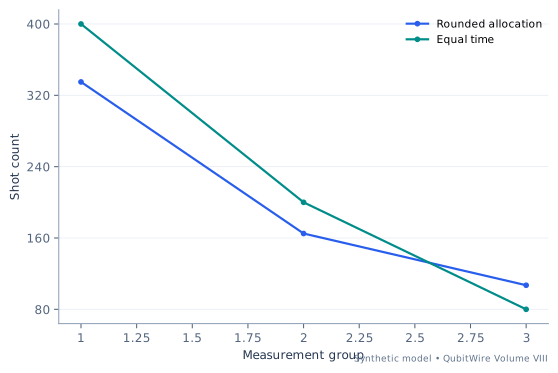
Each case uses invented inputs. The results follow from this model and do not describe measured hardware.
| Calculated quantity | Synthetic result |
|---|---|
| Allocated shots, group 1 | 335 |
| Allocated shots, group 2 | 165 |
| Allocated shots, group 3 | 107 |
| Used time | 1200 |
| Allocated variance | 0.010799631409646753 |
| Equal-time variance | 0.01143 |
| Continuous lower bound | 0.010799510630309797 |
| Group | Continuous shots | Rounded shots | Equal-time shots |
|---|---|---|---|
| 1 | 333.3408855913823 | 335 | 400 |
| 2 | 164.99532045387687 | 165 | 200 |
| 3 | 107.33369470017277 | 107 | 80 |
The rounded allocation uses 1,200 of 1,200 time units. Its variance is 0.001118% above the continuous lower bound. The calculation shows why a costly measurement may deserve fewer shots even when its contribution is noisy.
| Calculated quantity | Synthetic result |
|---|---|
| Allocated shots, group 1 | 531 |
| Allocated shots, group 2 | 275 |
| Allocated shots, group 3 | 192 |
| Used time | 2700 |
| Allocated variance | 0.009628693716829308 |
| Equal-time variance | 0.01101111111111111 |
| Continuous lower bound | 0.009628675841389512 |
| Group | Continuous shots | Rounded shots | Equal-time shots |
|---|---|---|---|
| 1 | 529.5397902499327 | 531 | 900 |
| 2 | 275.1569464026749 | 275 | 300 |
| 3 | 192.1413386488632 | 192 | 128 |
The rounded allocation uses 2,700 of 2,700 time units. Its variance is 0.000186% above the continuous lower bound. The calculation shows why a costly measurement may deserve fewer shots even when its contribution is noisy.
| Calculated quantity | Synthetic result |
|---|---|
| Allocated shots, group 1 | 662 |
| Allocated shots, group 2 | 335 |
| Allocated shots, group 3 | 309 |
| Used time | 4500 |
| Allocated variance | 0.010430443022618991 |
| Equal-time variance | 0.012276722741433023 |
| Continuous lower bound | 0.010430312959808825 |
| Group | Continuous shots | Rounded shots | Equal-time shots |
|---|---|---|---|
| 1 | 656.8369671128199 | 662 | 1500 |
| 2 | 334.8709207605855 | 335 | 300 |
| 3 | 309.8297755834646 | 309 | 214 |
The rounded allocation uses 4,500 of 4,500 time units. Its variance is 0.001247% above the continuous lower bound. The calculation shows why a costly measurement may deserve fewer shots even when its contribution is noisy.
Try the reasoning: Which group gains most from the next affordable shot? Compare its variance reduction per unit time with that of the other groups.
Uncertainty propagation includes sensitivities and covariance; independent terms simplify the variance sum. Covariance, bias and distribution assumptions in the teaching models are declared separately; no NIST endorsement is implied.
Source research checked . Teaching calculations are ideal models.
A finite quantum simulator answers a finite question. Researchers may then ask how the observable changes as the represented system becomes larger. Extrapolation can be informative, but the inferred limit depends on a functional form and a range of sizes. A narrow fitted residual is evidence about the observed window, not automatic evidence about an unobserved limit.
This lab creates an exact curve with both inverse-size and inverse-size-squared terms. It deliberately fits only the first term. Because the generating limit is known, the error in the extrapolated intercept is visible. Comparing all sizes with the largest two, and testing a new holdout size, reveals sensitivity that the fitted line alone could conceal.
The example avoids simulated measurement noise so the source of error stays clear: the model is misspecified. In a real study, sampling noise, control error and different finite-size corrections can coexist. Comparing fit windows alongside explicit extrapolation assumptions exposes this sensitivity. Readers should be able to distinguish a directly measured finite-size observable from an inferred large-system value.
Synthetic observable y(L) = y_infinity + a/L + b/L²
Deliberately restricted fit y_fit(L) = intercept + slope/L
Holdout error = fitted prediction at unused size - generating value
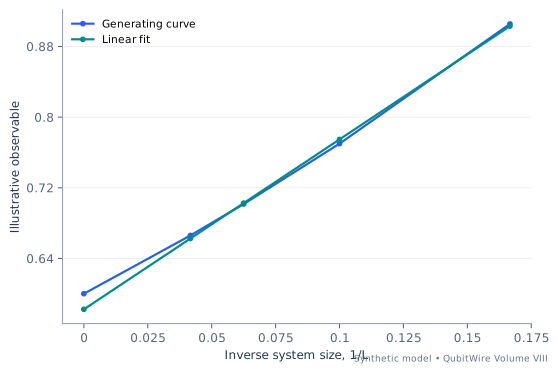
Each case uses invented inputs. The results follow from this model and do not describe measured hardware.
| Calculated quantity | Synthetic result |
|---|---|
| All-size linear extrapolated intercept | 0.5823186709873579 |
| Largest-two extrapolated intercept | 0.5947916666666666 |
| Known synthetic infinite-size reference | 0.6 |
| All-size intercept bias | -0.017681329012642077 |
| In-sample residual RMS | 0.003240669796073463 |
| Unfitted holdout prediction minus truth | -0.008308929428708534 |
| System size | Observable |
|---|---|
| 6 | 0.9055555555555556 |
| 10 | 0.77 |
| 16 | 0.7015625 |
| 24 | 0.6659722222222222 |
The known intercept is 0.6, so the fitted intercept error can be measured directly here. A small residual over the observed window does not guarantee an accurate extrapolation outside it. On a real experiment the infinite-size answer is unknown; varying the fit window and testing held-out sizes becomes evidence about model sensitivity, not proof of the limit.
| Calculated quantity | Synthetic result |
|---|---|
| All-size linear extrapolated intercept | 0.6217640825006453 |
| Largest-two extrapolated intercept | 0.6368637110016419 |
| Known synthetic infinite-size reference | 0.65 |
| All-size intercept bias | -0.028235917499354724 |
| In-sample residual RMS | 0.0027585201551087405 |
| Unfitted holdout prediction minus truth | -0.01121975718117707 |
| System size | Observable |
|---|---|
| 11 | 0.8161157024793388 |
| 15 | 0.758888888888889 |
| 21 | 0.7205215419501134 |
| 29 | 0.6974435196195006 |
The known intercept is 0.65, so the fitted intercept error can be measured directly here. A small residual over the observed window does not guarantee an accurate extrapolation outside it. On a real experiment the infinite-size answer is unknown; varying the fit window and testing held-out sizes becomes evidence about model sensitivity, not proof of the limit.
| Calculated quantity | Synthetic result |
|---|---|
| All-size linear extrapolated intercept | 0.6827909087164262 |
| Largest-two extrapolated intercept | 0.6939153439153434 |
| Known synthetic infinite-size reference | 0.71 |
| All-size intercept bias | -0.02720909128357374 |
| In-sample residual RMS | 0.0015193266736859916 |
| Unfitted holdout prediction minus truth | -0.009680813148590484 |
| System size | Observable |
|---|---|
| 17 | 0.7990657439446367 |
| 21 | 0.7739909297052153 |
| 27 | 0.7538134430727023 |
| 35 | 0.7401224489795918 |
The known intercept is 0.71, so the fitted intercept error can be measured directly here. A small residual over the observed window does not guarantee an accurate extrapolation outside it. On a real experiment the infinite-size answer is unknown; varying the fit window and testing held-out sizes becomes evidence about model sensitivity, not proof of the limit.
Try the reasoning: Can a two-point fit with zero residual certify the infinite-size limit? Compare the fit-window change and the held-out-size error.
Source research checked . Teaching calculations are ideal models.
Splitting an evolution into more steps can make a product-formula approximation more faithful to the target mathematical evolution. The implementation then performs more operations, each of which may introduce error or consume resources. A step count therefore sits between two models: the mathematical approximation and the physical realization.
The deliberately simple objective in this lab contains one term that falls as an inverse power of the step count and one that grows linearly. Its continuous minimum can be derived by differentiation, then compared with the allowed integers. Both contributions remain visible. This prevents a decreasing approximation bound from being mistaken for a decreasing total experimental error.
The cited product-formula work supplies the context that approximation error depends on mathematical structure. It does not supply this toy model’s coefficients or certify that a linear implementation term is appropriate. Before applying the sum to a real experiment, the two contributions would need compatible units and an error measure for which the combination is justified. Changing the step count is meaningful only while those model assumptions remain appropriate.
Illustrative error objective E(r) = a/r^q + b r
Continuous stationary point r* = (q a/b)^(1/(q+1))
Integer optimum is selected from the stated finite step range
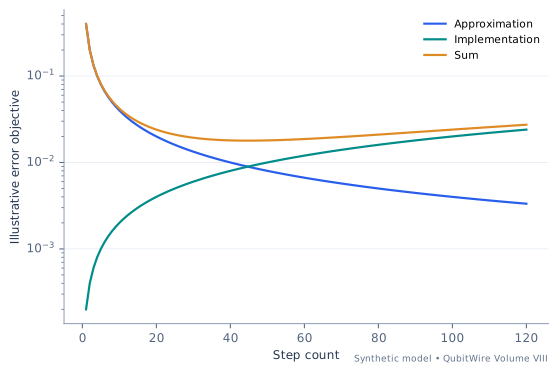
Each case uses invented inputs. The results follow from this model and do not describe measured hardware.
| Calculated quantity | Synthetic result |
|---|---|
| Continuous unconstrained optimum | 44.721359549995796 |
| Best tested integer step count | 45 |
| Approximation contribution at optimum | 0.008888888888888889 |
| Implementation contribution at optimum | 0.009000000000000001 |
| Combined illustrative error objective | 0.01788888888888889 |
| One-step objective / best objective | 22.371428571428567 |
The numerical optimum is 45 steps. Increasing steps beyond it reduces one term while increasing the other. The cited product-formula literature motivates the existence of approximation error, but the additive linear implementation term and all coefficients are assumptions created for this decision exercise.
| Calculated quantity | Synthetic result |
|---|---|
| Continuous unconstrained optimum | 13.700134211888825 |
| Best tested integer step count | 14 |
| Approximation contribution at optimum | 0.004591836734693878 |
| Implementation contribution at optimum | 0.0098 |
| Combined illustrative error objective | 0.014391836734693877 |
| One-step objective / best objective | 62.58408961996597 |
The numerical optimum is 14 steps. Increasing steps beyond it reduces one term while increasing the other. The cited product-formula literature motivates the existence of approximation error, but the additive linear implementation term and all coefficients are assumptions created for this decision exercise.
| Calculated quantity | Synthetic result |
|---|---|
| Continuous unconstrained optimum | 13.214760630124598 |
| Best tested integer step count | 13 |
| Approximation contribution at optimum | 0.008875739644970414 |
| Implementation contribution at optimum | 0.016900000000000002 |
| Combined illustrative error objective | 0.025775739644970416 |
| One-step objective / best objective | 58.24469135235646 |
The numerical optimum is 13 steps. Increasing steps beyond it reduces one term while increasing the other. The cited product-formula literature motivates the existence of approximation error, but the additive linear implementation term and all coefficients are assumptions created for this decision exercise.
Try the reasoning: At the continuous stationary point, what relation holds between the approximation and implementation terms for inverse-step power q?
Product-formula approximation error depends on the mathematical structure of Hamiltonian terms. The lab does not reproduce a paper benchmark or a Hamiltonian-specific bound. Its additive implementation-error term is a teaching assumption.
Source research checked . Teaching calculations are ideal models.
A laboratory may have more worthwhile experiments than available time. The choice is rarely settled by selecting the fastest experiment or the one with the largest individual expected value. Some combinations fit the schedule better than others. The objective also deserves scrutiny: a numerical value assigned to a task is a planning preference until it has a defensible information model behind it.
This example enumerates every subset of eight tasks, keeping only schedules under a fixed time budget. It compares the exact best subset with input-order packing and a value-per-time greedy rule. Because the example is small, exhaustive classical search is transparent and cheap. It demonstrates the optimization problem without creating a claim that quantum computation is required to solve it.
The cases give all task durations and values, along with the exact selected subset. The most useful follow-up is to challenge the assumptions: two experiments may answer the same question, one may enable another, or learning from an early result may change the remaining choices. Those effects require dependencies or adaptive information value. Stating the simple objective makes those omissions easier to discuss than hiding the choice behind a generic intelligent scheduler label.
Choose a subset S with sum_{i in S} time_i <= available time
Maximize sum_{i in S} declared learning_value_i
Eight tasks have 2^8 = 256 subsets
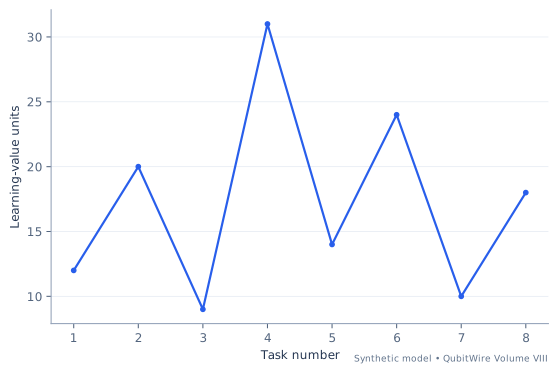
Each case uses invented inputs. The results follow from this model and do not describe measured hardware.
| Calculated quantity | Synthetic result |
|---|---|
| Exact best selected task numbers | 2, 4 |
| Exact best total learning value | 51 |
| Exact best used time | 34 |
| Input-order schedule value | 41 |
| Value-per-time greedy schedule value | 51 |
| Total subsets checked | 256 |
| Task | Duration | Declared learning value | Selected by exact search |
|---|---|---|---|
| 1 | 9 | 12 | No |
| 2 | 14 | 20 | Yes |
| 3 | 7 | 9 | No |
| 4 | 20 | 31 | Yes |
| 5 | 11 | 14 | No |
| 6 | 17 | 24 | No |
| 7 | 8 | 10 | No |
| 8 | 13 | 18 | No |
This small classical calculation makes an experimental planning objective explicit. The learning values are invented preferences, not measured information gain or a ranking of scientific importance. Dependencies between experiments, uncertain duration and complementary results violate the additive model. No quantum optimization advantage is claimed.
| Calculated quantity | Synthetic result |
|---|---|
| Exact best selected task numbers | 1, 2, 3, 5, 7 |
| Exact best total learning value | 90 |
| Exact best used time | 49 |
| Input-order schedule value | 87 |
| Value-per-time greedy schedule value | 90 |
| Total subsets checked | 256 |
| Task | Duration | Declared learning value | Selected by exact search |
|---|---|---|---|
| 1 | 9 | 17 | Yes |
| 2 | 14 | 20 | Yes |
| 3 | 7 | 19 | Yes |
| 4 | 20 | 31 | No |
| 5 | 11 | 19 | Yes |
| 6 | 17 | 24 | No |
| 7 | 8 | 15 | Yes |
| 8 | 13 | 18 | No |
This small classical calculation makes an experimental planning objective explicit. The learning values are invented preferences, not measured information gain or a ranking of scientific importance. Dependencies between experiments, uncertain duration and complementary results violate the additive model. No quantum optimization advantage is claimed.
| Calculated quantity | Synthetic result |
|---|---|
| Exact best selected task numbers | 1, 3, 4, 5, 7, 8 |
| Exact best total learning value | 149 |
| Exact best used time | 68 |
| Input-order schedule value | 130 |
| Value-per-time greedy schedule value | 149 |
| Total subsets checked | 256 |
| Task | Duration | Declared learning value | Selected by exact search |
|---|---|---|---|
| 1 | 9 | 23 | Yes |
| 2 | 14 | 20 | No |
| 3 | 7 | 31 | Yes |
| 4 | 20 | 31 | Yes |
| 5 | 11 | 25 | Yes |
| 6 | 17 | 24 | No |
| 7 | 8 | 21 | Yes |
| 8 | 13 | 18 | Yes |
This small classical calculation makes an experimental planning objective explicit. The learning values are invented preferences, not measured information gain or a ranking of scientific importance. Dependencies between experiments, uncertain duration and complementary results violate the additive model. No quantum optimization advantage is claimed.
Try the reasoning: Why can sorting by learning value per time miss the exact subset optimum? Which dependency between experiments would break the additive model?
Source research checked . Teaching calculations are ideal models.
A variational routine may require many expectation-value measurements to estimate a gradient. Measuring only a subset of parameters appears to reduce the work, but the omitted directions can contribute a systematic error to the update. The fair comparison asks how both choices meet the same gradient-error target.
The model uses a standard two-shift estimator where each derivative is half the difference of two independent sample means. Summing the coordinate variances gives an expected squared Euclidean sampling error. A subset estimator receives an additional squared-error contribution from the known synthetic gradient components it omits. If that contribution already exceeds the target, no number of extra shots on the retained coordinates can repair the estimate.
The omitted norm is supplied by construction, which is a major advantage unavailable in most real optimization runs. The lab should therefore accompany a discussion of screening, pilot estimates or structural assumptions used to select parameters. It explains what a claimed measurement saving must preserve, while avoiding the claim that an actual algorithm can discover harmless omissions without paying for information.
Derivative estimate = (mean_plus - mean_minus)/2
Per-coordinate variance with n shots per shift = v/(2n)
Full expected squared gradient error = parameters × v/(2n)
Subset total = omitted squared norm + active_parameters × v/(2n)
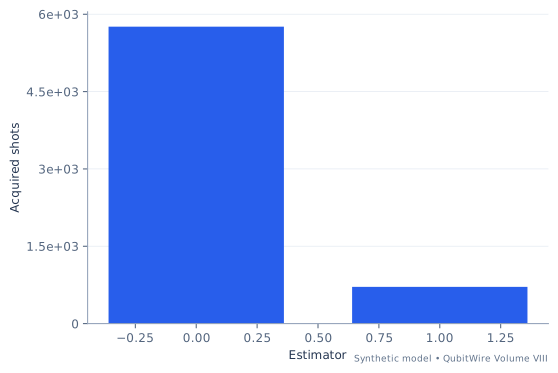
Each case uses invented inputs. The results follow from this model and do not describe measured hardware.
| Calculated quantity | Synthetic result |
|---|---|
| Shots per shift, full gradient | 240 |
| Total full-gradient shots | 5760 |
| Full-gradient acquisition, seconds | 0.576 |
| Subset remaining squared-error budget | 0.009 |
| Total subset-gradient shots | 712 |
| Subset acquisition, seconds | 0.0712 |
Measuring fewer coordinates can reduce work or consume the error budget through omitted directions. The omitted-gradient norm is provided by construction here; an actual optimizer normally does not know it for free. Parameter-shift identities require an appropriate gate generator and shift rule. Correlations within or between the two shifted sample means can change each coordinate variance; cross-coordinate covariance alone does not change the trace-based squared-error sum.
| Calculated quantity | Synthetic result |
|---|---|
| Shots per shift, full gradient | 440 |
| Total full-gradient shots | 19360 |
| Full-gradient acquisition, seconds | 3.872 |
| Subset remaining squared-error budget | 0.0045 |
| Total subset-gradient shots | 7200 |
| Subset acquisition, seconds | 1.44 |
Measuring fewer coordinates can reduce work or consume the error budget through omitted directions. The omitted-gradient norm is provided by construction here; an actual optimizer normally does not know it for free. Parameter-shift identities require an appropriate gate generator and shift rule. Correlations within or between the two shifted sample means can change each coordinate variance; cross-coordinate covariance alone does not change the trace-based squared-error sum.
| Calculated quantity | Synthetic result |
|---|---|
| Shots per shift, full gradient | 680 |
| Total full-gradient shots | 46240 |
| Full-gradient acquisition, seconds | 14.796800000000001 |
| Subset remaining squared-error budget | -0.0009 |
| Total subset-gradient shots | Omitted gradient alone exhausts target |
| Subset acquisition, seconds | Infeasible |
Measuring fewer coordinates can reduce work or consume the error budget through omitted directions. The omitted-gradient norm is provided by construction here; an actual optimizer normally does not know it for free. Parameter-shift identities require an appropriate gate generator and shift rule. Correlations within or between the two shifted sample means can change each coordinate variance; cross-coordinate covariance alone does not change the trace-based squared-error sum.
Try the reasoning: When the omitted squared gradient norm meets or exceeds the target, can more shots make the subset estimator feasible?
Parameter-shift identities can estimate exact expectation derivatives for specified gate generators. Finite-sample uncertainty and covariance are independently derived; the two-shift identity is not claimed for every parameterization.
Uncertainty propagation includes sensitivities and covariance; independent terms simplify the variance sum. Covariance, bias and distribution assumptions in the teaching models are declared separately; no NIST endorsement is implied.
Source research checked . Teaching calculations are ideal models.
Compare the phase gate S=diag(1,i) with its inverse S†=diag(1,-i). Start with a plus state so the phase change can later become visible in an X measurement. The example deliberately avoids a gate such as X that happens to equal its own inverse.
A circuit is an ordered product of operations. Undoing a whole circuit requires both inversion of every operation and reversal of their order. Merely reading the original gate list backward works only if every gate is self-inverse. This is a practical distinction for uncomputation, test circuits and any story about reversing a quantum process.
Figure and table scope: Start from plus. Compare S then S with S then S†, followed by H and Z-basis readout in both cases.
Derivation step 1: One S operation changes plus into (|0>+i|1>)/√2. Its Z histogram is still balanced.
Derivation step 2: Applying S again gives (|0>-|1>)/√2, the minus state. Algebraically S²=Z, not the identity.
Derivation step 3: Applying S† after S cancels their phases and recovers plus. The product S†S is the identity.
Derivation step 4: After a final Hadamard, the repeated-S branch gives one while the inverse branch gives zero, under the stated ideal preparation and measurement conventions.
Separate challenge: For U=HS, with S applied first, write U† and verify that U†U is identity. What goes wrong if the order is not reversed?
Worked challenge answer: The inverse is S†H because H†=H and (HS)†=S†H. Then S†HHS=S†S=I. The unreversed product HS†HS is generally not identity. The exercise tests ordering rather than hardware noise.
S²=Z; S†S=I; H|−>=|1>; H|+>=|0>.
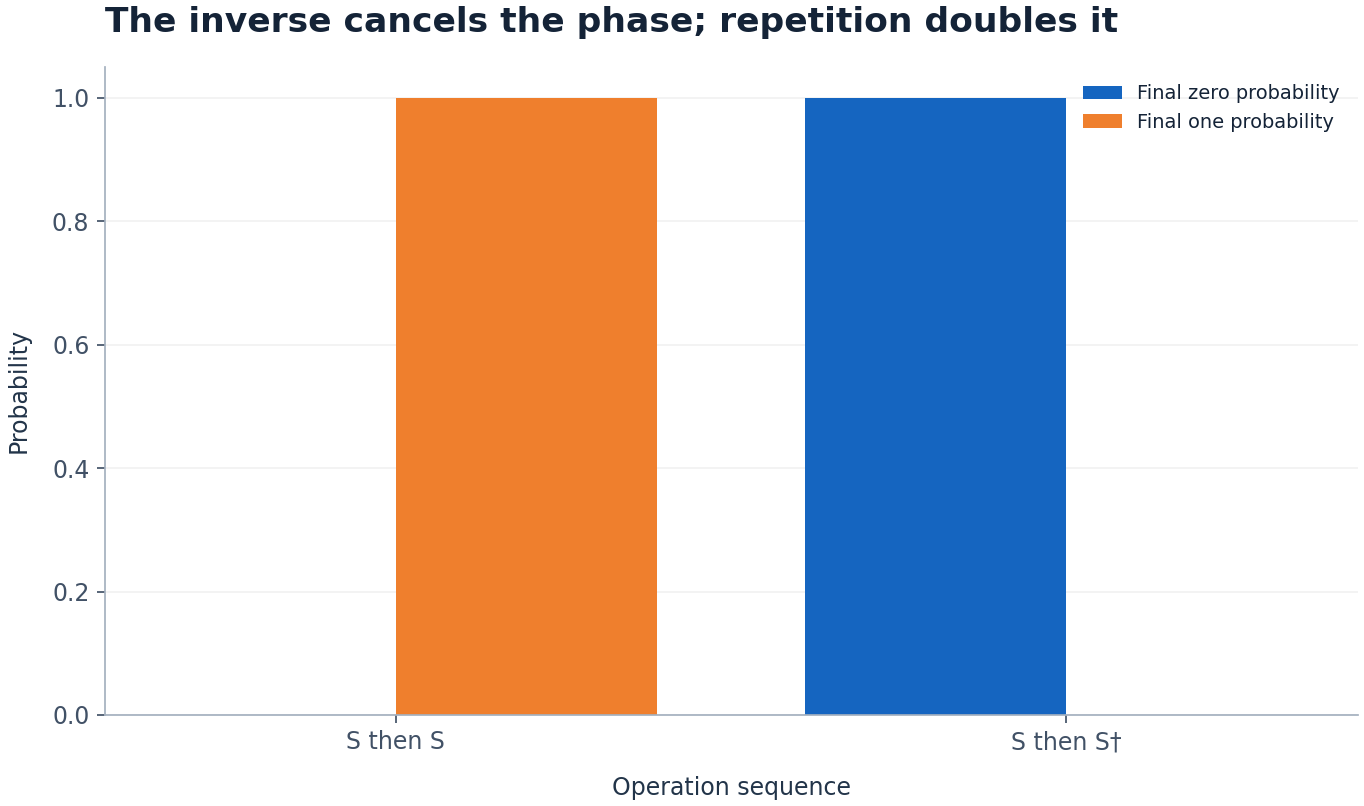
Each case uses invented inputs. The results follow from this model and do not describe measured hardware.
| Reference | Prediction |
|---|---|
| Original declared example | Two S gates turn plus into minus, which differs in a subsequent X-basis measurement. S followed by S-dagger returns plus in the ideal model. |
| Operation sequence | Final zero probability | Final one probability |
|---|---|---|
| S then S | 0 | 1 |
| S then S† | 1 | 0 |
The declared reference example predicts: Two S gates turn plus into minus, which differs in a subsequent X-basis measurement. S followed by S-dagger returns plus in the ideal model.
Try the reasoning: For U=HS, with S applied first, write U† and verify that U†U is identity. What goes wrong if the order is not reversed?
Primary scientific context for an original ideal teaching example. Source research checked 19 October 2026; site integration inspected 20 October 2026. These are different checks.
Source research checked . Teaching calculations are ideal models.
Assume the target register is an exact eigenstate of a unitary with eigenvalue exp(2πiθ), and choose θ=3/8. Use a three-qubit estimation register. This special case has an exact three-bit binary representation, letting readers see the ideal phase-estimation logic before approximation and noise are introduced.
The number of displayed bits is a resolution convention, not proof that an arbitrary phase has been determined exactly. Nonrepresentable phases give a distribution peaked near the phase, with tails across the periodic estimation grid. Controlled powers also carry implementation cost; counting only the three final bits hides potentially expensive evolution. A strong explainer keeps output precision and query resources in the same view.
Figure and table scope: Display all eight output integers for an exact eigenphase θ=3/8 and three ideal estimation qubits. Bits are written most-significant first.
Derivation step 1: Three counting qubits represent integers j from zero to seven. Controlled powers of the unitary imprint phases exp(2πijθ) on their superposition.
Derivation step 2: With θ=3/8, the phase pattern matches one Fourier basis vector exactly. The inverse quantum Fourier transform maps it to the integer three.
Derivation step 3: In the declared most-significant-bit-first notation, the output string is 011 and the reported fraction is 3/8.
Derivation step 4: If the target is a superposition of eigenstates, the result is sampled from their eigenphases with the corresponding weights. The exact single-eigenstate example does not describe every input.
Separate challenge: If a software display reverses the bits and shows 110, must the physics have failed?
Worked challenge answer: No. First inspect its bit-order convention. Reversing 011 gives 110, but the numerical decoder may still associate that printed order with the integer three. A correct demonstration publishes both the convention and a known-phase check.
P(y=3)=1 in the ideal model; y=3 is 011. Tiny nonzero table residuals are floating-point roundoff.
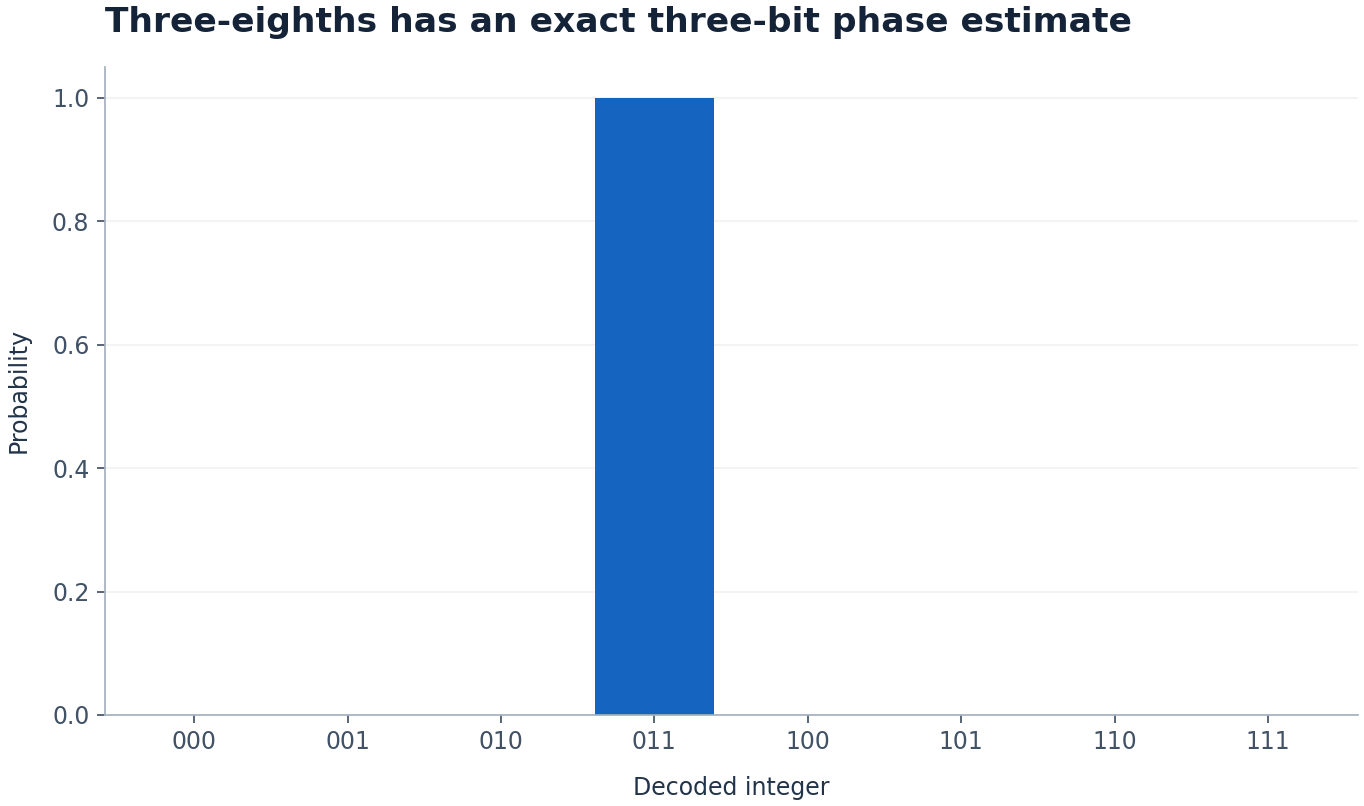
Each case uses invented inputs. The results follow from this model and do not describe measured hardware.
| Reference | Prediction |
|---|---|
| Original declared example | Ideal phase estimation returns 011 with probability one for an exact eigenstate and exact controlled operations. A different SDK display order may print the bit string differently, so resolve endianness before comparison. |
| Decoded integer | Ideal output |
|---|---|
| 0 | 1.3096323621833204e-32 |
| 1 | 5.95212187002079e-33 |
| 2 | 5.585196838722983e-33 |
| 3 | 1 |
| 4 | 5.585196838722983e-33 |
| 5 | 5.95212187002079e-33 |
| 6 | 1.3096323621833204e-32 |
| 7 | 3.749399456654644e-33 |
The declared reference example predicts: Ideal phase estimation returns 011 with probability one for an exact eigenstate and exact controlled operations. A different SDK display order may print the bit string differently, so resolve endianness before comparison.
Try the reasoning: If a software display reverses the bits and shows 110, must the physics have failed?
Primary scientific context for an original ideal teaching example. Source research checked 19 October 2026; site integration inspected 20 October 2026. These are different checks.
Source research checked . Teaching calculations are ideal models.
Construct an n-qubit GHZ state with a Hadamard on the first qubit and controlled-NOT gates from it to the others. The state is entangled for n greater than one, but this circuit lies inside the stabilizer framework. The exercise separates the presence of entanglement from a sufficient claim of classical simulation hardness.
A photograph of many qubits or a statement that they are entangled does not establish that a classical computer cannot reproduce the relevant outputs. Simulation difficulty depends on exploitable structure. The GHZ example gives a concrete counterexample to a common shortcut while preserving the physical significance of entanglement itself.
Figure and table scope: Sweep GHZ register size n from 2 to 16. Count independent stabilizer generators only, with the GHZ construction fixed.
Derivation step 1: The state is stabilized by the product of X on every qubit and by adjacent Z-pair products Z1Z2, Z2Z3 and so on.
Derivation step 2: These n independent commuting generators specify the pure stabilizer state compactly. For three qubits they are XXX, ZZI and IZZ.
Derivation step 3: Clifford operations map Pauli operators to Pauli operators under conjugation, allowing updates to a compact stabilizer representation.
Derivation step 4: Adding a non-Clifford operation changes the applicable simulation structure. It does not automatically prove a particular circuit is hard; the whole circuit and chosen task still matter.
Separate challenge: Verify that ZZI stabilizes the three-qubit GHZ state. What eigenvalue does it assign to each of the two occupied basis strings?
Worked challenge answer: On 000, both Z factors contribute plus one. On 111, the two minus signs multiply to plus one. Both components therefore retain the same positive sign, and the superposition is unchanged.
n independent generators. A full tableau also stores Pauli symbols and phases; this is not a runtime curve.
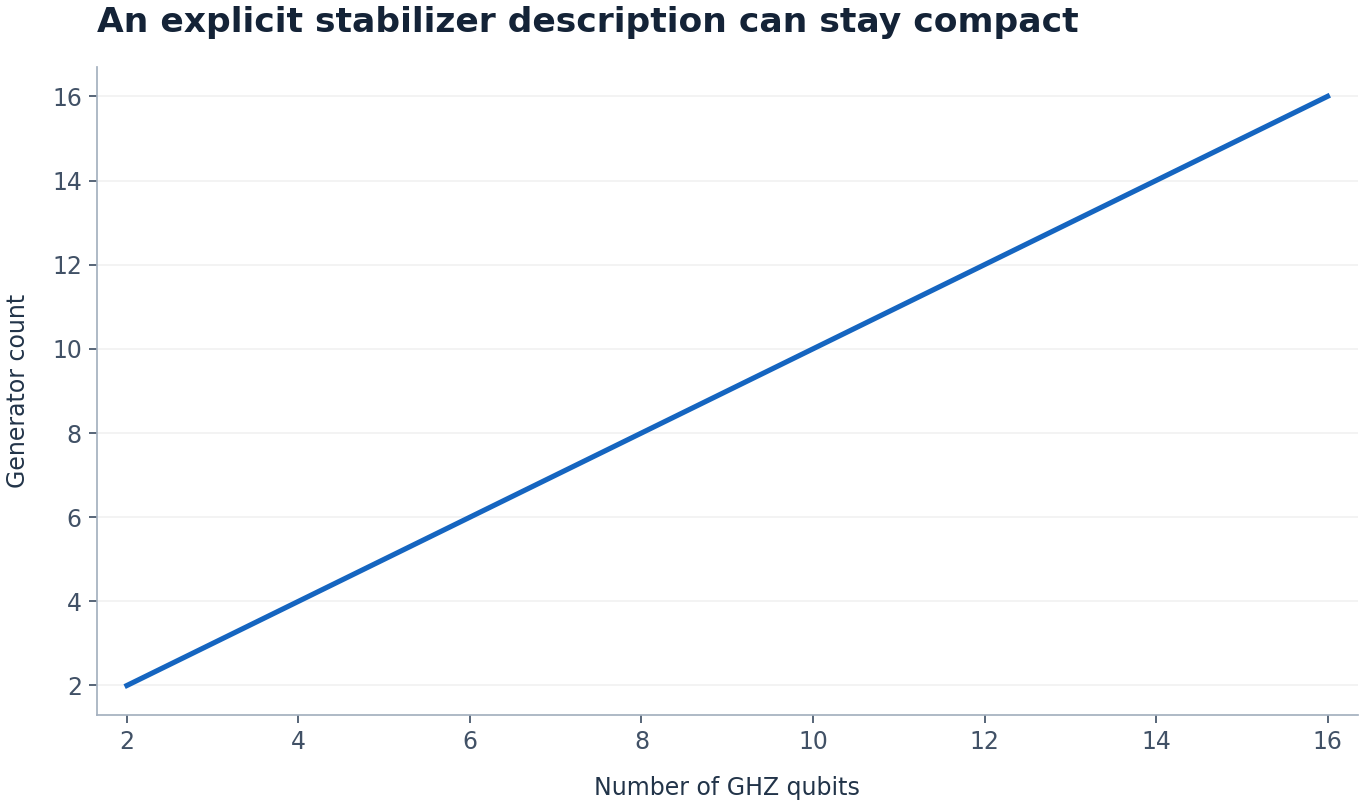
Each case uses invented inputs. The results follow from this model and do not describe measured hardware.
| Reference | Prediction |
|---|---|
| Original declared example | The generators characterize the ideal state while its generic full-state-vector representation would allocate 2^n complex amplitudes. This is a representation comparison, not a timing benchmark. |
| Number of GHZ qubits | Independent generators |
|---|---|
| 2 | 2 |
| 3 | 3 |
| 5 | 5 |
| 7 | 7 |
| 9 | 9 |
| 10 | 10 |
| 12 | 12 |
| 14 | 14 |
| 16 | 16 |
The declared reference example predicts: The generators characterize the ideal state while its generic full-state-vector representation would allocate 2^n complex amplitudes. This is a representation comparison, not a timing benchmark.
Try the reasoning: Verify that ZZI stabilizes the three-qubit GHZ state. What eigenvalue does it assign to each of the two occupied basis strings?
Primary scientific context for an original ideal teaching example. Source research checked 19 October 2026; site integration inspected 20 October 2026. These are different checks.
Source research checked . Teaching calculations are ideal models.
Prepare a control qubit in plus and a target in an eigenstate of U with eigenvalue exp(iφ). Apply controlled-U. The target’s eigenstate is unchanged up to its phase, but the control branches acquire a relative phase that a later interference measurement can reveal.
The phrase phase kickback becomes useful once the branches are written explicitly. Nothing needs to travel backward in time or violate the controlled gate’s direction. The gate condition links a target eigenvalue to a relative phase on the control, and interference turns that relative phase into a measurable distribution.
Figure and table scope: Sweep target eigenphase φ from 0 to 2π with an exact target eigenstate, plus-state control, controlled-U and final H on the control.
Derivation step 1: Before the controlled operation the joint state is [|0>+|1>]|u>/√2.
Derivation step 2: Afterward it is [|0>+exp(iφ)|1>]|u>/√2. The target factors out because it was an eigenstate.
Derivation step 3: A Hadamard on the control gives zero probability [1+cos φ]/2. For eigenvalue minus one, the control becomes minus before the Hadamard and is measured as one afterward.
Derivation step 4: For a target superposition of different eigenstates, control and target can become entangled. The single-eigenvalue factorization no longer describes the entire joint state.
Separate challenge: For φ=2π/3, calculate the control’s zero probability. Would measuring the target eigenstate directly reveal this phase?
Worked challenge answer: The zero probability is (1-1/2)/2=1/4. A direct measurement of the unchanged target eigenstate does not reveal its acquired overall phase; the controlled comparison supplies the necessary reference.
P(control zero)=(1+cos φ)/2; P(control one)=(1−cos φ)/2.
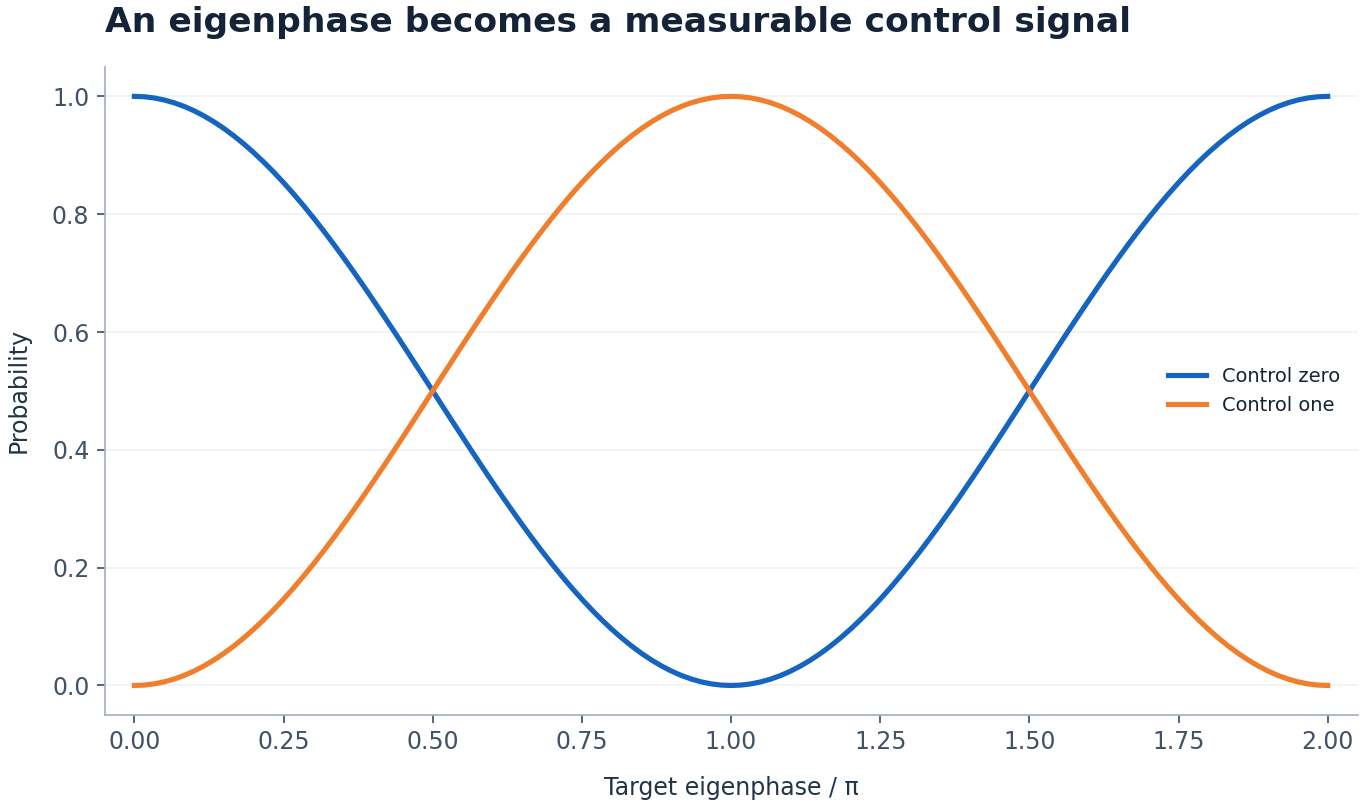
Each case uses invented inputs. The results follow from this model and do not describe measured hardware.
| Reference | Prediction |
|---|---|
| Original declared example | The target returns as the same eigenstate while the control ideally measures one. The minus sign is relative between control branches and is therefore observable. |
| Target eigenphase / π | Control zero | Control one |
|---|---|---|
| 0 | 1 | 0 |
| 0.25 | 0.8535533905932737 | 0.1464466094067262 |
| 0.5 | 0.5 | 0.49999999999999994 |
| 0.75 | 0.14644660940672627 | 0.8535533905932737 |
| 1 | 0 | 1 |
| 1.25 | 0.14644660940672616 | 0.8535533905932738 |
| 1.5 | 0.4999999999999999 | 0.5000000000000001 |
| 1.75 | 0.8535533905932737 | 0.14644660940672632 |
| 2 | 1 | 0 |
The declared reference example predicts: The target returns as the same eigenstate while the control ideally measures one. The minus sign is relative between control branches and is therefore observable.
Try the reasoning: For φ=2π/3, calculate the control’s zero probability. Would measuring the target eigenstate directly reveal this phase?
Primary scientific context for an original ideal teaching example. Source research checked 19 October 2026; site integration inspected 20 October 2026. These are different checks.
Source research checked . Teaching calculations are ideal models.
Start at position zero with coin state zero. At each step apply a Hadamard to the coin, then shift right for coin zero and left for coin one. Do not measure between steps. Compare the final position distribution with a classical fair walk after the same number of steps.
A quantum walk is not a classical random walk with a faster clock. Interference changes how paths combine. The coin is part of the state, so paths ending at the same position but different coin states do not interfere when position alone is read. A symmetric initial coin would produce a different distribution and must not be silently substituted.
Figure and table scope: Display the position distribution after three steps from position zero and coin zero. Each step applies H then shifts right for coin zero and left for coin one; the final coin is unobserved.
Derivation step 1: After one step, the amplitudes at (position +1, coin 0) and (position -1, coin 1) are both 1/√2.
Derivation step 2: After two steps, four coin-position amplitudes are present. Paths that arrive at the same full coin-position state must be added as amplitudes, including their signs.
Derivation step 3: After three steps, sum squared magnitudes over coin states at each position. For the stated initial coin, the probabilities at -3,-1,+1,+3 are 1/8,1/8,5/8,1/8.
Derivation step 4: The classical fair walk instead gives 1/8,3/8,3/8,1/8. The quantum asymmetry follows from the chosen initial coin and convention, not an error in normalization.
Separate challenge: Why does a display that sums all coin amplitudes before squaring produce an incorrect position distribution?
Worked challenge answer: The two coin states are orthogonal alternatives. A position-only measurement traces over the coin, so it sums their probabilities. Coherent addition is appropriate only within the same coin-position state. The implementation must preserve that distinction.
Quantum probabilities at −3,−1,1,3: 1/8,1/8,5/8,1/8. Classical fair-walk probabilities: 1/8,3/8,3/8,1/8.
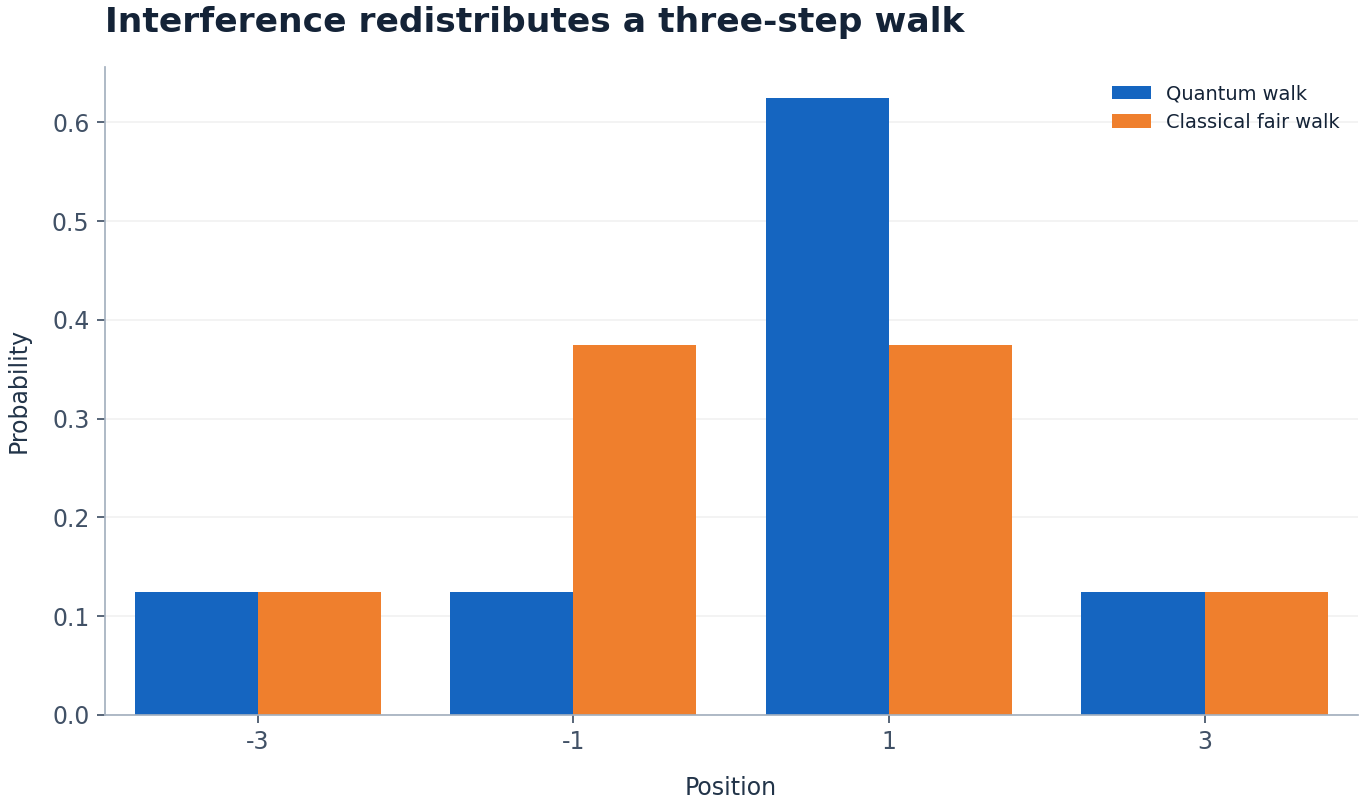
Each case uses invented inputs. The results follow from this model and do not describe measured hardware.
| Reference | Prediction |
|---|---|
| Original declared example | The reference calculation supplies the full three-step distribution. Its orientation follows the stated coin convention; reversing the shift convention mirrors the plot rather than changing the physics. |
| Position | Quantum walk | Classical fair walk |
|---|---|---|
| -3 | 0.125 | 0.125 |
| -1 | 0.125 | 0.375 |
| 1 | 0.625 | 0.375 |
| 3 | 0.125 | 0.125 |
The declared reference example predicts: The reference calculation supplies the full three-step distribution. Its orientation follows the stated coin convention; reversing the shift convention mirrors the plot rather than changing the physics.
Try the reasoning: Why does a display that sums all coin amplitudes before squaring produce an incorrect position distribution?
Primary scientific context for an original ideal teaching example. Source research checked 19 October 2026; site integration inspected 20 October 2026. These are different checks.
The companies will evaluate a concrete engineering workflow and its computational costs.
A programming study tests workflow dependencies and states its hardware boundaries.
The proposal combines qubits and oscillator modes. Its reported scattering results come from tensor-network simulations.
Drawing counts directly avoids generating every simulated shot when a workflow needs only the final frequency table.
A new optimization benchmark separates solution quality from optimality certification and finds no quantum advantage in its tested protocols.
A laboratory demonstration uses variational optimization for polarization protocols. Deployed fiber networks remain future work.
A new similarity-estimation proposal links a modified SWAP test to simulated interference images. Magnetic-field sensing remains a prospective use.
Initial experiments have begun at IQCC. Decoder integration remains ahead, and the company says real-time correction has not yet been demonstrated.
The new collaboration will study optimization and error mitigation. Faster operating networks remain a result to demonstrate.
The startup’s CUDA-Q compiler plans address developer workflow. Inception membership and future AI orchestration answer separate questions.
The Brazilian project plans matched classical, quantum and hybrid comparisons. The research announcement reports a question to investigate, rather than an advantage already measured.
The new workflow proposes AI-driven experiments across classical, quantum-inspired and quantum approaches. Its announced rollout begins in Q4, with human validation gates.
The prototype does not establish a utility-scale fault-tolerant computer. The paper identifies remaining interconnect, controller-power, device-uniformity and system-architecture work.
This source-locator check adds context to the existing record. Its original publication and claim-review dates remain unchanged. No independent scientific replication was performed.
Where to look: Abstract; Main, system architecture; Figure 1
These selected views resolve the same ledger claim. Historical citations keep their cited revision.
Members of the HRL Quantum Team and Collaborators. A digitally controlled silicon quantum processing unit.
Nature. Source published 2026-07-29. Published journal article, 29 July 2026.
Abstract; Main, system architecture; Figure 1. https://www.nature.com/articles/s41586-026-10754-7#Fig1
Source authority: The reported 4 K controller, ribbon interconnect and configurable quantum-dot system.
Does not establish: Independent replication or a complete useful fault-tolerant application.

QubitWire: Cryogenic control connects to a silicon processor. Record first published 2026-09-26. Cited revision claim-hrl-cryogenic-control-integration-r1.
https://qubitwire.com/evidence/hrl-cryogenic-control-integration?revision=claim-hrl-cryogenic-control-integration-r1
Current record and corrections: https://qubitwire.com/evidence/hrl-cryogenic-control-integration
Limitation: The prototype does not establish a utility-scale fault-tolerant computer. The paper identifies remaining interconnect, controller-power, device-uniformity and system-architecture work.
Cooling connected cells does not demonstrate fault-tolerant computation across chips. Deployment timing and future qubit capacities are plans, not measured computing outcomes.
This source-locator check adds context to the existing record. Its original publication and claim-review dates remain unchanged. No independent scientific replication was performed.
Where to look: Why isn’t IBM using existing modular approaches for cryogenics? Final prototype paragraph
These selected views resolve the same ledger claim. Historical citations keep their cited revision.
Catherine Dundon; Shawn Hall; Matthew Hollister; Allie Lindler. IBM’s new modular architecture for cryogenic systems.
IBM Quantum Computing Blog. Source published 2026-08-19. Dated company report, 19 August 2026.
Why isn’t IBM using existing modular approaches for cryogenics? Final prototype paragraph. https://www.ibm.com/quantum/blog/modular-cryogenics#:~:text=two%20modular%20cryogenic%20cell%20prototypes
Source authority: IBM’s report that two prototype cryogenic cells were coupled and operated together.
Does not establish: Independent validation, a working inter-processor logical operation or completion of the roadmap.

QubitWire: Two cryogenic cells are an infrastructure demonstration. Record first published 2026-09-26. Cited revision claim-ibm-modular-cryogenic-prototypes-r1.
https://qubitwire.com/evidence/ibm-modular-cryogenic-prototypes?revision=claim-ibm-modular-cryogenic-prototypes-r1
Current record and corrections: https://qubitwire.com/evidence/ibm-modular-cryogenic-prototypes
Limitation: Cooling connected cells does not demonstrate fault-tolerant computation across chips. Deployment timing and future qubit capacities are plans, not measured computing outcomes.
An announcement does not verify gate fidelity, reproducibility or a larger processor. Projected footprint reductions and future atom counts are not demonstrated results in this record.
An operational GPU platform does not establish end-to-end hybrid advantage or unrestricted public access. This record does not verify current admission availability.
This proof of principle does not establish scalable fault tolerance or an application advantage. The journal version was inaccessible; this assessment is limited to the inspected preprint.
Results depend on the tested data and constraints. Potential compatibility with smaller quantum devices does not demonstrate quantum speedup or production portfolio returns.
This source-locator check adds context to the existing record. Its original publication and claim-review dates remain unchanged. No independent scientific replication was performed.
Where to look: Abstract; Introduction, Our contribution; IV Numerical Results
These selected views resolve the same ledger claim. Historical citations keep their cited revision.
Atithi Acharya et al.. Decomposition Pipeline for Large-Scale Portfolio Optimization with Applications to Near-Term Quantum Computing.
arXiv. Source published 2024-11-20. arXiv:2409.10301v2, 20 November 2024.
Abstract; Introduction, Our contribution; IV Numerical Results. https://arxiv.org/html/2409.10301v2#S4
Source authority: The tested decomposition method and its comparison with the same classical solver.
Does not establish: Quantum speedup, investment returns or identity with every result in the related journal version.

QubitWire: Smaller portfolio subproblems improve a classical baseline. Record first published 2026-09-26. Cited revision claim-portfolio-decomposition-classical-baseline-r1.
https://qubitwire.com/evidence/portfolio-decomposition-classical-baseline?revision=claim-portfolio-decomposition-classical-baseline-r1
Current record and corrections: https://qubitwire.com/evidence/portfolio-decomposition-classical-baseline
Limitation: Results depend on the tested data and constraints. Potential compatibility with smaller quantum devices does not demonstrate quantum speedup or production portfolio returns.
Selection does not establish a successful useful application, completed fault-tolerant system or technical winner.
This source-locator check adds context to the existing record. Its original publication and claim-review dates remain unchanged. No independent scientific replication was performed.
Where to look: Stage C description; selected-company list; paragraph explaining the programme is not a competition
These selected views resolve the same ledger claim. Historical citations keep their cited revision.
DARPA. Four more teams enter QBI’s final stage.
DARPA. Source published 2026-10-07. Dated programme announcement, 7 October 2026.
Stage C description; selected-company list; paragraph explaining the programme is not a competition. https://www.darpa.mil/news/2026/four-more-teams-enter-quantum-benchmarking-initiative-final-stage#:~:text=The%20following%20companies
Source authority: DARPA’s Stage C selections and the stated scope of the evaluation.
Does not establish: A completed utility-scale machine, a technical ranking or investment performance.

QubitWire: DARPA is testing roadmaps, not declaring winners. Record first published 2026-10-08. Cited revision claim-qbi-stage-c-selection-2026-10-07-r1.
https://qubitwire.com/evidence/qbi-stage-c-selection-2026-10-07?revision=claim-qbi-stage-c-selection-2026-10-07-r1
Current record and corrections: https://qubitwire.com/evidence/qbi-stage-c-selection-2026-10-07
Limitation: Selection does not establish a successful useful application, completed fault-tolerant system or technical winner.
No independently reproduced benchmark, universal platform winner or replacement QRank metric is established here.
This source-locator check adds context to the existing record. Its original publication and claim-review dates remain unchanged. No independent scientific replication was performed.
Where to look: Abstract, paragraphs 2–4; submission history for the cited v1
These selected views resolve the same ledger claim. Historical citations keep their cited revision.
Timothy Proctor et al.. Benchmarking the computational power of quantum computers · v1.
Proctor and colleagues · arXiv. Source published 2026-09-10. arXiv:2609.12146v1, 10 September 2026.
Abstract, paragraphs 2–4; submission history for the cited v1. https://arxiv.org/abs/2609.12146v1#:~:text=Here%20we%20demonstrate%20direct
Source authority: The paper’s stated benchmark scope, named processors and separation of measurements from projections.
Does not establish: Independent reproduction, any individual uninspected table value or a universal platform winner.

QubitWire: QUOPS separates measured capability from future projections. Record first published 2026-10-08. Cited revision claim-quops-method-2609-12146-v1-r1.
https://qubitwire.com/evidence/quops-method-2609-12146-v1?revision=claim-quops-method-2609-12146-v1-r1
Current record and corrections: https://qubitwire.com/evidence/quops-method-2609-12146-v1
Limitation: No independently reproduced benchmark, universal platform winner or replacement QRank metric is established here.
A direct methods review, independent replication, manufacturing yield, complete multi-qubit performance or an error-corrected application is not established by these releases.
The software announcement does not demonstrate that a proposed fault-tolerant application has executed on completed hardware.
The MOU does not establish delivered access, a measured application benefit, a contract price or recognized revenue.
Provides a common access layer for supported processors, classical simulators and jobs combining quantum tasks with classical computing.
Research & evidence →Helps developers write quantum programs, submit supported workloads to cloud providers and explore the resources future error-corrected machines would need.
Research & evidence →Programs an energy landscape and samples candidate solutions with superconducting flux qubits. Leap also offers solvers that combine classical processing with quantum annealing.
Research & evidence →Combines programmable quantum processors with Qiskit tools, cloud job execution and device calibration records, giving developers a route from circuit design to experiments on hardware.
Research & evidence →Lets developers express quantum routines and combine them with classical computing, then select a simulator or supported quantum-hardware backend.
Research & evidence →Designs circuits and quantum algorithms for interacting-electron models and materials research. Its public database helps readers inspect estimated qubit and circuit-depth requirements for candidate materials.
Research & evidence →Selected organizations relevant to this topic. Inclusion is not a ranking.
Jay Patel presents Bloq Quantum’s workflow for creating quantum experiments. Product claims belong to the presenter. Hardware access, pricing and backend availability have not been independently tested. Opens on YouTube.
View video details →Official Qiskit recording. Video details include the original YouTube link.
View video details →Quantinuum and SoftBank introduce their joint roadmap for quantum chemistry, topological data analysis and future quantum, AI and HPC infrastructure. Recorded September 29 and uploaded October 21. Commercial timelines remain the presenters’ projections.
View video details →Official Qiskit recording. Video details include the original YouTube link.
View video details →