
Skip to content
RESEARCH · RESEARCH

Hybrid quantum encoding studies how to compare simulated atomtronic images

A new similarity-estimation proposal links a modified SWAP test to simulated interference images. Magnetic-field sensing remains a prospective use.
Published Source report Sources checked
My reading list
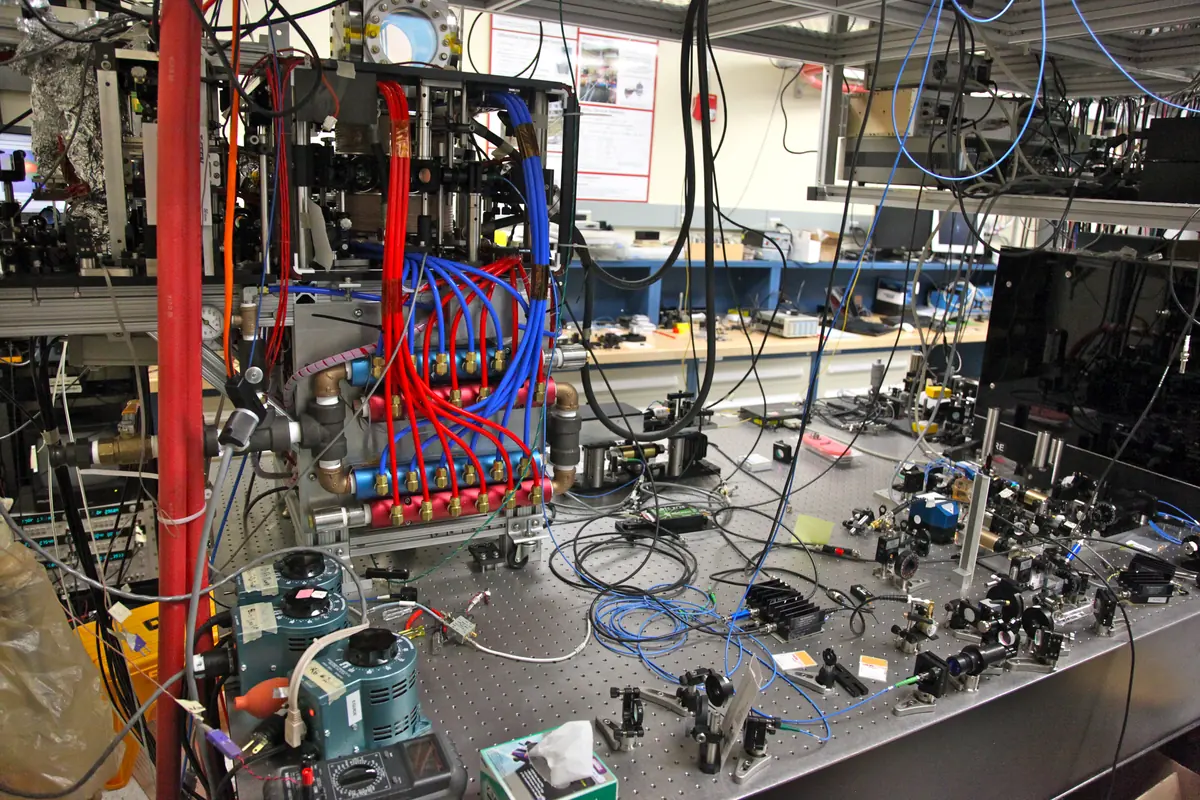
An optical table crowded with vacuum equipment, cables and red and blue tubes in a Stanford cold-atom laboratory.
Archival ultracold-rubidium apparatus at Stanford, photographed in 2010. It shows the laboratory setting of coherent cold-atom work; the new study compares simulated atomtronic interference images, not data from this apparatus.Image: Pipes + Wires (Stanford ultracold-atom apparatus) · Steve Jurvetson · CC BY 2.0Full image credit

A paper released by Scientific Reports on October 24 proposes a quantum route for estimating similarity, then applies the idea to numerically generated interference images from an atomtronics model.[1]

The method combines discrete and continuous encoding with a modified SWAP-test protocol. The authors derive a similarity measure, outline a circuit implementation and examine shot-noise simulations using benchmark data. They discuss magnetic-field sensing as a possible application.[1]

The images are simulated, rather than documentary photographs of a newly measured device. The reviewed evidence does not establish experimental sensor sensitivity or practical quantum advantage. The publisher labels the article an accepted early version, subject to further editing.[1]

### QubitWire analysis

For a measurement application, the decisive question is whether the chosen definition of similarity tracks the quantity a user wants to estimate. A comparison that reacts to irrelevant changes could return a precise number while supporting an uncertain inference.

An experimental assessment would need to connect a controlled parameter change to an observed pattern, then carry uncertainty through the comparison to the final estimate. That would test the sensing proposal at the level of the whole inference rather than one algorithmic operation.

A computational assessment requires its own complete accounting. Encoding the input, performing the circuit and obtaining enough measurements for the target precision all belong beside the central comparison step. A matched classical method would need the same task and accuracy requirement.

The next useful milestone would combine those conditions in a defined experiment or resource comparison. That would show whether the proposed representation offers a practical benefit for a specific measurement problem.

Keep your reading trail

Your Updates →

Evidence & context

1 linked source

Algorithm derivation and numerical simulation. Journal-publication milestone; earlier disclosures retained. Source scope checked October 26, 2026; original analysis is identified in the text.

How to read the evidence and dates

An announcement records what an organization stated. An experiment reports an observation. A simulation or resource estimate depends on its assumptions. QubitWire’s analysis connects these sources; the labels are not quality scores.

Published is the article’s first QubitWire publication. Updated marks a substantive content change. Sources checked records a review of the underlying evidence. An older paper can support a new explanation, and another press release about the same work is not independent replication.

Sources

  1. Publisher record: 10.1038/s41598-026-71403-7

    Primary evidence checked October 26, 2026. Scope and stage retained in the article.

READ NEXT

Continue exploring

All Research stories
  1. More on hybrid computing

    Argonne Couples Traveling Spin Waves to Superconducting Circuits

    The hybrid experiment demonstrates direction-dependent microwave transmission. Its 4-decibel isolation result also shows why qubit-level protection remains a separate test.

    Published · Source report · Sources checked
  2. More on hybrid computing

    A hybrid quantum design models particle collisions

    The proposal combines qubits and oscillator modes. Its reported scattering results come from tensor-network simulations.

    Published · Source report · Sources checked
THE QUANTUM BRIEFING

A clearer signal.
Read the latest edition.

A little perspective on a fast-moving field.

Read the on-site briefing →

Read selected quantum coverage in the on-site briefing, or register your interest below.