
Argonne Couples Traveling Spin Waves to Superconducting Circuits
The hybrid experiment demonstrates direction-dependent microwave transmission. Its 4-decibel isolation result also shows why qubit-level protection remains a separate test.
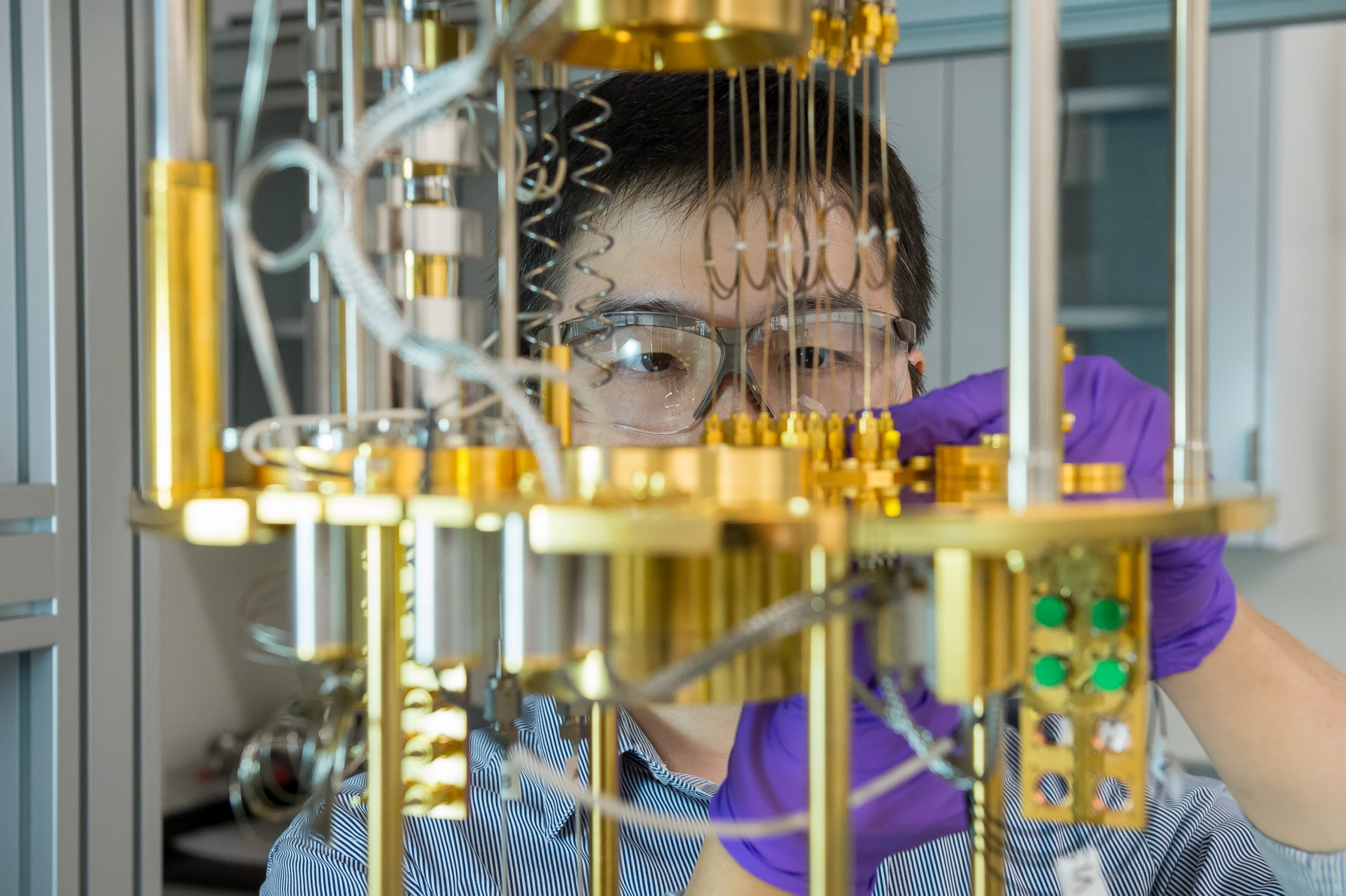
Argonne National Laboratory and University of Illinois Urbana-Champaign researchers have connected traveling magnetic waves with a superconducting circuit, demonstrating a route toward directional microwave components for quantum hardware. Argonne highlighted the work on October 13; the underlying study appeared in Physical Review Letters on September 10.[1][2]
The practical question is how to let a useful signal move forward while limiting signals returning toward delicate quantum components. Argonne identifies compact, on-chip microwave isolators as a potential application. Spin waves offer direction-dependent behavior that researchers want to bring into superconducting circuits, a platform already important in quantum information systems.[1]
The experiment pairs a superconducting resonator with a thin film of yttrium iron garnet, or YIG. A materials change matters: conventional substrates can absorb microwaves at low temperatures. The team instead used a cryogenic-compatible YSGG substrate. The paper reports coupling between the magnetic and microwave modes that exceeds their respective damping rates. This strong-coupling condition establishes that their interaction can outrun the losses that would otherwise wash it out.[2]
Directionality has a measurable limit. The authors' openly available manuscript reports 4 decibels of isolation at a hybrid-mode transmission peak. Reversing the magnetic field reversed the favored transmission direction; rotating the field into another configuration removed the nonreciprocity. Those tests support a magnetic-wave origin for the effect, but 4 decibels does not mean that reverse transmission disappears.[3]
For readers evaluating quantum-computing claims, the next distinction is crucial. The manuscript presents integration with magnetic-field-compatible as a future extension into the quantum regime. It also identifies magnetic losses as an obstacle to coupling distant resonators through traveling waves. The current achievement is an experimentally supported building block: superconducting microwave circuits can inherit directional behavior from propagating magnetic excitations. Demonstrating useful qubit-level operation remains a separate task.[3]
QubitWire’s analysis: the useful distinction is between a directional physical effect and a protective component. A circuit can favor one direction yet still pass unwanted power backward. Evaluating this platform requires both the coupling result and its measured transmission asymmetry.[3]
A useful next test would put the hybrid element beside a compatible qubit and measure the qubit’s performance with and without the element, alongside forward loss and reverse transmission. That would connect the present wave-coupling demonstration to the noise-protection job an on-chip isolator is intended to do.[1][3]