
HRL Demonstrates Digital Cryogenic Control of a Silicon Quantum Chip
A Nature study combines a 4-kelvin controller, ribbon-cable interconnect and millikelvin silicon quantum-dot processor.
Cryogenic control connects to a silicon processor
- Reported
- HRL's team reports a silicon quantum processor connected to a 4-kelvin CMOS controller through a superconducting ribbon cable.
- Supported observation
- The controller generates time-varying signals for a millikelvin chip with 54 quantum dots, configurable as up to 18 exchange-only qubits. The study includes repetition-code and quantum error-detection experiments.
- Conditions
- The integrated prototype retains room-temperature digital communication, static biases and readout digitization. Fifty-four dots is not fifty-four qubits. The error-detection demonstration used six physical qubits and postselection.
The prototype does not establish a utility-scale fault-tolerant computer. The paper identifies remaining interconnect, controller-power, device-uniformity and system-architecture work.
- A digitally controlled silicon quantum processing unitNature · Peer-reviewed primary research paper · Source published Source checked
Inspect the exact evidence and citation
This source-locator check adds context to the existing record. Its original publication and claim-review dates remain unchanged. No independent scientific replication was performed.
- Evidence context
- Reported hardware experiment
- Independent replication
- not assessed. This describes what was assessed, rather than evidence that replication failed.
- A digitally controlled silicon quantum processing unit →
Where to look: Abstract; Main, system architecture; Figure 1
- Cited version
- Published journal article, 29 July 2026
- Source origin
- Organization and collaborator originated
- Publication stage
- Peer-reviewed journal article
- Primary evidence for
- The reported 4 K controller, ribbon interconnect and configurable quantum-dot system.
- Does not establish
- Independent replication or a complete useful fault-tolerant application.
Four dates, four meanings
- Underlying event
- Experiment date not established in this reading
- Source publication
- · Nature
- Record first published
- Original claim review
- · Attributed primary-source summary; no independent scientific review.
Connected current views
These selected views resolve the same ledger claim. Historical citations keep their cited revision.
Selectable text with sources
Members of the HRL Quantum Team and Collaborators. A digitally controlled silicon quantum processing unit.
Nature. Source published 2026-07-29. Published journal article, 29 July 2026.
Abstract; Main, system architecture; Figure 1. https://www.nature.com/articles/s41586-026-10754-7#Fig1
Source authority: The reported 4 K controller, ribbon interconnect and configurable quantum-dot system.
Does not establish: Independent replication or a complete useful fault-tolerant application.

QubitWire: Cryogenic control connects to a silicon processor. Record first published 2026-09-26. Cited revision claim-hrl-cryogenic-control-integration-r1.
https://qubitwire.com/evidence/hrl-cryogenic-control-integration?revision=claim-hrl-cryogenic-control-integration-r1
Current record and corrections: https://qubitwire.com/evidence/hrl-cryogenic-control-integration
Limitation: The prototype does not establish a utility-scale fault-tolerant computer. The paper identifies remaining interconnect, controller-power, device-uniformity and system-architecture work.
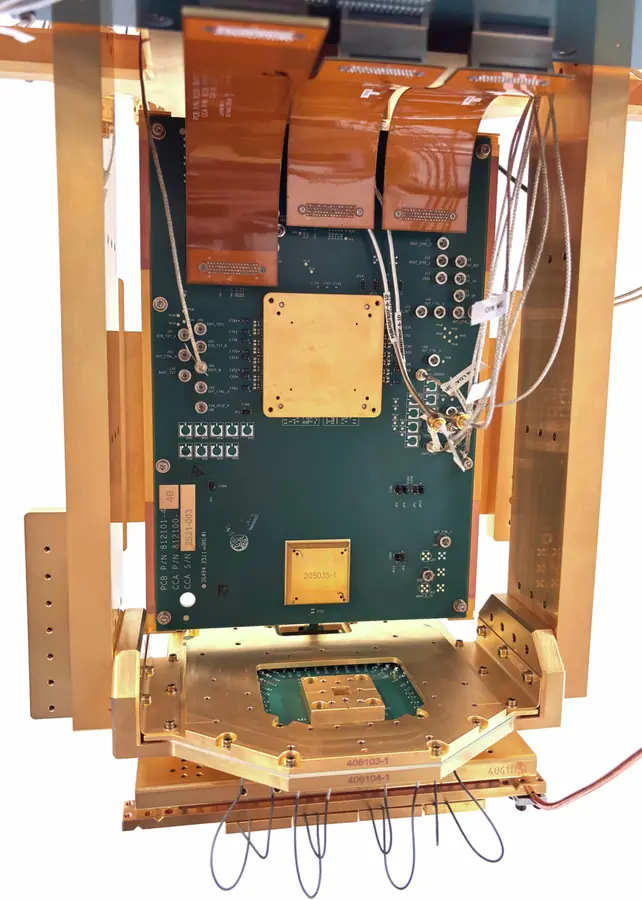
HRL researchers have moved the control electronics for a silicon quantum processor inside its cryogenic system, bringing digital control closer to the chip. The Nature study addresses a practical obstacle to larger processors: fitting the wiring and packaging around quantum devices.
A ribbon-cable interconnect links a controller operating at approximately 4 kelvin to a millikelvin processor containing 54 exchange-coupled quantum dots. Those dots can form up to 18 exchange-only .
The distinction matters: 54 quantum dots does not mean 54 encoded qubits. The reported error-detection experiments are limited demonstrations, not a complete fault-tolerant computer. Evaluating the design at larger scales will require measurements of control fidelity, wiring density, thermal load and logical performance together.