
Skip to content
HARDWARE · EXPLAINER · QUANTUM CURIOSITIES

That Gold Quantum Chandelier? It’s Actually a Very Serious Fridge

The glamorous hardware in quantum-computer photos has a surprisingly practical job: keeping a tiny processor extraordinarily cold.
Sources checked Published
My reading list
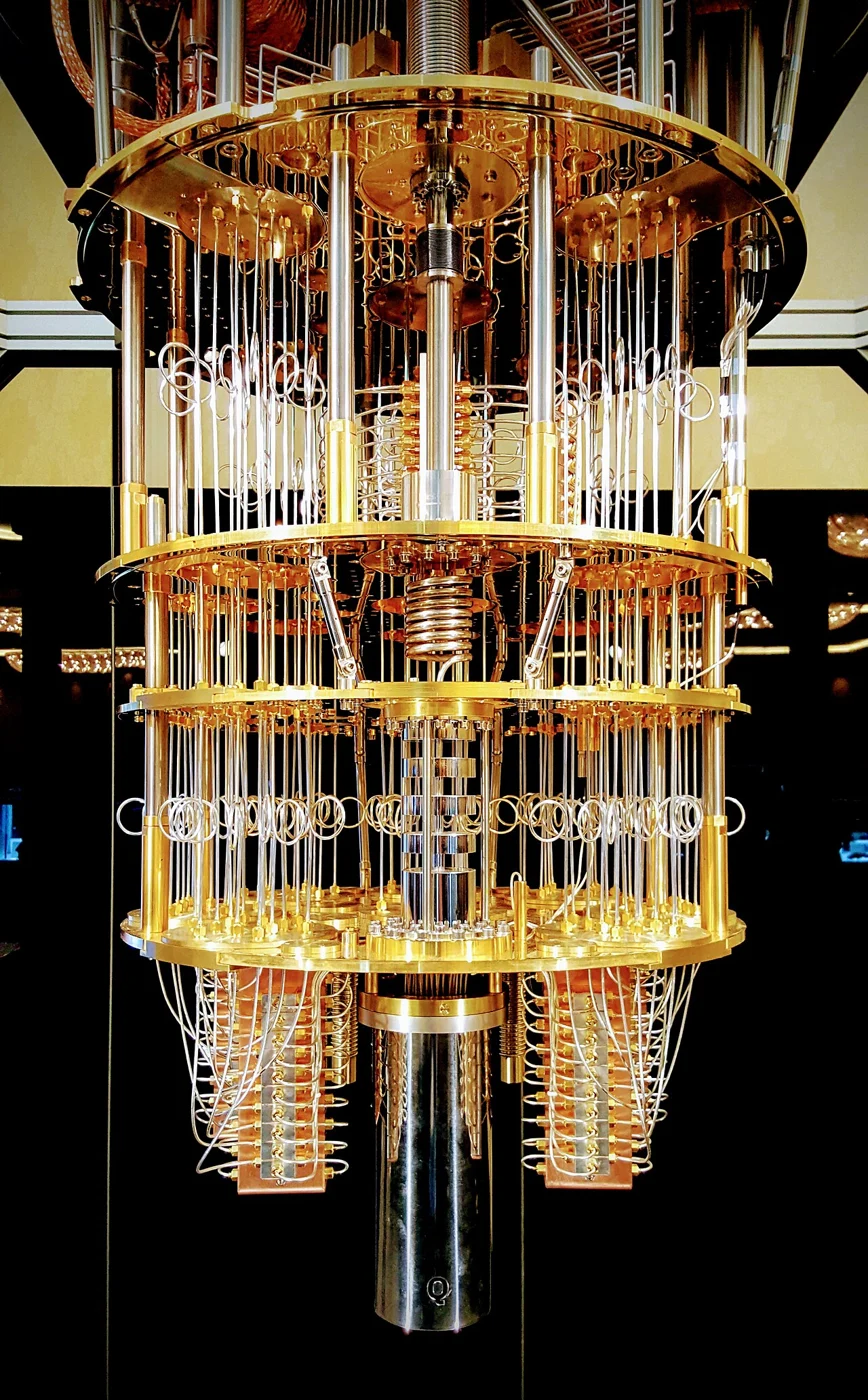
IBM’s cryogenic prototype on display at CES 2018. This historic exhibit is not the 2022 Goldeneye fridge or the connected modules announced in 2026.
Photo: Lars Plougmann

IBM’s cryogenic prototype on display at CES 2018. This historic exhibit is not the 2022 Goldeneye fridge or the connected modules announced in 2026. Image credit“IBM Q at CES (39660636671)” — Lars Plougmann. CC BY-SA 2.0. · https://creativecommons.org/licenses/by-sa/2.0/

You’ve probably seen the picture: a towering gold chandelier dripping with cables, presented as the face of quantum computing. Much of that spectacular structure is the refrigerator and its supporting hardware. The quantum processor lives inside an elaborate system built to keep it cold and controllable.

How cold? In IBM’s chip-testing laboratory, superconducting processors sit at about 15 millikelvin, or 0.015 degrees above absolute zero. That is colder than deep space. The temperature is part of the carefully controlled environment these particular quantum chips need to operate.
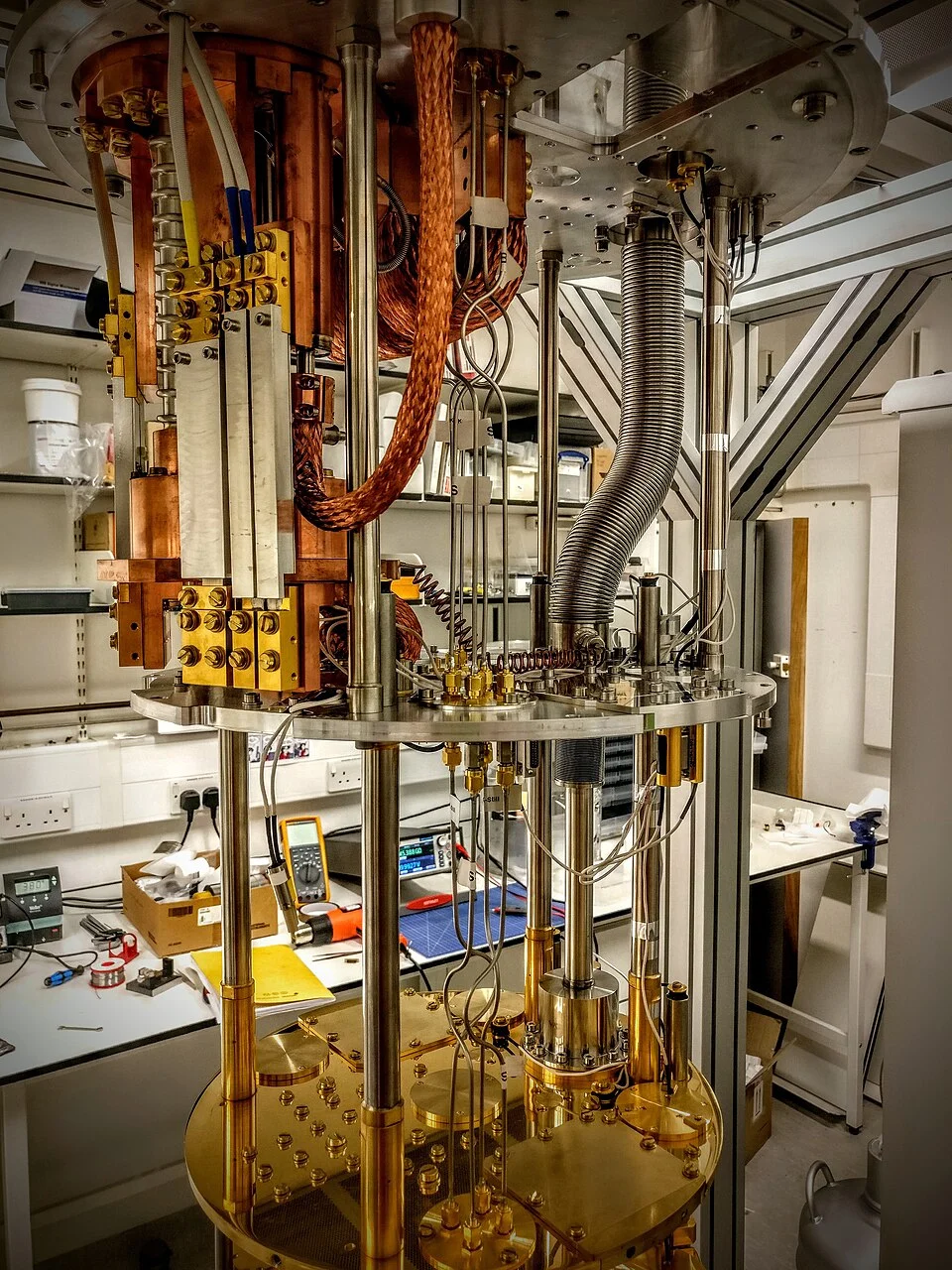
Inside a dilution refrigerator at the London Centre for Nanotechnology. A separate example of the cooling infrastructure used in low-temperature quantum experiments.
Inside a dilution refrigerator at the London Centre for Nanotechnology. A separate example of the cooling infrastructure used in low-temperature quantum experiments. Image credit“Dilution Refrigerator (39016294284)” — Pavlos Apostolidis / UCL Mathematical & Physical Sciences. CC BY 2.0. · https://creativecommons.org/licenses/by/2.0/

Getting there takes more than an industrial freezer. Dilution refrigerators use two forms of helium, helium-3 and helium-4, through several cooling stages. IBM’s Goldeneye prototype, reported in 2022, weighed 6.7 metric tons and cooled to roughly 25 millikelvin. Its size made room for larger experiments.

The next challenge is fitting more machinery together. In August 2026, IBM reported joining two box-shaped cryogenic modules and cooling them below 15 millikelvin. Each enclosure provides substantially more wiring space, helping address the practical problem of connecting quantum processors while keeping everything cold.

Those new modules are an engineering milestone; processor installation and further testing were still planned in that announcement. The fridge itself doesn’t establish useful computing performance. But it explains why building a superconducting quantum computer involves cranes, vacuum chambers and refrigeration expertise alongside quantum physics.

READ NEXT

Continue exploring

All Hardware stories
  1. Explore the related question

    Earth's Hidden Water Has Weight. NASA Wants a Quantum Sensor to Track It

    Cold atoms could let an orbital pathfinder detect tiny gravity differences caused by shifting water and ice—but it is not mapping aquifers yet.

    Sources checked
  2. Hardware desk

    Some Quantum Computers Move Their Atoms to Do the Math

    In trapped-ion machines, getting the right qubits together can mean giving the atoms a carefully controlled commute.

    Sources checked
THE QUANTUM BRIEFING

A clearer signal.
Straight to your inbox.

A little perspective on a fast-moving field.

Read a briefing preview →

Selected quantum coverage in a weekly briefing. Read the preview or register your interest.