
A Cheaper Test for Quantum Error Correction Starts Before the Logical Qubit
An October 5 preprint tests a hardware-screening method across ten quantum processors. Its strongest question is whether cheaper checks can identify where logical-memory experiments will work best.
.jpg)
How do you tell whether a quantum processor is getting better at correcting errors before spending heavily on a full experiment? An October 5 preprint by J. A. Montañez-Barrera and Kristel Michielsen proposes a screening test that stresses the hardware operations involved. Across ten processors from IBM, IQM and Quantinuum, the researchers probe repeated measurements inside circuits. They then check whether the test identifies stronger logical-memory patches on one IBM processor. It is a promising diagnostic, with a deliberately narrower claim than a working fault-tolerant computer.[1][2]
That distinction matters because a quantum computer can have individually good gates and still struggle when operations run together. Error correction repeatedly gathers information about faults without directly reading the stored logical information. Extra qubits help perform those checks; measurements, resets, conditional actions and the waiting time between them all contribute to the result. A gate-calibration number describes a component. A decoded memory experiment measures how the assembled protection behaves. The new proposal occupies the engineering space between those two levels.[2][3]
A stress test built around error checks
The researchers use a fixed-schedule version of the quantum approximate optimization algorithm, called LR-QAOA. Rather than optimize its settings separately for every experiment, they choose a simple progression of circuit angles. The algorithm produces an output-quality score, the approximation ratio. On ideal hardware, adding useful layers can improve that score. On noisy hardware, extending the circuit eventually damages the signal. Watching that rise and fall offers a way to stress a processor without first completing an entire logical-computation stack.[2]
To make the test relevant to error correction, the authors build the algorithm's interactions from an error-correcting code's check structure. Which qubits interact, which intermediate measurements occur and how repeated layers are scheduled therefore resemble ingredients of syndrome extraction, the process that collects error clues. This resemblance is the central design choice. An arbitrary deep circuit could also reveal noise, but might stress a pattern of connectivity or operations that a proposed error-correction code would never actually use.[2]
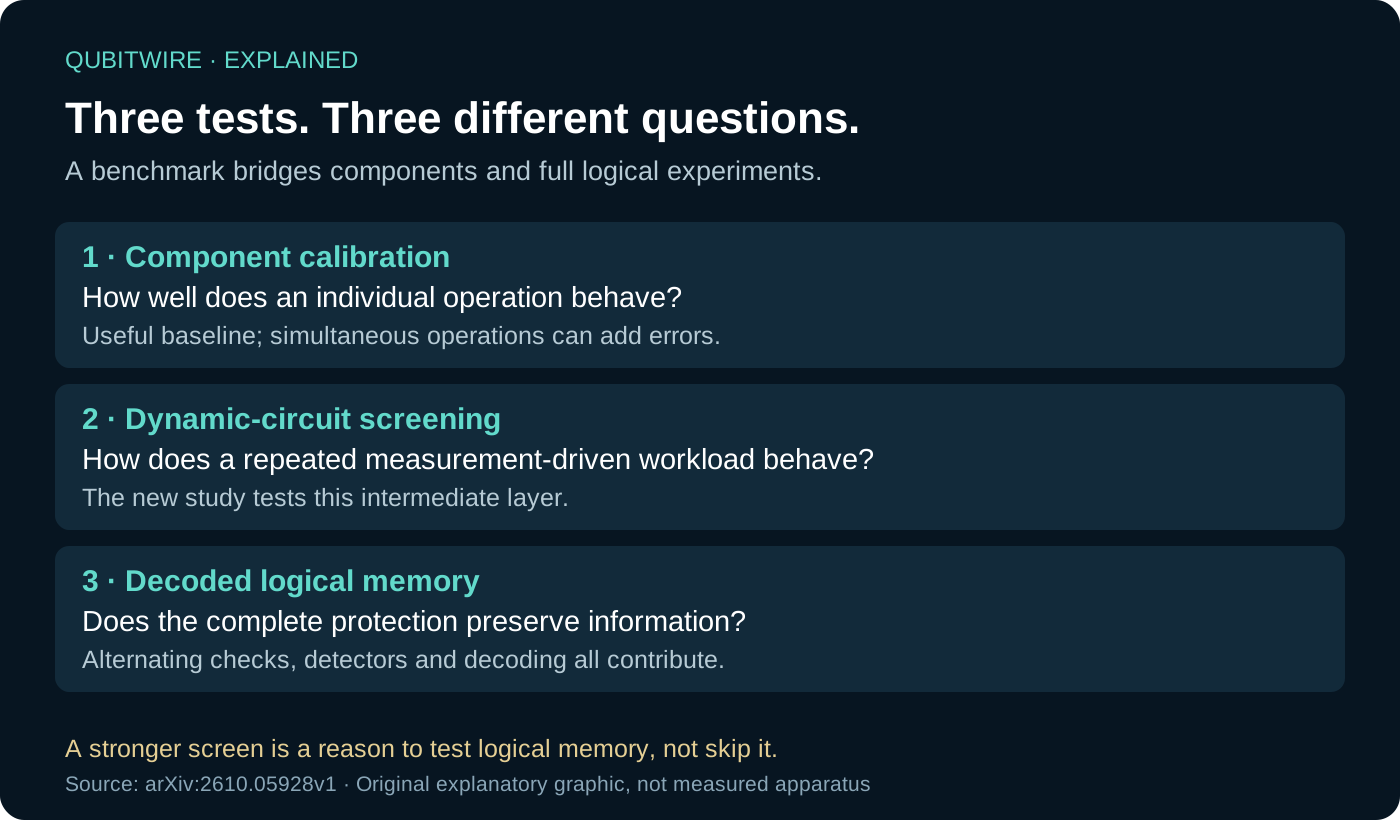
One comparison places direct implementations beside measurement-mediated versions of related circuits. Their difference helps expose the additional cost of introducing mid-circuit measurement. The paper translates signal degradation into an equivalent depolarizing error rate, a simplified model for comparing performance. That rate is not a universal physical error probability extracted from every part of the machine. It is a summary of how this workload behaves under a chosen reference model. Readers should keep the circuit, mapping and reference attached to the number.[2]
What the experiments actually measured
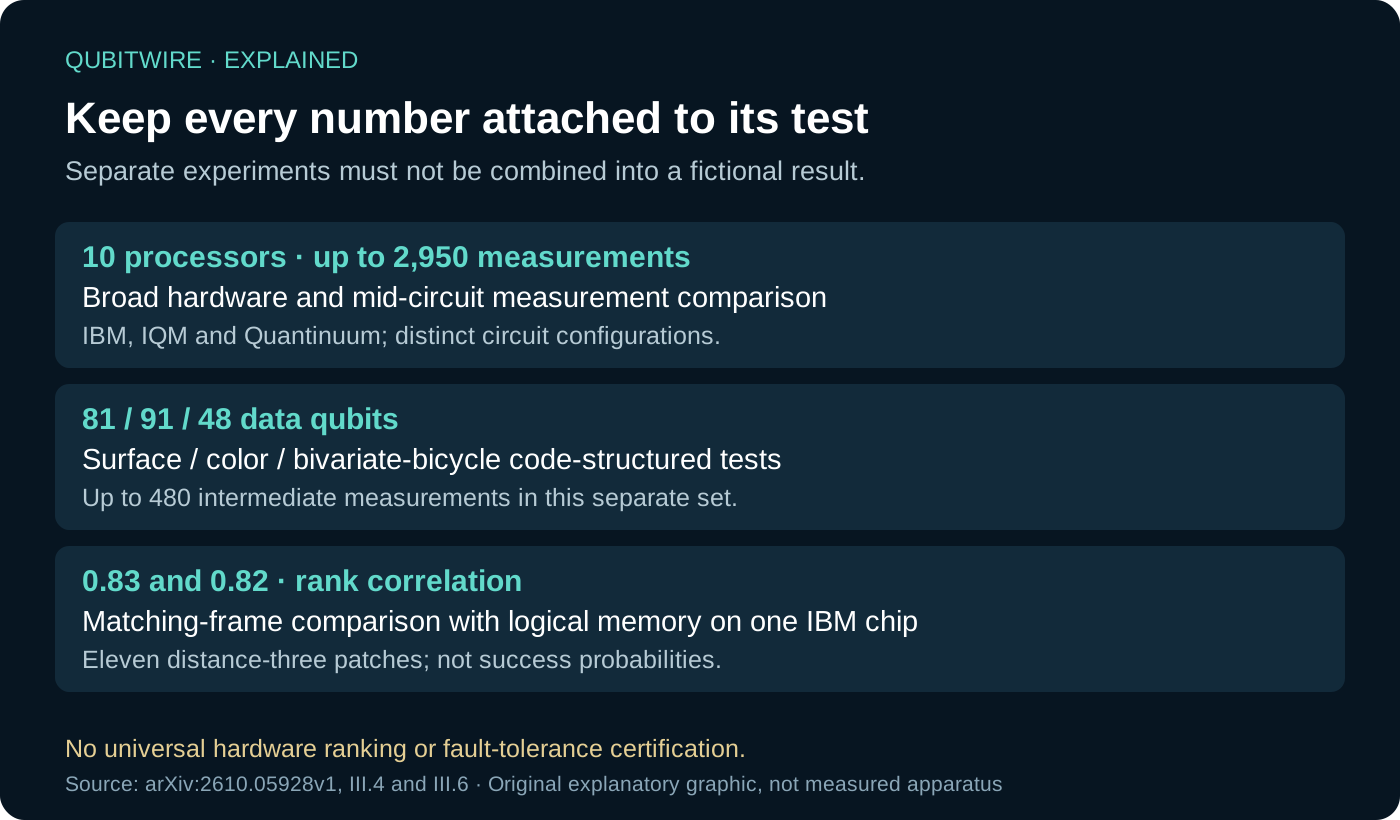
The largest circuit count in the study reaches 2,950 intermediate measurements. A separate set of code-structured tests covers surface-code, triangular color-code and bivariate-bicycle layouts, reaching 81, 91 and 48 data qubits respectively, with up to 480 intermediate measurements. These figures describe different experiments. Combining their maximum sizes into one imagined circuit would exaggerate the result. Nor do 91 data qubits in a benchmark mean that the researchers operated 91 protected : the units and the job those qubits perform are different.[2]
The more consequential comparison is smaller. On IBM's ibm_phoenix processor, the researchers evaluate eleven distance-three surface-code patches and compare their benchmark rankings with actual logical-memory results. For the matching measurement frames, the reported rank correlations are 0.83 and 0.82. Those values indicate substantial agreement in the ordering of patches; they are not 83% and 82% error-correction success probabilities. The question is whether a comparatively inexpensive screen can help choose where to spend a more expensive experimental budget.[2]
The paper also makes the sampling tradeoff concrete. Its memory experiments use 4,000 shots per experiment, while the corresponding benchmark data use 1,000. The authors examine whether smaller sampled subsets retain useful rankings and propose a lightweight procedure using a single selected depth. A shot is one execution and measurement of a circuit, so fewer shots can reduce sampling work. But a fourfold difference in these example counts is not automatically a fourfold reduction in total cost: circuit duration, initialization, compilation and access charges can differ.[2]
The practical opportunity: choose better experiments
QubitWire's analysis: the strongest near-term application is experiment triage. Imagine a team deciding which regions of a chip deserve a full decoded-memory study. A cheap screen is useful if it reliably eliminates weak candidates and keeps promising ones. It need not perfectly reproduce every logical failure mechanism to improve that decision. The fair operational comparison is therefore the quality of the selected patches at a fixed total testing budget, including the screening runs themselves, rather than the prettiest single benchmark score.[2]
That framing also changes how to judge a hardware upgrade. Running the same screening circuits before and after a calibration change could reveal whether the combined measurement-driven workload improved. A higher score would justify a follow-up memory experiment; it would not by itself show that the device crossed an error-correction threshold. A threshold claim needs evidence about how protection changes as the code grows. A regional ranking on one chip answers a different question: where this specific workload presently performs better. Google’s separate Willow memory study illustrates the distinction: it measures logical-error suppression as surface-code distance increases, rather than predicting patch rankings from a screening workload.[2][3]
Where the shortcut stops
The critical limitation is visible in the construction. The benchmark evaluates commuting checks in one measurement frame. A complete memory experiment alternates different check types, builds error detectors across rounds and relies on a decoder to interpret them. The memory comparison is also restricted to distance-three patches on one processor. Agreement there cannot establish that the same ordering survives larger codes, different noise correlations or a different decoder. These are specific boundaries on the evidence, not reasons to discard an otherwise useful screening tool.[2]
Sampling confidence needs similar care. Being distinguishable from random output is a first check that useful algorithmic structure remains. Distinguishing two good implementations from each other is a harder task. The paper's simulations show why deeper circuits can help separate lower-noise models: there must be enough repeated work for a small difference to accumulate. That does not create free information. More depth may introduce additional hardware costs and stronger sensitivity to drift, so a useful protocol has to choose its depth and sample budget together.[2]
The result suggests three questions worth carrying into the next quantum-hardware announcement. Does the quoted number describe a component, a repeated dynamic circuit or decoded logical information? Are the compared systems running the same relevant structure under a clearly stated sampling budget? Has a prediction about logical performance been checked against an actual memory or operation? Keeping those questions separate prevents a compelling intermediate test from being promoted into evidence of a complete capability that it was never designed to certify.[2]
The next strong validation would be prospective. Choose patches and set the screening budget before inspecting their memory results, then test the selections across additional processors and larger code distances. Report disagreements as carefully as successful predictions, including where closely matched patches change order. That would reveal whether the procedure improves decisions outside the data used to develop it. For now, the useful advance is a practical bridge between attractive calibration numbers and costly logical tests, with a clear plan for checking how far that bridge reaches.[2]
Keep your reading trail
Keep up with these topics
Choose the subjects you want to find again in Your Updates.