
Skip to content
RESEARCH · RESEARCH / ERROR CORRECTION

Alice & Bob tests cat-qubit building blocks, with threshold still ahead

Three demonstrators bring core error-correction operations onto hardware. The company explicitly says its logical error rate is not yet below threshold.
Published Source report Sources checked
My reading list
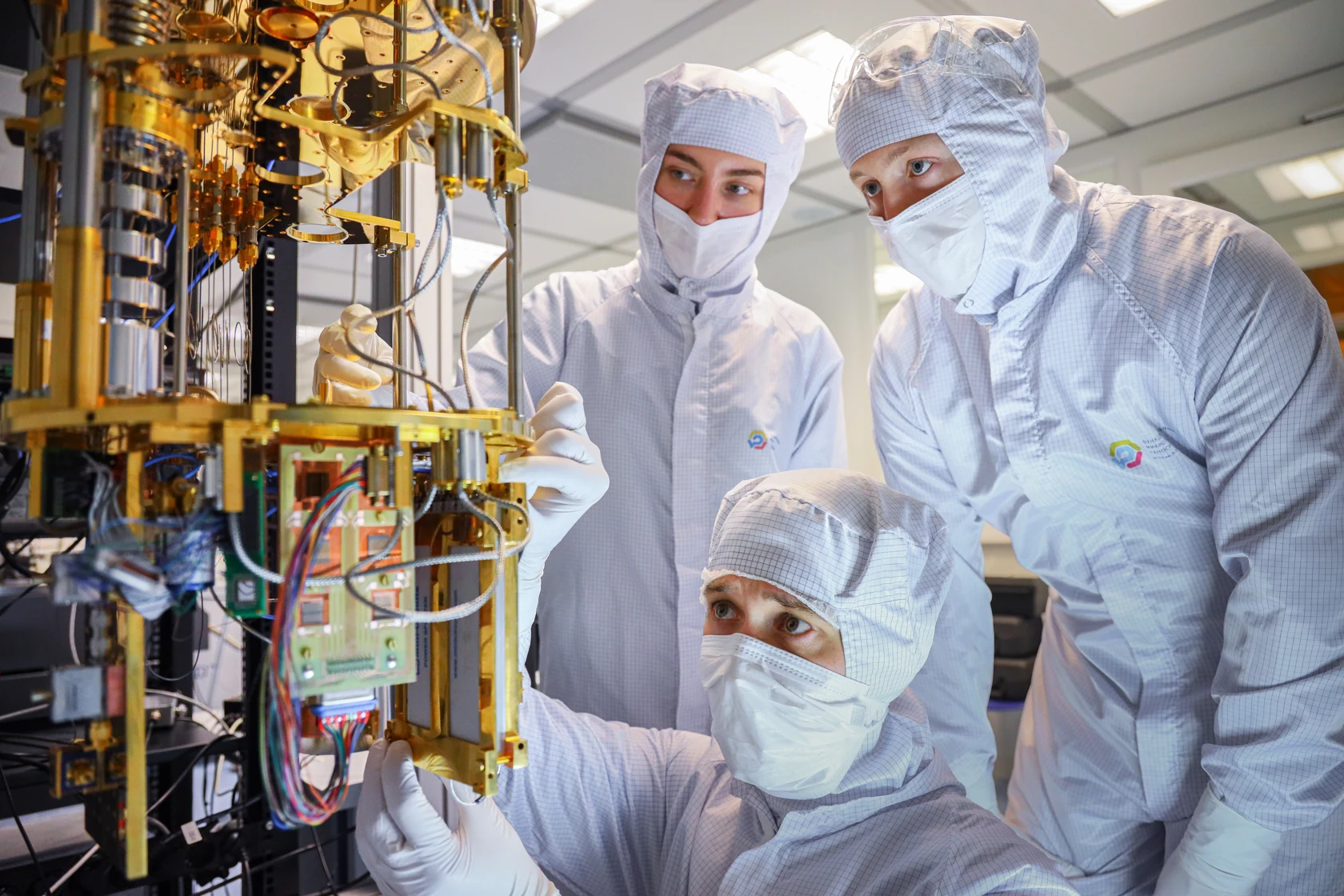
Three FMN Laboratory engineers in cleanroom clothing assemble the gold-colored cryogenic stages and wiring of a superconducting quantum computer
FMN Laboratory engineers assemble cryogenic quantum-computing hardware in December 2019. Archival superconducting-hardware context; this is not an Alice & Bob device or a PROQCIMA demonstrator.Photo: Sergey Kushlevich / FMNLab · CC BY 4.0 · CC BY 4.0Full image credit

What the hardware shows

Alice & Bob says it has assembled and operated three cat- demonstrators for Phase 1 of France’s PROQCIMA programme: two six-qubit chips and one twelve-qubit chip. The October 20 announcement describes the building blocks of its architecture on real hardware.[1]

The reported work includes noise-biased CNOT gates, auxiliary-qubit measurement and reset, repeated cycles of a distance-three repetition code and a non-Clifford operation. The company also measured logical error across the register. Its key qualification is explicit: that logical error rate is not yet below threshold.[1]

Why the threshold matters

That boundary belongs beside the result. Demonstrating the required ingredients is a different engineering task from showing that the assembled system suppresses errors sufficiently to support a useful logical computation. The announcement should be read as progress toward that integration test.

Alice & Bob says a digital twin built from measured device performance identifies improvements needed to reach below-threshold operation, beginning with more consistent coherence across the chip. Those simulations are a guide to the next experiment, rather than a measurement that the target has been reached.[1]

The next question

For readers comparing architectures, the next useful report would put the whole operating sequence on one clock: error checks, logical operations, classical decisions, recalibration and final output. A clear denominator would show which failure rate applies to which task.

QubitWire’s reading is that the integration work matters precisely because the remaining boundary is visible. A roadmap for universal fault tolerance and a measured result from a demonstrator serve different purposes. Keeping both in view makes the next milestone easier to judge.

Keep your reading trail

Your Updates →

Evidence & context

1 linked source

Company-reported hardware demonstration

How to read the evidence and dates

An announcement records what an organization stated. An experiment reports an observation. A simulation or resource estimate depends on its assumptions. QubitWire’s analysis connects these sources; the labels are not quality scores.

Published is the article’s first QubitWire publication. Updated marks a substantive content change. Sources checked records a review of the underlying evidence. An older paper can support a new explanation, and another press release about the same work is not independent replication.

QubitWire take

Core operations have reached hardware; sustained below-threshold logical computation remains a separate test.

Sources

  1. Alice & Bob PROQCIMA Phase 1 results

    Company announcement dated October 20, 2026; read in full on October 20. Hardware results are company-reported; no independent replication is claimed.

Keep up with these topics

Choose the subjects you want to find again in Your Updates.

READ NEXT

Continue exploring

All Research stories
  1. More on error correction

    Quantinuum reports five logical memory errors per million rounds

    Helios improves a logical-memory benchmark and separately tests protected Clifford operations. The statistics and workload define what each rate means.

    Published · Source report · Sources checked
  2. More on error correction

    Why a quantum error-correcting code needs carefully designed edges

    A PRX Quantum paper develops algorithms for building boundaries in topological stabilizer codes. It is a mathematical route toward finite layouts, with hardware validation still ahead.

    Published · Source report · Sources checked
THE QUANTUM BRIEFING

A clearer signal.
Read the latest edition.

A little perspective on a fast-moving field.

Read the on-site briefing →

Read selected quantum coverage in the on-site briefing, or register your interest below.