
Why One Logical Qubit Can Need 101 Physical Qubits
Physical qubits are the hardware. Logical qubits are error-protected systems built from them—and the conversion is never a universal ratio.
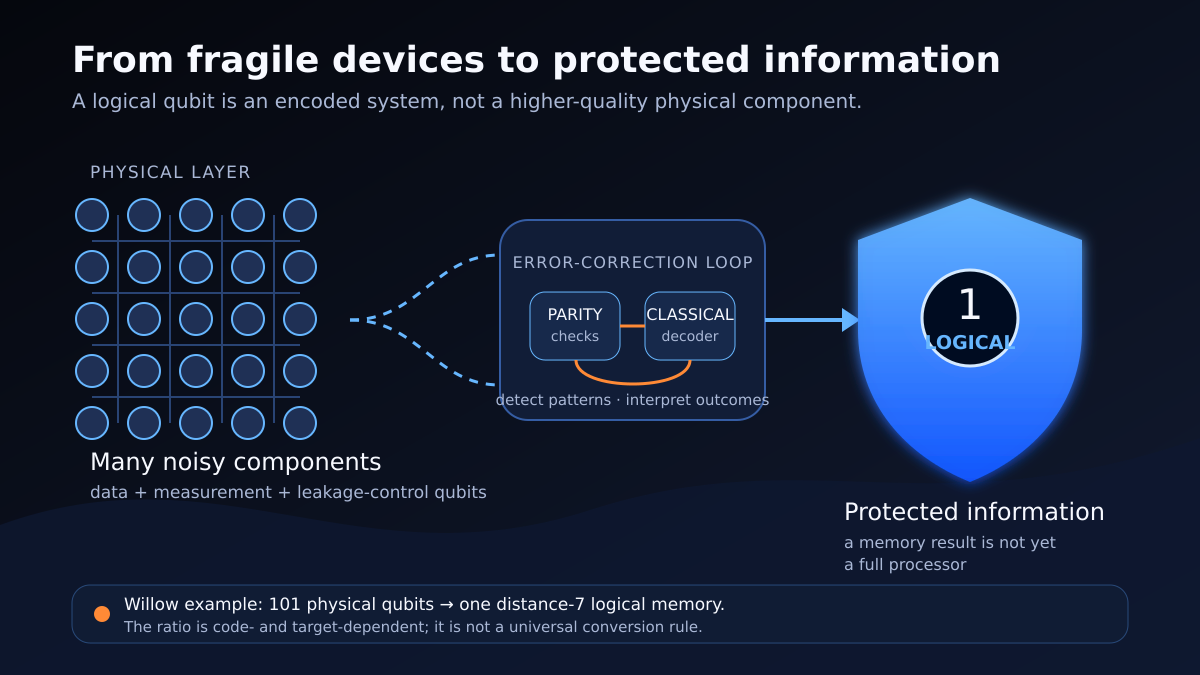
A is a controllable quantum device: perhaps a superconducting circuit, trapped ion or neutral atom. A is different. It is encoded across multiple physical qubits so errors can be detected and corrected without directly measuring away the information researchers want to preserve.[1][2]
That distinction makes raw qubit counts a poor shortcut for comparing machines. The overhead depends on the error-correcting code, hardware connectivity, physical error rates and the logical reliability a workload needs. More physical qubits help only when operations are good enough for a larger code to suppress errors instead of adding more of them.[1][2]
Google's Willow experiment offers a concrete example. Its distance-7 surface-code memory used 101 physical qubits and reported a logical error rate of 0.143% per correction cycle. Increasing the code distance by two produced a 2.14-fold error-suppression factor, while the logical memory lifetime exceeded the best constituent physical-qubit lifetime by 2.4 times.[1][2]
Those numbers do not mean every logical qubit costs 101 physical qubits. This memory used 49 data qubits, 48 measurement qubits and four additional leakage-removal qubits. Other codes and devices use different structures. The experiment protected memory rather than running a complete fault-tolerant application, and the authors still observed rare correlated errors.[1][2]
Useful systems need more than isolated logical memories. They must perform logical gates, decode error signals quickly, remain stable and scale without correlated failures overwhelming the code. When reading hardware announcements, compare physical and logical counts separately—and ask what logical operation, error rate and workload were actually demonstrated.[1][2]
October 15 update: measure the logical operations too
An October 13 preprint uses Quantinuum H1 and the seven-qubit Steane code to characterize a universal single-logical-qubit gate set. Its hardware and emulator results answer different questions. The experiment retained about 50 shots per circuit; the larger emulator studies used 14,100. The absence of compelling non-Markovian behavior in hardware data does not prove smaller effects were absent: the paper treats sensitivity as a limitation.[3]
Circuits containing logical T gates were kept only when all relevant injections passed postselection. The fitted T operation describes accepted events rather than the unconditional operation including discarded attempts. A usable computer therefore needs more than a logical-qubit count or a conditional diagnostic: acceptance and throughput still matter.[3]