
Helium Could Be Quantum Computing’s Next Unlikely Ingredient
A new blueprint turns helium’s tiny mass into a computing resource. The surprising part is what the atoms would do—not what they would cool.

The helium in this story is not there to keep a quantum computer cold. It is being considered for a much stranger job: becoming part of the computer itself.
A University of Chicago-led team has proposed a machine that would hold individual helium-3 atoms in carefully arranged spots of laser light. The research appeared in July and received a new university spotlight on September 8. It is a blueprint, not an operating processor. That distinction makes the idea no less intriguing. An element associated with floating balloons could help researchers explore how matter behaves at its most difficult-to-calculate scale.[1]
The useful question is not whether someone has made a computer out of party gas. They have not. It is why changing the atom might change what a quantum machine can conveniently do.
Here, being light is an advantage
The proposal focuses on motion: atoms moving between traps, moving with their traps and using their controlled motion to hold quantum information. Heavy objects are harder to accelerate than light ones. At atomic scales, mass also changes the quantum behaviour that lets a particle move between neighbouring traps.[2]
Think of a musical instrument rather than a faster laptop. Changing the material or tension of a string changes which notes are easy to produce. It does not automatically make every song better. A different atom similarly changes the operations that an experimental platform can perform naturally.
The paper describes a toolkit for exploiting helium’s light mass, including faster inter-trap hopping than earlier lithium demonstrations and ways to manipulate information in the trap’s potential. Those are proposed physical capabilities, not a measured speedup for a commercial application. “Faster atom movement” and “faster answer to a useful problem” remain two different claims.[2]
The computer is also a carefully arranged landscape
An optical tweezer is not a microscopic pair of metal pincers. A tightly focused beam of light can create a small trapping potential for an atom. Researchers can cool the atom’s motion and manipulate its state while keeping it isolated from much of the surrounding world. A landmark 2012 experiment demonstrated cooling a single neutral atom to its three-dimensional vibrational ground state in such a trap.[3]
Imagine a landscape of small valleys whose positions and shapes can be controlled. An atom can be localised in one valley. Changing the landscape changes its possible motion. This picture is only an analogy: the atom is not a miniature marble following an ordinary classical path. But it helps explain why the trapping equipment is more than a holder. It helps define the machine’s operations.
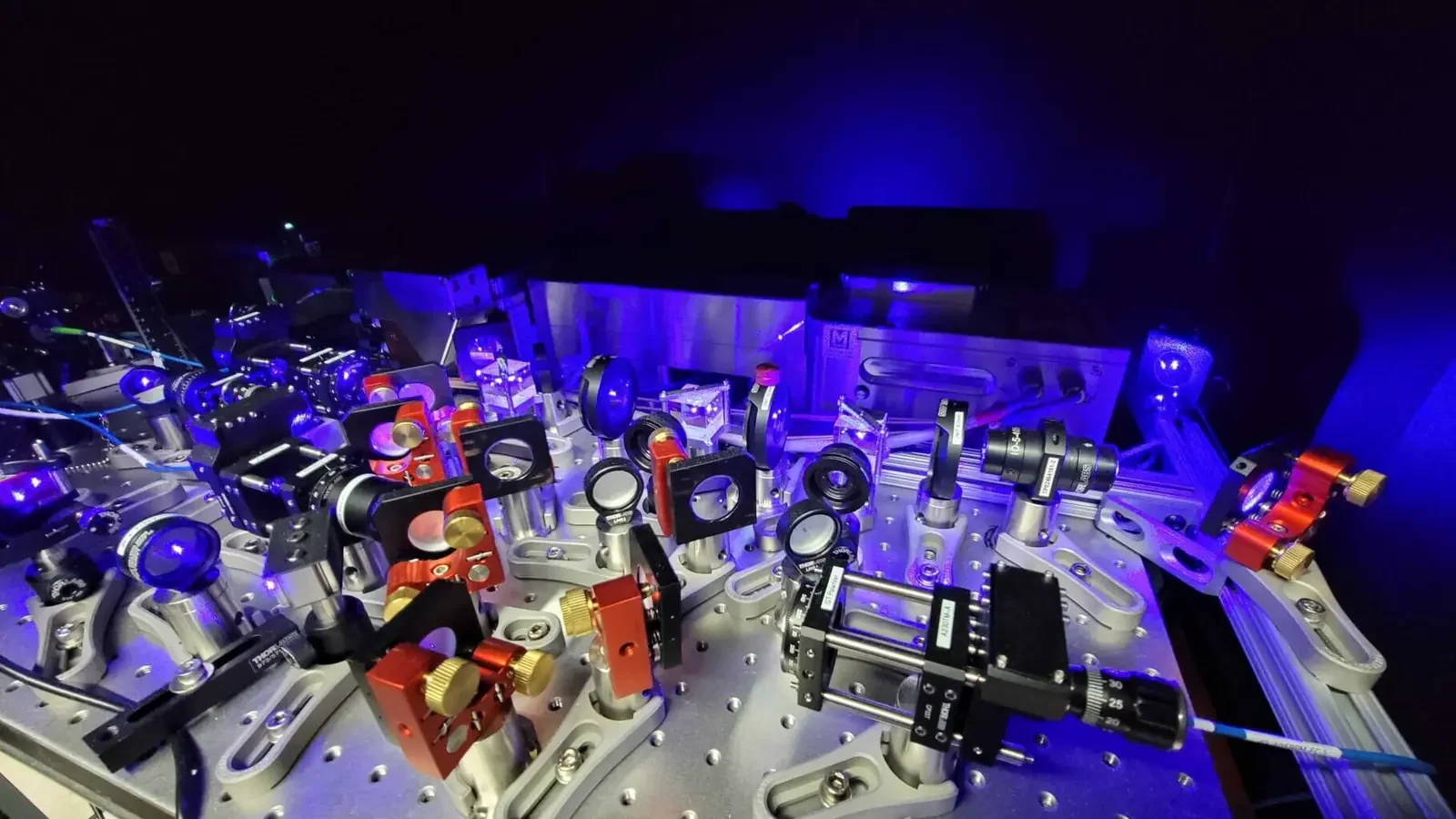
This is a useful way to look at a laboratory photograph. The optical table, lenses, mirrors and electronics are not decorative equipment surrounding the “real” computer. They are part of the infrastructure needed to prepare and control a quantum system. A beautiful atom diagram can hide most of that engineering.
Helium-3 is not the familiar isotope
The proposal uses helium-3 rather than the helium-4 normally associated with balloons and cryogenic cooling. Removing one neutron changes the atom’s quantum statistics. Helium-3 is a fermion; helium-4 is a boson. The proposed platform also uses a metastable atomic state, an excited state that lasts long enough to be useful for control.[1][2]
Fermions obey an exclusion rule: identical fermions cannot occupy the same complete single-particle quantum state. That is not the same as saying they cannot be near one another. Their behaviour is central to how electrons organise themselves in matter. Proposals for fermionic quantum processors aim to use particles with those statistics directly rather than translating every aspect of the problem into a different physical system.[4]
Here is the broader idea. A model railway is convenient for studying train movements because the model already contains tracks and trains. You could represent the same system with a spreadsheet, but the representation changes the work involved. Similarly, a quantum simulator’s physical ingredients may make some scientific questions more natural to express. The analogy does not establish an advantage; it explains why architecture matters.
Why a simulator can still be a computer
The word “simulator” can make a device sound like a lesser version of the real thing. In quantum research, simulation can be the whole point. A controllable quantum system can be used to study another quantum system whose behaviour is difficult to calculate directly.
Neutral-atom research has long explored interactions enabled by highly excited Rydberg states. Those interactions can support quantum gates and the study of many-particle physics. The helium blueprint belongs within that broader search for controllable physical systems, rather than replacing every other approach.[5]
A useful result might eventually be a better way to investigate a model of interacting matter. It need not look like opening a spreadsheet on a futuristic desktop. Conversely, the label “quantum simulator” does not guarantee that the simulation is more accurate, cheaper or harder to reproduce classically than competing methods.
One helpful thought experiment is to separate three questions. Can the apparatus implement the intended interaction? Can scientists verify that it did so? Does that interaction help answer a question they could not answer as effectively another way? A strong result needs all three, even when the hardware photographs are spectacular.
The first win would be much smaller than a finished machine
There is a long distance between a promising design and an experiment that repeatedly does what its designers intend. A blueprint can identify useful operations without establishing their achievable error rates, calibration burden or performance in a larger system. Those questions have to survive contact with the laboratory.
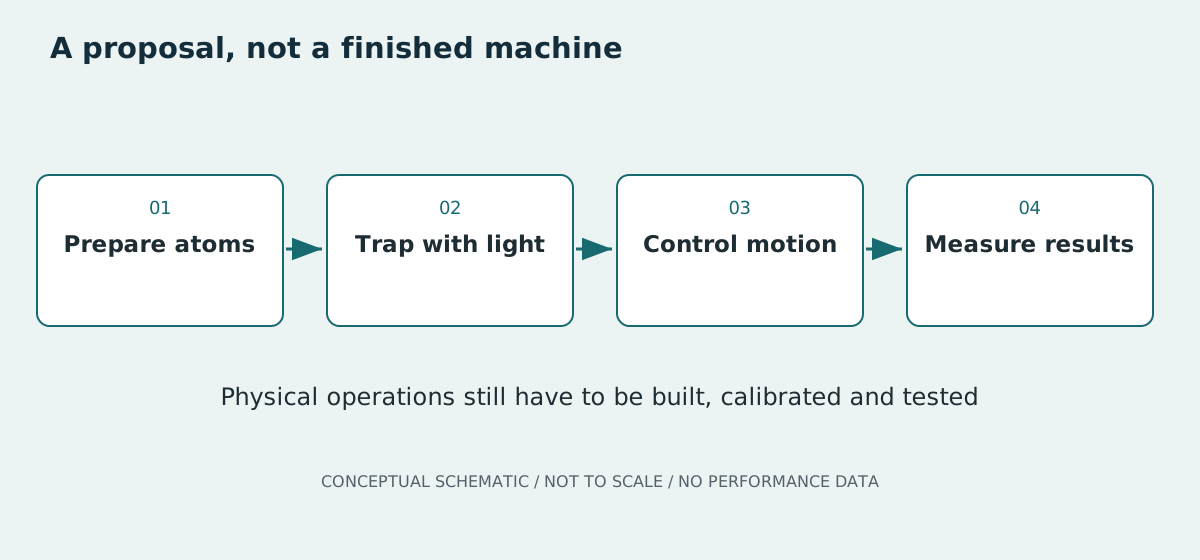
The researchers describe building and controlling the proposed atom array as future work. The university account says initial experiments will work toward helium-3 rather than presenting a completed device. No launch date for a useful general-purpose helium computer follows from that plan.[1]
For a reader watching the field, the revealing next milestone would therefore be something modest and concrete: reliable preparation, trapping, movement and measurement in the intended platform. A small demonstration with transparent error data could teach more than a much larger promised count.
That is also why the story is worth sharing before a finished computer exists. It reveals a side of computing that is easy to miss. Progress is not always a contest to manufacture more copies of the same component. Sometimes it begins by asking whether the component itself should be a different piece of nature. Helium will not replace your laptop because it is light. But lightness may give researchers a new set of quantum operations to work with. First, they have to build the instrument—and find out how well it plays.