
Skip to content
HARDWARE · HOW QUANTUM HARDWARE WORKS

Some Quantum Computers Move Their Atoms to Do the Math

In trapped-ion machines, getting the right qubits together can mean giving the atoms a carefully controlled commute.
Sources checked Published
My reading list
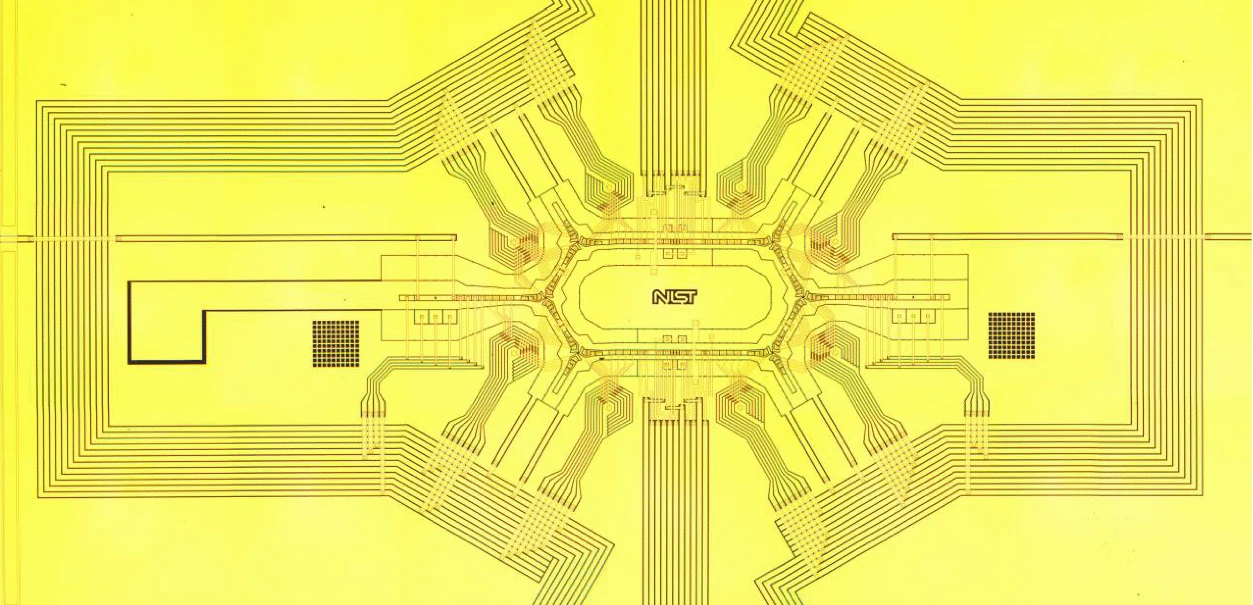
Gold electrode patterns form an oval racetrack with six branches on a NIST ion-trap device.
J. Amini / NIST

NIST’s racetrack ion trap, described in March 2010. Its electrode pattern defines zones for storing, transporting and probing ions. This archive device is not Quantinuum’s H2 processor. Image credit“NIST Racetrack Ion Trap” — J. Amini / NIST. NIST public information, reusable under NIST’s published terms; also identified as a U.S. Government work in the Wikimedia Commons rights record. · https://www.nist.gov/copyrights-disclaimers

Inside some quantum computers, the have a commute. The charged atoms that carry the information move from one part of a chip to another, bringing the right partners together for the next calculation. Moving the hardware is part of running the program.

The atoms hover in traps created by electric fields. Changing the voltages on nearby electrodes shifts those traps, carrying the ions along. Imagine moving a marble by sliding the bowl beneath it. NIST’s ion-trap research includes junctions that let scientists split, recombine and reorder groups of ions.

That idea appears in working machines. Quantinuum’s H2 operating guide describes a racetrack layout: transport operations place the ions scheduled for a shared gate next to each other. A gate is a controlled operation on quantum information. Software works out both the operations and the travel schedule.
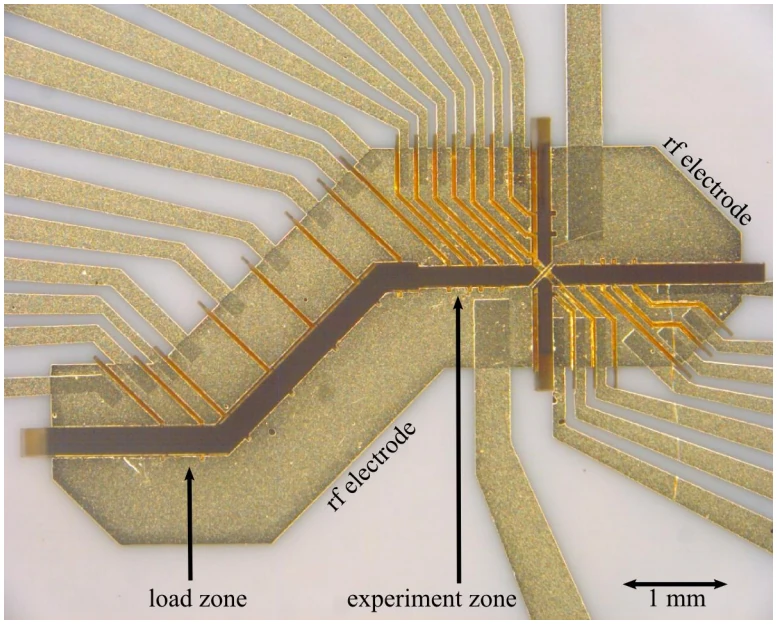
Annotated photograph of a segmented NIST ion trap with an X-shaped central junction and labels for loading and experimental zones.
NIST’s annotated photograph of a multi-zone ion trap. The central X-shaped junction provides routes for reordering ions; the labels identify different working zones. Image credit“X-Junction ion trap” — NIST. Reproduced under NIST’s published public-information reuse terms. Original source annotations retained. · https://www.nist.gov/copyrights-disclaimers

The journey has a cost. Transport takes time, and researchers must control the ions’ motion carefully. H2 uses a second species of ion to help with cooling. Moving atoms successfully is therefore a different engineering task from making a precise quantum gate; a useful computer needs both.

The reward is flexibility: qubits can meet different partners during a calculation instead of being limited to the same immediate neighbors. In this style of quantum computing, the processor’s layout and the program’s timetable are closely connected. Sometimes doing the math begins with arranging the seating.

READ NEXT

Continue exploring

All Hardware stories
  1. More on trapped ions

    Quantinuum Finalizes a $100 Million CHIPS Research Award

    The federal agreement targets ion-trap manufacturing and optical components, not a finished fault-tolerant computer.

    Source date
  2. More on trapped ions

    IonQ Preprint Tests MegaQuOp Decoding on One Laptop CPU

    A simulated trapped-ion architecture kept decoding delay below 12% across three compiled workloads, but no fault-tolerant quantum computer ran the experiment.

    Source date
THE QUANTUM BRIEFING

A clearer signal.
Straight to your inbox.

A little perspective on a fast-moving field.

Read a briefing preview →

Selected quantum coverage in a weekly briefing. Read the preview or register your interest.