
Atom Computing Reports Up to 90 Toric-Code Syndrome Cycles
A neutral-atom preprint tracks logical information through repeated measurement, lost-atom replacement and reservoir reloading.
Atom replacement extends a toric-code memory experiment
- Reported
- Atom Computing and collaborators report toric-code memory experiments with replacement atoms and repeated reservoir reloading.
- Supported observation
- The smaller code ran for up to 90 syndrome-extraction cycles; the larger code reached 70. Storage-zone atoms were replenished every tenth cycle.
- Conditions
- The preprint compares codes using 16 data plus 16 ancilla qubits and 32 data plus 32 ancillas. Recorded measurements were decoded with PyMatching using loss-aware reweighting. Long runs and the short-run code-size comparison are separate datasets.
The 90-cycle result does not demonstrate indefinitely accurate computation or universal fault tolerance. Lower error for the larger code in short runs must not be generalized to the deep-run results.
- Quantum error correction with the toric codearXiv · Primary research preprint, version 1 · Source published Source checked
.jpg)
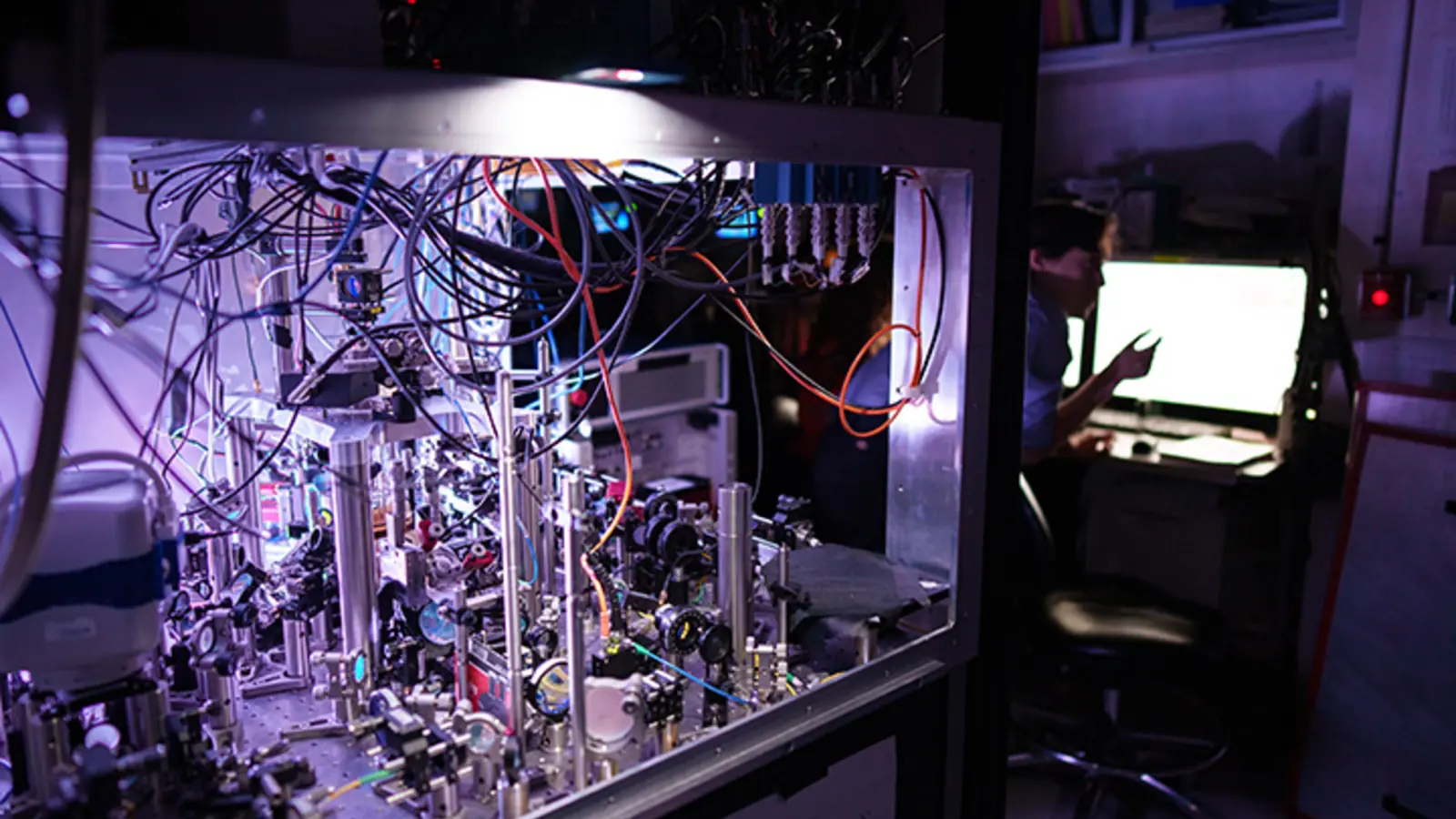
Atom Computing and collaborators have tracked logical information through repeated syndrome measurements on neutral-atom hardware using a toric code. The experiment addresses a practical problem for long computations: replacing lost atoms and reloading the reservoir while preserving information in the rest of the system.
Their preprint characterizes performance through up to 90 cycles and multiple reservoir reloads. It also compares two code distances through eight rounds, finding a lower absolute logical error for the larger code.
The eight-round comparison does not establish that the larger code keeps that advantage through all 90 cycles, let alone indefinitely. Sustained error suppression over longer runs remains the scaling question. The reported result remains a preprint, and independent review would help test the architecture's prospects.