
Skip to content
RESEARCH · SENSING / QUANTUM METROLOGY

How do you tune a quantum sensor for something you do not know?

A theoretical strategy uses earlier estimates to choose later controls and measurement times. The proposal tackles several unknown parameters together.
Published Source report Sources checked
My reading list
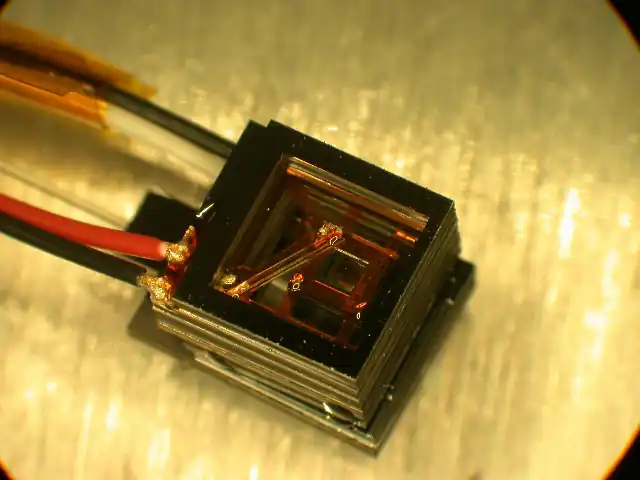
A small NIST magnetic sensor with a rubidium-vapor cell, wires and an optical fiber.
A miniature rubidium-atom magnetic sensor from NIST’s 2011 image archive. Documentary sensing context for a theoretical proposal; this sensor was not used to demonstrate the adaptive-control paper.Photo: Magnetic Sensor (5940478977).jpg · S. Knappe / NIST · Public domainFull image credit

Qifei Wei and Shengshi Pang’s theoretical sensing study appeared in Communications Physics on October 23. The proposal, public as a preprint since October 16, 2025, updates controls using earlier estimates. It concerns multiple unknown parameters in a two-level quantum system.[1][2]

The reviewed preprint also adapts trial durations and analyses estimation precision against an evolution-time budget. The authors describe approaching an optimum up to a constant factor within their model and test sensitivity to control-estimation errors. This is theoretical analysis, rather than a demonstrated instrument.[2]

The underlying circular problem is easy to recognise: how do you choose the best settings when that choice depends on what you are measuring? One answer is to stop treating a measurement as a single event. Each observation can inform a later decision, making the whole sequence the object that needs to be evaluated.

The everyday analogy is refining a search after each observation. A first estimate narrows where to look next; a better estimate then informs another choice. In a quantum experiment, however, the sequence also changes how the probe evolves. A useful comparison must therefore count the time and trials used to acquire the estimates, not just the accuracy of the final readout.

For an experimental implementation, the next questions would be which controls can actually be produced, how additional noise changes the result and whether the complete procedure retains its advantage within a fair resource budget. Those tests would turn a mathematical control proposal into evidence about a working instrument. The publication supplies a strategy to investigate, rather than a new sensor specification.

Keep your reading trail

Your Updates →

Evidence & context

2 linked sources

Peer-reviewed theoretical publication; author-preprint methods

How to read the evidence and dates

An announcement records what an organization stated. An experiment reports an observation. A simulation or resource estimate depends on its assumptions. QubitWire’s analysis connects these sources; the labels are not quality scores.

Published is the article’s first QubitWire publication. Updated marks a substantive content change. Sources checked records a review of the underlying evidence. An older paper can support a new explanation, and another press release about the same work is not independent replication.

QubitWire take

Adaptive sensing needs a fair accounting of the measurements used to improve its own controls.

Sources

  1. Efficient adaptive control strategy for multi-parameter quantum metrology in two-dimensional systems

    Communications Physics publication dated October 23, 2026; accepted September 22. Publisher metadata confirms the theoretical result.

  2. Author preprint: adaptive multiparameter metrology

    October 16, 2025. The two-dimensional system is a two-level quantum system, not a two-dimensional material. Feedback, time-resource accounting and robustness methods reviewed.

READ NEXT

Continue exploring

All Research stories
  1. Related reading

    A Quantum Search Algorithm Just Learned to Hunt a Real Signal

    A new preprint brings a famous computing idea into a sensing experiment, with an important difference: the unknown signal helps set the search.

    Published · Source report · Sources checked
THE QUANTUM BRIEFING

A clearer signal.
Read the latest edition.

A little perspective on a fast-moving field.

Read the on-site briefing →

Read selected quantum coverage in the on-site briefing, or register your interest below.