
An optical cat source should count every usable herald
A theoretical cat-state study asks how many acceptable outputs one fixed optical setting can produce.
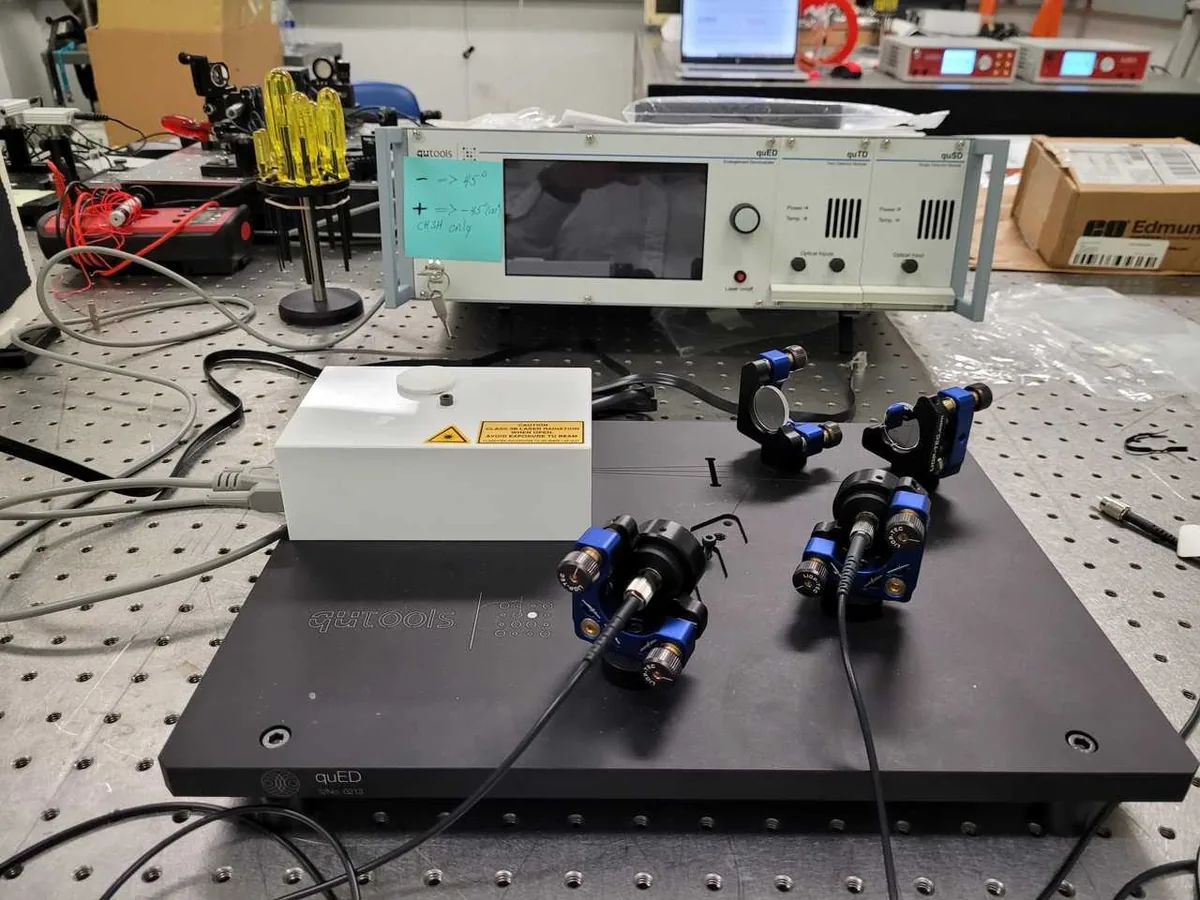
An October 14 preprint optimizes optical cat-state preparation by combining squeezing and conditional photon subtraction. Its objective counts all photon-number outcomes that meet a specified target-quality threshold at one common experimental setting. The authors find that detector resolution changes which architecture is preferred. The work is a theoretical optimization, not a newly demonstrated source. Its central design question is useful beyond this particular state: does a preparation protocol maximize one impressive outcome, or the total probability of obtaining an output that the next operation can actually use?[1]
An optical cat is a superposition of distinguishable coherent-state components, often written as two amplitudes with opposite signs. Their relative phase matters. A statistical mixture containing either component does not have the same interference structure as a coherent superposition. Preparing such a state therefore requires more than producing two possible classical field amplitudes. The protocol must preserve the quantum relation between them, and the measurement record must identify the conditional state that remains after part of the optical system is detected.
Squeezing changes the distribution of fluctuations between complementary field quadratures. Photon subtraction adds a conditional operation: light is weakly tapped, and a detection event heralds a change in the remaining mode. Alternating these ingredients gives a preparation scheme several adjustable choices. Those choices affect the final state, the probability of each measurement outcome and which outcomes can be resolved by the detector. Optimizing only the best-looking branch can miss useful outputs from other branches, but counting every click indiscriminately would conceal differences in output quality.
Consider an invented setting with two mutually exclusive herald outcomes. The first produces the required state with probability 0.06 per attempt; the second also meets the same acceptance conditions with probability 0.04. Their combined success probability is 0.10. This addition is valid because the branches belong to one physical setting and satisfy one defined output requirement. Adding the first probability from one optimized apparatus setting to the second probability from a different setting would describe a source that cannot operate as specified in a single attempt.
The output requirement needs more detail than a word such as cat. Two branches can differ in amplitude, parity or phase convention. If the next operation accepts only one of those states, the other branch is not automatically a success. A known and implementable correction may make it usable, but that correction brings its own cost and failure probability. An honest acceptance rule therefore states which differences are tolerated, which can be corrected using the herald information and which require discarding the output altogether.
Detector resolution enters through information, not just efficiency. A device that distinguishes one photon from two can assign different conditional states to those outcomes. A device that merges them into the same reported event may leave a mixture of possibilities. That mixture can fail a quality threshold even if its separate components would have been valuable with a more informative record. Improving resolution can consequently change the optimal preparation sequence itself. It is not always equivalent to multiplying an otherwise unchanged success probability by a better detection efficiency.
The relevant resource also extends beyond a mathematical attempt. A larger accepted probability is useful only in relation to the attempt rate, optical loss, stabilization effort and downstream timing. A source with more branches may require more conditional routing or feed-forward. These considerations do not negate an idealized optimization; they identify where to connect it to an apparatus. A sensible experimental progression would measure the probability and state quality of each accepted branch, then report their combined useful rate under a common, explicitly fixed setting.
This approach makes a probabilistic source easier to assess. Readers can follow a complete chain from an experimental configuration to a detector outcome, a conditional state and an accepted output. The important advance to watch is whether a multi-branch design retains its advantage with realistic losses and finite resolution. That would establish how much usable nonclassical light the apparatus supplies, while preserving the distinction between a beautifully prepared rare state and a source that supplies the required state often enough for a larger task.