
A Famous Quantum Chemistry Challenge Just Got Harder to Win
A 2026 study tackles a much-discussed quantum-computing target without a quantum processor. The classical competition is not standing still.

.jpg)
The rival to a quantum computer is not a classical computer frozen in time. It is the best classical method someone can invent next. A 2026 chemistry study makes that competition unusually concrete by revisiting the FeMo-cofactor, a complex cluster inside the nitrogen-processing enzyme nitrogenase.[1]
That cluster has become a prominent target in discussions of useful quantum chemistry. In a preprint updated in June, Huanchen Zhai and colleagues reported a classical estimate of the ground-state energy of a widely studied FeMo-cofactor model to chemical accuracy. It is a claim about a defined model, not a complete simulation of an enzyme at work.[1]

Their insight was that the energy problem could be approached by ranking many competing states that were individually less complicated than the overall problem suggested. Combining numerical methods and extrapolation gave them a route to an answer without requiring a quantum processor.[1]
That does not settle the competition. A realistic enzyme changes shape and interacts with its surroundings; the study’s central claim is narrower. For a useful comparison, both methods must tackle the same task at the same accuracy. Beating a simplified or outdated rival would tell us much less.[1]
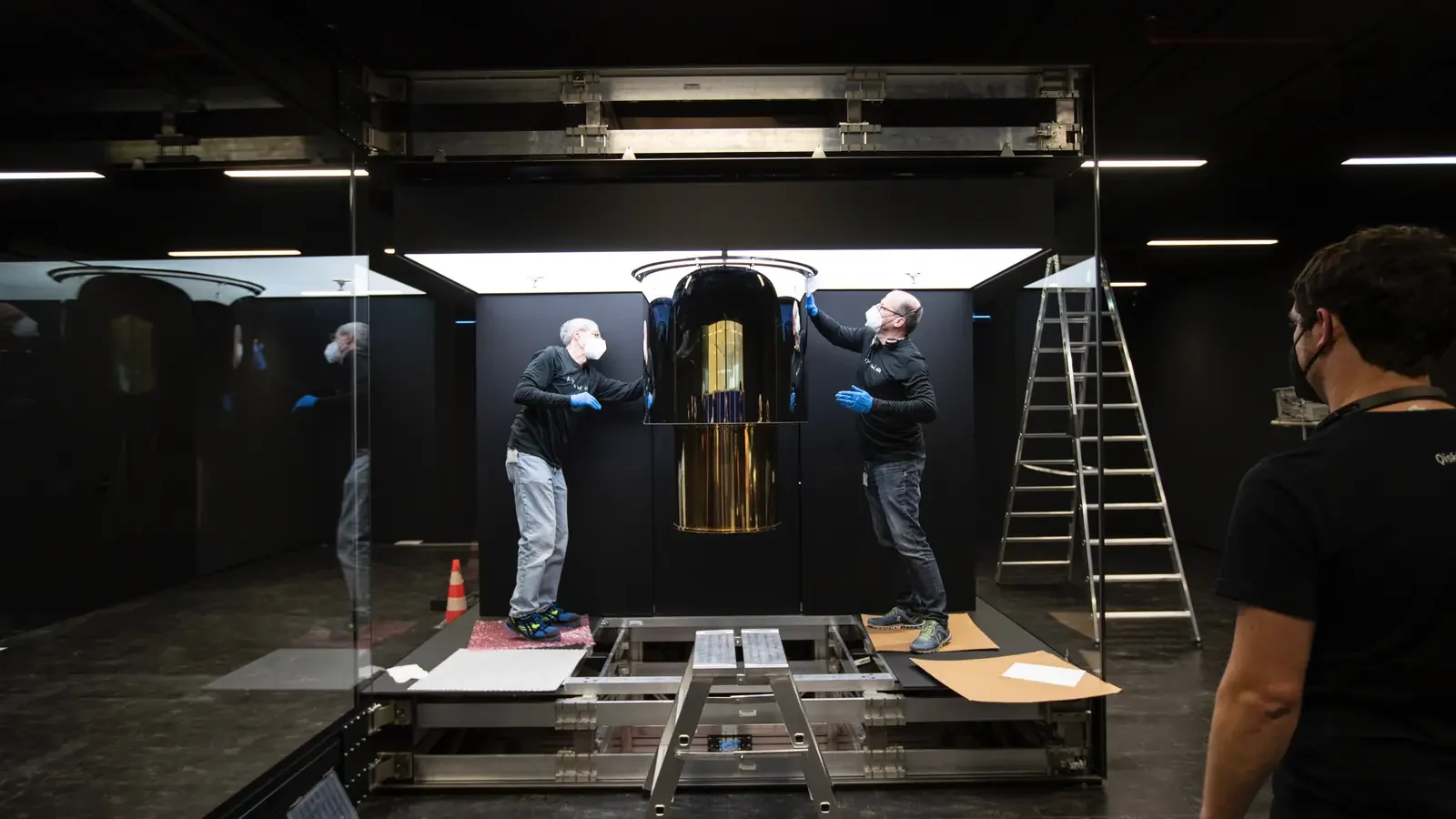
_installation.jpg)
For quantum chemistry, this is a raised bar rather than a closed door. More complicated models, different properties and changing geometries can remain hard. The revealing future demonstration will not beat an outdated classical estimate. It will outperform the strongest contemporary alternative on a scientifically useful task that both sides have agreed to solve.[1][2]
Separate model convergence from statistical precision
A narrow statistical interval does not bound errors from geometry, basis choice, active-space selection or an approximate solver. Keep those model choices beside the sampling uncertainty.
| Calculation change | Estimated reaction energy | Change from previous calculation |
|---|---|---|
| Initial model | 1.2000 | — |
| Expand active space | 1.2600 | 0.0600 |
| Expand it again | 1.2750 | 0.0150 |
| Same space, solver tolerance 0.001 → 0.0001 | 1.2754 | 0.0004 |
These changes measure sensitivity to the specified choices, not certified error bounds or FeMo-cofactor energies. The QICAS study, version 2, discusses the importance of orbital selection for active-space calculations.
For a difference A − B, Var(A − B) = σ_A² + σ_B² − 2ρσ_Aσ_B. In this separate synthetic example, both standard deviations are 0.01 energy units.
At ρ = −0.5, 0, 0.5 and 0.9, this deviation is 0.01732, 0.01414, 0.01000 and 0.00447. Covariance needs actual paired or joint data; it cannot be chosen to improve a reported error bar. Statistical cancellation does not establish cancellation of systematic bias.
A synthetic teaching model. Inputs stay in this page; no device, account or remote computation is used. The worked example remains readable without JavaScript.
Research in context · checked 17 Oct 2026
A chemistry method’s correlation temperature is a modeling parameter
A classical electronic-structure study uses an effective temperature to enrich its treatment of correlation.
An October 15 preprint develops thermally enhanced hybrid density functionals aimed at static and dynamic electronic correlation. It introduces a correlation-temperature construction and evaluates choices on molecular examples, including a biphenyl-derived benchmark set. The work is classical computational chemistry, not a quantum-processor experiment. The effective temperature is part of a modeling strategy for electronic structure; it should not be read as a report that the molecules were physically heated to that temperature. Its value depends on whether it improves predictions across the chemical situations the method is intended to describe. [1]
Electronic correlation is the difference between a many-electron problem and a picture in which each electron moves in an average description of the others. The term covers several difficulties. Dynamic correlation concerns coordinated fluctuations that remain important even when one configuration gives a useful starting point. Static correlation becomes prominent when more than one configuration is comparably important. A method can handle one aspect well and still fail on the other, particularly when a molecular geometry changes and the identity of the useful reference configuration changes with it.
Bond stretching is a helpful conceptual setting. Near an equilibrium geometry, one orbital-occupation pattern may dominate a simple approximation. As the bond is pulled apart, competing patterns can become essential to a balanced description. Insisting on a single sharply selected occupation can then introduce an artificial preference. A method that permits fractional occupations has more flexibility to represent the reduced electronic information. That flexibility does not by itself guarantee the correct energy, but it can provide a way to avoid forcing the calculation into an overly rigid reference.
An original one-particle illustration separates occupation from temperature. In a two-orbital basis, the occupation vector can be normalized as one and zero, or as one half and one half. The latter says that each orbital carries half the one-particle population in that description. It does not determine the complete underlying state, its correlations or a physical temperature. Distinct states can share those occupations. This simple example is not a molecular calculation; it explains why a fractional-occupation parameter must not automatically be interpreted as a thermometer reading.
An effective temperature can control how sharply occupations favor lower-energy orbitals. In a modeling construction, varying that parameter changes the smoothness of the occupation pattern and can mimic part of the information missing from a simpler reference. The resulting parameter has to be defined by the method's equations and calibration rule. Calling it temperature does not establish equivalence with putting the real molecule in contact with a thermal bath. Predictions about actual thermal populations require the appropriate physical ensemble and energy accounting as separate ingredients.
Combining approximate ingredients also raises the possibility of counting the same effect twice. If one component already describes part of a correlation contribution, another correction should not add it again without compensation. A formal connection between the ingredients can help organize that balance, but numerical tests remain necessary. The useful benchmark asks not only whether a few energies improve, but whether the method remains consistent as geometry and electronic character vary. Smooth, balanced changes can matter more for a reaction profile than an impressive improvement at one isolated point.
Choosing the correlation parameter creates a generalization problem. A value fitted to one molecule can produce favorable results there while failing on a different bonding pattern. A transferable rule should use information available when making the prediction, rather than an accurate reference answer that would already solve the problem. Comparing fixed, fitted and internally determined choices makes that dependence visible. The total calculation cost also belongs in the comparison, because a low-cost approximation loses some of its purpose if choosing its parameter requires an expensive calculation for every new case.
The manuscript is useful as an attempt to connect a flexible occupation description with a systematic hybrid-functional framework. Its strongest future evidence would show reliable energy differences and trends across independently chosen cases with changing electronic character, together with a parameter rule that remains affordable. For QubitWire readers, the broader lesson is that quantum chemistry advances include improvements in classical models of quantum matter. Assessing those models carefully provides better scientific tools and stronger reference calculations for any future quantum-computing application aimed at the same chemical questions.
Sources and evidence
- Adding Temperature to the Adiabatic Connection: Hybrid Functionals for Static and Dynamic Correlation ↗Source dated 2026-10-15; checked October 17, 2026. Bibliographic record, abstract and selected primary main-text passages reviewed. Complete supplements, proof correctness and reproducibility were not independently verified.