
Skip to content
RESEARCH · MATERIALS / QUANTUM INTERFERENCE

How electron waves can stay trapped inside a metal

Columbia’s account of Pd5AlI2 research highlights interference around atomic defects. Deliberately placing those defects remains an engineering step ahead.
Published Source report Sources checked
My reading list
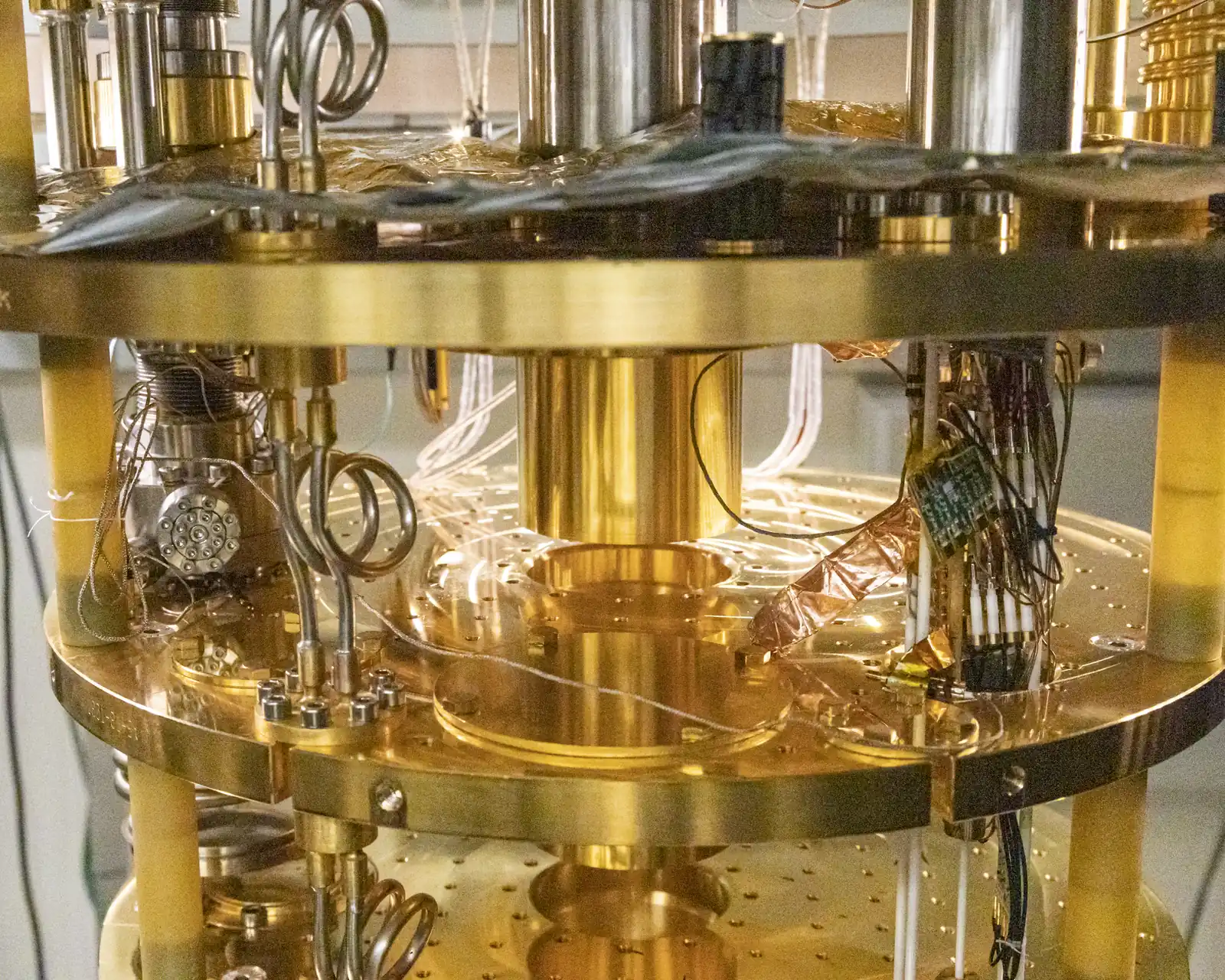
A closed-cycle dilution refrigerator and laboratory instrumentation at Oak Ridge National Laboratory.
An ORNL dilution refrigerator designed for optical and scanning-probe microscopy, photographed in January 2020. Archival materials-research context; this is not Columbia’s Pd5AlI2 sample or its reported microscopy apparatus.Photo: Quantum lab (53804358991).jpg · Oak Ridge National Laboratory · CC BY 2.0Full image credit

Columbia’s October 22 account of research in the layered metal Pd5AlI2 describes electron waves localized near atomic defects, even though the surrounding material supports extended electronic states. The university links the work to a Science paper. The research has a longer public history: the matching author preprint first appeared on October 25, 2024.[1][2][3]

The useful idea is interference. Electrons behave as waves, and different possible paths through a lattice can reinforce or cancel one another. The team’s explanation connects that interference to localized states around defects. The observation concerns particular electronic states; it does not mean that all electrons stop moving or that the entire metal becomes an insulator.[1][2]

The preprint reports scanning tunnelling microscopy and spectroscopy, which probe the surface and its local electronic response. Its methods describe measurements at about 7 kelvin on samples cleaved in ultrahigh vacuum. The researchers combine these observations with modelling to explain how localized states can coexist with the metallic continuum. These details describe the reviewed preprint version.[2]

A bound state in the continuum is the name for that apparently awkward combination: a state remains spatially confined even though extended states are available at the same energy. The conceptual surprise is coexistence, rather than confinement by an ordinary wall. That distinction makes interference a more useful explanation than a picture of individual electrons simply parked at defects.[2]

Turning the observation into a device would require control over where the relevant defects occur. Columbia identifies deliberate defect placement as future work. Possible uses in sensing or computing therefore remain research directions, not demonstrated applications of this experiment. A convincing next step would show repeatable placement together with the desired electronic behaviour.[1]

The study is an instructive reminder that a material’s defects can be part of the physics worth investigating, rather than only imperfections to eliminate. The engineering question is whether the helpful effect can be reproduced where it is needed, while preserving the conditions that make the state remain localized.

Keep your reading trail

Your Updates →

Evidence & context

3 linked sources

University research report; full author-preprint methods

How to read the evidence and dates

An announcement records what an organization stated. An experiment reports an observation. A simulation or resource estimate depends on its assumptions. QubitWire’s analysis connects these sources; the labels are not quality scores.

Published is the article’s first QubitWire publication. Updated marks a substantive content change. Sources checked records a review of the underlying evidence. An older paper can support a new explanation, and another press release about the same work is not independent replication.

QubitWire take

Observation and deliberate device construction are different milestones.

Sources

  1. Quantum interference is key to catching electron waves

    Columbia Quantum Initiative, October 22, 2026. Links the observation to Science DOI 10.1126/science.adt9825 and describes controlled defect placement as future work.

  2. Electronic bound states in the continuum in a 2D metal

    Author preprint first posted October 25, 2024; revised October 28. Full 28-page PDF, including microscopy and spectroscopy methods, reviewed.

  3. Science publication record

    Final research DOI linked by Columbia. This review uses the institutional account and explicitly dated author-preprint methods; full final text was not retrieved.

READ NEXT

Continue exploring

All Research stories
  1. Related reading

    A Quantum Sensor Remembers Weak Signals That Classical Memory Forgets

    A new theory result uses persistent quantum memory to decode weak coded rotations that comparable classical-memory receivers lose.

    Published · Source report · Sources checked
THE QUANTUM BRIEFING

A clearer signal.
Read the latest edition.

A little perspective on a fast-moving field.

Read the on-site briefing →

Read selected quantum coverage in the on-site briefing, or register your interest below.