The Quantum Security Risk Starts Before the Quantum Computer
Encrypted information stolen today could still matter years from now. That changes when organizations need to prepare.

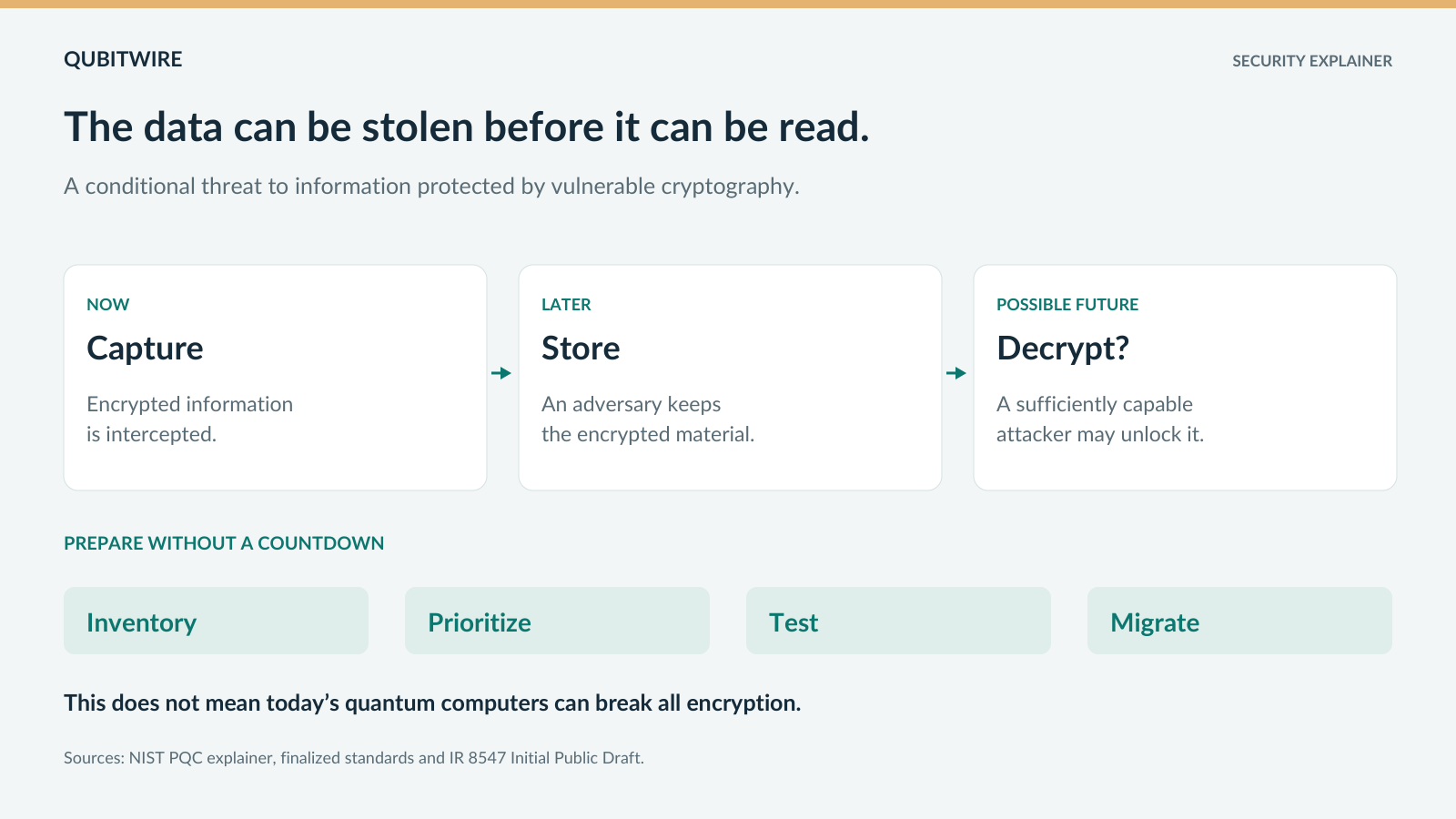
An attacker does not have to read an encrypted file today for stealing it today to matter.
That is the concern behind “harvest now, decrypt later.” An adversary can retain intercepted, encrypted information and hope to unlock it with future capabilities. For records that must remain confidential for decades, the security problem starts before those capabilities arrive.[3][4]
A sufficiently powerful future quantum computer could undermine widely used RSA and elliptic-curve public-key systems. That is not a claim that today’s quantum computers can read your encrypted messages, or that every form of encryption faces the same threat.[3]
The response is post-quantum cryptography: algorithms designed to resist known quantum attacks while running on conventional computers. Organizations do not need to buy a quantum computer to begin the transition.[3]
NIST finalized its first three principal standards in August 2024. ML-KEM supports key establishment. ML-DSA and SLH-DSA support digital signatures. These are different jobs within a security system, not three interchangeable ways to encrypt every file.[1]

The difficult part is finding where vulnerable cryptography is buried. Connections, certificates, software updates and long-lived products can depend on systems an organization does not control directly. A sensible starting question is: what data must still be secret in ten or twenty years, and what protects it today?[4]
From there, the work is practical: inventory cryptographic dependencies, identify long-lived sensitive data, ask suppliers about standards-based support and test migrations before broad deployment. Changing algorithms without checking compatibility and implementation can create new problems.[1][4]
Do not confuse preparation with a countdown. NIST IR 8547 is still labeled an Initial Public Draft on the checked publication record. Its 2030 and 2035 transition milestones are proposals for specified algorithms, not a universal business deadline or a prediction of when a code-breaking quantum computer will arrive.[2][4]
The useful question is not simply when quantum computers will become powerful enough. It is whether information captured now will still need protection then.