
Quantum AI Has a Hidden Cost Before the Calculation Starts
An algorithm can look spectacularly fast when the stopwatch starts late. Loading data and reading the answer can change the quantum-AI calculation.
Imagine being offered a spectacularly fast delivery service, then discovering that the quoted time excludes getting your parcel to the depot. Some quantum-AI claims have an analogous complication: the algorithm is fast once its input is available in the required quantum form. Preparing that input may be a substantial job of its own.[1]
Ordinary files cannot simply be treated as ready-made quantum states. A method may need a special data-access structure or a sequence of operations that encodes the information. For arbitrary large datasets, that preparation can erase the advantage suggested by a calculation that starts its stopwatch afterward.[1]
The way out matters, too. An influential quantum algorithm for linear equations produces access to properties of a quantum-encoded solution, rather than instantly printing every entry of an enormous answer. Asking for the whole classical output is a different task from estimating a useful summary of it.[2]
None of this proves quantum machine learning is pointless. Structured inputs can be easier to prepare, and an application may need only a small amount of output. The right question is whether the complete procedure retains an advantage for that particular problem, compared with a strong classical method given a fair starting point.[1][2]


So ask four questions: where did the data begin, what did preparation cost, what answer came back and which classical baseline was used? A fair race needs the same starting and finishing lines.[1]
What comes back from a linear-system solver
A two-number example shows what quantum-encoded output means. Take the diagonal matrix with entries 1 and 2, and the right-hand vector (1, 1). The ordinary solution is (1, 1/2). The corresponding normalized quantum state has amplitudes (2/√5, 1/√5). This is an arithmetic illustration of the output format, not an HHL experiment or a performance comparison.
Measuring that state in the computational basis yields the first label with probability 4/5 and the second with probability 1/5. One shot returns one label, not both solution entries. Repeated shots estimate those probabilities. The same basis measurements also cannot distinguish a plus sign from a minus sign on the second amplitude. Extracting a different property requires an appropriate measurement procedure.
In this example, the expectation of the diagonal observable with entries 1 and −1 is 3/5. A suitably chosen summary can therefore be the intended answer. The input model still matters: a linear-systems algorithm needs access to the matrix and preparation of the right-hand-side state. Matrix sparsity, conditioning and required error affect the cost. Harrow’s review defines those assumptions explicitly; the array dimension alone cannot establish a practical advantage.[3]
For a proposed application, write the final output requirement before comparing runtimes: one observable, samples from the solution state or a full classical vector. Then give the classical method the corresponding task and data access. This prevents an algorithm that returns a restricted summary from being compared as though it had printed an entire spreadsheet.
Read the deeper explanation · about 6 min
This estimate covers the explanation below, separate from the overview. Optional depth was added in this reading edition. The article keeps one canonical address and its original chronology. Source review: . The relevant source dates and limitations are recorded below.
A quantum algorithm can sound extraordinary when the clock starts after the difficult preparation is already complete. Give the machine a particular quantum state, let it perform a clever sequence of operations, and an attractive scaling result may follow. But the real world does not begin with the right state waiting politely at the entrance. Someone has to create it.[1]
That is not a technicality. For applications involving ordinary classical data, the work of loading or preparing the input can change the end-to-end value of an algorithm. The same is true at the other end, where a useful answer has to be extracted from quantum measurements. A speedup claim is most informative when it states where the clock starts, where it stops and what the user receives.[1]
What an input assumption buys you
An algorithm is usually studied within a defined model. It may assume access to an oracle, a structured matrix, a method for preparing a state or a particular kind of memory. Such assumptions allow researchers to isolate a question and prove something precise. The mistake is not making an assumption. The mistake is losing the assumption while translating the result into a business promise.[1][2]
For example, a mathematical method may have a favorable dependence on the size of a problem under a specified data-access model. That does not automatically mean a company can upload an arbitrary spreadsheet and obtain the advertised improvement. The cost of building the access mechanism, the structure of the data and the accuracy required remain relevant.[1][2]
A good explanation therefore treats the input model as part of the result. It asks what form the information takes, which operations are available and what each operation costs. Readers do not need to reject the algorithm because its assumptions are demanding. They need to understand the conditions under which the algorithm is useful.
A quantum state is not an ordinary compressed file
It is tempting to describe a quantum state using many amplitudes and then say the computer has stored an enormous classical database in a small number of qubits. That shorthand hides two important questions. How was the state prepared? And which information can actually be recovered through measurement?[3]
A state description may contain many parameters, but a user cannot generally read them all out from one copy of the state. Measurement produces outcomes according to the chosen procedure. Learning a detailed description may require many preparations and measurements. The representation is not a free, randomly accessible version of every number in a classical file.[1][3]
This is one reason output requirements matter so much. An algorithm that helps estimate a particular property can be useful even if it does not return an entire data structure. But a customer asking for every entry of a large classical answer is asking a different question from a researcher estimating a specific observable. The output contract should not change halfway through the headline.[1][2]
Structure can make the difference
Not all input preparation is equally difficult. Some states can be generated by compact circuits or arise naturally from the problem being studied. Some algorithms exploit a special structure that makes data access economical. Other proposals assume a resource whose construction is itself a major engineering task.[1][2]
This diversity is important. Saying that input costs matter is not the same as saying that quantum algorithms are useless. It is an instruction to examine the actual problem rather than treating all data as interchangeable. A compact scientific model, a previously generated quantum state and an arbitrary collection of classical records can present very different opportunities.
An application assessment should therefore explain why the input is favorable, rather than merely asserting that loading can be ignored. Is the data generated repeatedly in a suitable form? Can preparation be reused? Does the problem have sparsity or another exploitable structure? Does the claimed advantage survive the cost of producing the required representation? Those questions can reveal a credible use case or expose a gap that still needs research.[1]
One useful thought experiment
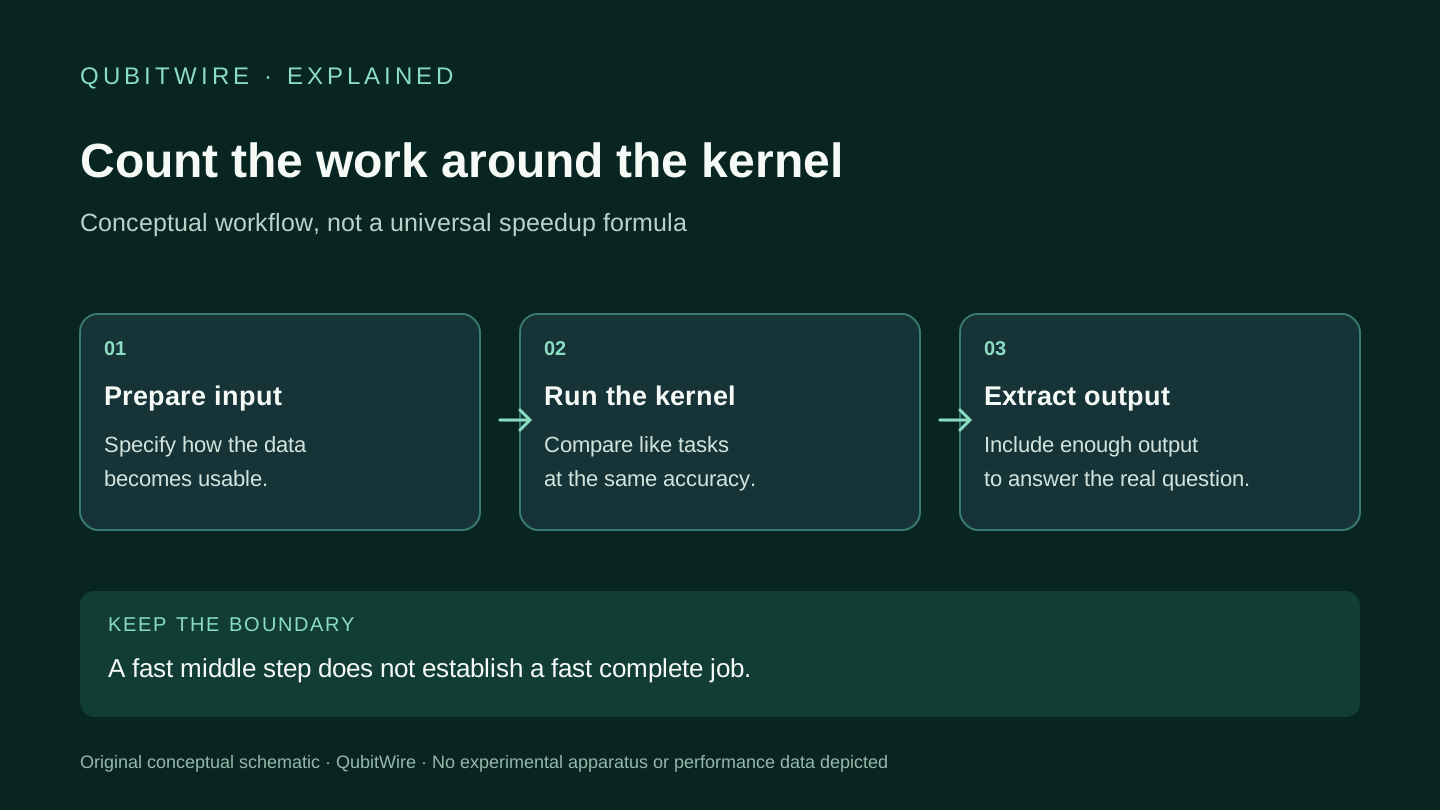
Imagine two hypothetical workflows that produce the same useful scalar estimate at the same target accuracy. Workflow A spends most of its time preparing an input, then finishes the central calculation quickly. Workflow B takes longer in the central calculation but begins from the data already available. It is impossible to identify the faster workflow by timing only the middle step.
Now imagine the input can be reused across many closely related calculations. The economics may change. The preparation cost could be spread across multiple outputs, provided the proposed reuse is actually compatible with the state preparation and measurement process. This is not permission to assume unlimited free reuse of a quantum state. It is a reminder to define the workload carefully.
Finally, change the requested output from one estimate to an entire table. The extraction cost may change the comparison again. The exercise shows why a universal claim such as 'quantum handles big data faster' is less useful than a precise description of the input, task, accuracy and output.
The accuracy requirement belongs in the headline analysis
Many computational costs depend on how accurate an answer must be and how confidently it must be established. A method that looks attractive for a rough estimate may face a different resource requirement when a downstream decision needs tighter uncertainty. Ignoring that dependence can turn a legitimate scientific result into a misleading practical comparison.[1][2]
The right question is not whether the quantum and classical workflows produce numbers with the same number of decimal places on a screen. It is whether they meet the same meaningful accuracy criterion for the same task. That includes statistical uncertainty, systematic effects and any approximation introduced by the method.
An honest application story will often become more interesting at this point. It may reveal that a modestly accurate estimate is enough for one workflow, while another genuinely needs a much more demanding answer. Quantum computing is not required to win every version of a task to have value. But the version it addresses should be named.
A practical way to read the next claim
Start with the noun. What is the input: a circuit, a Hamiltonian, a graph, a matrix, a quantum state or a classical dataset? Then find the verb. Is the algorithm sampling, estimating, optimizing, simulating or producing a complete explicit answer? Finally, identify the output that a user could actually act on.
Next, inspect the access assumptions. What does the method get to query, and what is the cost of supplying that access? Ask whether the stated resource estimate includes preparation, repeated measurements, error correction where relevant and classical processing. A partial analysis can still be valuable, but it should remain a partial analysis.[1][2]
Only then compare the alternatives. A fair comparison uses a relevant classical method, a matched task and a stated target quality. It does not compare the best-known quantum middle step with a deliberately naive classical workflow while leaving the interfaces out.[1]
The useful conclusion
The first step in a quantum computation is part of the computation. So is the last. Recognizing that does not diminish the ingenuity of quantum algorithms. It helps distinguish a striking mathematical opportunity from an application whose whole workflow has been accounted for.[1]
The next result worth returning for may be less dramatic than a headline about an exponential speedup. It could be a better state-preparation method, a more realistic data-access model or a demonstration that a useful output can be obtained with a manageable total cost. Those advances close the distance between an algorithmic idea and something a user can actually run.
Before asking whether the quantum computer is faster, ask what had to happen before it was allowed to start.
Evidence for this explanation
- Scott Aaronson: Read the fine print
Primary author manuscript of the 2015 Nature Physics commentary; complete PDF checked October 11, 2026. Input access, sparsity, conditioning and output limits in quantum machine-learning proposals, not a blanket rejection of quantum algorithms.
- Quantum algorithm for solving linear systems of equations
Primary preprint first submitted November 19, 2008, last revised September 30, 2009. Its stated task estimates properties of a solution state under assumptions; it does not print every entry of an arbitrary classical solution vector.
- IBM Quantum Learning: quantum information in single systems
Foundational primary course checked October 11, 2026. State descriptions, measurement and basis dependence; no cloud hardware experiment was run.