
Two Teams Found the Same Boundary for Quantum Impurity Models
Concurrent proofs put static equilibrium properties in polynomial-time classical reach for a fixed-size impurity, while dynamics can still capture universal quantum computation.
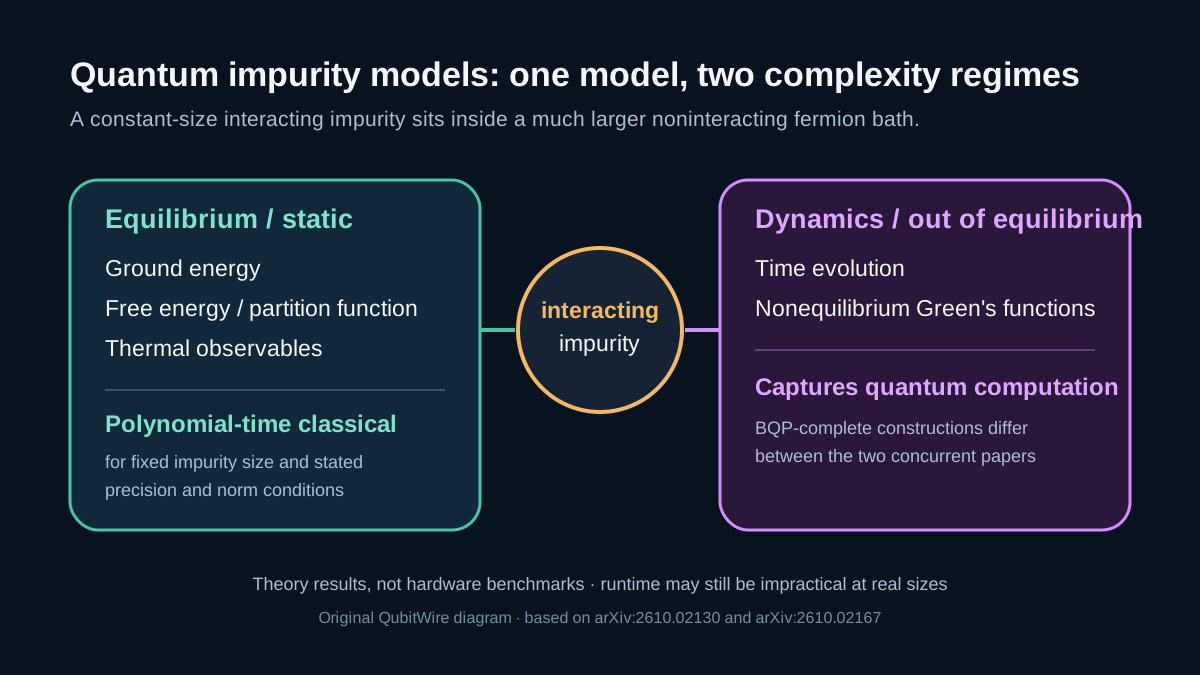
Two independent research teams have drawn nearly the same computational boundary through quantum impurity models. For a constant-size interacting impurity coupled to a much larger bath of noninteracting fermions, they show that important equilibrium properties admit polynomial-time classical algorithms. Move from equilibrium to dynamics, however, and the same model family can express the full power of quantum computation.[1][2]
Quantum impurity models are not a niche mathematical toy. They describe a small correlated subsystem embedded in an environment of otherwise free particles, and they are core ingredients in methods used to study strongly correlated materials. The practical question is whether the impurity solver inside those methods belongs on a classical or quantum machine.[1][2]
The first preprint gives a classical algorithm that estimates ground energy to additive error epsilon in time polynomial in the number of fermionic modes and inverse precision when the impurity size is fixed. It also gives polynomial-time procedures for Helmholtz free energy and a classical description of a thermofield-double state, with explicit dependence on inverse temperature and precision.[1]
The second team independently reaches the same static conclusion with different finite-temperature techniques. Its algorithms estimate ground energy to additive precision and the partition function to relative precision in polynomial time. It also covers thermal expectation values for fermionic Gaussian observables, including local fermionic observables, without requiring extra geometry or bath-spectrum assumptions.[2]
That agreement closes one tempting route to a large quantum speedup: these proofs rule out a superpolynomial advantage for the covered static tasks under their assumptions. But polynomial does not mean fast in practice. The runtime is exponential in impurity size, which the results hold constant, and its dependence on precision and temperature can still matter at realistic scales.[1][2]
Dynamics is the escape hatch. The first paper proves that time evolution under a time-independent impurity Hamiltonian with fixed impurity size is BQP-complete, using a stationary quantum-processor construction programmed by freely propagating fermions. The second proves hardness for estimating nonequilibrium Green's functions, including BQP-completeness at finite inverse temperature and DQC1-completeness at infinite temperature, using time-dependent impurity Hamiltonians.[1][2]
The distinction matters for quantum materials research. Ground energies, free energies and equilibrium observables may have rigorous efficient classical routes in this model class, while real-time response and nonequilibrium propagation retain a plausible quantum role. That is a sharper target than the broad claim that quantum computers will simulate materials better.[1][2]
These are complexity-theory preprints, not hardware demonstrations or measured speedups. They do not make arbitrary correlated-electron Hamiltonians classically easy, nor do they show that today's quantum processors can solve the hard dynamical cases at useful scale. The next useful work is to turn the proofs into practical classical solvers, benchmark their constants, and identify dynamical observables whose quantum hardness survives realistic noise and measurement costs.[1][2]