
When quantum particles get stuck, their defects can move together
An ultracold-atom experiment follows mobile pairs of defects through a constrained lattice. The new milestone is peer-reviewed publication.
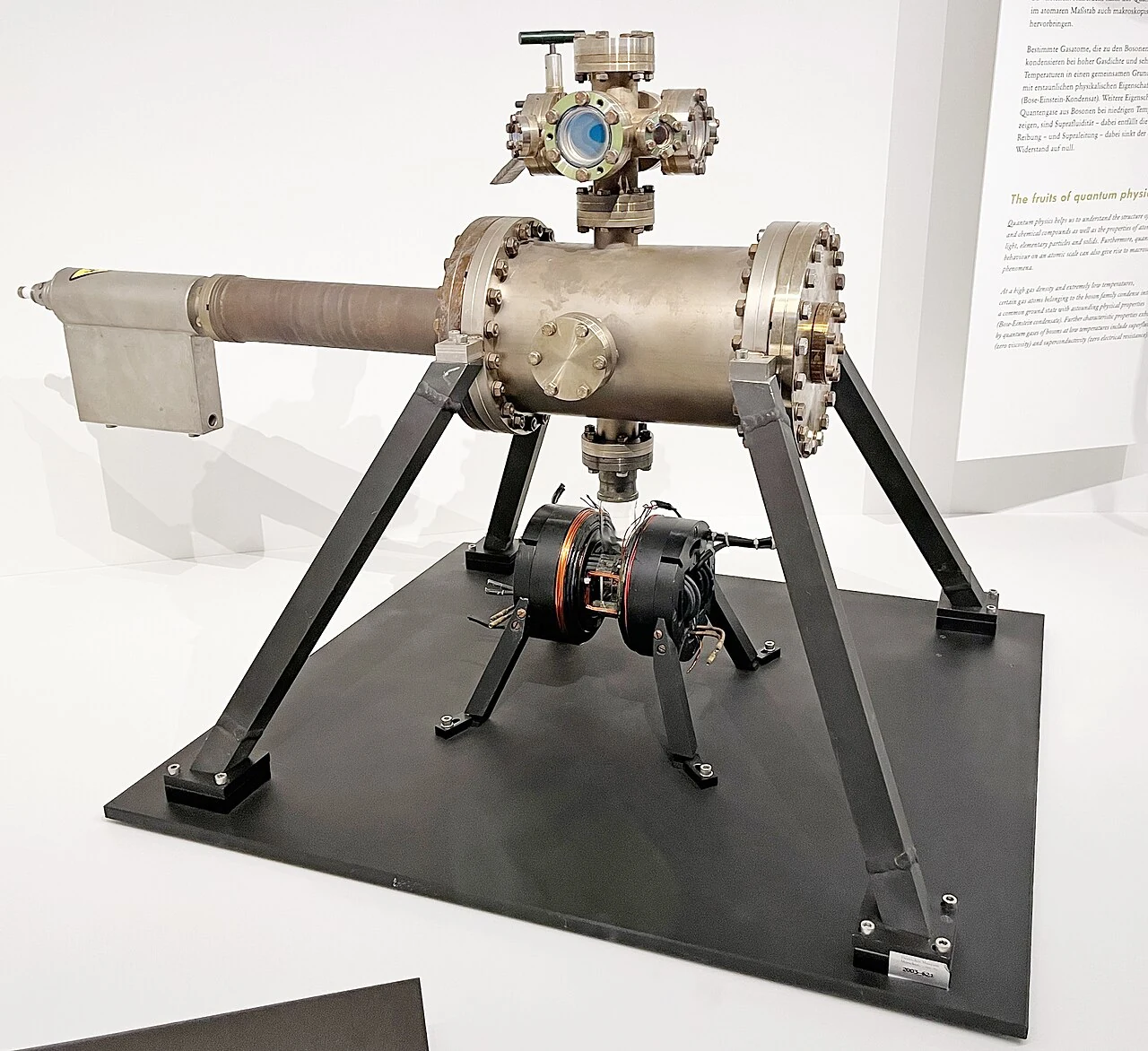

A row of atoms can resist ordinary movement while still allowing a carefully arranged disturbance to travel. Researchers have observed that behavior in an ultracold-atom lattice, tracking paired defects that move even though isolated excitations are constrained. The result reached Nature Physics on October 30, 2026. It offers a striking view of motion governed by collective rules.[1]
The paper first appeared as a preprint on November 4, 2025. Its journal publication is the current milestone. The experiment prepares and follows bound states made from a hole and a doublon: an empty lattice site and a site containing two atoms, relative to a background with one atom per site.[2]
Start with the pattern
Those names describe the arrangement, rather than two unfamiliar species of atom. Imagine counting the occupants of a row of seats. A vacant seat and a seat with two occupants form a distinctive pattern against a background of single occupancy. That picture helps identify the defects; it does not reproduce the quantum dynamics.
The physical constraint comes from a strong potential gradient that makes ordinary hopping costly. Correlated motion can still preserve the overall center of mass. The researchers prepared localized bound excitations, followed their quantum walks and studied their scattering. This behavior connects the experiment to fracton physics, where conservation constraints restrict the mobility of individual excitations.[1][3]
A three-site way to see it
A small arithmetic example makes the conservation rule visible. Number three sites zero, one and two. Put zero atoms at the first, two at the second and one at the third. The total is three. The position-weighted sum is zero times zero, plus one times two, plus two times one: four.
The pattern moves. The totals stay fixed.
Before
Total: 0 + 2 + 1 = 3
Weighted sum: 0 × 0 + 1 × 2 + 2 × 1 = 4
After
Total: 1 + 0 + 2 = 3
Weighted sum: 0 × 1 + 1 × 0 + 2 × 2 = 4
Now change the occupancies to one, zero and two. There are still three atoms. The weighted sum is again four: zero times one, plus one times zero, plus two times two. The empty site and double occupancy have both shifted one place along the row while the overall center of mass stays fixed.
This is an explanatory example, not an experimental image, measured trajectory or simulation. It says that the proposed rearrangement respects two bookkeeping rules. It does not specify how likely the move is, how quickly it occurs or which quantum amplitudes are involved. Those questions require the physical model and the experiment.


Why the result matters
The interesting question becomes which collective moves remain possible after individual moves are restricted. Removing one option need not freeze every possible pattern. It can leave a smaller and more structured set of choices. Here that idea is tied to a measurable conserved quantity, which makes the question more precise than a general claim that particles cooperate.
For readers interested in quantum computing, this is a study of controlled many-body behavior. A commercial application would need its own evidence: a defined task, useful output and a relevant comparison. The scientific result stands on the behavior observed in the lattice; no speedup or useful computer is required to make the question worth asking.
A useful follow-up would test more complicated arrangements and ask which predictions distinguish competing explanations. Repeating the behavior in another apparatus would answer a separate question about reproducibility. For now, the memorable insight is already concrete: a rule that pins isolated disturbances can still leave a path for their combined pattern to travel.