
Quantum 'Wings' Give AI More Room to Read the Grid
A simulated quantum classifier gained 1.6 percentage points by feeding new sensor features into small side modules—not by simply adding circuit capacity.
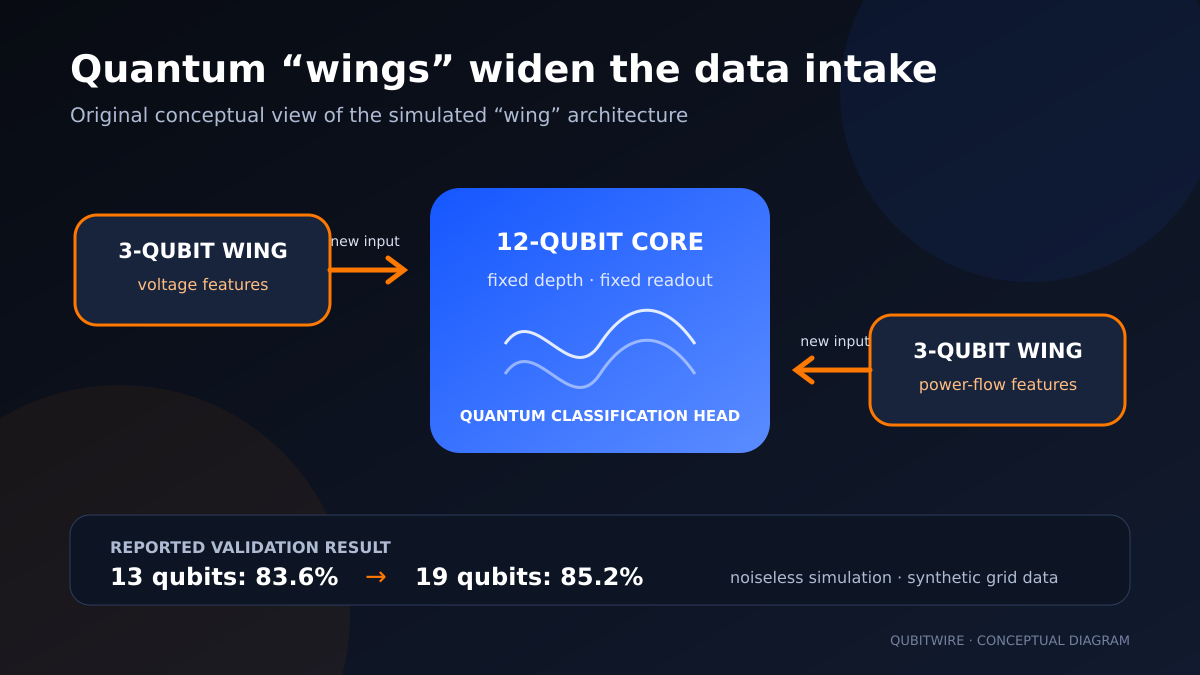
IonQ and QuantumBasel researchers have tested a modular way to widen a quantum machine-learning model without deepening its core circuit. On synthetic power-grid data, adding two three- “wings” raised mean internal-validation balanced accuracy from 83.63% at 13 qubits to 85.23% at 19.
The model starts with frozen Chronos time-series embeddings, then asks a quantum classification head to identify generator trips, line trips, bus trips and faults. Each wing supplies a separate stream of voltage or power-flow features through sparse one-way couplings, giving the core more information without making it deeper.
The authors used four seeds and five-fold cross-validation on 439 training samples. Accuracy climbed at every rung: 83.63%, 84.62% and 85.23%. A larger classical neural-network head trailed by 1.7–2.0 percentage points on identical engineered inputs. Adding circuit parameters without new data instead cut accuracy to 83.85%.
Every quantum circuit in this study ran as a noiseless simulation with analytic expectation values; no quantum processor or live utility network was involved. The 549-example dataset is synthetic, most ladder numbers come from internal validation after learning-rate selection, and several authors work for IonQ. This is a preprint, not peer-reviewed evidence of a production advantage.
The architecture now needs execution on noisy hardware, comparison under equal compute and tuning budgets, and tests on larger real-world grid datasets. The most informative result would be whether the small validation gain survives finite shots, device noise and genuinely unseen utility telemetry.