
Skip to content
RESEARCH · QUANTUM SIMULATION

Structured noise reveals hidden order in a small quantum experiment

A small experiment uses a tailored measurement strategy to examine mixed-state order.
Published Source report Sources checked
My reading list
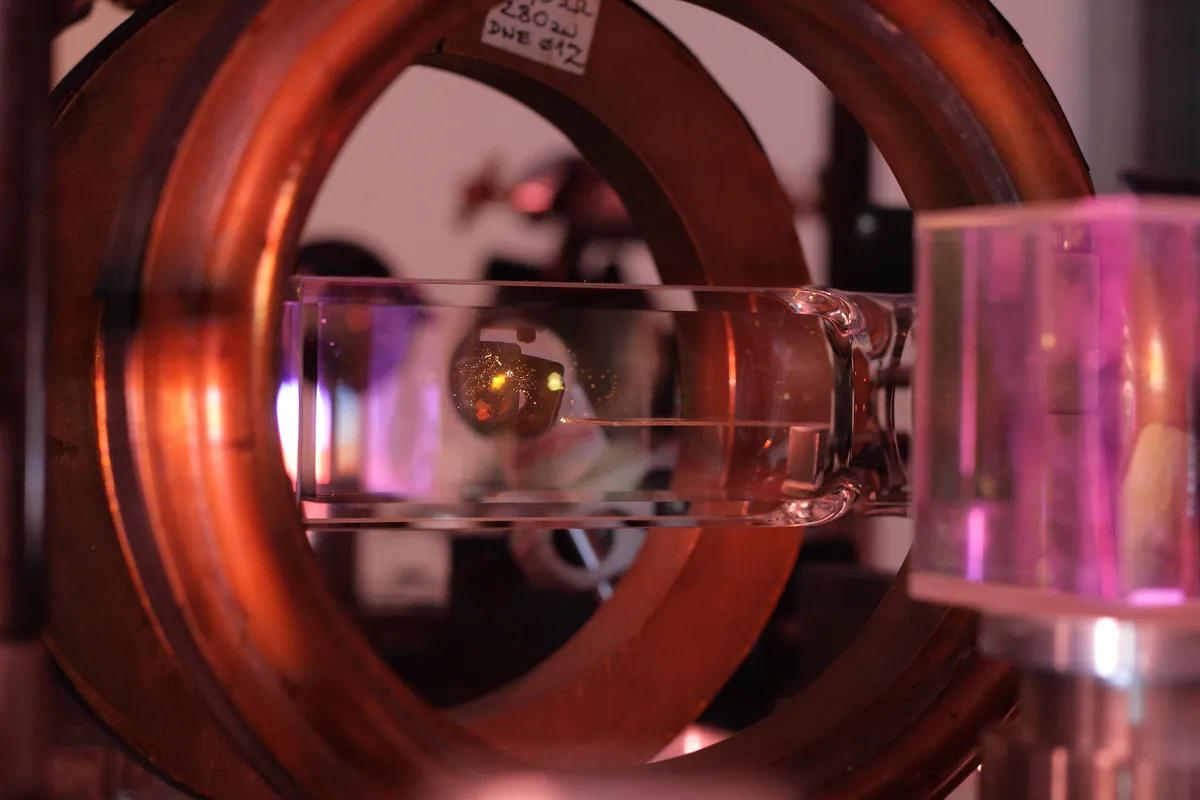
Laboratory optics and vacuum equipment used for a cold-atom experiment.
An archival cold-atom laboratory experiment. Neutral-atom context; not an image of the state or equipment measured in the mixed-state-order study.Image: Cold atoms experiment 04.JPG · Tomasz Kawalec · CC BY-SA 4.0Full image credit

Noise can produce a form of quantum order that ordinary measurements miss. A team using superconducting processors reports finite-size signatures of strong-to-weak spontaneous symmetry breaking, an effect in mixed quantum states that requires nonlinear diagnostics.[1][2]

The team prepared quantum states and collected measurements, then incorporated known dephasing probabilities during classical processing. That let it study many noise parameters using the same measured data. Two measurement settings reconstructed correlations that reveal hidden order alongside ordinary correlations that decay.[1][2]

The preprint was submitted on October 19. An October 20 QLab report says the experiment used access to IBM Heron processors and studied systems of no more than 12 .[1][2]

That system size should accompany any claim about the transition. The researchers report finite-size crossings and scaling behavior, rather than a direct experiment on an infinite system.[1][2]

The work also explores links between mixed-state order and the survival of encoded quantum information. It does not show that adding arbitrary noise improves a quantum computer.[1]

Keep your reading trail

Your Updates →

Evidence & context

2 linked sources

Experimental preprint first submitted October 19, 2026; institutional coverage October 20.

How to read the evidence and dates

An announcement records what an organization stated. An experiment reports an observation. A simulation or resource estimate depends on its assumptions. QubitWire’s analysis connects these sources; the labels are not quality scores.

Published is the article’s first QubitWire publication. Updated marks a substantive content change. Sources checked records a review of the underlying evidence. An older paper can support a new explanation, and another press release about the same work is not independent replication.

Sources

  1. Strong-to-Weak Spontaneous Symmetry Breaking Transitions on a Quantum Processor

    Experimental preprint; QLab institutional report October 20; source dated 2026-10-19. Reviewed 2026-10-27.

  2. QLab institutional report on the strong-to-weak symmetry-breaking experiment

    University research news; source dated 2026-10-20. Reviewed 2026-10-27.

READ NEXT

Continue exploring

All Research stories
  1. Related reading

    A quantum phase benchmark must follow the crossing as the system grows

    A superconducting simulation tests signatures of a known critical transition while finite-size and preparation effects remain part of the result.

    Published · Source report · Sources checked
  2. Related reading

    A Quantum Compiler Kept the Symmetry—and Recovered the Right Physics

    Standard Clifford+T synthesis gave the wrong transport exponent in a Heisenberg-model test. A measurement-assisted compiler preserved SU(2) exactly and used about five times fewer T gates at matched accuracy.

    Published · Source report · Sources checked
THE QUANTUM BRIEFING

A clearer signal.
Read the latest edition.

A little perspective on a fast-moving field.

Read the on-site briefing →

Read selected quantum coverage in the on-site briefing, or register your interest below.