
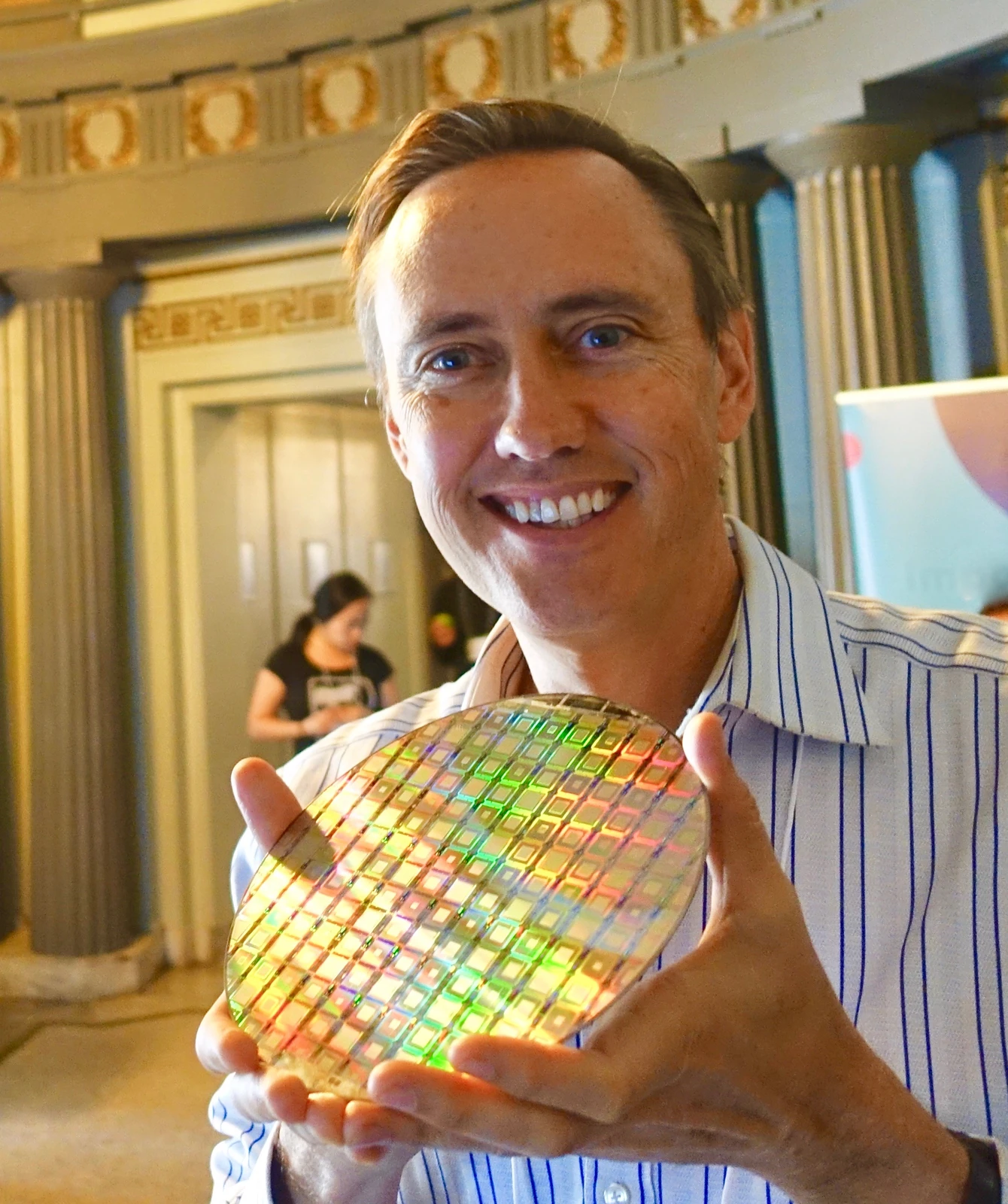
A wafer at human scale
A wafer provides a different mental picture from a single finished processor. Its repeated pattern invites the reader to think about manufacturing multiple devices and then determining which meet the required specifications. The original description identifies the subject as a D-Wave wafer, and the photograph is historical. Do not turn the visible grid into a claim about the number of functioning processors or qubits. Use the image to introduce the questions that follow fabrication: inspection, packaging, electrical tests and measurement under intended operating conditions. The human scale makes a manufacturing story accessible without needing an invented comparison or a misleading performance label.
- Organization
- D-Wave
- Image type
- Photograph
- Capture date
- 2018-02-01
- Photographer / creator
- Steve Jurvetson from Menlo Park, USA
- Reuse terms
- CC BY 2.0
Steve Jurvetson from Menlo Park, USA — The Beauty of Quantum Computers (25215168907).jpg — CC BY 2.0 — https://commons.wikimedia.org/wiki/File:The_Beauty_of_Quantum_Computers_(25215168907).jpg — https://creativecommons.org/licenses/by/2.0.
Full original frame retained; EXIF orientation normalized where present, resized without enlargement and converted to WebP. No crop or content alteration.
Read the image
A wafer connects repeated fabrication with individual device testing
Steve Jurvetson holds a round wafer with an iridescent grid in this February 2018 photograph. The hand-held view makes the object’s scale immediately understandable. The source identifies it with D-Wave processors, giving the image a specific historical manufacturing context.
A wafer can carry repeated device patterns before individual devices are separated and incorporated into systems. Repetition is useful for manufacturing, but it also creates a testing question: which fabricated devices meet the intended requirements? Yield concerns that qualified fraction under a specified test, not simply the number of visible repeated regions.
The photograph can introduce this relationship without claiming a measured yield or current production status. Keep the 2018 date prominent and avoid repeating an old “latest” description as though it refers to today. The useful story is how a repeated fabrication object becomes a collection of individually characterized devices.
Does every visible region equal a usable processor?
No. Device boundaries and qualification outcomes require fabrication and testing records. The photograph alone does not provide them.
Why is the person useful in the image?
The person supplies human scale and handling context. Exact wafer dimensions still need a reliable specification or measurement.
How should manufacturing yield be reported?
Define the tested population, acceptance criteria, period and result. A percentage without those conditions is hard to interpret.
An independent QubitWire lesson based on this image and the cited source reading. The image does not establish a performance result.
Keep exploring
More from the same organization or hardware architecture.
 A D-Wave processor in close-upSteve Jurvetson · CC BY 2.0
 D-Wave’s deep freezeSteve Jurvetson · CC BY 2.0
 D-Wave’s 128-qubit chipD-Wave Systems, Inc. · CC BY 3.0
 The Washington annealing chipMwjohnson0 · CC BY-SA 4.0
 D-Wave processor generations on a waferSteve Jurvetson · CC BY 2.0
 A wafer of Vesuvius processorsSteve Jurvetson · CC BY 2.0
Back to all images · Explore the interactive Model · Image rights and corrections