
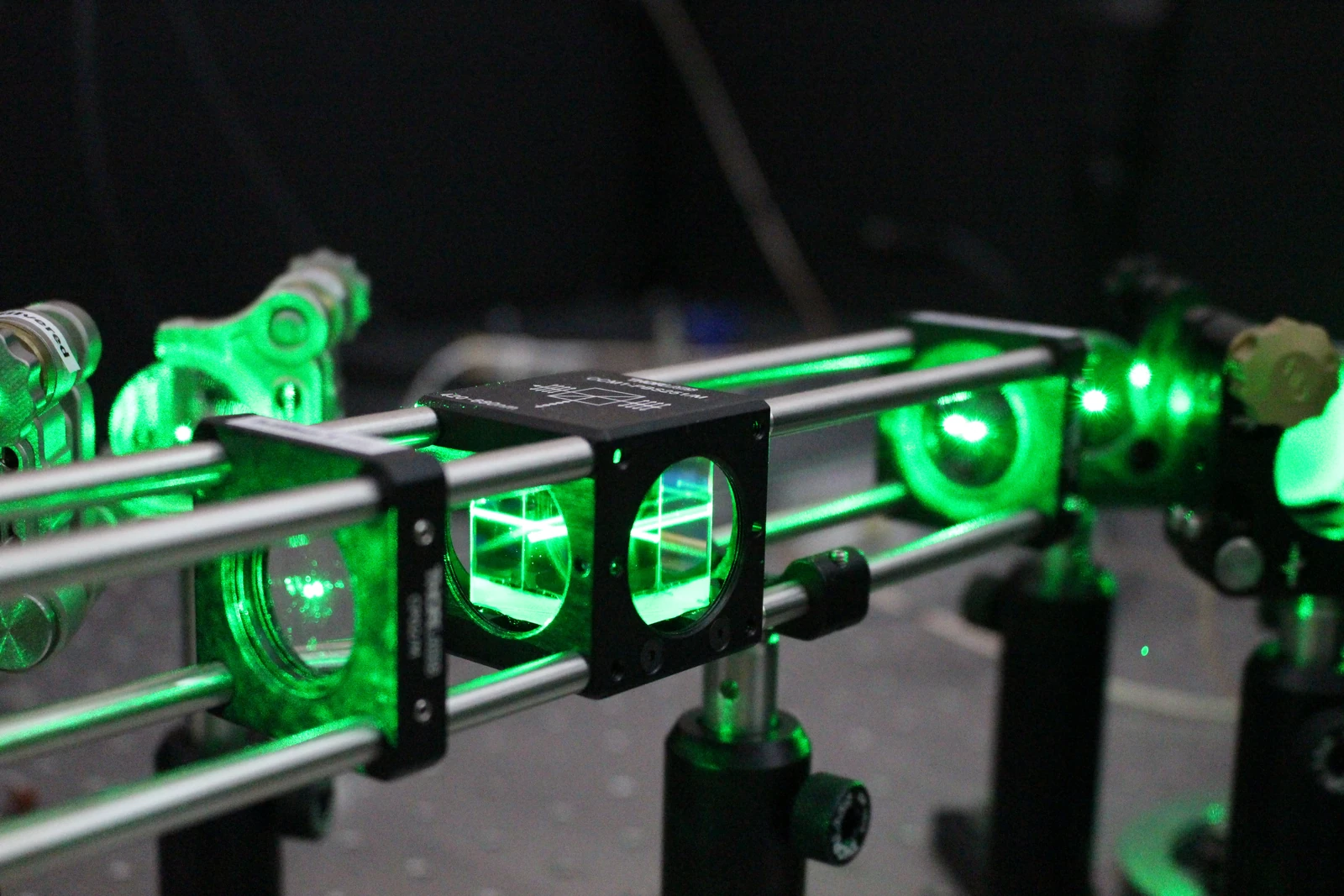
Green light through diamond-quantum optics
The green beam is an inviting entry point into a solid-state quantum experiment, but it is not itself a picture of a qubit. The photographer identifies this setup with the optical control of nitrogen-vacancy centers in diamond. Use the image to explain why a microscopic quantum system can require a visible collection of lenses, mounts and alignment hardware. A separate schematic can connect the light path to preparation and readout while making clear which parts are generic teaching elements. Keep the photograph’s colors intact and avoid adding artificial glow that could be mistaken for experimental evidence.
- Organization
- University of Warwick
- Image type
- Photograph
- Capture date
- 2016-10-28
- Photographer / creator
- Gavin Morley
- Reuse terms
- CC BY-SA 4.0
Gavin Morley — Attocube beamsplitter GWMorley.jpg — CC BY-SA 4.0 — https://commons.wikimedia.org/wiki/File:Attocube_beamsplitter_GWMorley.jpg — https://creativecommons.org/licenses/by-sa/4.0.
Full original frame retained; EXIF orientation normalized where present, resized without enlargement and converted to WebP. No crop or content alteration.
Read the image
Green light introduces the control-and-readout problem
Bright green light passes through small optical elements mounted on posts. Gavin Morley’s source identifies a 532-nanometer laser in a laboratory working with nitrogen-vacancy centers in diamond. The photograph offers a clear visual entry into a setup where light interacts with a quantum system.
An optical experiment must distinguish the light deliberately sent toward a sample from the light eventually measured. Components can prepare, direct, filter or collect light, and their arrangement supports the experiment’s signal path. The green beam visible in the photograph should not be mistaken for a picture of a qubit state or a complete readout record.
The best companion is a generic pathway with separate preparation, sample and detection stages. It explains why an optical table contains many elements even when the quantum object is small. Exact labels for the pictured components should come from the source’s apparatus documentation rather than their visual resemblance.
What does the wavelength statement rely on?
It comes from the photographer’s source description. The exact wavelength cannot be measured reliably by looking at the displayed green color.
Why separate excitation from detection?
They can involve different signals and optical paths. Conflating them makes it harder to understand how the experiment distinguishes a response from its input light.
What does the photograph establish about quantum performance?
It documents an optical setup. Coherence, sensitivity or readout fidelity would require a measurement source linked to the experiment.
An independent QubitWire lesson based on this image and the cited source reading. The image does not establish a performance result.
Back to all images · Explore the interactive Model · Image rights and corrections