
Quantum in pictures
Quantum work in orbit still needs a maintenance day
A photograph of Jessica Meir working inside the Cold Atom Lab reveals the practical work behind an unusually cold experiment in space.
Research context: October 19, 2026 · Source review: October 20, 2026
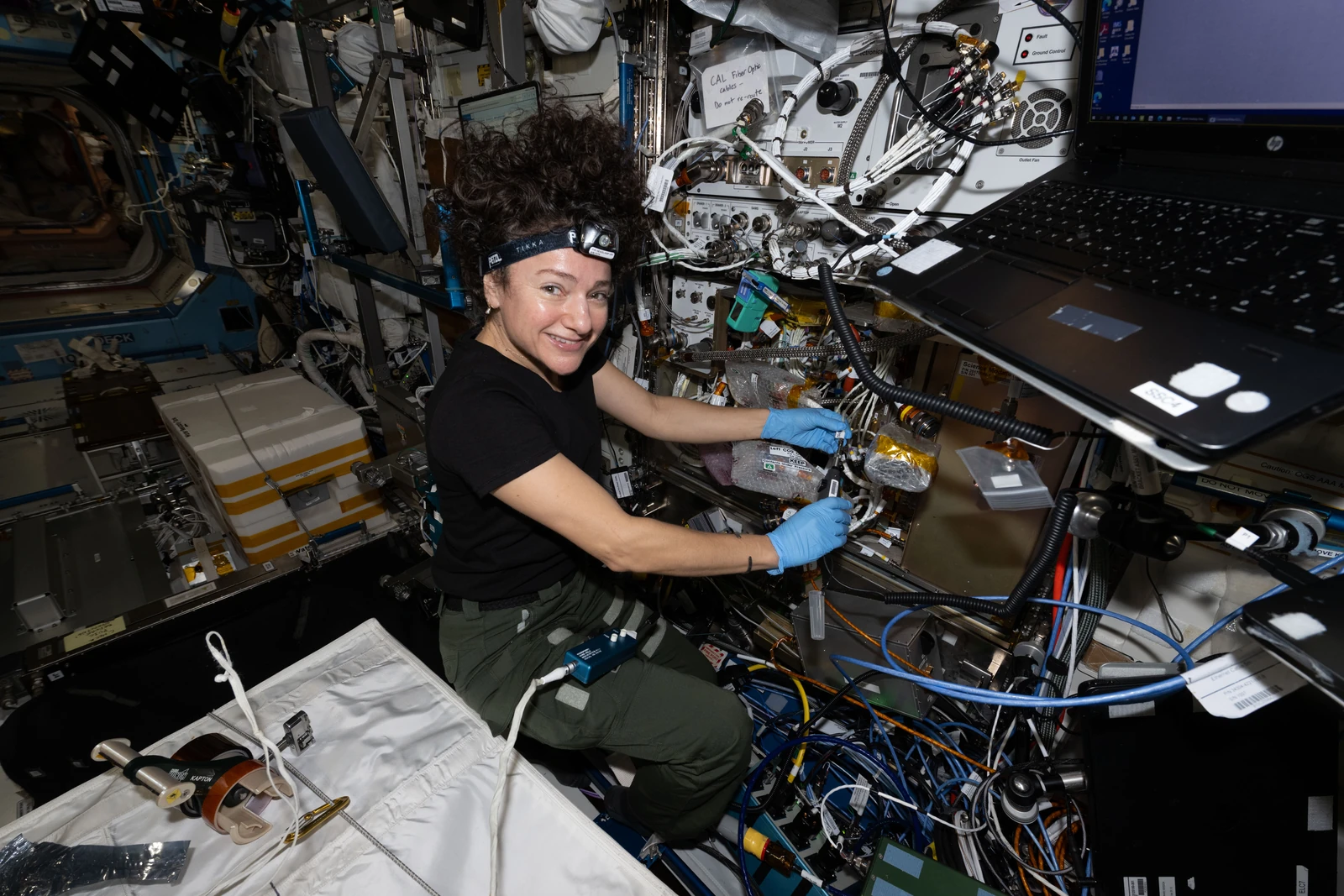
The hardware work is the story here. NASA identifies Jessica Meir as inspecting optical fibers while updating the Cold Atom Lab aboard the International Space Station in May 2026. The picture lets a newcomer connect an abstract quantum experiment with practical maintenance in an unusually constrained workplace. Cold Atom Lab studies ultracold atoms; it should not be relabeled as an operating general-purpose quantum computer. A companion explanation can ask why the experiment uses the space environment and how remote operation depends on physical hardware remaining serviceable. Keep the NASA credit and the specific date attached when the image accompanies later coverage.
NASA — Astronaut Jessica Meir Assists With Hardware Updates for NASA’s Cold Atom Lab (PIA26725).jpg — Public domain — https://commons.wikimedia.org/wiki/File:Astronaut_Jessica_Meir_Assists_With_Hardware_Updates_for_NASA%E2%80%99s_Cold_Atom_Lab_(PIA26725).jpg — https://commons.wikimedia.org/wiki/File:Astronaut_Jessica_Meir_Assists_With_Hardware_Updates_for_NASA%E2%80%99s_Cold_Atom_Lab_(PIA26725).jpg#Licensing.Full original frame retained; EXIF orientation normalized where present, resized without enlargement and converted to WebP. No crop or content alteration.
The most useful detail in this photograph is a pair of blue gloves. Astronaut Jessica Meir is leaning into equipment aboard the International Space Station, attending to the connections around NASA’s Cold Atom Lab. The picture was taken on May 8, 2026. Its subject is a maintenance task: the patient handling of hardware that allows an experiment to keep working far from its designers.[1]
That makes it a revealing image of quantum science. The atoms being studied are not the conspicuous objects in the frame. Cables, hoses, access panels and a person’s hands occupy the space around them.
The photograph gives an otherwise abstract field a physical location, and the location comes with a practical question. How do researchers improve an instrument that they cannot simply wheel back into their workshop?
NASA’s station reports supply part of the answer. On April 28, Meir and Jack Hathaway installed a new quantum-physics module. The following day’s report described preparation for connecting delicate optical fibers. A May 8 entry recorded inspection of water hoses and fiber cables. These are separate dated steps, not interchangeable descriptions of a single moment. Together they show an upgrade moving through installation, connection and checking.[2][3][4]
In June, NASA reported that the upgraded laboratory had been switched on. The new science module included a redesigned magnetic trap and changes to the metal sources used to create atom clouds. The facility cools and manipulates atoms, allowing researchers to investigate matter under conditions where its quantum behavior becomes especially accessible. Microgravity gives those experiments longer opportunities to study freely evolving ultracold clouds than the same geometry would offer on the ground.[5]
Think of the module as an experimental environment with several jobs that must agree. Light must reach the intended place. Fields must follow a controlled sequence. Heat must be managed. Information must travel between the instrument and the people running it. A useful scientific measurement emerges when those jobs work together. Replacing one component therefore involves more than demonstrating that the replacement fits into a slot.
The photograph also changes how we should picture remote operation. A remotely controlled experiment can still depend on human work at the instrument. Software commands cannot cleanly stand in for every connector inspection or physical intervention. Designers have to anticipate which parts might need replacement, what the crew can reach and how a procedure can communicate a task precisely enough to carry it out.
Follow the connections between the ground team, station crew and instrument, then return to the hands. Each part of that relationship explains a different scale of responsibility. The ground team develops and operates the experiment; the station crew can carry out the physical intervention that keeps it accessible. The science depends on microscopic states, but its continuity depends on a maintainable system. That is the achievement this particular image makes visible: an experiment designed to receive another careful day of work.[1][2][3][4][5]
Who keeps the orbital experiment working?
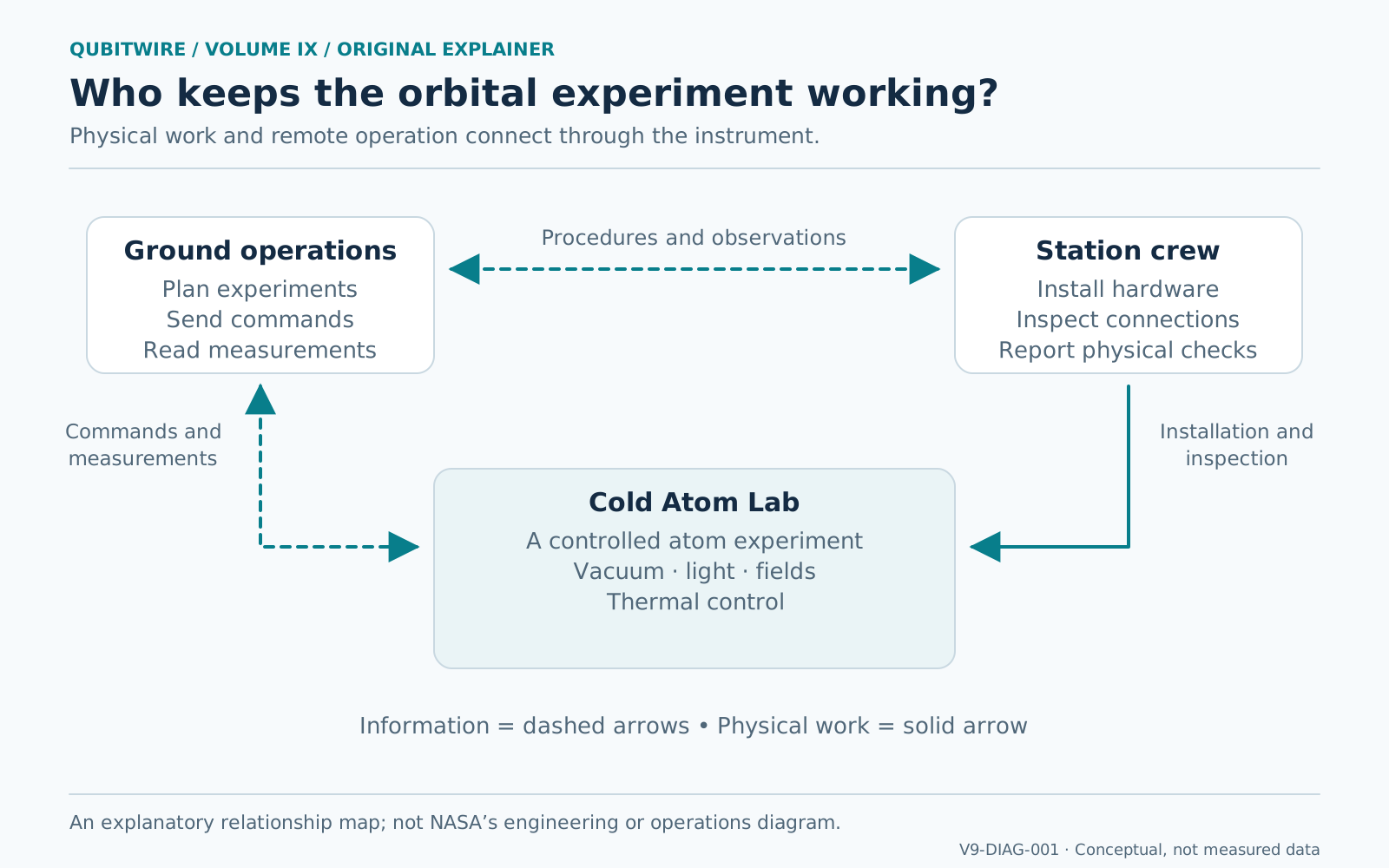
Ground operations exchanges commands and measurements with Cold Atom Lab. The station crew installs and inspects hardware at the instrument, using procedures coordinated with the ground team. The instrument depends on vacuum, light, fields and thermal control. Arrows distinguish information from physical work.
Conceptual explanation; not an apparatus construction drawing or a measured result. Original QubitWire explanatory diagram.
Sources and further reading
- Astronaut Jessica Meir Assists With Hardware Updates for NASA’s Cold Atom Lab ↗NASA
Photograph identity, NASA credit and May 8, 2026 capture date.
- Crew Opens Cargo Craft, Works on Physics Gear and Biomedical Tech ↗NASA
April 28 installation of the new quantum-physics module.
- Quantum Physics, Biomedicine, and Computer Gear Fill Wednesday’s Schedule ↗NASA
April 29 preparation for fiber connections.
- DNA-Inspired Cancer Research, Vision, Heart, and Psychology Tests Wrap Up Week ↗NASA
May 8 hose and optical-fiber inspection.
- NASA’s Quantum Lab Aboard Space Station Gets Chilly Upgrade ↗NASA/JPL
June 16 upgrade report, redesigned trap/source hardware and microgravity purpose.