
Quantum in pictures
From an open enclosure to a submitted experiment at Euro-Q-Exa
A January photo sequence and LRZ’s account of early users connect the machine people can see with the experiments they actually run.
Research context: October 19, 2026 · Source review: October 20, 2026
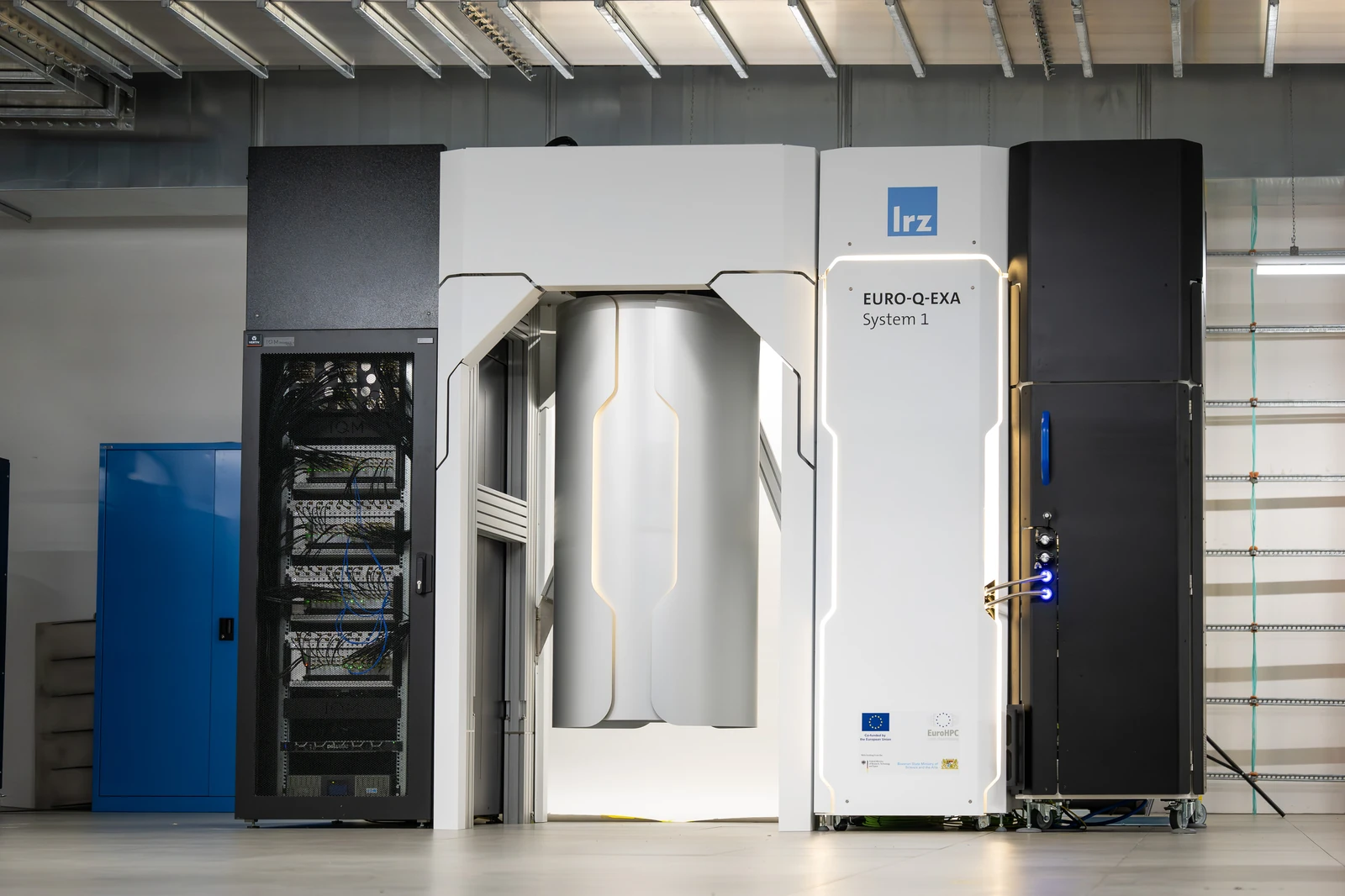
With the enclosure closed, the installation looks more like an integrated computing resource than the exposed apparatus familiar from promotional images. That contrast is useful when discussing the work required to place quantum equipment inside a computing center. The photograph shows physical organization, while availability, maintenance arrangements and workload access remain separate questions. Use the original Euro-Q-Exa identity and January 2026 date rather than treating the picture as generic evidence for any European quantum announcement. A reader should leave understanding why a recognizable cabinet is only the visible boundary of a larger operational system.
© European Union, 2026 / photo: Sebastian Widmann — Quantum computer, Germany (17).jpg — CC BY 4.0 — https://commons.wikimedia.org/wiki/File:Quantum_computer,_Germany_(17).jpg — https://creativecommons.org/licenses/by/4.0.Full original frame retained; EXIF orientation normalized where present, resized without enlargement and converted to WebP. No crop or content alteration.
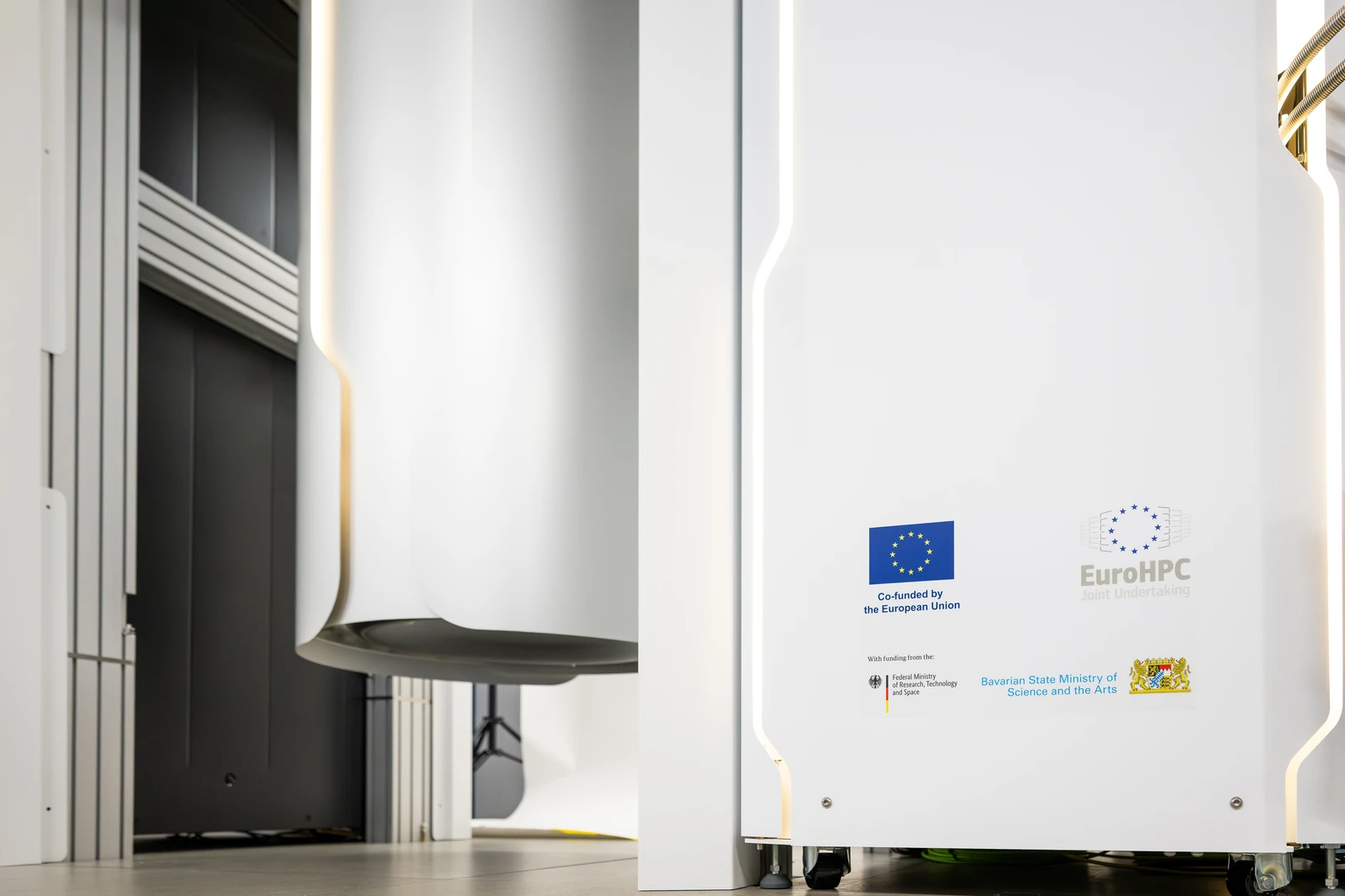
An enclosure is easy to crop away when the goal is a dramatic image. Keeping it visible creates a more useful question: what does the outside of a system need to do for the people and equipment around it? This photograph documents the outer form and the institutional context of Euro-Q-Exa, without showing the processor inside. It works well beside an installation-wide view and a clearly labeled generic section diagram. Do not use the exterior to infer qubit count or thermal performance. Its contribution is to make physical integration and the boundaries of the photographed evidence visible to the reader.
© European Union, 2026 / photo: Sebastian Widmann — Quantum computer, Germany (18).jpg — CC BY 4.0 — https://commons.wikimedia.org/wiki/File:Quantum_computer,_Germany_(18).jpg — https://creativecommons.org/licenses/by/4.0.Full original frame retained; EXIF orientation normalized where present, resized without enlargement and converted to WebP. No crop or content alteration.
The door is open, and two people in white coats stand beside the equipment. This January 15, 2026 photograph of Euro-Q-Exa at the Leibniz Supercomputing Centre gives the viewer access to a side of quantum computing that a processor specification rarely describes. An instrument has to occupy a room, provide access to its components and fit into the routines of the people responsible for it.[1]
The next photograph closes the enclosure. The contrast is useful because neither view is the whole system story. The open view explains physical access; the closed view shows the installed equipment as a user of the facility might recognize it. A closer photograph of the exterior adds institutional context. Together they document an installation at one point in its history, before the later expansion announcements that should be reported with their own dates.[1][2][3]
LRZ’s June account supplies another view, this time from the people submitting experiments. It described an early group of researchers testing workflows, benchmarks, error mitigation and hybrid methods. In one example, mathematician Hedwig Keller ran previously simulated quantum models using two or six qubits over several days, comparing different physical qubits and trying parallel execution. Daily recalibration and differences in hardware quality were part of the experimental setting.[4]
That small-scale example is a particularly good companion to a large equipment photograph. The size of the installed system does not dictate that every useful test must occupy all of it. A researcher may deliberately begin with a compact model to learn how a method behaves, compare results with a simulator and investigate which parts of a workflow are sensitive to the machine’s conditions.
A submitted program also passes through more than one kind of work. The researcher defines the model and its observable outputs. Software expresses the circuit in an accepted form. The system executes repeated preparations and measurements.
Classical analysis then turns the returned data into a comparison. If a result changes, the next question is where in that chain the change arose. A photograph of an enclosure cannot answer it, but the photograph can locate the physical stage of the chain.
This is why a gallery sequence should pair the room with a workflow diagram. The machine view establishes that the quantum resource is an operated instrument. The diagram establishes that a scientific result includes model design, classical computation, repeated measurements and interpretation. Neither should suggest that the presence of a quantum processor has already improved a full climate model or delivered an application advantage.
The photographs and the user report belong to different dates, and that distinction helps the story. January records an installation. June records some experiences of working with it. Progress becomes more concrete when it is described as the movement from equipment to reproducible use: people learn which experiments to submit, how to compare outcomes and what to change next. Those are meaningful steps even when the experiment itself occupies only a small part of the available device.[1][2][3][4]
Where the experiment travels
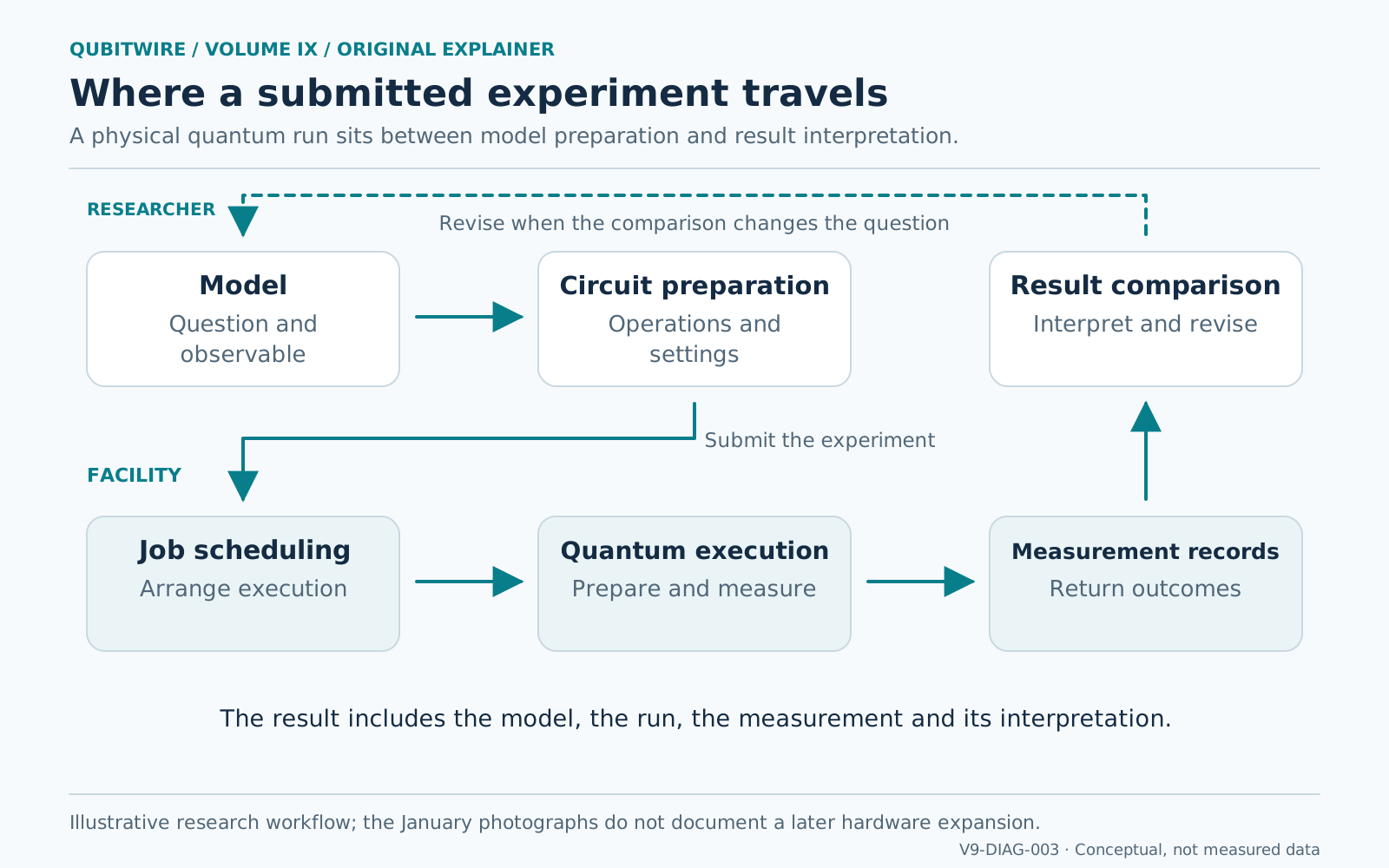
The researcher defines a model and prepares a circuit. Facility scheduling sends the job to quantum execution, which produces measurement records. The researcher compares the result and may revise the model. This is a conceptual workflow, not an exact diagram of LRZ software.
Conceptual explanation; not an apparatus construction drawing or a measured result. Original QubitWire explanatory diagram.
Sources and further reading
- Quantum computer, Germany (15) ↗European Union / Sebastian Widmann
January 15, 2026 Euro-Q-Exa service-access photograph, CC BY 4.0.
- Quantum computer, Germany (17) ↗European Union / Sebastian Widmann
Closed equipment view from the same dated photo set.
- Quantum computer, Germany (18) ↗European Union / Sebastian Widmann
Exterior context view from the same set.
- Euro-Q-Exa in the Experimental Phase ↗Leibniz Supercomputing Centre
June 15, 2026 report of user experiments, two/six-qubit models, calibration and workflow experience.