
QubitWire · Illustrated field guide
Inside a quantum computer
Find the chip, follow an instruction and see how a measurement becomes a record. Six illustrated chapters explain one superconducting design. The hardware reference goes deeper into each part.
Inside the machine in six chapters
01 / 06 · Find the chip
Where is the quantum computer?
Most of what you see keeps a tiny chip ready to work. The qubit circuits live on the chip, inside a package at the bottom of the refrigerator.
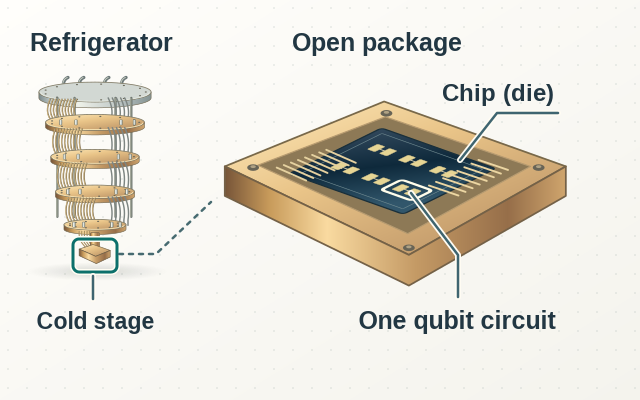
- Whole system
- The rack creates and records electrical signals. The refrigerator provides a cold, shielded home for the processor.
- Processor package
- The package holds the chip and routes electrical connections between the chip and its surroundings.
- Quantum chip
- Tiny patterned circuits on the chip act as qubits. This close-up enlarges the parts to show how they fit together.
Find the small die inside its package and see how it connects to the larger machine.
02 / 06 · Keep it cold
Why is the refrigerator so large?
Heat can disturb the qubits. Cold stages draw heat out along the wiring. The vacuum reduces heat transfer through gas, while nested shields intercept radiation from warmer surfaces.
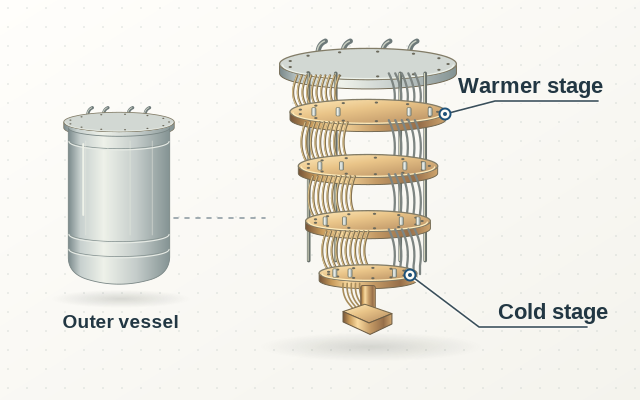
- Enclosure and vacuum
- The outer vessel surrounds a vacuum. With very little gas inside, much less heat can reach the cold parts through air.
- Cooling stages
- The metal stages become progressively colder toward the chip. A dilution refrigerator uses a mixture of helium isotopes for its coldest stage.
- Cold wiring
- Cables must carry useful signals without bringing too much heat or electrical noise down to the chip.
Compare the cold stage with the nearby package: the stage supports the environment; the chip carries the circuits.
03 / 06 · Send an instruction
How does an instruction reach the chip?
Electronics turn a program instruction into a carefully shaped electrical pulse. A control line carries the pulse from the rack down to the chip.
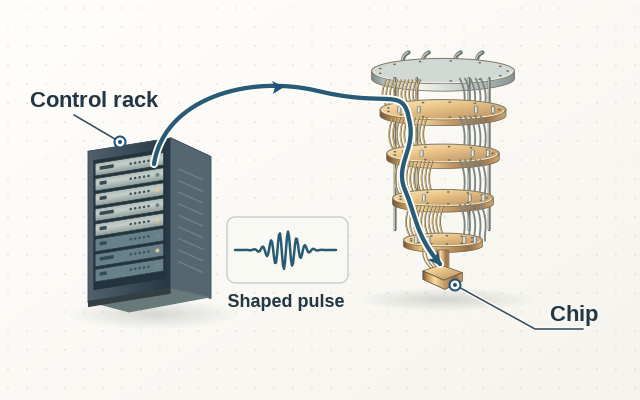
- Program
- A classical computer translates a circuit into operations the available device can perform.
- Signal conditioning
- Filters and attenuators help set the signal level and limit unwanted noise along the line.
- Pulse route
- A calibrated pulse can drive a chosen circuit operation. The drawing follows one representative route through a more complex wiring system.
Change the derivative weight and watch the waveform change. This teaching activity does not calculate gate fidelity.
04 / 06 · Change a quantum state
What changes when the pulse arrives?
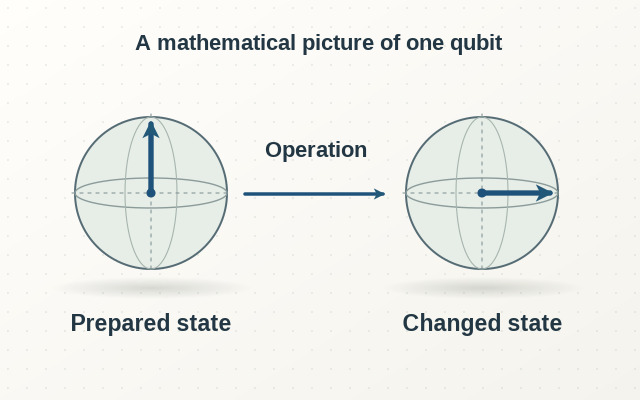
A pulse can change the quantum state of a circuit. That state helps predict what later operations and measurements will produce.
- Physical circuit
- In this design, a superconducting circuit has distinct energy levels. Two chosen levels form the qubit used in the model.
- Coupled qubits
- Operations can link the states of two qubits. Their joint state can carry correlations that individual descriptions miss.
- Mathematical picture
- A state diagram is a picture of a calculation. A single measurement cannot reveal the complete state, and matched outcomes alone do not establish entanglement.
Predict the next measurement. Prepare a qubit in 0. An ideal 90° rotation about the Y axis gives a 50% chance of measuring 1. A 180° rotation gives a 100% chance. These predictions use the 0/1 measurement basis.
Change the prepared state, then compare the physical interaction with the record collected by the receiver.
05 / 06 · Read a result
How does the answer get back out?
The readout circuit responds differently depending on the qubit’s state. Electronics amplify and digitize that signal so a computer can interpret it as a 0 or 1.
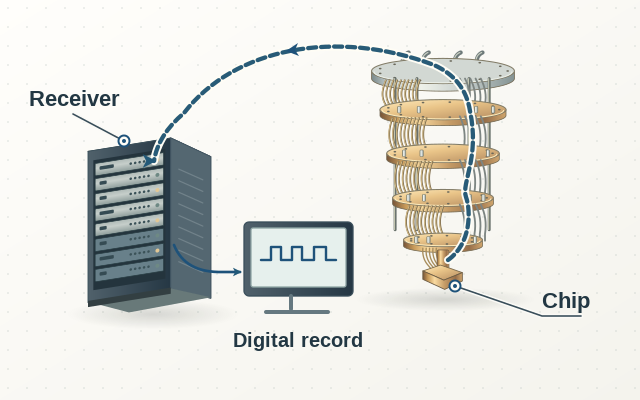
- Readout circuit
- A superconducting qubit can slightly change the response of a nearby resonator. A probe helps make that difference observable.
- Return electronics
- The weak response travels through a chain of amplification and processing before a receiver digitizes it.
- Result record
- A classifier assigns a result to a response. Readout can make mistakes, and a single run gives only one record of the chosen measurement.
Collect a batch. With that 90° rotation, prepare and measure a fresh qubit 100 times. One possible simulated batch gives 53 zeros and 47 ones. Each independent trial still has the same 50% probability of a 1.
Change collection efficiency and see why the usable record can change while physical backaction stays the same.
06 / 06 · See what it is for
What can researchers do with these results?
Individual bits can answer a bigger question. Start with the batch from the previous chapter and see how its average compares with the prediction.
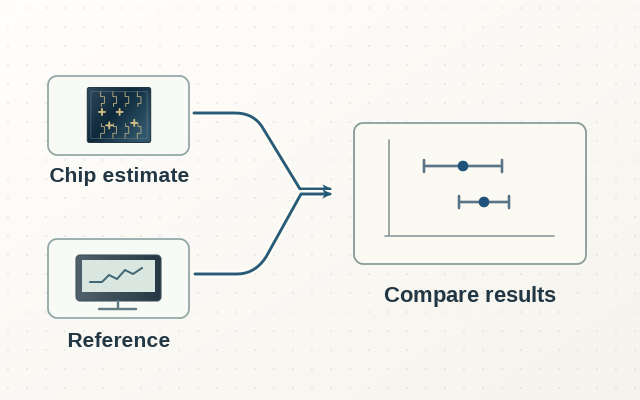
- Errors
- Imperfect controls, unwanted interactions and readout mistakes can affect an estimate. A larger experiment can demand more accuracy.
- Other machines
- Trapped ions and neutral atoms also serve as qubits. Their hardware and control methods differ from this superconducting example.
- What you have seen
- The chip holds the qubits. The surrounding machine protects and controls them. A classical computer turns the measurements into data researchers can use.
Use the records. Score each 0 as +1 and each 1 as −1. In the worked example the average is (53 − 47) ÷ 100 = +0.06. The exact average from the ideal probabilities is 0. This dimensionless quantity, called Z, illustrates how researchers can estimate one term of an energy model.
From a molecule to an energy estimate
- Ask a question
Estimate the lowest energy of a chosen model of a hydrogen molecule.
- Define the model
Choose a nuclear geometry and a basis for the electronic states; express the energy operator in terms of qubits.
- Prepare and measure
Prepare a trial state with an adjustable circuit. Repeat suitable measurements to estimate the terms in the energy operator.
- Build the estimate
Combine those averages with the model’s coefficients. A classical optimizer changes the circuit parameters and repeats the process.
- Check the uncertainty
More samples can reduce statistical variation. They do not automatically remove hardware bias, model approximations or an optimizer’s error.
- Compare fairly
Use a classical reference for the same model and accuracy. Count preparation, optimization, measurements and postprocessing in the total work.
This small molecule is a teaching example. The illustrated machine has not run this calculation, and the example does not establish a quantum advantage.
Read the source walkthrough of preparation, repeated measurements and classical optimization for a small molecule.
Hardware reference
A closer look at the parts
Open a named hardware stop to see what a component does, what connects to it and which details the illustration leaves out.
Meet the machine
Where is the processor inside the machine?
The processor is a small chip inside a package near the bottom of this machine. Most of the surrounding structure protects it, keeps it cold, delivers instructions or helps read results. Follow those four jobs from the room to the chip.
Takeaway Look for the small processor, then ask what supports it.
- What it is
- An installation combines a refrigerator, its supporting structure and classical electronics around a small processor.
- Why it matters
- A useful quantum circuit depends on a carefully controlled environment as well as the chip itself.
- How it connects
- The package joins the lowest cooling stage to control and readout connections from the electronics racks.
- Clear up a misconception
- The entire chandelier is not a single giant qubit.
- What this model can show
- This is one representative superconducting design. The installation is not a manufacturer-certified digital twin.
Sources for this stop
Explore “Find the chip” in the model
Back to this stop in the indexWhat does the classical equipment do?
Ordinary electronics remain essential. The room-temperature rack prepares control signals and receives measurement data through different connections. Follow one module and its cable toward the cold assembly: the quantum processor works with the classical equipment, rather than replacing it.
Takeaway Classical equipment and the quantum processor work together.
- What it is
- The rack contains classical equipment for preparing signals and collecting measurement records.
- Why it matters
- Quantum operations need controlled physical inputs, while results must become data that ordinary computers can analyse.
- How it connects
- Control paths run toward the processor; readout paths return through amplification to acquisition equipment.
- Clear up a misconception
- Rack modules are not additional cold qubits.
- What this model can show
- Module placement and cable routes are representative. No operating frequency, waveform or instrument performance is simulated.
Sources for this stop
Explore “Send an instruction” in the model
Back to this stop in the indexMake a quiet space
What does the vacuum vessel do?
The outer vessel helps maintain a vacuum around the cold assembly. An educational cut reveals the hardware inside, rather than demonstrating a physical removal path. Its walls, seals and connections form a boundary; this opened view is not an operating refrigerator.
Takeaway The vessel maintains a low-gas environment; refrigeration and thermal shields perform different jobs.
- What it is
- A vacuum vessel surrounds the cold assembly and separates its internal environment from room air.
- Why it matters
- Reducing gas inside limits heat transfer through the gas. The refrigeration system, rather than the vacuum itself, provides cooling.
- How it connects
- Seals close the vessel, while feedthroughs allow connections through its boundary.
- Clear up a misconception
- Vacuum is not the cooling mechanism and an open vessel is not operating.
- What this model can show
- Outer-vessel placement changes in an educational cut; it does not demonstrate a physical removal path. This is not a laboratory maintenance or operating procedure.
Sources for this stop
Explore “Keep it cold” in the model
Back to this stop in the indexWhy are there nested thermal shields?
Nested shields surround different temperature stages. Their job differs from the outer vacuum vessel: thermal shielding reduces heat reaching colder regions. Look at the openings and supports between layers. They allow connections through a protected assembly rather than through one empty cold box.
Takeaway The nested structure organizes protection and thermal relationships.
- What it is
- Nested thermal shields surround portions of the staged refrigerator.
- Why it matters
- Radiative heat must be managed before it reaches the coldest regions.
- How it connects
- Each shield relates to a temperature stage, with openings and supports that accommodate other hardware.
- Clear up a misconception
- A radiation shield is not automatically magnetic shielding.
- What this model can show
- Shield geometry and separation distances are representative. Magnetic and thermal protection have different functions.
Sources for this stop
Explore “Keep it cold” in the model
Back to this stop in the indexCreate the cold
Why does cooling happen in stages?
The whole machine is not equally cold. Upper stages intercept heat before connections reach colder stages below. Follow the plates, supports and cable anchors through that sequence. Temperature labels are nominal values for this exhibit, not readings from operating equipment.
Takeaway Different stages have different supporting thermal roles.
- What it is
- Several cooling stages manage heat at different temperatures.
- Why it matters
- Removing heat in stages reduces the burden on the lowest-temperature region.
- How it connects
- Supports and signal lines cross stage boundaries; thermal anchors couple connections to appropriate stages.
- Clear up a misconception
- The pulse tube alone does not produce the lowest dilution temperature.
- What this model can show
- The displayed temperatures are illustrative reference values. Stage temperature alone does not describe every noise source seen by a qubit; nearby labels do not measure every cable or component.
Sources for this stop
Explore “Keep it cold” in the model
Back to this stop in the indexHow does dilution refrigeration help?
The lowest temperatures use a dilution refrigerator, which relies on a mixture of helium isotopes. Its circulation and heat-exchange hardware has a different job from the electrical cables. This view shows how the supporting parts relate; it does not simulate flowing helium.
Takeaway The dilution assembly is a distinct cooling system, not another signal cable.
- What it is
- The dilution assembly includes circulation and heat-exchange hardware for the deepest cooling.
- Why it matters
- The processor environment requires cooling beyond the upper stages of this representative system.
- How it connects
- The dilution system connects its circulation and heat-exchange components to the lowest stage.
- Clear up a misconception
- Helium circulation is not the electrical control route.
- What this model can show
- This model does not calculate fluid flow, cooling power or operating pressures, and is not an operating procedure.
Sources for this stop
Explore “Keep it cold” in the model
Back to this stop in the indexHow does the cold stage support the package?
The lowest represented stage is nominally 20 mK. The processor package is mounted near it, but the stage is not the chip. Cooling works together with shielding, mounting and carefully managed connections. Opening the assembly here shows those relationships, not a running cold system.
Takeaway The stage supports an environment; the package contains the processor.
- What it is
- The mixing-chamber stage is the lowest represented cooling stage, with the processor package nearby.
- Why it matters
- The package needs a cold, supported and protected environment.
- How it connects
- Mounting and thermal connections link the package to its surroundings; electrical connections carry control and readout signals.
- Clear up a misconception
- The lowest cooling stage is not the chip, and a nominal temperature label is not a live measurement.
- What this model can show
- 20 mK is this model’s nominal reference value, not a measured base temperature or an operational guarantee.
Sources for this stop
Explore “Keep it cold” in the model
Back to this stop in the indexConnect and protect
How do cables connect the machine?
Follow one electrical connection into the cold assembly. Its connector, bends and thermal anchors define a physical route as well as a signal path. Cable count is not a count of quantum bits, or qubits. A qubit does not travel through the cable.
Takeaway Cable routes connect electrical purpose with physical construction.
- What it is
- A cable connects components along a supported physical route.
- Why it matters
- Cables carry heat as well as signals, so their attachments matter.
- How it connects
- Connectors join components; thermal anchors couple portions of the cable to stages along the route.
- Clear up a misconception
- A qubit is not a glowing particle traveling down a wire.
- What this model can show
- Highlighted paths explain connectivity. They do not display measured waveforms, propagation speed or moving qubits.
Sources for this stop
Explore “Send an instruction” in the model
Back to this stop in the indexWhat do filters and attenuators change?
The input path includes more than wire. Attenuators reduce signal power, while filters affect which frequency components pass. Their roles differ, and their arrangement depends on the system. Compare the two components along this representative connection before continuing toward the processor.
Takeaway Different components along the path serve different conditioning roles.
- What it is
- Attenuators and filters are signal-conditioning components with distinct roles.
- Why it matters
- The signal environment at sensitive hardware depends on the entire connection chain.
- How it connects
- Each component sits along a representative input signal path.
- Clear up a misconception
- Signal conditioning does not remove every source of error from a quantum computation.
- What this model can show
- The exhibit does not assign measured attenuation, filter response, noise temperature or experimental performance to the rendered hardware.
Sources for this stop
Explore “Send an instruction” in the model
Back to this stop in the indexWhat else protects the processor?
Not every disturbance arrives through a cable. Supports and mechanical isolation help manage motion; thermal and magnetic shields address different environmental effects. Inspect these separate roles around the package. No single shield or cold stage makes a quantum state immune to errors.
Takeaway Mechanical support and shielding have distinct protective roles.
- What it is
- Supports, mechanical isolation and shielding serve different environmental and structural roles.
- Why it matters
- A sensitive circuit needs more than a low temperature.
- How it connects
- The support structure carries hardware while shielding boundaries surround protected regions.
- Clear up a misconception
- Shielding does not eliminate all decoherence.
- What this model can show
- The geometry does not establish vibration rejection, magnetic shielding effectiveness or an error rate.
Sources for this stop
Explore “See what it is for” in the model
Back to this stop in the indexInside the processor
What is inside the processor package?
The processor package holds a carrier, a small die and fine wire bonds. Watch the fastening group release before the lid lifts clear. The carrier supports the die; the surrounding connections link it to the rest of the machine. Keeping the cavity in view makes the scale easier to understand.
Takeaway The package, carrier, die and connections form a real physical hierarchy.
- What it is
- The package is the physical assembly around the processor die.
- Why it matters
- A chip must be packaged, connected and tested as part of a complete system. A promising component and a dependable machine are different achievements.
- How it connects
- The die sits on a carrier; fine bonds connect it to surrounding package features and signal connections.
- Clear up a misconception
- Bond removal is not ordinary reversible mechanical disassembly.
- What this model can show
- The internals are original representative geometry, not a fabrication specification or a manufacturer’s certified package.
Sources for this stop
Explore “Find the chip” in the model
Back to this stop in the indexHow does the chip connect to its circuit diagram?
Physical zoom has a limit. We now use a labelled conceptual view to explain 25 representative transmon sites and their connections. The enlarged circuit is not a microscope image. It helps connect the small device in the package to the quantum-information ideas it represents.
Takeaway The enlarged layout explains circuit relationships; it is not a microscope image or a fabrication plan.
- What it is
- The enlarged chip view is a conceptual layout of representative superconducting circuit features.
- Why it matters
- These relationships are too small to explain through the package geometry alone.
- How it connects
- Sites, readout resonators and coupling relationships belong to one circuit, rather than being loose mechanical parts.
- Clear up a misconception
- Integrated chip features do not join the detachable-part count.
- What this model can show
- The 25-site layout is authored for education. Its physical sites do not demonstrate encoded logical qubits, error correction or a fault-tolerant computation.
Sources for this stop
Explore “Change a quantum state” in the model
Back to this stop in the indexHow does a signal become an operation?
A qubit is controlled through carefully prepared physical signals. In this conceptual view a control path connects to a circuit element. An operation changes the quantum state; it is not simply a tiny ordinary switch turning on or off. The equipment and experiment determine the details.
Takeaway Control links physical signals to intended quantum operations.
- What it is
- A control operation is a prepared physical interaction with the circuit.
- Why it matters
- Calibration, timing and pulse shape determine whether the signal reaching the device matches the intended operation.
- How it connects
- Classical electronics prepare signals that reach the circuit through the conditioned input path.
- Clear up a misconception
- A qubit is not simply a faster classical bit.
- What this model can show
- This conceptual relationship is not a calibrated pulse, executed gate or measured fidelity.
Sources for this stop
Explore “Send an instruction” in the model
Back to this stop in the indexHow do states, operations and measurements relate?
A qubit can have a superposition state, but measurement still produces an outcome. Quantum operations and interference must be arranged carefully; useful quantum computing does not mean reading every possible answer at once. Connections between circuit elements introduce relationships, including quantum correlations.
Takeaway Quantum operations and measurement need an explanation beyond classical on/off intuition.
- What it is
- Quantum states, operations and measurement describe what the circuit is intended to support.
- Why it matters
- These ideas explain why a quantum circuit differs from a collection of classical switches.
- How it connects
- Circuit relationships support interactions between elements; measurement connects the experiment back to classical outcomes.
- Clear up a misconception
- No faster-than-light communication or universal speedup is implied.
- What this model can show
- No algorithm, state evolution, entanglement result or computational speedup is being simulated by this scene.
Sources for this stop
Explore “Change a quantum state” in the model
Back to this stop in the indexRead and reconnect
How does readout produce a record?
Readout has its own chain. A response from the circuit passes through components that help make the weak signal usable, then reaches classical acquisition equipment. Follow this representative output path back toward the rack. The highlighted connection is an explanation, not experimental data.
Takeaway Readout connects the processor context to interpretable measurement data.
- What it is
- Readout converts a circuit response into classical measurement records.
- Why it matters
- An experiment needs interpretable outcomes. Amplification improves detectability; a stronger signal alone does not establish a more reliable answer.
- How it connects
- The represented chain connects the package through readout components and amplifiers to acquisition electronics.
- Clear up a misconception
- Amplification is not cloning an unknown quantum state.
- What this model can show
- The highlighted path is not a live signal, and amplifier gain or measurement accuracy is not simulated.
Sources for this stop
Explore “Read a result” in the model
Back to this stop in the indexWhat makes a measurement useful evidence?
One measurement does not reveal a complete quantum state. Experiments use repeated observations, calibration and an account of uncertainty to interpret results. To evaluate a real device, compare repeated measurements and their uncertainty with the claimed task and operating conditions.
Takeaway Distinguish an educational model from measurements of a real device.
- What it is
- Measurement records become scientific evidence through experimental context and analysis.
- Why it matters
- A single outcome cannot tell you everything about a quantum state or a processor’s performance.
- How it connects
- Acquisition hardware supplies classical records for repeated experiments and analysis.
- Clear up a misconception
- A smooth animation is not experimental evidence.
- What this model can show
- This exhibit contains no live measurements, benchmark results, calibrated error rates or evidence of quantum advantage.
Sources for this stop
Explore “Read a result” in the model
Back to this stop in the indexHow do the supporting systems fit together?
Watch the inspection layers return around the small package. Protection, cooling, control and readout belong to one system, but each has a different role. The metal structure should now be easier to read. This restores the educational assembly; it is not a laboratory startup sequence.
Takeaway Cooling, protection, control and readout have distinct roles around the small processor.
- What it is
- The complete installation brings the inspected subsystems back into context.
- Why it matters
- Understanding relationships is more useful than memorising a list of parts.
- How it connects
- The package, stages, protective layers and classical equipment form a coordinated supporting system.
- Clear up a misconception
- Restoring this educational model does not demonstrate a laboratory startup or cooldown.
- What this model can show
- Reassembly returns the illustrated parts to their starting positions. It does not represent laboratory startup, cooldown or servicing.
Sources for this stop
Explore “See what it is for” in the model
Back to this stop in the indexHow do the four supporting jobs work together?
A small processor depends on cooling, protection, control and readout. The cooling stages manage heat; shields limit disturbances; control paths carry instructions; the readout chain produces classical records. Inspect any relationship again or use the sources to continue reading.
Takeaway Follow a connection from the processor to the cooling, protection, control or readout system that supports it.
- What it is
- You have followed a representative superconducting installation from room scale to circuit scale.
- Why it matters
- The next step is to explain one relationship in your own words and inspect the part that supports it.
- How it connects
- A small quantum circuit depends on cooling, protection, control and a route back to classical measurement.
- Clear up a misconception
- Tour completion is not proof of understanding.
- What this model can show
- Other quantum-computing approaches use different hardware; this exhibit does not represent every architecture.
Sources for this stop
Explore “See what it is for” in the model
Back to this stop in the index