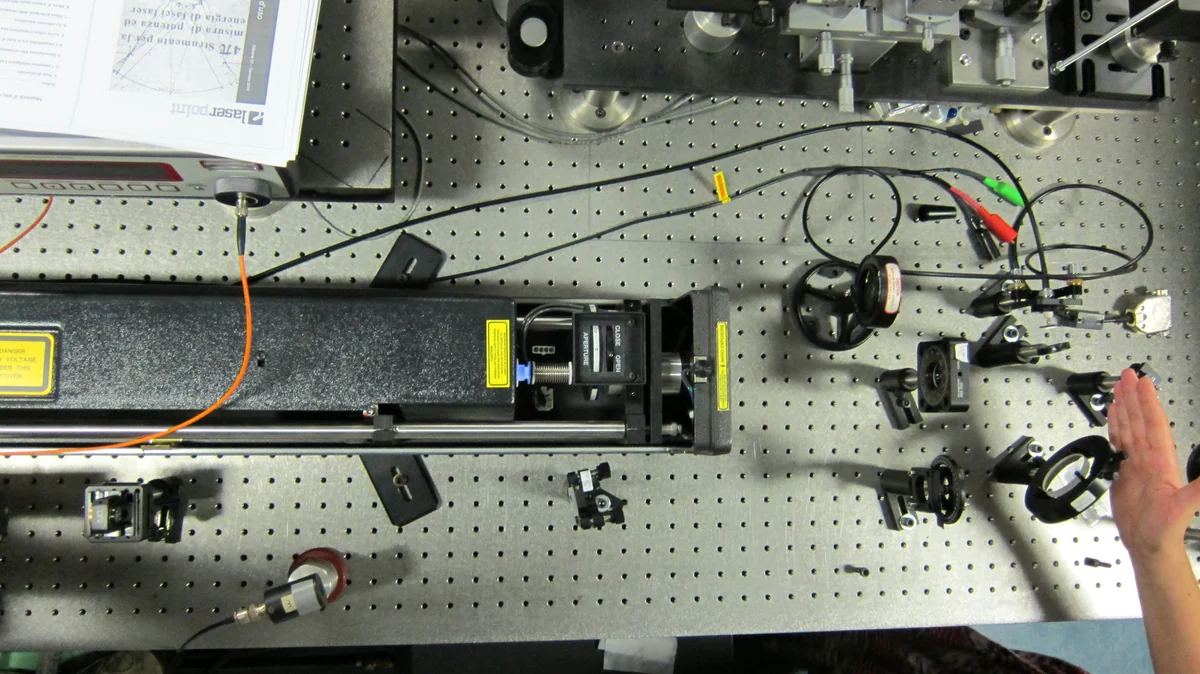
An archival overhead photograph of an optical table. Frequency-conversion context; not the apparatus used for the paper’s 393-nanometer experiment.Image: Optical table - Up view · Giorgio Brida · CC BY 2.0Full image credit
An experimental frequency converter provides a route between ultraviolet photons and the telecom wavelengths used for low-loss fiber transmission.[1]
Yi Yang and colleagues report single-stage conversion from 393 nanometers to the telecom C band in a Physical Review Letters paper published October 13.[1]
The device reaches a reported external conversion efficiency of 28.8 percent with a noise rate of 35 counts per second. Its design uses thin-film lithium-niobate waveguides.[1]
The researchers analyze how imperfections in the crystal's patterned domains affect conversion and exploit different tuning behavior in the desired conversion and unwanted noise processes.[1]
The result concerns a component that could help connect physical quantum systems operating at different wavelengths. It does not itself demonstrate a complete quantum network or long-distance between deployed nodes.[1]