
Quantum computers need to talk. A diamond memory may help them wait.
An experimental ion-to-diamond link reports 1.03(1) kHz entanglement at 87.9(7)% fidelity. Its next test is what connected devices can reliably do together.
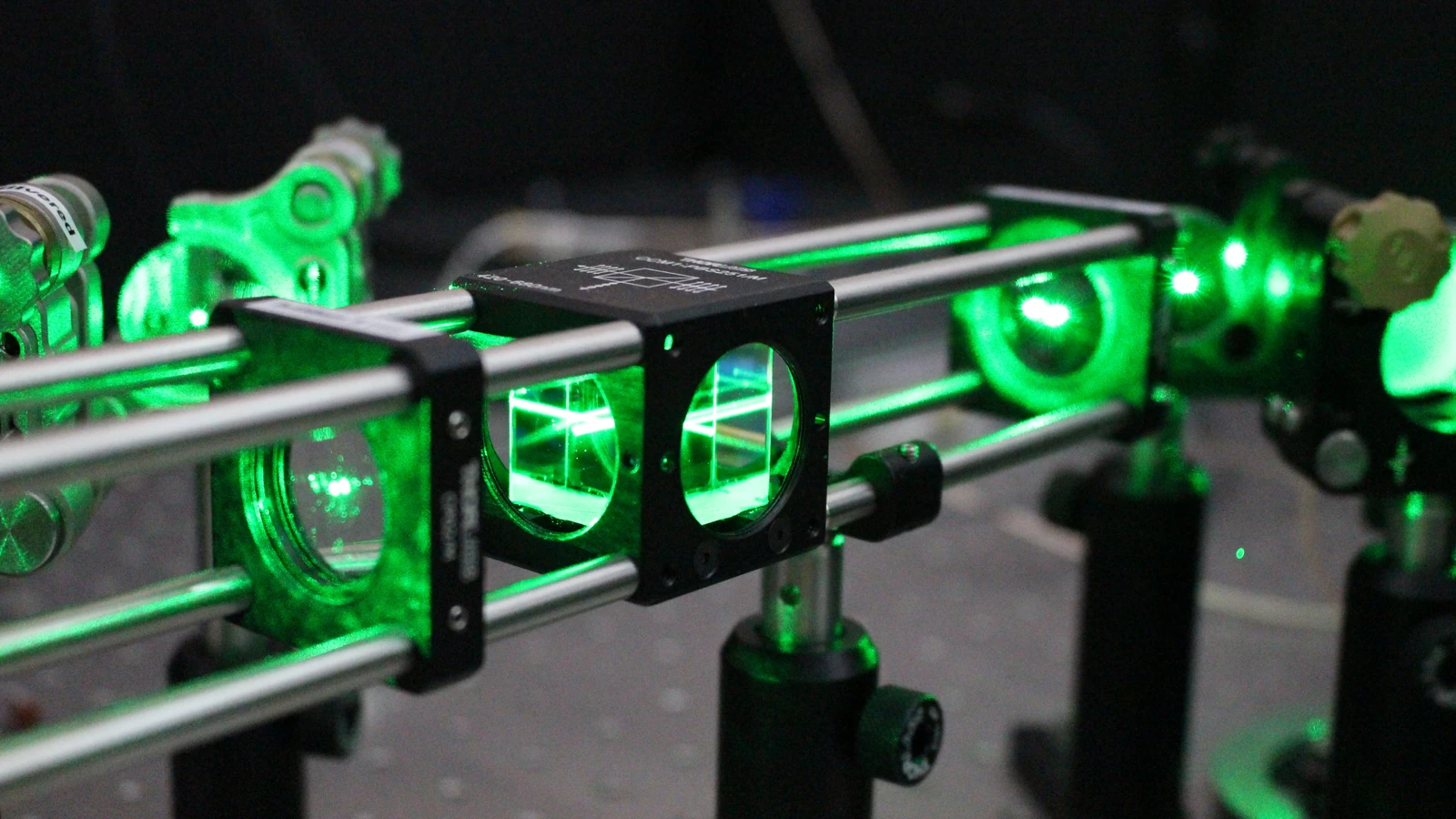

Connecting quantum computers creates a surprisingly familiar problem: waiting. One connection can succeed while another is still trying. Ordinary computers store and resend messages; fragile quantum information needs different treatment. An IonQ-linked experiment connects a trapped barium ion with a diamond-based quantum memory, testing an interface between devices that could play different roles in a larger system.[1][2]
The team shared a preprint on October 7; IonQ announced it on October 9. The reported link produces pairs at an average rate of 1.03(1) kilohertz with 87.9(7)% state fidelity. Put plainly, that is roughly a thousand heralded events per second, alongside a separate measurement of how closely the resulting state matches the intended one.[1][2]
Speed needs a quality measurement
Both numbers belong together. A fast stream of connections does not automatically contain states clean enough for the task you want to perform. The figures describe this experimental protocol, including its conversion losses. They do not mean a thousand useful algorithms per second, and the fidelity is not a promise that every future network operation succeeds.[1]
The two endpoints use different hardware. One is a trapped barium ion; the other is a silicon-vacancy centre in a diamond nanophotonic cavity. A photon emitted by the ion passes through wavelength and encoding conversions, interacts with the diamond device and is detected. That detection heralds an entangled state shared by the two endpoints.[1]
Different devices could bring different strengths to a network. A component good at processing information might not be the best optical interface or memory. Combining them is attractive only if the interfaces preserve enough of the expected benefit. Loss, noise and timing can all enter during the handoff, so the connection itself needs a careful accounting.
The waiting room has limits
Imagine organising a meeting in which each participant’s connection becomes ready at an unpredictable time. A waiting room helps the group coordinate. Quantum memory can serve an analogous purpose, but it cannot be assumed to hold information perfectly. The analogy explains the scheduling problem; it does not make a quantum state as durable or copyable as an ordinary message.
That makes storage and retrieval important follow-up questions. How long can the relevant state wait in this protocol? What happens to its quality while it waits? How efficiently can it be retrieved and used in another operation? A memory result under different conditions would not, by itself, answer every question about this link.
Connecting a pair is also different from coordinating a network. Several links introduce schedules, repeated attempts and failure handling. A convincing next demonstration would show what the connected modules can do together and count the resources across the whole task, including preparation, storage, additional gates and unsuccessful attempts.
The available technical source is a preprint. That status is useful information about the publication process, rather than a reason to dismiss the experiment. Peer review, expanded methods or independent reproduction could strengthen or refine its interpretation. Those would be genuine later milestones, with their own dates.[1]
The diamond makes this story more interesting than a speed headline. It provides an example of unlike quantum devices sharing a task through an optical interface. Keep four questions together: how often does the link work, how good is the state, how long does it remain useful, and what larger operation can follow? The next chapter begins after the detector clicks.
Quantum computers need to talk. A diamond memory may help them wait. · about 6 min
This estimate covers the explanation below, separate from the overview. Optional depth was added in this reading edition. The article keeps one canonical address and its original chronology. Source review: . The relevant source dates and limitations are recorded below.
Connecting two computers sounds routine until the information between them is quantum. In an ordinary network, a message can be buffered, copied and sent again. A quantum network has to work with fragile states, probabilistic events and restrictions on copying unknown quantum information. Even the apparently simple instruction wait here until the other connection is ready becomes a serious engineering problem.
An October 2026 experiment offers a concrete way to think about that challenge. A preprint submitted on October 7 reports entanglement between a trapped barium ion and a silicon-vacancy system in diamond, with a rate of 1.03(1) kilohertz and fidelity of 87.9(7)%. IonQ announced the work on October 9. The result is an experimental link between different physical platforms, not a demonstration that a large distributed computer is now ready for general use.[1][2]
Waiting is part of the computation
Imagine arranging a conversation in which several people must be available simultaneously, but each person's connection becomes ready at an unpredictable time. A waiting room would make the coordination much easier. In a quantum network, memory can play an analogous role, except that holding the information is itself a physical operation with limits. The waiting room cannot be assumed to preserve a state perfectly.
That is why networking and memory belong in the same discussion. A very fast link is useful, but its value depends on what the rest of the system can do with each successful connection. Can a state wait while another link is prepared? Can it be retrieved or processed with sufficient quality? Can the control system tell which attempts succeeded and coordinate the next operation? A network is the combination of those capabilities, not the cable alone.
The analogy also shows why a single headline number can mislead. If one participant connects quickly but everyone else is slow, speeding up that participant again may make little difference to the whole meeting. Likewise, distributed quantum performance depends on compatible rates, storage times, operation quality and coordination. Improving one part is important; identifying the new bottleneck is the next useful question.
Two different devices, one shared quantum task
The reported experiment links a trapped ion with a diamond-based system through a photon. The photon is converted in wavelength and encoding before interacting with the diamond device. Detection then signals the successful creation of an entangled state. The researchers call this a heterogeneous quantum system because the two ends use different physical hardware.[1]
Heterogeneity is not automatically a weakness. Different technologies may be good at different jobs. A processor optimized for local operations need not be the best long-distance interface or waiting memory. An engineering strategy could combine specialized components, provided that converting between them does not erase the expected benefit. That proviso is the important part. Every interface is another place where loss, noise or timing constraints can enter.
Readers do not need to visualize an invisible quantum packet moving intact like a parcel. The experimental protocol establishes a shared state through controlled interactions and a heralding event. The details matter because different protocols have different success conditions. Treating every optical connection as interchangeable would conceal precisely the interface problem that this experiment addresses.
A thousand events per second is only half the sentence
The reported rate is roughly a thousand successful entanglement events per second. The notation 1.03(1) kilohertz also carries an uncertainty; it is not an infinitely precise throughput promise. The accompanying fidelity, 87.9(7)%, describes agreement with the intended state under the reported characterization. Neither quantity should be stripped of its definition or experimental context.[1]
Rate and fidelity are not rival marketing slogans. They measure different aspects of usefulness. A system designer might accept a lower raw rate to obtain cleaner states, or introduce additional procedures that improve quality at a resource cost. Whether a particular trade is worthwhile depends on the task, the available memory and the rest of the network. This article does not claim that multiplying rate by fidelity produces a universal useful-computing score.
A simple everyday analogy helps. A courier service that delivers quickly but often damages the contents is not fully described by deliveries per hour. Nor can one number capture how easy it is to repair the damage. Quantum states require their own mathematical treatment, but the practical lesson is familiar: count successful events and inspect what successful means.
The experimental rate includes the conversion losses described by the researchers. That makes the interface accounting important. It still does not establish the cost of every component in a future network. An end-to-end machine would have to account for repeated attempts, coordination, additional gates, storage and the criteria for accepting a computation's result. A laboratory link is a building block whose quality must be carried forward honestly.[1]
What the diamond changes—and what it does not
A memory-enhanced link offers a way to think beyond direct, perfectly synchronized connections. It can potentially make unlike systems cooperate across different timing requirements. But a headline containing memory should not be read as a claim of unlimited storage. The useful duration, retrieval behavior and compatibility with other operations must be established for the intended architecture.
The diamond also does not make every problem in quantum computing disappear. Local processor errors remain. Optical collection and conversion remain. Detectors, control electronics and software remain. A network can distribute work, but it also introduces resources needed to connect that work. Modularity is an architectural trade, not a loophole in the need for reliable operations.
This is what makes the field worth following. Different designs are not merely competing to display the largest machine. They are testing which combinations of components can deliver a useful sequence of operations. A connection between unlike devices can matter because it expands the set of combinations that engineers can seriously evaluate.
The next experiment should test the waiting room
A sensible follow-up list starts with memory performance in the actual protocol. How long can the relevant state be held? What happens to quality during that interval? How do retrieval and subsequent operations change the resource accounting? A standalone memory record would not answer all those questions unless it used the same conditions and task.
Then comes coordination. A pairwise link does not automatically demonstrate a network of many nodes. Combining links introduces schedules, failure handling and quality requirements that can be invisible in a two-device demonstration. Showing a useful operation across connected modules would provide a different kind of evidence from improving the raw entanglement rate.
Independent scrutiny matters as well. The source available for this report is a preprint. That status does not invalidate the result, but it tells the reader what has and has not been established about the publication process. A later peer-reviewed paper, expanded methods or replication could sharpen the interpretation. Those should be recorded as genuine updates, not treated as if they had already happened.
A network story worth returning to
The most useful way to follow this result is to keep four questions together: how often does the link work, how good is the resulting state, how long can it remain useful, and what larger operation can the system complete? Progress on any one question can be meaningful. Progress across all four would tell a much stronger story.
For a first-time reader, the takeaway is surprisingly human. Large systems need their parts to cooperate, and cooperation includes waiting. A quantum memory is not just another impressive component inside a laboratory. It could help solve the coordination problem that appears when different quantum devices try to work as one.
The diamond link is therefore more interesting than a headline about speed alone. It is an attempt to connect different strengths while paying attention to the fragile information between them. The next chapter is not simply more clicks. It is what the connected system can reliably do after the click.
Evidence for this explanation
- Quantum Networking at the Speed of Quantum Computation — preprint v1
Submitted October 7, 2026, 18:00:08 UTC. Abstract and full author HTML inspected: barium-ion/SiV diamond Bell pairs, 1.03(1) kHz and 87.9(7)% fidelity including conversion losses. Preprint status retained; no independent replication claimed.
- IonQ Demonstrates Quantum Memory-Enhanced Interconnect
Company announcement dated October 9, 2026; complete public release inspected. World-first, fastest and future-architecture claims remain the company’s interpretation, rather than independent editorial findings.
The next quantum breakthrough may be the connection between the computers · about 6 min
This estimate covers the explanation below, separate from the overview. Optional depth was added in this reading edition. The article keeps one canonical address and its original chronology. Source review: . The relevant source dates and limitations are recorded below.
A photograph of a quantum computer usually invites you to look at the middle. There is a chip, a vacuum chamber or a carefully arranged collection of optical components. The eye goes to the object that seems to do the computing. But one of the most consequential engineering questions sits at the edge: how does that object talk to another one?
The answer could help determine whether quantum computing grows by making each processor larger, by connecting many processors, or by combining both approaches. It also changes what a useful milestone looks like. A link that works once is a physics result. A link that delivers the right quantum resource, to the right place, often enough to support a workload is part of a computing system. Those are different achievements.
Why joining the machines is unusually difficult
Ordinary computers move information between components all the time. A program can copy a file, resend a damaged packet and keep another copy elsewhere. Quantum information does not offer an unrestricted version of that convenience. An unknown quantum state cannot simply be copied perfectly on demand. Measurement can also change the state being processed. The network therefore has to be designed around the resources quantum mechanics actually permits, rather than around an imagined quantum version of an Ethernet cable.[2]
One important resource is entanglement shared between locations. It allows protocols that cannot be reproduced merely by giving each location an independent state. Yet entanglement alone does not create a faster-than-light messaging service. Useful protocols still require appropriate local operations and, in familiar cases such as teleportation, classical communication. The classical messages are part of the system, not an embarrassing detail to leave out of the story.[2]
A modular processor might use light to help connect matter-based qubits, for example. That description leaves most of the engineering unresolved. The system must generate the relevant optical signal, couple it into a channel, transmit it, detect it or transfer it into another degree of freedom, and determine what happened. Each stage can introduce loss, timing uncertainty or errors. A compelling experiment therefore needs a clearly defined boundary: what was prepared, what was transmitted, what was measured and what counted as success?[1][2]
The number that a beautiful photograph cannot show
Suppose a link sometimes creates an entangled pair. The first question is whether the pair has the properties claimed. The second is how frequently usable pairs arrive. The third is how long a pair remains useful while the rest of the machine gets ready. A system designer needs all three answers. Strong performance on only one axis can leave the application waiting.[1][2]
Consider an explicitly hypothetical example. One connection creates a high-quality pair occasionally. Another produces pairs more frequently but with a lower quality that requires extra processing. It is not possible to choose the better connection from the headline rate alone. The answer depends on the protocol, the errors it can tolerate, the memories available, and the cost of any purification or error-correction steps. The example is a way of thinking, not a claim about two real products.
This is why a report should distinguish an attempted operation from a heralded success, and a heralded success from an application-ready resource. Heralding means the system obtains information indicating that the relevant event occurred. That is valuable, but the indication and the state quality still need to be characterized. A count without its success definition is difficult to interpret.[1][2]
A network has a scheduling problem, too
Imagine two processor modules that both need an entangled connection at a particular stage of a computation. The modules are not helped equally by a pair that arrives before they can store it, a pair that arrives on time, and a pair that arrives after their local states have degraded. Timing changes the usable value of the resource.
This brings familiar computing concerns into an unfamiliar physical setting. A scheduler must decide which requests to serve, whether to wait, what to do after a failed attempt and when to abandon an operation. Buffering is constrained by the available quantum memories. A routing decision can affect both the probability of success and the time the information spends waiting. Classical control is not outside this picture. It coordinates much of what makes the quantum operation possible.[2]
The practical result is that a modular-computing claim should be evaluated as a workload claim. What sequence of operations was supported? How many attempts were required? Which parts ran in parallel? What happened when the expected connection was unavailable? An application cannot live indefinitely inside the best individual trial selected from a long afternoon.
Connecting processors is not the same as connecting cities
A short connection inside a computing installation and a long-distance quantum network can share scientific ideas while facing very different constraints. Distance, optical wavelength, available infrastructure, storage time, routing and operating environment all matter. A successful interconnect demonstration should not automatically be presented as a completed national quantum internet.[2][3]
The reverse mistake is also possible. A metropolitan networking experiment can be scientifically important without establishing that a particular modular computer can run a useful distributed algorithm. The question is not which category sounds more impressive. The question is which task the experiment actually addressed. Keeping the categories distinct makes both kinds of work easier to appreciate.
For readers, the simplest discipline is to ask for the two endpoints. Were these two qubits in one apparatus, two processor modules, two laboratories, or two distant network nodes? Then ask what crossed the boundary. Was it a classical control message, a photon, an entangled resource or a reconstructed state? Those questions remove a surprising amount of ambiguity without requiring a graduate course.
What would make the next announcement meaningful?
A genuinely useful update might improve several dimensions at once: the quality of the delivered resource, the rate at which it becomes available, the time it can be stored, or the reliability of repeated operation. It might also demonstrate integration with a more demanding local processor. None of these improvements has to be universal to be valuable. A tightly scoped advance can solve a real bottleneck.[1][2]
The evidence becomes stronger when a report includes distributions rather than only a best result. How variable was delivery time? How stable was performance across the run? Were unsuccessful attempts included in the accounting? Were the local processor and the connection characterized together? These details are the difference between recognizing a promising component and understanding a working system.
Another important step is making the experiment legible to someone who did not build it. The operation sequence, data-selection rules and error model should be clear enough for an informed reader to understand the claim. Independent replication is not always immediately practical for specialized hardware, but clarity about the procedure is still a meaningful advance.
The broader picture
The most interesting future quantum computer may not be the one that is easiest to photograph. Its performance could depend on links, controls and scheduling decisions distributed across an installation. The visible processor would remain essential, but it would not tell the whole story.
That should make the field more interesting, not less. It creates room for advances in optics, networking, memory, software and systems engineering. It also gives readers a better test for the next modular-computing headline. Do not ask only whether two things were connected. Ask what the connection allowed the whole machine to do.
The next piece of news worth returning for is therefore not necessarily another impressive-looking cable or a longer separation. It is a demonstration that turns a connection into dependable computing capacity. That is a harder claim to make. It is also a much more useful one.
Evidence for this explanation
- Quantum Networking at the Speed of Quantum Computation — version 1
Preprint October 7, 2026; complete primary version checked October 11. A heterogeneous barium-ion and silicon-vacancy diamond-memory link, not a completed distributed application or national network.
- Architectural Principles for a Quantum Internet — RFC 9340
Informational architectural document, March 2023; primary text checked October 11, 2026. No-cloning, entanglement, classical messages and resource boundaries; not a mandatory standard or current product ranking.
- Quantum internet: A vision for the road ahead
Institutional publication record for the 2018 research review; checked October 11, 2026. Historic network stages, not evidence of present deployment.