
A Quantum Memory Scored 98.6%. Here’s the Other Number That Matters.
An October 6 preprint puts quantum-memory tests on a common footing. Its experiment shows why high conditional fidelity can coexist with low retrieval efficiency.
A quantum memory can return a beautifully preserved photon and still lose most of the photons sent into it. An October 6 preprint from researchers in Geneva and Vienna makes that distinction unusually concrete: its solid-state experiment reports 98.6% conditional average fidelity after 10 microseconds, alongside roughly 16.5% retrieval efficiency. The development is a framework for making memory tests comparable, with an experimental application. It is not a claim that 98.6% of all incoming photons survive, or that a complete quantum network has reached that reliability.[1][2]
Three questions hiding inside one percentage
That distinction matters because a quantum network needs more than a channel that produces an occasional convincing result. Memories let fragile quantum information wait while another connection or operation becomes ready. Engineers therefore need to know how long information can wait, how often it comes back, and how accurately the surviving output preserves the input. Compressing those questions into one percentage makes a component look easier to use than its full operating record may justify.[1][2]
The paper models a memory as a quantum channel: a physical process that maps an incoming state to an outgoing state after a delay. Its chosen quality measure asks how closely the output resembles the input, averaged across all pure input states. This is more useful than selecting a few convenient test states and calling their performance representative. A device should not earn an excellent score simply because the experiment happened to ask the questions it answers best.[1][2]
There is a practical shortcut. The researchers connect memory testing to a mathematical construction called a 2-design, a carefully balanced finite collection of quantum states. For a , six suitable states drawn from three complementary measurement bases reproduce the desired average. The experiment need not prepare an endless sweep of every possible state. The shortcut changes the number and choice of tests, while preserving the meaning of the quantity being estimated. Statistical uncertainty and apparatus assumptions still require attention.[1][2]
What the experiment actually measures
The optical experiment uses a crystal containing ytterbium ions and stores a qubit encoded in an early or late photon arrival time, including superpositions of those possibilities. An atomic frequency comb inside the material creates a programmed delay. Correlated photon pairs supply the input and a herald that helps identify when its partner is present. Interferometric measurements then check whether the timing information and the coherence between the alternatives survive storage. This is a specific photonic memory implementation, not a general-purpose quantum processor.[1][2]
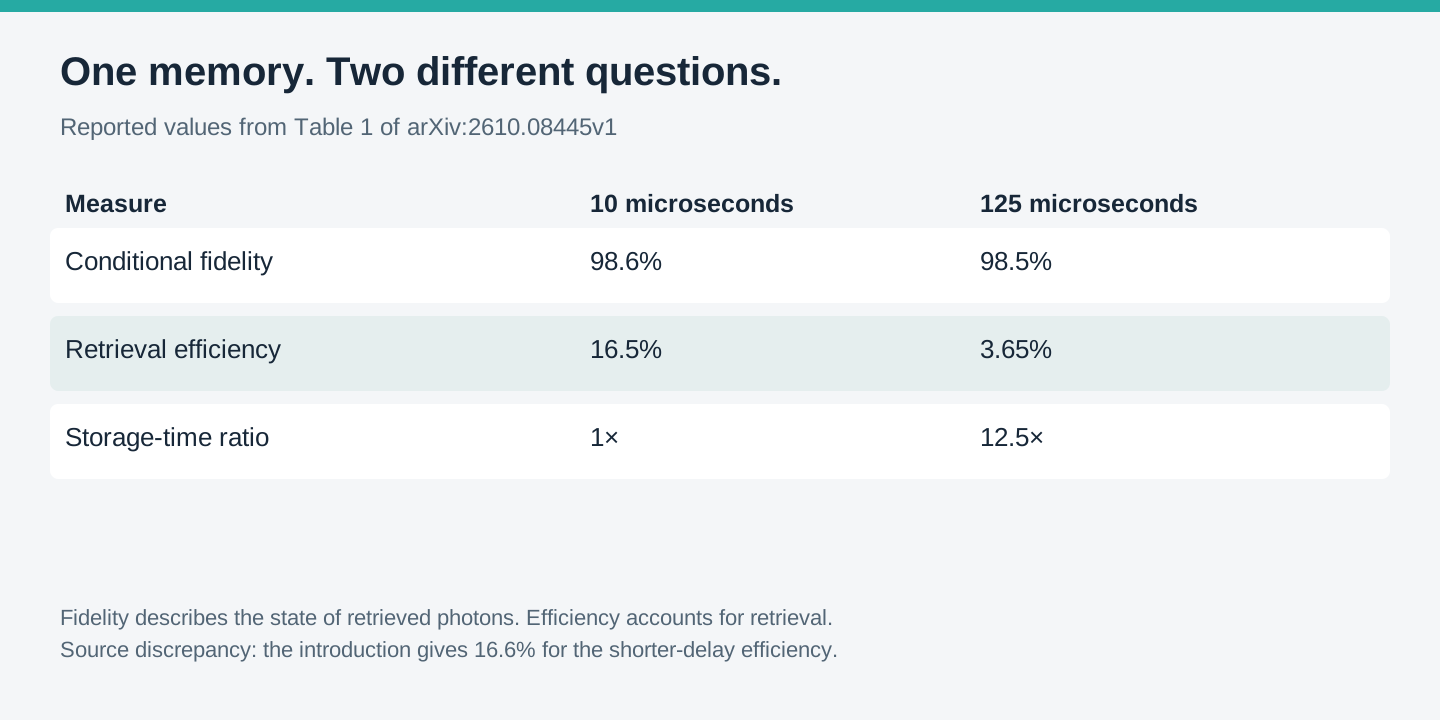
At 125 microseconds, the reported conditional fidelity remains almost unchanged at 98.5%, while retrieval efficiency falls to 3.65%. The longer delay is 12.5 times the shorter one. Using the paper's Table 1 efficiencies, the proportion retrieved is about 4.5 times lower. Those two observations can both be true: the memory can preserve the quantum state of the photons that return very well, while returning fewer photons as storage lengthens. Fidelity and efficiency describe different costs.[1][2]
QubitWire's calculation makes the contrast easier to inspect. Multiplying efficiency by conditional fidelity gives about 0.163 at 10 microseconds and 0.0360 at 125 microseconds, using Table 1's 16.5% and 3.65% efficiencies. In the paper's loss model, those are average input-output overlaps with vacuum outcomes retained. They are not percentages of correctly delivered messages, quantum-network throughput, or a new experimental measurement. The introduction gives 16.6% for the shorter delay; the table gives 16.5%, a small source discrepancy that does not change the interpretation.[1][2]
A weaker certificate can describe the same hardware
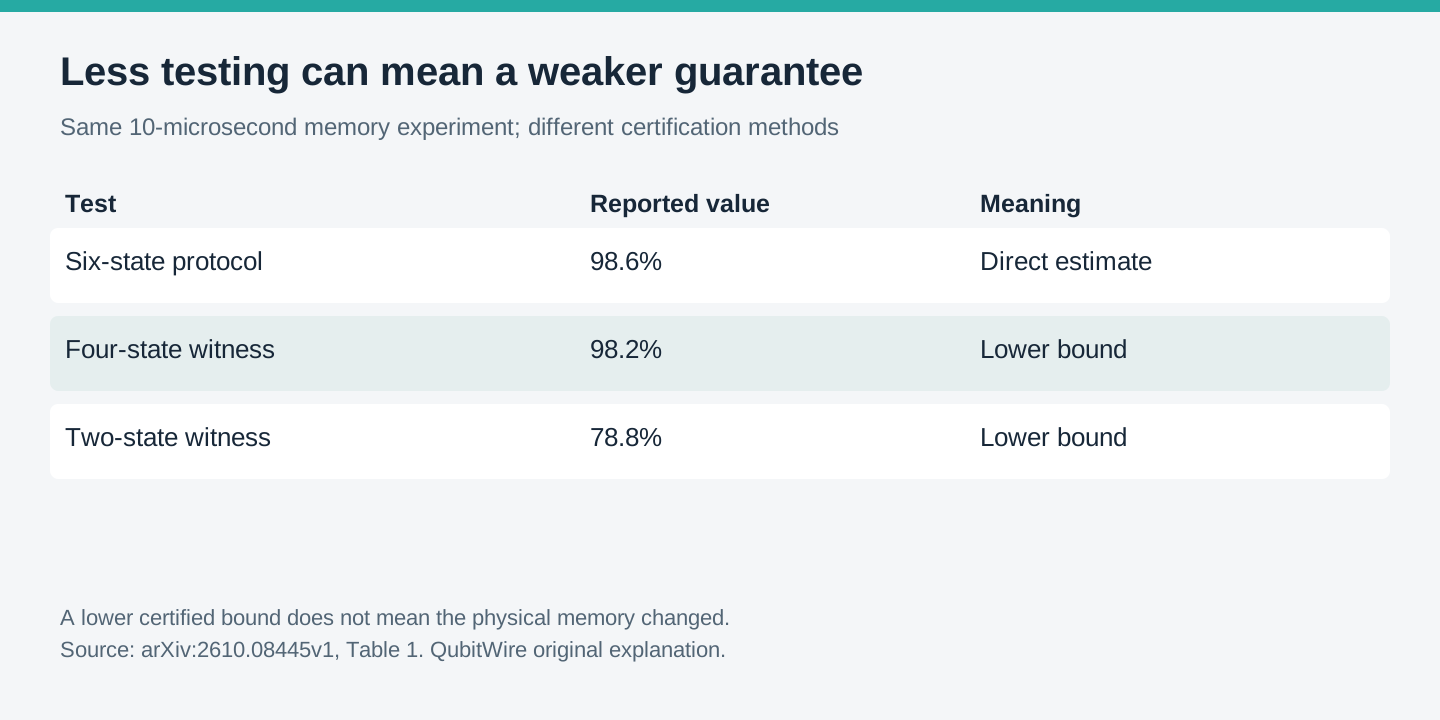
The new framework also helps distinguish an estimate from a lower bound. The six-state procedure estimates the chosen average directly. Simpler four-state and two-state tests can certify a floor below it. For the 10-microsecond experiment, the reported four-state bound is 98.2%, while the two-state bound is 78.8%. The underlying memory did not suddenly deteriorate when the test was simplified. The smaller test collected less information, so the guaranteed statement became weaker.[1][2]
A separate 2023 paper by Sekatski and colleagues developed memory certification that does not begin by trusting a characterized source or measurement device. Its experimental illustration used a relaxed setting and certified a fidelity of 0.87. That is a methodological baseline, not a lower score in a league table against the October result. Different assumptions and certification targets change what a number guarantees. Comparing the two papers makes the new framework more useful: its high percentage comes with a specified test, rather than replacing the need to state which devices and sampling rules are trusted.[1][2][4]
The authors also examine a semi-device-independent approach, which relaxes how much must be known about the output measurement apparatus. In the experimental application, that approach certifies 96.8% at the shorter delay and 96.6% at the longer one. Relaxing a characterization assumption costs some numerical strength, but can make the conclusion less dependent on a particular detector model. It does not make the experiment assumption-free: the paper specifies a fair-sampling-type requirement for that version of the test.[1][2]
What the certificate leaves open
There are other qualifications beside the percentages. The experimental analysis assumes the memory efficiency does not depend on the input state, although it may depend on the measurement basis. The device behaves as a programmed delay line in this test. The source and memory were described in earlier work, so the October preprint's main contribution is the certification framework and its application, rather than a newly commissioned metropolitan network. This is research awaiting peer review, not a certified product specification.[1][2]
QubitWire's interpretation is that a useful memory specification should look like a small table, not a trophy number. Put storage time, retrieval efficiency, conditional fidelity and testing assumptions together. Then add the properties required by the intended application, such as wavelength compatibility or how storage is scheduled. A memory that excels at preserving rare successful outputs may suit one experiment; another system may prefer a less pristine output delivered more often. This study does not select a universal winner between those designs.[1][2]
The practical value extends beyond memories because the same question appears whenever quantum information passes through a component. An optical link or a transducer should preserve the state while moving it to a different place or physical form. A transparent certification method gives teams a common way to state what survived and under which assumptions. That is a more useful comparison than ranking platforms by isolated fidelities reported under different acceptance rules and storage conditions.[1][2]
The next test is comparability
The next informative test is to apply the same certification procedures across devices and operating points while publishing the efficiency and assumptions beside every fidelity. For this experiment, that means tracking the quality-throughput tradeoff as storage time changes, then checking performance inside the intended network operation. The shareable lesson is simple: a quantum memory's accuracy is only half its report card. Readers also need to know how often information returns, and what the test was actually entitled to conclude.[1][2]