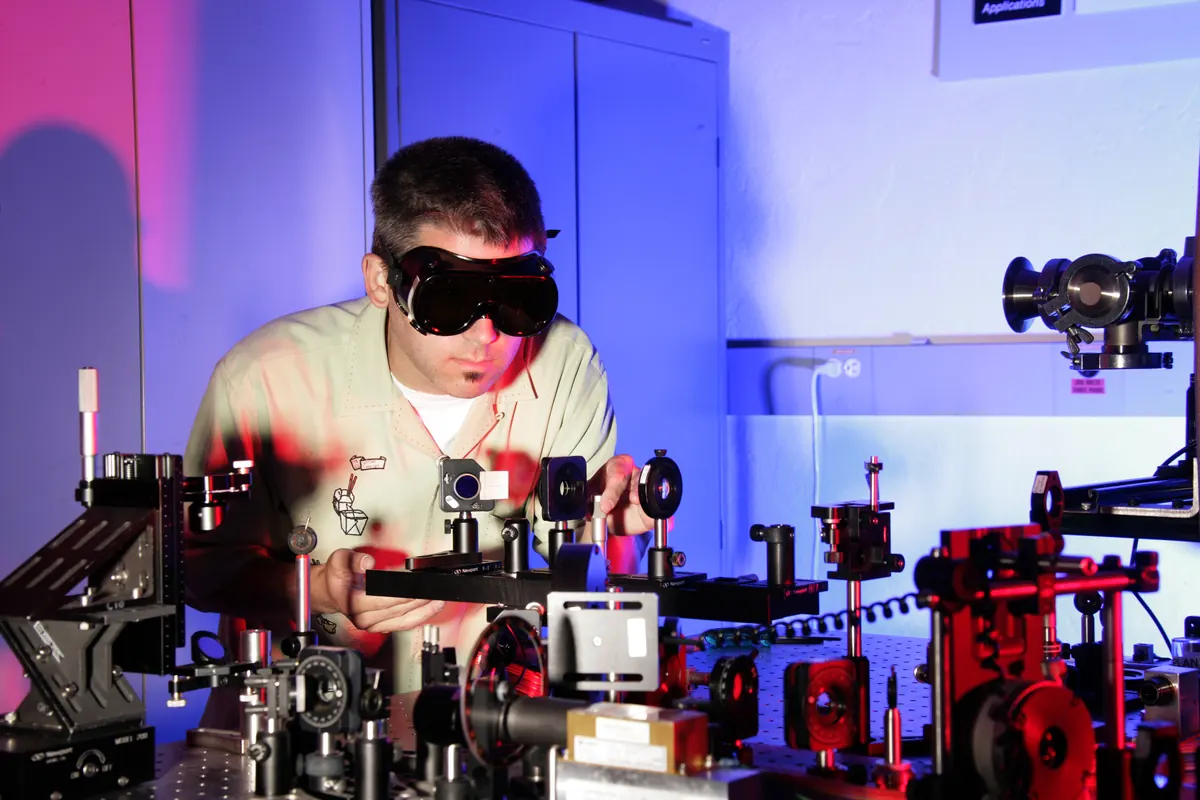
Laser-optics work at Idaho National Laboratory in an archival photograph. Photonics context; this is not a photograph of the featured paper’s authors or a demonstration of its theoretical protocol.Image: Laser Optics - Idaho National Laboratory.jpg · Idaho National Laboratory · CC BY 2.0Full image credit
A protocol in Physical Review Letters uses geometric phase to amplify information in a coupled -oscillator sensor. Nishchay Suri and colleagues encode the signal in the area enclosed by a path through oscillator phase space, then use squeezing to increase that area.[1][2]
The journal paper appeared October 21, 2026. The underlying preprint was first shared November 26, 2025, and its current author version was revised October 23, 2026.[1][2][3]
The study derives the protocol mathematically and tests noise effects numerically. It does not report a new physical sensor experiment.[1][2][3]
Under the specified model, the protocol can achieve sensitivity beyond the standard quantum limit. Its independence from the oscillator's initial state persists under the modeled qubit noise. Oscillator noise can distort the trajectory and corrupt the signal, so robustness is conditional.[2][3]
For the force-sensing example, the analysis compares the protocol with free evolution while accounting for the geometric loop's longer duration. Low squeezing can lose that comparison; the modeled improvement emerges beyond roughly 4 dB. These are resource-dependent predictions, not a measured field-instrument sensitivity record.[3]