
A smaller optical frequency comb points toward portable atomic clocks
A two-laser microresonator advances one link in an optical clock’s measurement chain. A portable instrument needs more than a smaller comb.
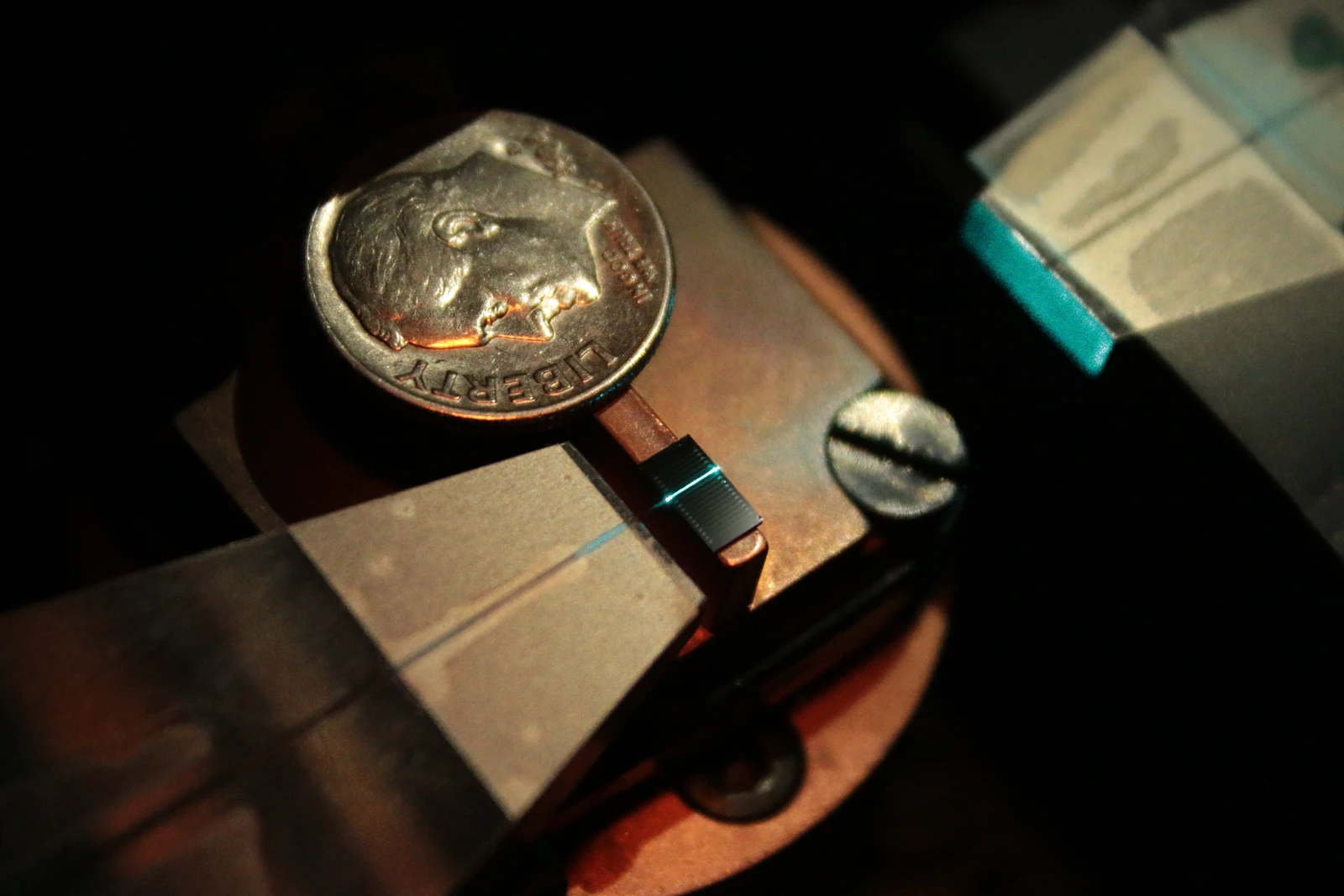
A smaller bridge between light and electronics
Researchers described a chip-based optical frequency comb designed to make precision timekeeping hardware more portable. The Joint Quantum Institute’s October 5 account and NIST’s October 16 follow-up discuss a microresonator approach using two lasers, with a Nature paper published September 30. The advance concerns a component that connects optical frequencies with more manageable signals; it is not a complete portable atomic clock.[1][2]
What the experiment changes
The researchers synchronize overlapping optical lines into one frequency comb, avoiding bulky amplification equipment in that part of the system. The experiments demonstrate links from microwave to optical frequencies and from optical to microwave frequencies, checked against a tabletop comb under the reported conditions. This is a measured component result, not a demonstration that an entire optical clock has become portable.[2]
Why a comb belongs in a clock
An optical reference oscillates far too quickly to be counted like a slow electronic pulse. A frequency comb supplies a structured set of optical frequencies that can help connect those scales. The familiar comb analogy is useful because it directs attention to the spacing between successive teeth.
But a real measurement must also know where the pattern sits on the frequency axis. Equal spacing alone cannot identify an absolute frequency. Both the spacing and the offset have to be understood within the measurement system.
Portability has more than one dimension
A smaller optical component can remove an important obstacle while leaving several others. A practical instrument still needs sources of light, controls, a stable environment, power and a way to know when its output remains trustworthy. Size, electrical consumption, warm-up time, vibration tolerance and repeatable operation are separate requirements. A device can improve one and worsen another. A useful comparison therefore follows the complete system through an actual operating scenario, such as moving it between two locations and checking whether its calibration survives.
That scenario must be demonstrated before it becomes a product claim.
The next questions are about the whole instrument
QubitWire’s analysis is that this result should be followed as progress in a component chain. The reader should ask what equipment it replaces, what remains outside the chip and which part of the performance budget it controls. The boundary between the comb and the surrounding equipment determines the scope of a portability claim. A smaller comb may be especially interesting if it reduces the amount of alignment or control needed to operate the full instrument.
That possibility belongs in a follow-up test, with conditions and results clearly stated. For people encountering optical clocks for the first time, the story also gives a concrete route into an abstract subject: a precise reference needs a way to turn rapid optical oscillations into a signal that can be compared and used. Better references and better measurement bridges must develop together. The most persuasive future headline will explain both the component improvement and the practical capability it enables in a complete clock.
A component should have a boundary drawing
A small resonator still needs surrounding equipment to operate. Reducing its footprint differs from reducing the complete instrument’s size, power consumption or operating effort. These are separate quantities that a portability comparison can measure.
Research in context · checked 20 Oct 2026
Why comb spacing is only half the address
A worked explanation of the distinction behind the result.
An idealized frequency comb can be written as fₙ = f₀ + n fᵣ. Here n identifies a tooth, fᵣ is the spacing between neighboring teeth and f₀ is an offset. This equation is a general teaching model, not a claim that every practical comb architecture uses the same stabilization arrangement.
Imagine two rulers whose tick marks are one centimeter apart. Their spacing is identical, but if one ruler begins five centimeters to the right of the other, a tick with the same printed index points to a different place. A comb has an analogous bookkeeping issue. Knowing the spacing does not by itself tell you the absolute frequency of a selected tooth.
The index matters as well. If a measurement attaches the right spacing and offset to the wrong tooth number, the answer can be consistently wrong. Precision is therefore not simply a matter of making the pattern visually neat. It also requires identifying the relationship among the reference, the comb and the signal being measured.
This perspective clarifies why a component can be small yet technically demanding. A compact resonator may create an appealing optical pattern, but an instrument needs that pattern to maintain the right relationship to a reference under its intended conditions. The relevant evidence could concern stability, repeatability, sensitivity to disturbances or the amount of control hardware required.
For a portable device, the disturbance itself should be specified. Temperature drift and a brief mechanical shock are different tests. A successful response to one does not establish the response to the other. Nor does a good measurement immediately after careful adjustment establish unattended operation for a long interval. Portability is a set of operating claims that can be checked individually.
Sources and evidence
- New Chip-Based Tape Measure for Light Could Revolutionize Mobile Timekeeping and Enhance National Security ↗Source published 2026-10-16. government research announcement.
- New Chip-Based Frequency Combs Demonstrate Potential for Portable Atomic Clocks ↗Source published October 5, 2026. University research announcement; underlying Nature paper published September 30, 2026.
Research in context · checked 20 Oct 2026
Will a smaller comb make navigation independent of satellites?
A worked explanation of the distinction behind the result.
That conclusion would require evidence about a much larger system. A clock may supply timing information to a navigation process, but navigation also depends on the signals, sensors, models and reference information available to that process. Improving one component cannot establish every consequence for the complete application.
The sensible question is narrower and more useful: does this component make a specified timing instrument easier to transport or operate while preserving its required performance? If that is demonstrated, a second question can test what the improved instrument changes for navigation. Keeping those steps explicit allows a reader to appreciate a genuine engineering advance without treating an application possibility as an already delivered capability.
A useful field test should state whether the instrument was recalibrated after transport. Successful operation following extensive laboratory adjustment supports a different claim from repeated operation after movement with a specified automatic recovery procedure. Both can be progress, but they answer different practical questions.
Sources and evidence
- New Chip-Based Tape Measure for Light Could Revolutionize Mobile Timekeeping and Enhance National Security ↗Source published 2026-10-16. government research announcement.
- New Chip-Based Frequency Combs Demonstrate Potential for Portable Atomic Clocks ↗Source published October 5, 2026. University research announcement; underlying Nature paper published September 30, 2026.