
A trapped-ion experiment makes swapping quantum motion continuously tunable
Two ion motional modes undergo a coherent exchange operation. The gate’s exponential name describes its mathematics, not a speed advantage.
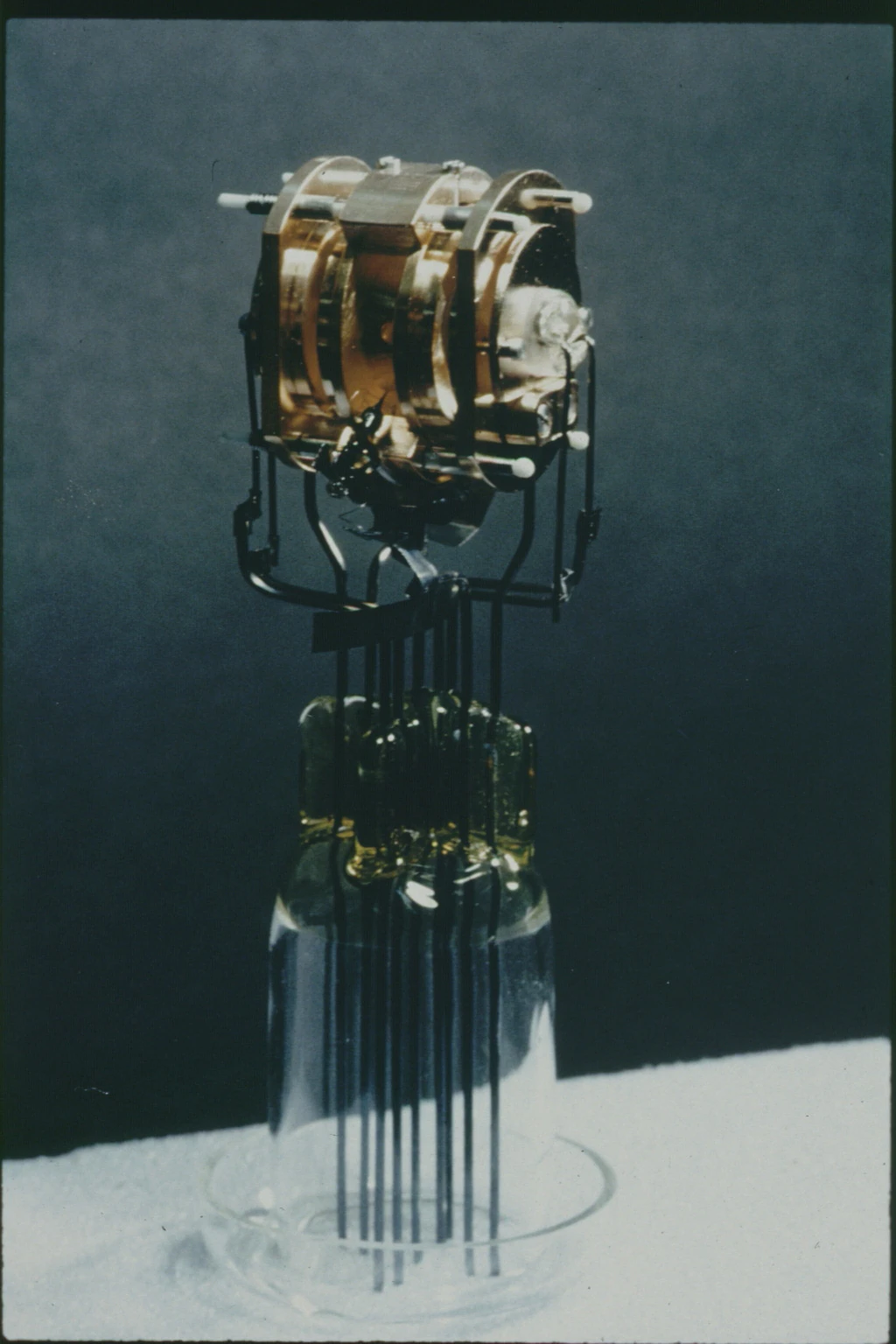


A controllable exchange of motion
A preprint submitted October 16 reports an experimental exponential-SWAP gate between two motional modes of trapped ions. The operation coherently combines leaving the modes unchanged with exchanging them, with a continuously adjustable balance. The researchers test it through selected slices of the modes’ joint characteristic function. The result concerns a building block for hybrid -and-bosonic processing, rather than a complete fault-tolerant computer.[1]
The experiment uses two ytterbium-171 ions. Two axial motional modes carry the computational oscillator states, while a radial mode supplies an auxiliary degree of freedom. Selected slices of characteristic functions test the resulting states. Those measurements support the reported operation on the studied inputs; they do not provide complete characterization for every arbitrary oscillator input.[1]
The word exponential describes an operation
The gate’s name can easily be mistaken for a claim about computational speed. Here it refers to the mathematical form of the operation. At one setting, the operation can leave a pair of systems unchanged. At another, it can exchange them. Between those settings, the result is a coherent quantum combination. That differs from deciding randomly whether to perform an ordinary swap: coherent alternatives can interfere in a later operation, whereas a classical mixture has discarded the phase relationship that makes such interference possible.
Motion offers another kind of information register
An oscillator can support a collection of excitation states rather than only the two states used to label a qubit. That gives an experiment additional choices about how to represent information.
It also introduces questions about which states can be prepared, how accurately they can be controlled and what happens when unwanted excitations appear. A useful gate must be evaluated on the intended family of inputs. Demonstrating a visually striking output for one state does not automatically characterize every state a larger algorithm might use.
What makes the result worth following
QubitWire’s analysis is that continuous control of a coherent exchange is interesting because it expands the language available to a hybrid processor. The next useful account would identify a specific task for which that language reduces operations, improves robustness or simplifies the representation of a physical model. Such a comparison needs to include the cost of preparing and reading the oscillator states. It should also ask whether the gate can be repeated reliably and combined with the other required controls.
Those questions explain how a primitive becomes part of a useful machine. Coherent exchange changes the amplitudes of two alternatives while retaining a relative phase that a later operation can reveal. A coin flip between two ordinary swaps would produce a different kind of state and miss the experiment’s point.
The small system makes that distinction testable: output probabilities alone do not describe every phase relationship that a subsequent operation can use.
Test the operation on a useful family of states
A gate’s value depends partly on how it behaves when inputs change. A follow-up should select inputs that exercise the intended application, including cases where phase coherence is essential. It should explain what the chosen measurements can distinguish and what remains uncharacterized. That connects an elegant primitive to a falsifiable performance claim.
Research in context · checked 20 Oct 2026
A swap dial that is more than a coin flip
A worked explanation of the distinction behind the result.
Let S be an ideal SWAP operation. Applying it twice returns both systems to their original positions, so S² = I, where I is the identity operation. This property gives a compact expression for a tunable unitary: U(θ) = cos(θ)I − i sin(θ)S. The expression is a general mathematical example of an exponential-SWAP convention; laboratory definitions can choose different signs or angle normalizations.
Take an illustrative input |0,1⟩, with one mode in state 0 and the other in state 1. At θ = π/4, the output is (|0,1⟩ − i|1,0⟩)/√2. A measurement in that basis finds either arrangement with equal probability. Looking only at those two probabilities might make the result seem identical to randomly swapping half the time.
The difference appears when a later operation is sensitive to the relative phase. Apply the exact inverse U(−θ) to the coherent output and the ideal mathematical model returns the starting state. A classical mixture of the two arrangements does not contain the same phase relationship, so the same reversal generally cannot reconstruct the initial pure state in that way.
This is why a quantum gate needs more characterization than a count of how often each arrangement appears. The probabilities in one measurement basis can agree even when the states differ in a way another operation can detect. Carefully chosen measurements test those hidden relationships without requiring a picture of every possible feature of a complicated state.
The example also explains the limits of the phrase continuously tunable. It means the intended operation changes with a control parameter. It does not mean the laboratory realizes every setting without error, nor that one calibration works equally well across every input. Those are performance questions that need measurement.
Sources and evidence
- Exponential-SWAP gate between bosonic motional modes of trapped ions ↗Source published 2026-10-16. experimental preprint. First listed in quantum-ph feed on 2026-10-19; submission was October 16.
Research in context · checked 20 Oct 2026
Can one oscillator replace an arbitrary number of qubits?
A worked explanation of the distinction behind the result.
An oscillator has a richer state space, but usable information depends on which states the apparatus can prepare, distinguish and protect. Raising the number of accessible excitation levels can make control or noise more demanding. A mathematical space with many possible states is not equivalent to a fully usable memory with that many reliably addressable states.
The fair comparison specifies the task and the supported operations. A model involving motion may fit naturally into an oscillator description, while a different workload may benefit from conventional qubit encoding. The interesting engineering choice is the representation that makes the required calculation reliable and economical, not the largest state-space number that can be attached to a component.
The ideal inverse example also assumes the second operation has the correct phase convention. A laboratory reversal can fail because of errors in either operation or their reference relationship. Interpreting it as a diagnostic therefore requires controls that separate those possibilities.
Sources and evidence
- Exponential-SWAP gate between bosonic motional modes of trapped ions ↗Source published 2026-10-16. experimental preprint. First listed in quantum-ph feed on 2026-10-19; submission was October 16.